
Inkipedia
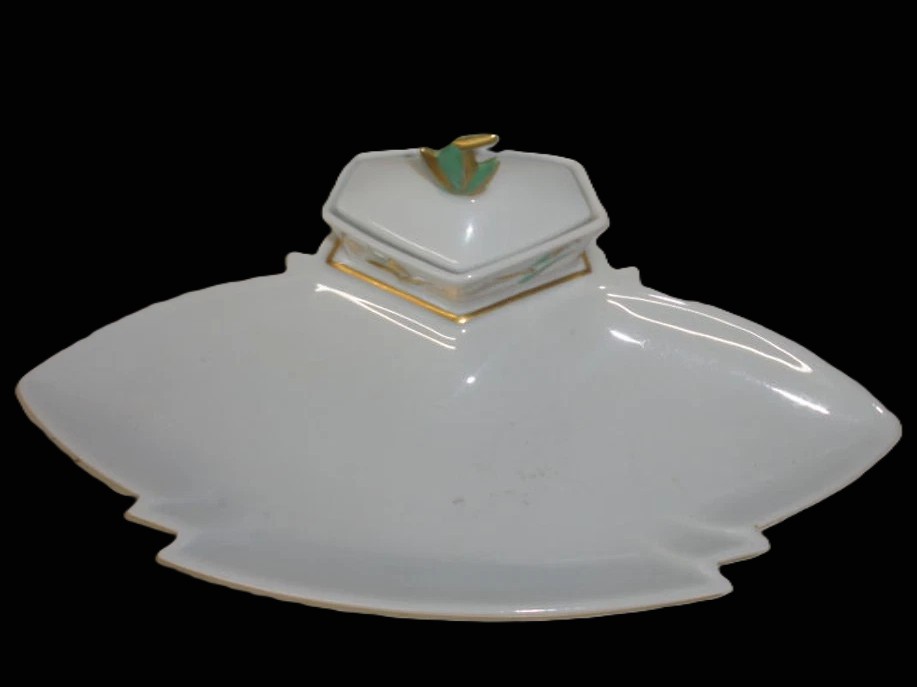
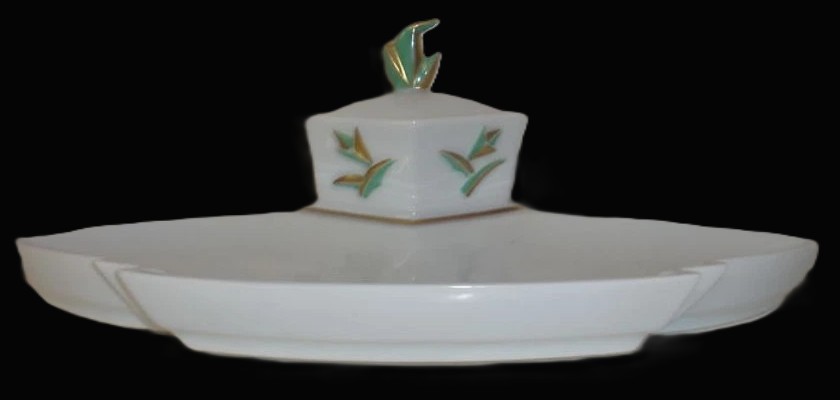
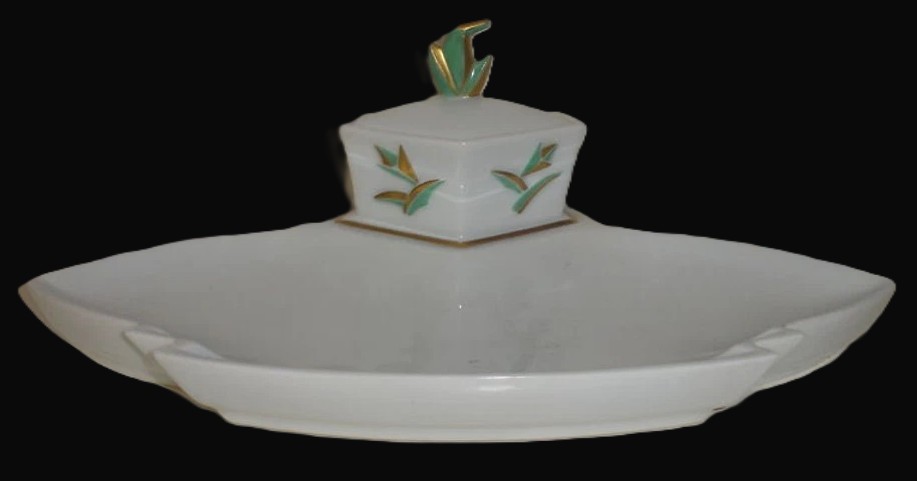
Rosenthal Porcelain Art Deco Inkstand
| Categories | Art Deco, Ceramics/Porcelain "Named" Makers |
| Material | Porcelain |
| Markings | See Narrative |
| Manufacturer | Rosenthal |
| Origin | Germany |
| Date or Era | circa 1920 |
| Measuring | 10” x 5” |
Description
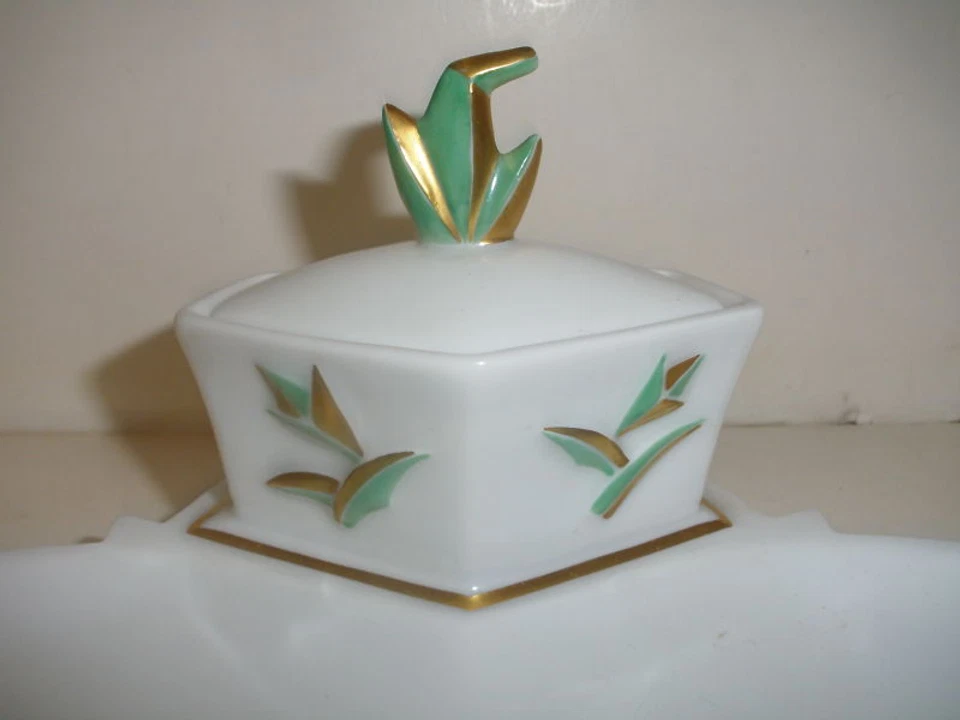
This porcelain inkstand is an Art Deco design made by Rosenthal in Selb, Bavaria:
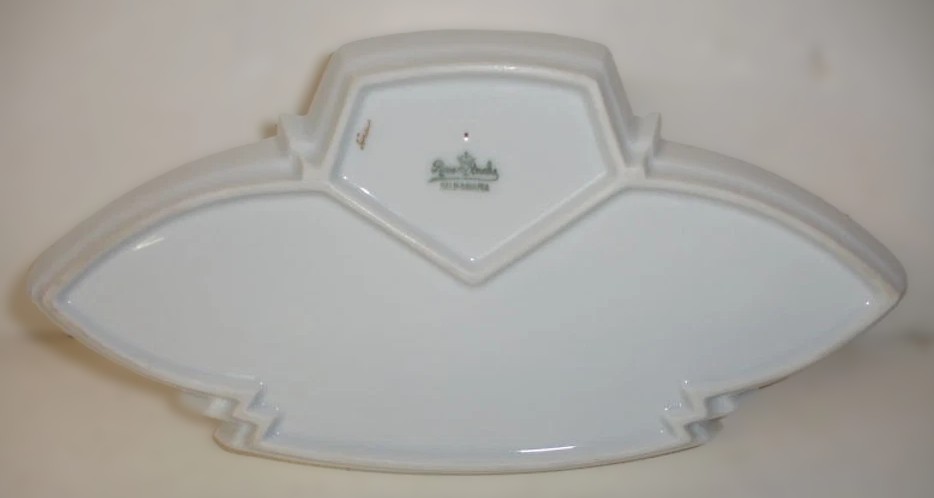
- Overall Form: Features a wide, fan-like tray with stylized stepped/notched sides characteristic of Art Deco geometry. The shallow, broad front section functions as a pen tray.
- Inkwell & Lid: Set into a raised, shaped recess at the back of the tray sits a pentagonal/diamond-shaped inkwell. The matching lid is topped with a stylized, sculpted leaf/bud finial finished in mint-green and gold gilding.
- Decoration: Clean white glazed porcelain decorated with stylized mint/teal green leaf sprigs edged in bright liquid gold gilding. Gold accents also border the rims and base contours.
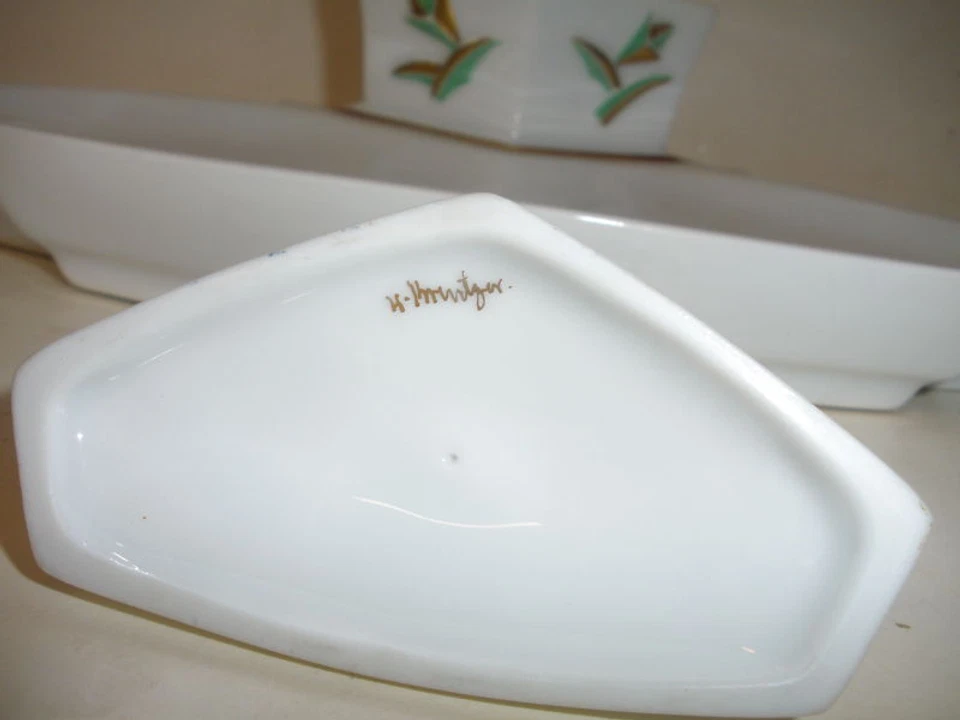
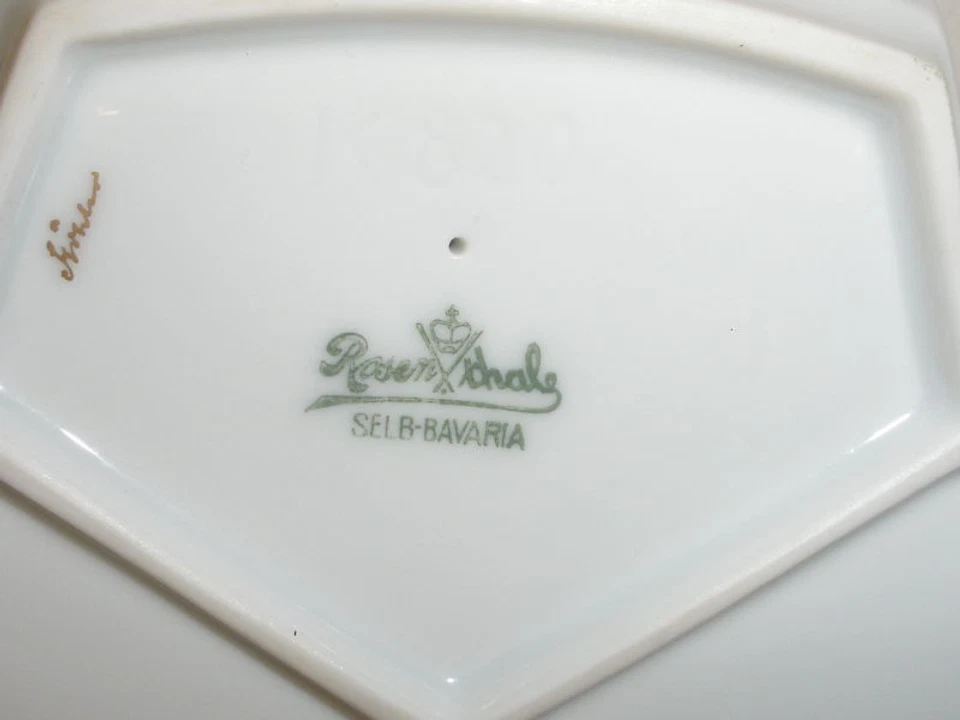
- Markings & Signatures:
- Backstamp (Tray Base): An underglaze green stamp featuring the crowned emblem above script Rosenthal and “SELB-BAVARIA”.
- Artist/Decorator Signature: On the underside of the inkwell, a handwritten gold decorator/artist signature reads “W. Mentzer” (or H. Mentzer).
Date of Manufacture
- Circa: 1920s – 1933 (Art Deco Period).
- Dating Clues: The green underglaze stamp with the crowned logo over Selb-Bavaria was used by Rosenthal during the German Imperial and Weimar eras (specifically from around 1907 until 1933, after which “Germany” replaced “Bavaria” on backstamps). The crisp geometric contours and stylized floral motifs are quintessential 1920s Art Deco styling.
Background Information on Rosenthal
- Founding: Founded in 1879 by Philipp Rosenthal in Erkersreuth near Selb, Bavaria, Germany. The business initially began as an art-decorating workshop buying porcelain blanks (whiteware) from other factories and hand-decorating them.
- Expansion & Innovation: By 1891, Rosenthal established its own porcelain manufacturing plant to meet demand. Over the next few decades, Rosenthal acquired factories across Bavaria (in Selb, Kronach, and Marktredwitz) and established a reputation for fine hard-paste porcelain.
- Art Departments (Kunstabteilung): In 1910 and the 1920s, Rosenthal created dedicated art departments in Selb. They hired prominent sculptors, designers, and decorators to produce avant-garde figurines, vanity sets, and desk items—propelling Rosenthal to the forefront of Art Nouveau and Art Deco porcelain design.
- 20th Century & Legacy: Philipp Rosenthal (who was of Jewish heritage) was forced out of the company by the Nazi regime in 1934. After World War II, his son, Philip Rosenthal, reclaimed management in 1950 and led the company into a modern era, famously launching the Studio-Linie in 1961 featuring avant-garde collaborations with international designers like Tapio Wirkkala and Walter Gropius. Today, Rosenthal remains one of Germany’s most celebrated porcelain manufacturers.
Sold for $145 in June 2026
Content disclaimer. The information posted is the owner’s best knowledge and may not have been vetted by the SOIC. We welcome comments, corrections, and additions, working to make our website information comprehensive and accurate.
Join the Society of Inkwell Collectors (SOIC) – it’s free!
Founded in 1981 as a non-profit organization,
we are documenting inkwells (and accessories).
We’re here to help and inform!