

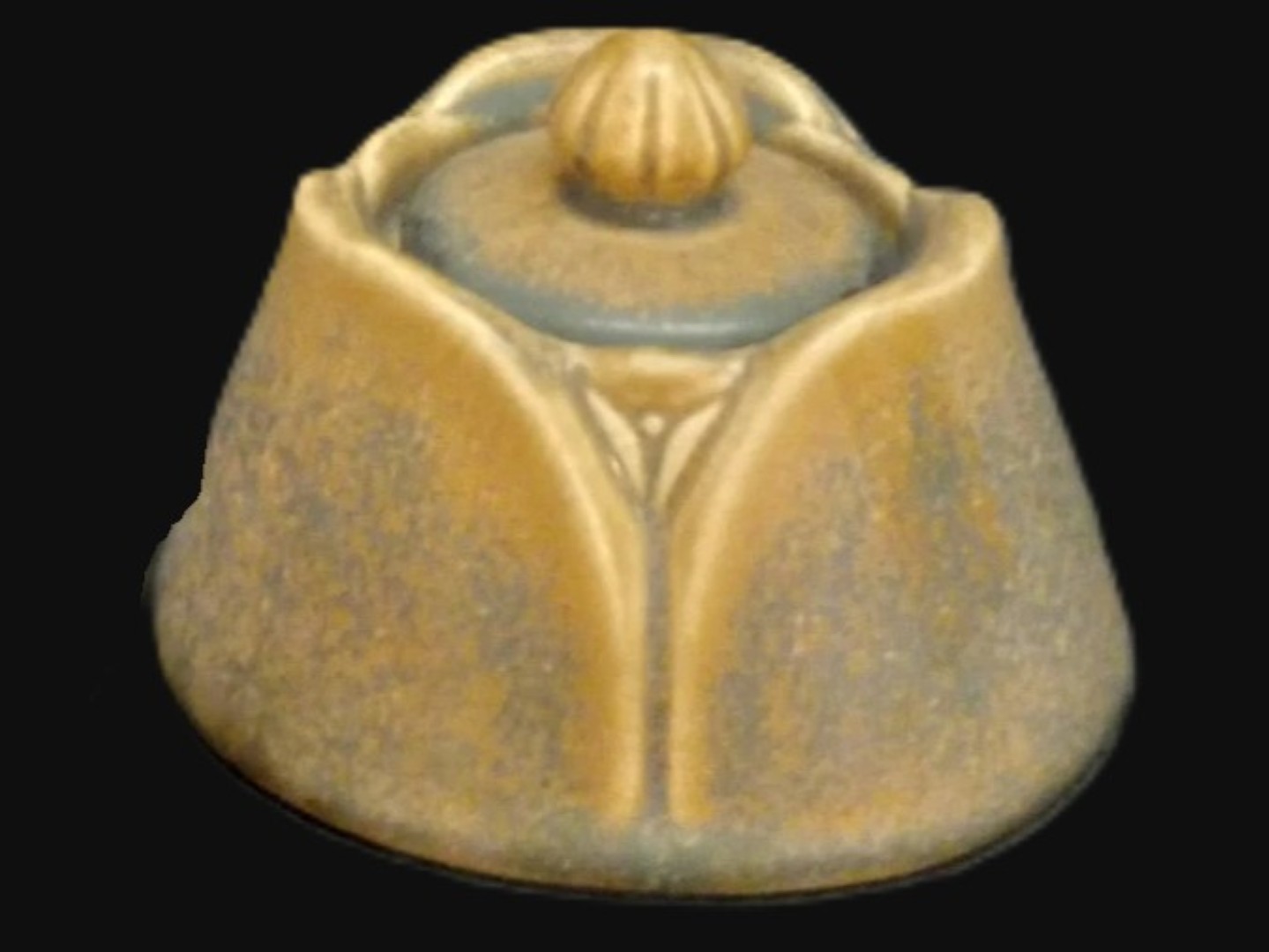
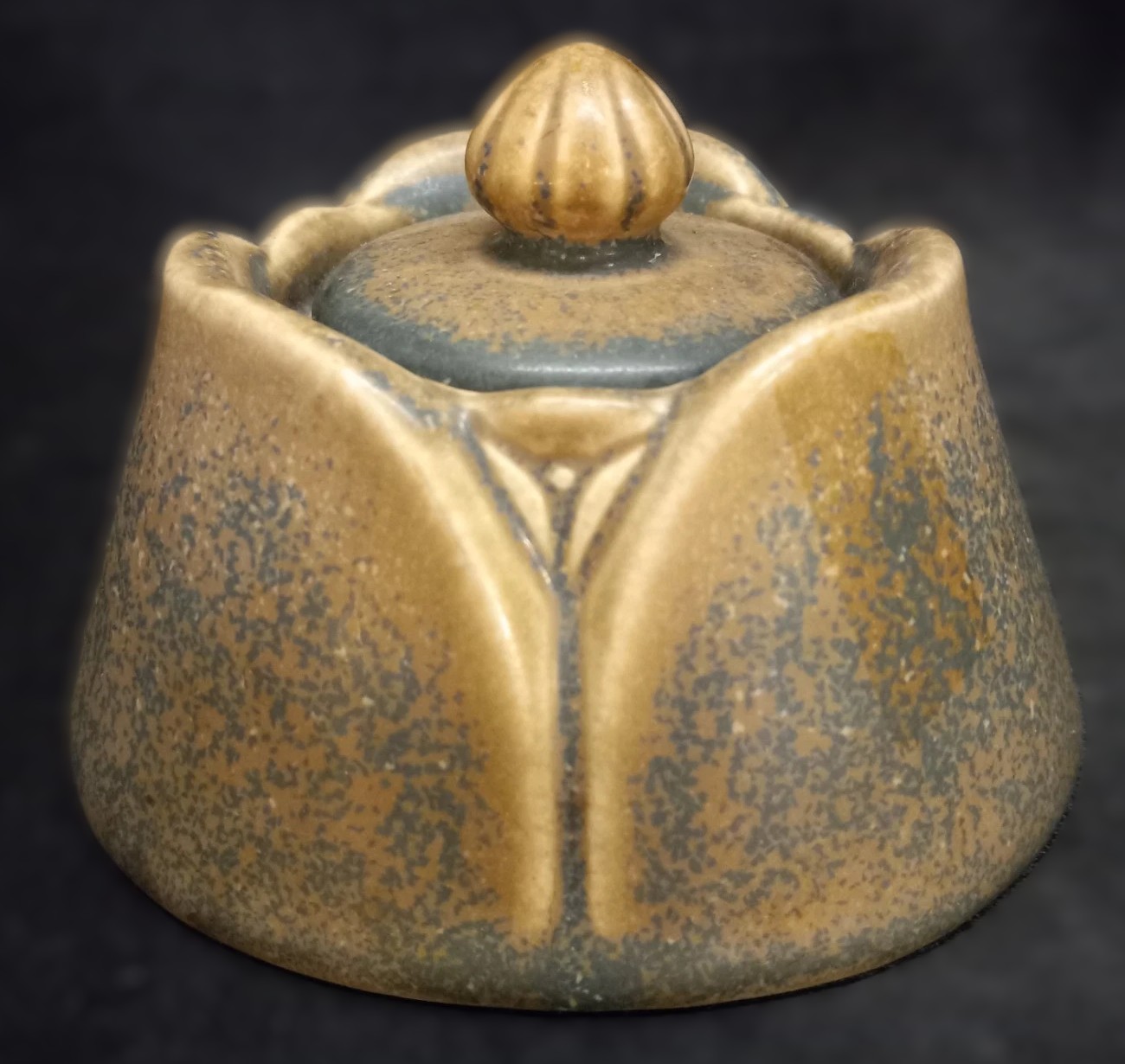
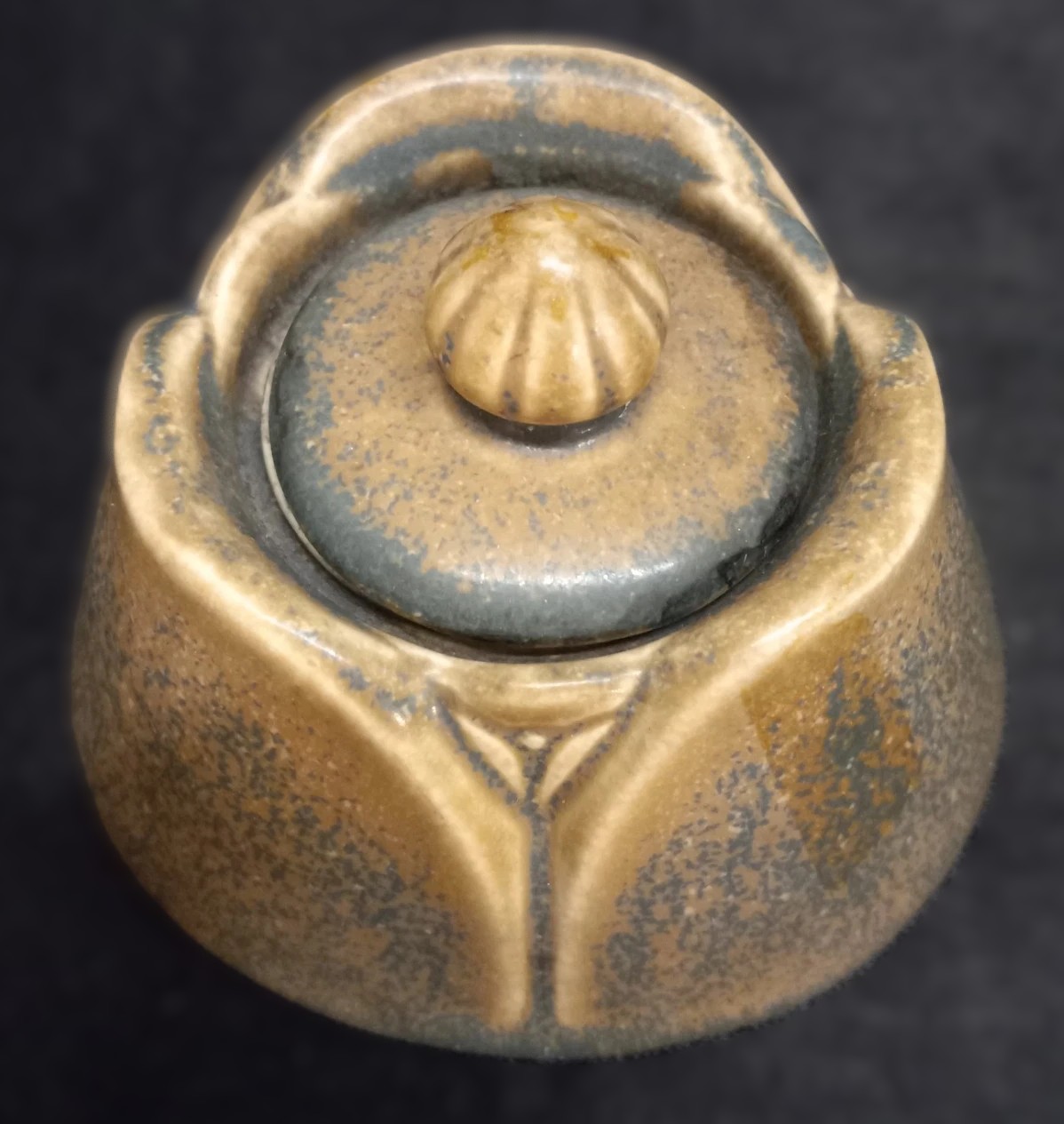
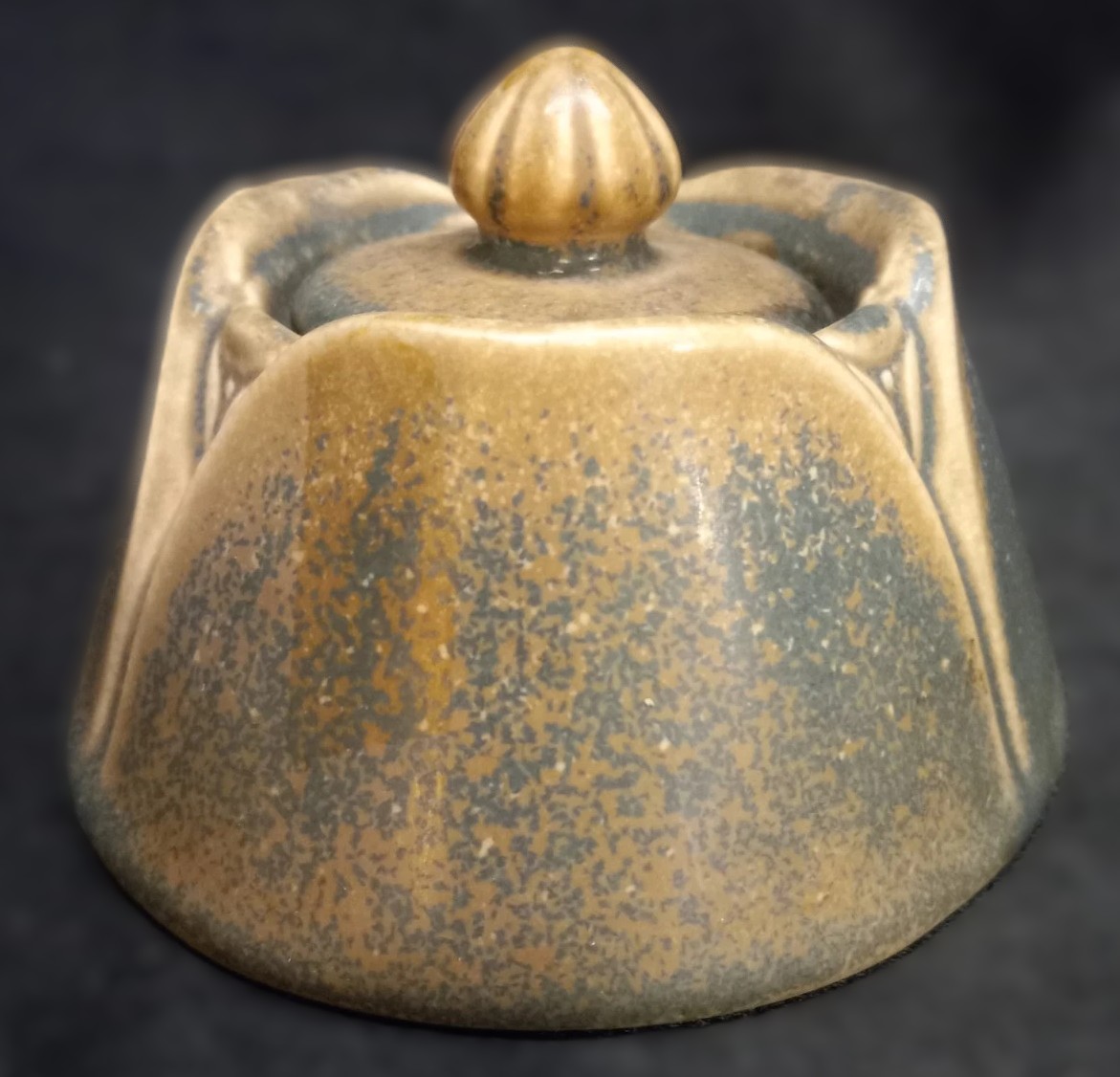





Rookwood Pottery Inkwell
| Categories | Ceramics/Porcelain "Named" Makers |
| Material | Pottery |
| Markings | See Narrative |
| Manufacturer | Rookwood |
| Origin | United States |
| Date or Era | circa 1922 |
| Measuring | 3 ¾” diameter; 2 ⅝” high |
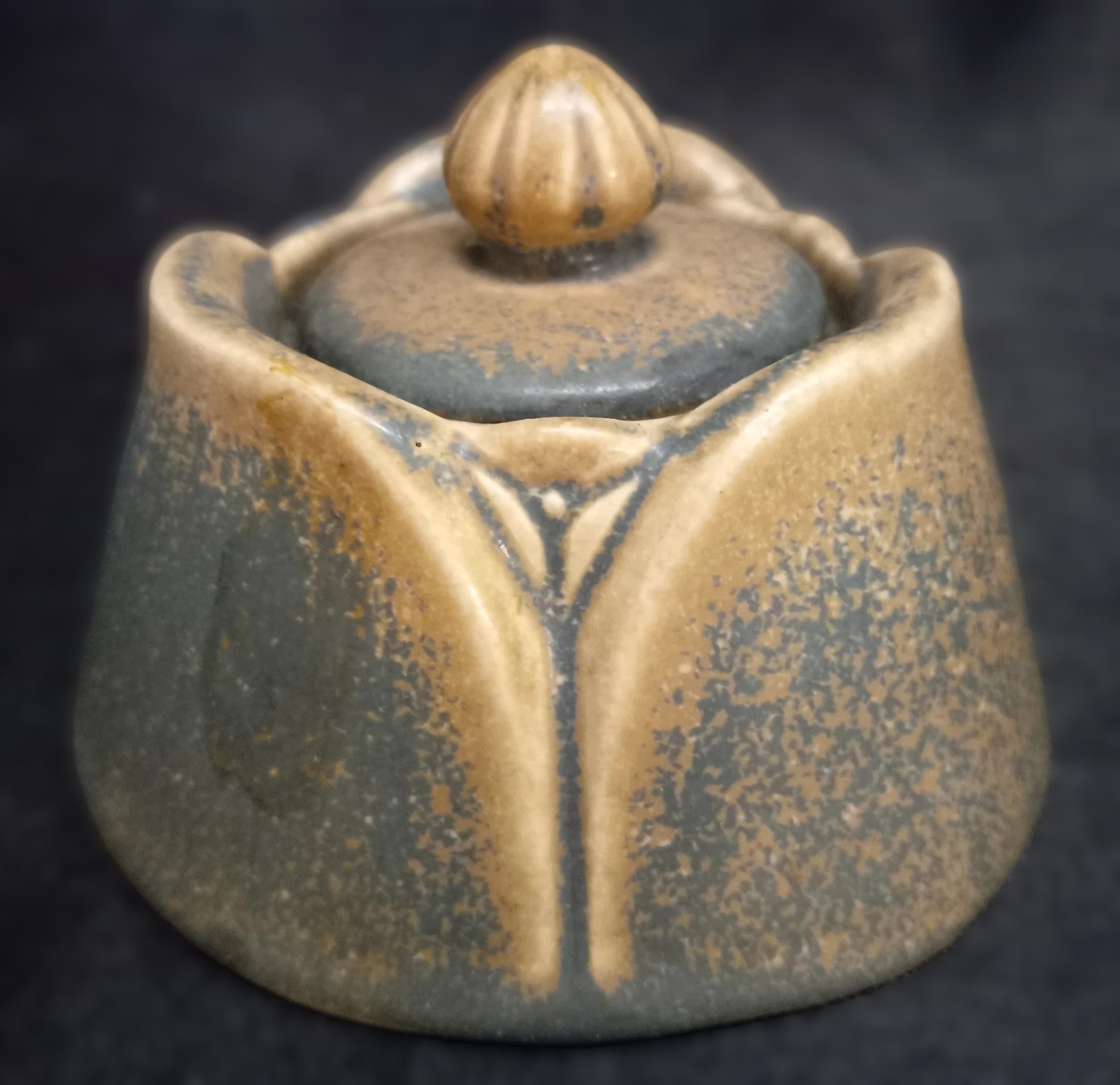
This three-piece art pottery inkwell is a textbook representation of the Arts & Crafts movement’s late production era at Rookwood.
Description
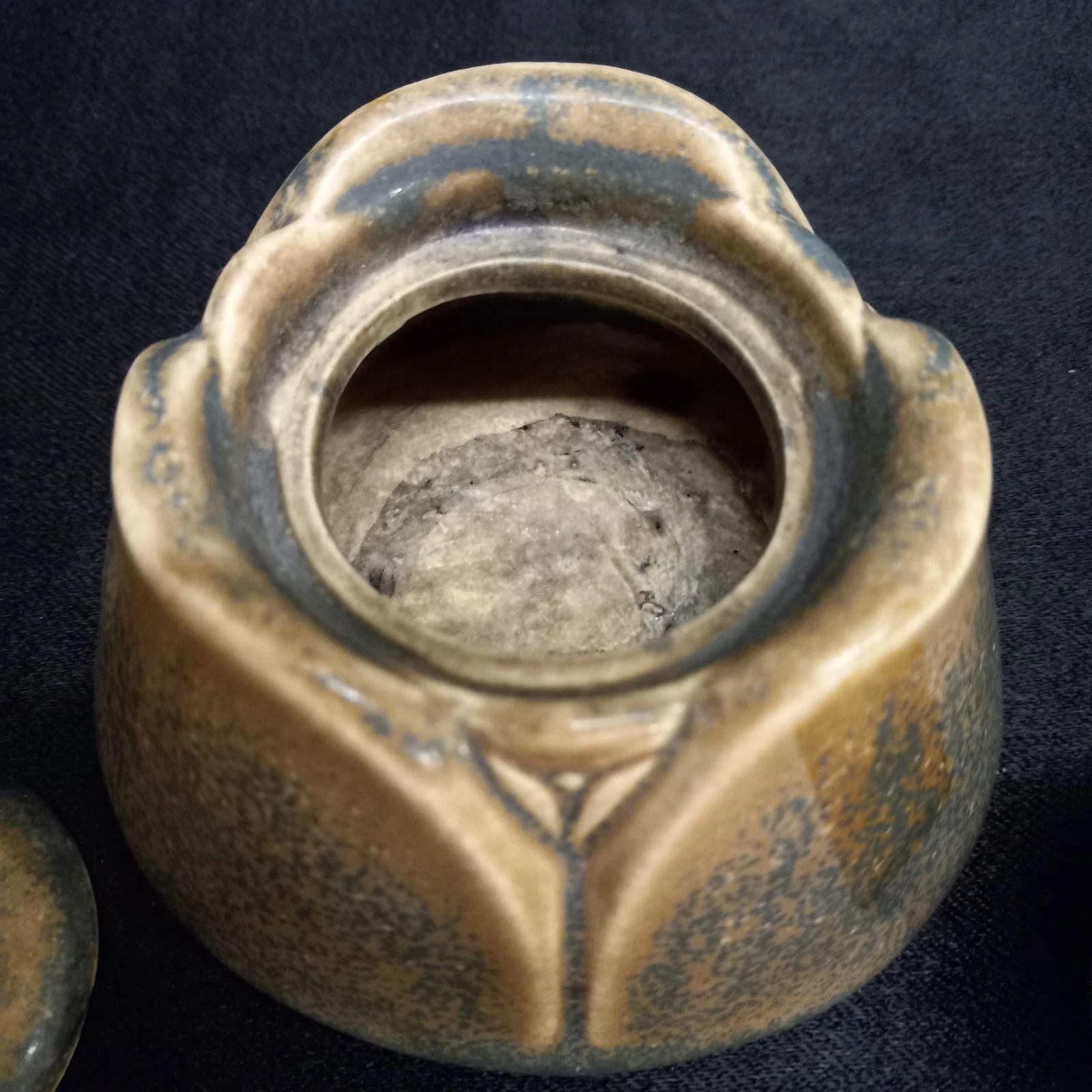
- Design & Form: The inkwell features a stylized, organic, tripartite (three-sided) form reminiscent of a closing flower bud or inverted tulip. Stylized, molded lines gather at three distinct corners to form gentle ridges, giving the squat, heavy-bottomed piece a structural yet organic presence.
- Glaze: It is finished in a mottled production matte glaze. The primary colorway consists of a multi-toned, speckled matrix of mustard-tan and a deep slate/industrial green. The crystalline or curdled texture of the matte glaze breaks over the raised, molded edges, allowing the lighter tan tones to accent the structural lines of the design.
- Components: This is a complete three-piece set:
- Main Body/Base: The heavy, stable exterior housing.
- Original Ceramic Ink Cup Insert: A separate, removable well that sits inside the body to hold the actual ink.
- Lid: A matching, flat-profile lid topped with a distinctively ribbed, melon-shaped or acorn-style finial knob.
Maker’s Marks & Authentication
The underside of the base features impressed factory marks:
- The Rookwood Logo: The classic reversed “RP” monogram surrounded by a sunburst of flames. (The 14 flames represent the year 1900).
- Date Mark: The Roman numerals XXII directly below the logo signify the piece was manufactured in 1922.
- Shape Number: The digits 1677 identify the specific design shape in the Rookwood catalog registry.
Background & History of Rookwood Pottery
Founded in 1880 by Maria Longworth Nichols Storer in Cincinnati, Ohio, the Rookwood Pottery Company stands as the preeminent American art pottery manufacturer of the late 19th and early 20th centuries.
The Foundation and Innovation (1880s–1890s)
Maria Longworth Nichols, a wealthy socialite, became inspired by Japanese ceramics at the 1876 Centennial Exhibition in Philadelphia. She established Rookwood (named after her family’s estate) as a hobbyist venture that rapidly evolved into a powerhouse of industrial art.
Rookwood was unique because it was largely built, driven, and staffed by women artists in its foundational years. Nichols hired exceptional talent, including chemist Stanley G. Burt and legendary decorator Kitaro Shirayamadani. Through rigorous experimentation, Rookwood developed revolutionary slip-painting techniques and legendary transparent glazes, such as their famous “Standard Glaze” (a warm, dark amber/brown tone decorated with underglaze botanicals or portraits) and the iridescent “Tiger Eye.”
Global Recognition and the Arts & Crafts Movement
By the 1889 and 1900 Paris Expositions, Rookwood was winning grand prizes globally, proving that American art pottery could compete with—and surpass—historic European porcelain houses.
As tastes shifted away from the dark, high-gloss Victorian aesthetics toward the Arts & Crafts movement, Rookwood pivoted effortlessly. In 1904, they introduced their famous matte glazes, developed primarily by ceramic chemist William Watts Taylor. These glazes required no post-firing polishing and excelled at accentuating the understated, molded, architectural, and naturalistic lines prized by the Craftsman style.
The Production Era (1910s–1920s)
While Rookwood continued to produce high-end, one-of-a-kind “Artist Signed” pieces, they successfully introduced “Production Pieces” like this shape 1677 inkwell. These items were cast from master molds but finished by hand with sophisticated, complex glaze formulas. This allowed households across America to own a piece of world-class Cincinnati art pottery at a commercial price point. Production peaked during the 1920s, defined by the rich blues, greens, and tans of their matte-vellum and architectural glazes.
Legacy
Like many luxury art manufacturers, Rookwood was devastated by the Great Depression, which forced a stark decline in production quality and eventual bankruptcy in 1941. After changing hands and moving locations mid-century, the brand was revitalized in the 21st century. Today, historical pieces from Rookwood’s golden era (1880–1930) are celebrated for their unparalleled glaze chemistry, elegant forms, and central role in the American Art Pottery movement.
Sold for $261 in May 2026
Content disclaimer. The information posted is the owner’s best knowledge and may not have been vetted by the SOIC. We welcome comments, corrections, and additions, working to make our website information comprehensive and accurate.
Join the Society of Inkwell Collectors (SOIC) – it’s free!
Founded in 1981 as a non-profit organization,
we are documenting inkwells (and accessories).
We’re here to help and inform!