


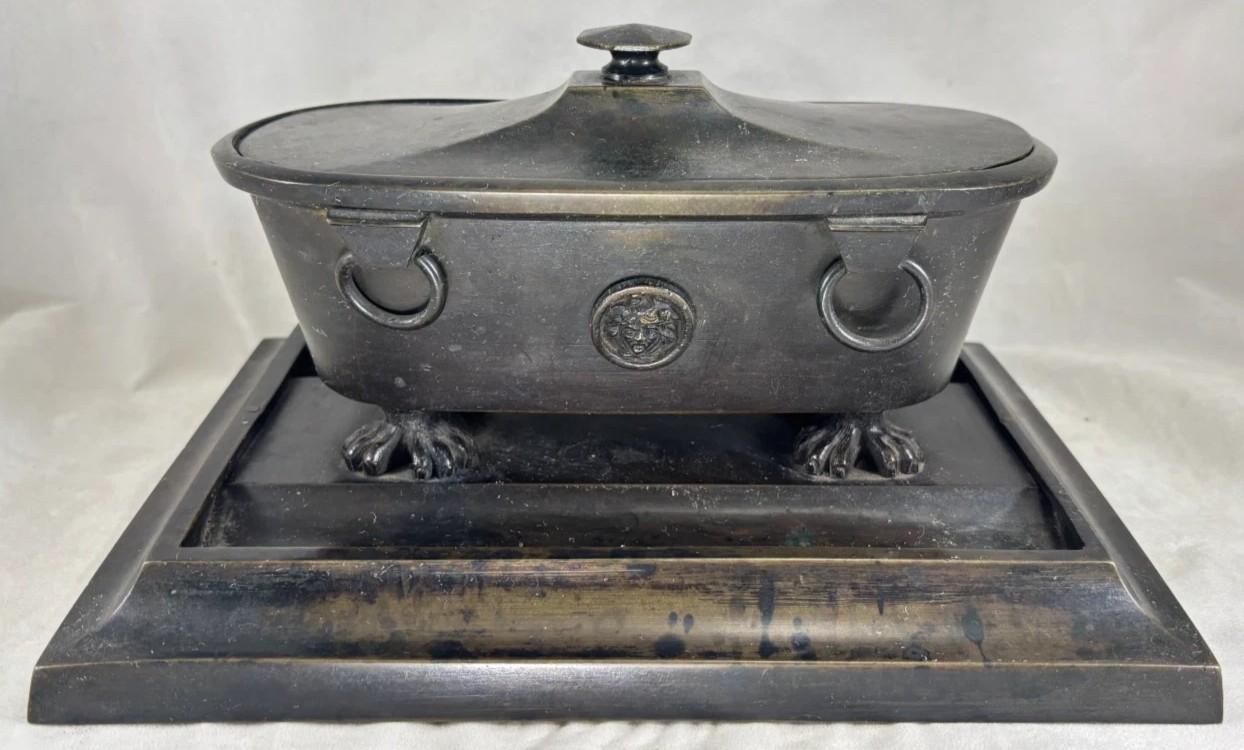


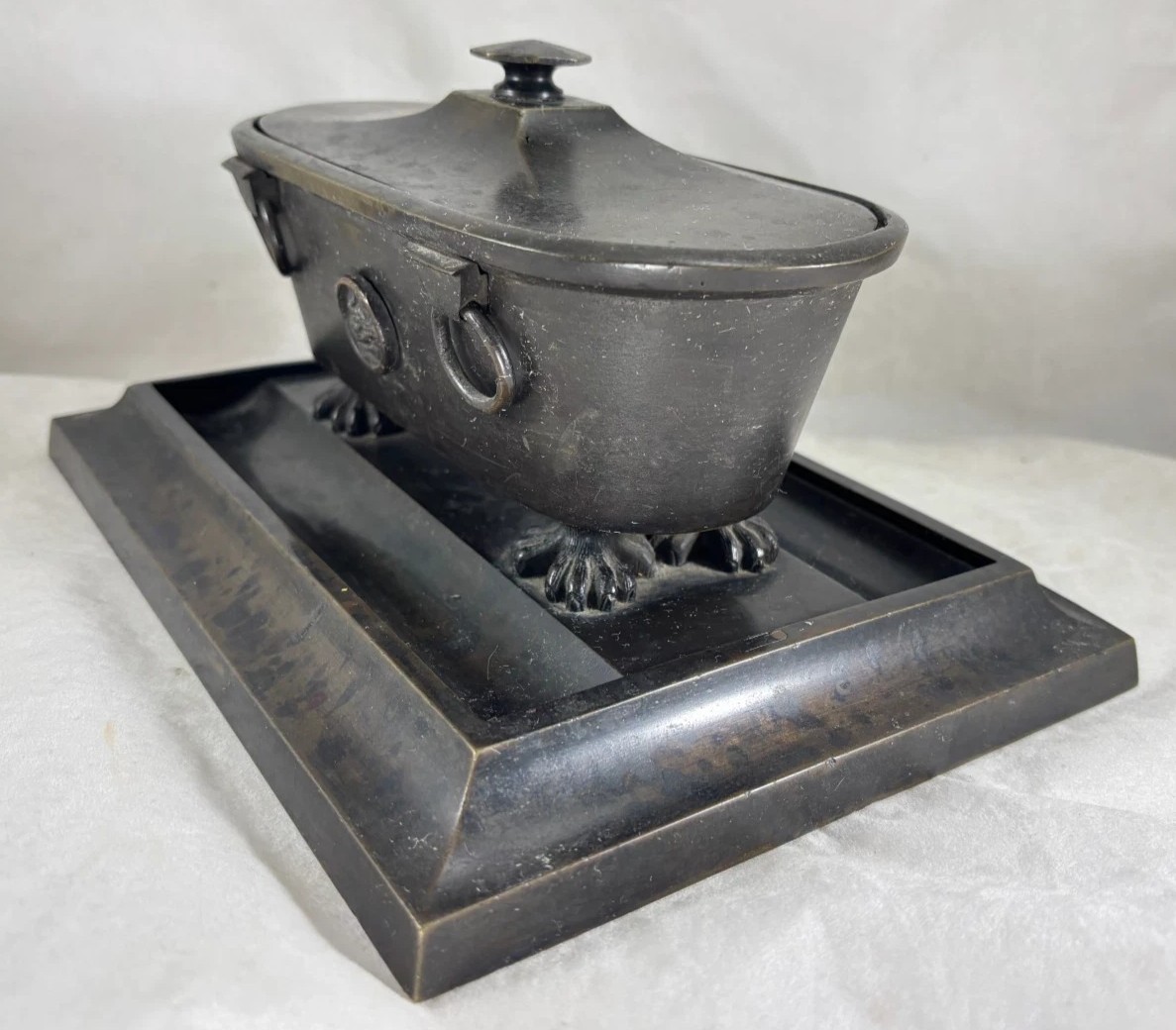


Roman Sarcophagus Grand Tour Inkstand
| Categories | Figural - Inanimate, Souvenir |
| Type | Grand Tour |
| Material | Bronze |
| Markings | Unmarked |
| Manufacturer | Undetermined |
| Origin | Italy |
| Date or Era | circa 1870 |
| Measuring | 9 ½” x 7” x 5” high |
This inkstand is an example of an object created during the height of the Neoclassical movement and the tradition of the Grand Tour.
Detailed Description
- Overall Form: The inkstand is modeled after a Classical Roman sarcophagus (a stone coffin), a form widely admired by 18th and 19th-century European scholars and collectors.
- Material: It is made of bronze (or a patinated spelter alloy designed to look like bronze).
- Base and Feet: The base is supported by four sculpted feet executed in the form of animal claws, often associated with Roman furniture and architectural pieces.
- Decorative Motifs:
- Medusa Head: The center front features a striking Gorgoneion (a Medusa-type head) in high relief. In ancient times, this motif was often used as an apotropaic device—a symbol meant to ward off evil—making its presence on a sarcophagus model appropriate.
- Carrying Rings: The sides are adorned with decorative carrying rings (or handles), which mimic the bronze fittings found on full-sized ancient sarcophagi.
- Lid: The lift-off lid is rectangular with a slightly arched or stepped profile, resembling the heavy stone lids of Roman burial boxes.
- Functionality:
- Inkwells: The lid, when removed, reveals two fitted inkwells, which are the original clear glass inserts. One well would held black ink, and the other red.
“Grand Tour” Item
The term “Grand Tour” refers to the traditional trip of Europe undertaken by young upper-class European (and later American) men from about the 17th to the mid-19th centuries.
- Purpose: The primary goal was to complete a young man’s education, expose him to classical culture, and instill a deeper understanding of art and history. The itinerary always focused heavily on Italy (Rome, Florence, Naples) due to its abundance of ancient ruins and Renaissance art.
- Souvenirs: Grand Tour items are the small, portable souvenirs purchased by these travelers. These items included miniature sculptures, intaglios, cameos, and, crucially, functional desk accessories like inkstands, often made of bronze or marble and modeled after famous ruins or ancient artifacts (like this sarcophagus).
Age and Origin Estimate
The height of Grand Tour souvenir production coincided with the Neoclassical period:
- Origin: Italy (Rome or Florence).
- Age Estimate: circa 1850 – 1890 (Late Grand Tour/Victorian Neoclassical Period)
Additional Information
- Medusa Motif: The use of the Medusa head motif is perfectly aligned with other Grand Tour souvenirs, which frequently featured famous classical sculptures or mythical figures, such as copies of Canova’s Perseus with the Head of Medusa. Medusa’s ancient use as an apotropaic image makes it a powerful and appropriate symbol for a piece modeled after a Roman tomb.
- Form and Material: The piece fits the typical profile of Grand Tour objects: a smaller-scale, often bronze/patinated metal, functional item (inkwell) modeled after monumental architecture or sculpture, intended to be a tasteful memento of the traveler’s time in Rome.
- Manufacturing: The technique of high-quality casting and patination, as opposed to forging, was standard for these pieces and would have been made by Italian craftsmen catering to the constant stream of wealthy tourists.
Sold for $620 in October 2025
Content disclaimer. The information posted is the owner’s best knowledge and may not have been vetted by the SOIC. We welcome comments, corrections, and additions, working to make our website information comprehensive and accurate.
Join the Society of Inkwell Collectors (SOIC) – it’s free!
Founded in 1981 as a non-profit organization,
we are documenting inkwells (and accessories).
We’re here to help and inform!