


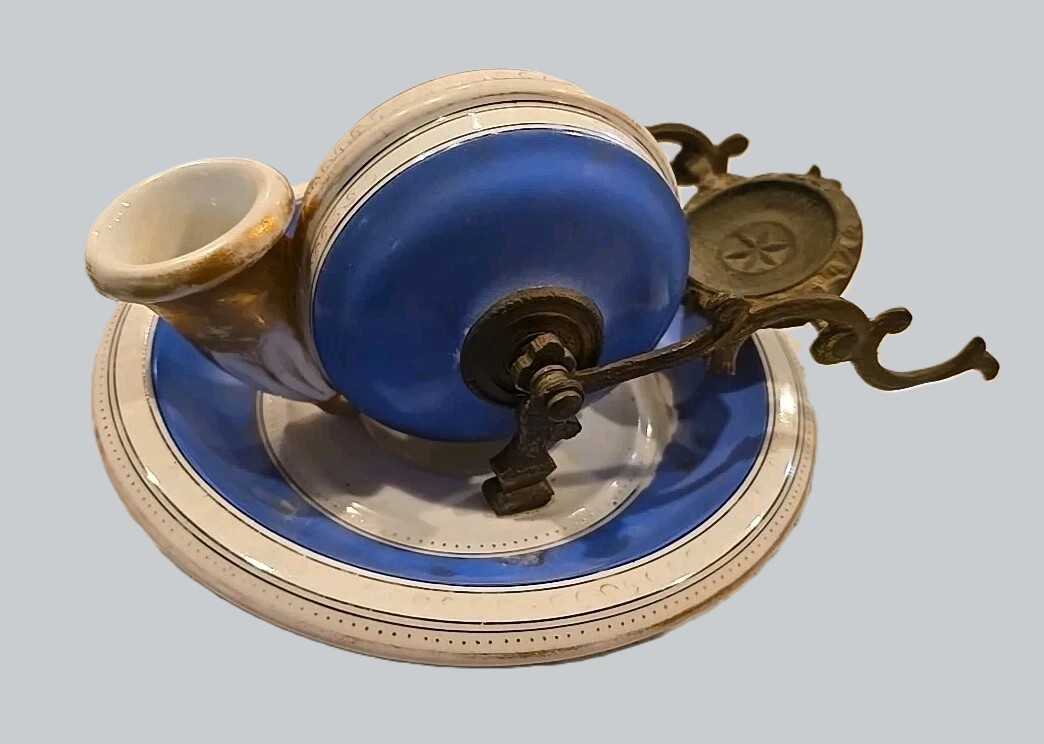


Revolving “Snail” Inkwell
| Categories | Mechanical - Snail / Pivoting |
| Material | Brass, Porcelain |
| Markings | 1761 |
| Manufacturer | Fischer & Mieg |
| Origin | Bohemia |
| Date or Era | circa 1860 |
This revolving snail inkwell was produced by Fischer & Mieg in Březová, Bohemia during the mid-19th century.
Design Features
- Porcelain Snail Reservoir: Shaped like a stylized snail shell, the reservoir features a vibrant cobalt blue and white glaze, typical of the high-quality porcelain produced in the Bohemia region during this era. Fine gold-leaf scrolling and geometric patterns decorate the edges of the saucer and the central band of the snail reservoir.
- Brass Mounting & Stopple Plate: The snail is affixed to a brass bracket with two vertical supports, or standards, flanking the reservoir. These standards house retaining set screws that form the axis of rotation, allowing the snail to tilt forward or back.
- Stopple Plate (Stopper Disc): A stationary brass disc—part of the brass mounting—serves as a stopple plate. When the trumpet-shaped reservoir is rotated forward (away from the user), the font is closed by the stopple plate, sealing the reservoir to prevent evaporation.
- Pen Rack: Integrated into the brass bracket is a pen holder.
- Saucer Base: The entire mechanism sits upon a matching porcelain saucer base with a cobalt blue band and gold-painted borders.
- Markings: The underside of the saucer features a small, hand-painted number “1761”, which likely refers to a factory pattern or model number.
Mechanism: Opening and Closing
- Opening: The user manually pulls the snail’s trumpet-shaped font forward (towards the user), which pivots on the set screws threaded through the standards. This movement lifts the trumpet-shaped opening away from the stopple plate, exposing the ink reservoir.
- Closing: The snail is rotated away from the user, and the opening seats itself around the stationary stopple plate, effectively sealing the ink chamber.
Historical Context and Attribution
Fischer & Mieg in the 1850s
This piece can be reliably dated to the mid-19th century based on the company’s history in Březová (Pirkenhammer):
- Maker: Fischer & Mieg, founded in 1814, was one of Bohemia’s premier porcelain manufacturers. By the 1860s, they were producing luxury desk accessories for export across Europe.
- 1853 Reorganization: Christian Fischer brought in his son-in-law, Ludwig von Mieg, as a partner in 1853, at which point the firm was officially renamed Fischer & Mieg.
- Recognition: In the 1850s, the factory was at the height of its international fame, even receiving a gold medal at the 1839 Vienna Fair for its technical precision.
- Date: Based on design, materials, and mechanical construction, this piece likely dates from circa 1860–1870.
Sold for $215 in December 2025
Content disclaimer. The information posted is the owner’s best knowledge and may not have been vetted by the SOIC. We welcome comments, corrections, and additions, working to make our website information comprehensive and accurate.
Join the Society of Inkwell Collectors (SOIC) – it’s free!
Founded in 1981 as a non-profit organization,
we are documenting inkwells (and accessories).
We’re here to help and inform!