

Inkipedia


Quadruple Plate Inkstand by Derby Silver Co.
| Categories | Silver |
| Material | Silverplate |
| Markings | See Narrative |
| Manufacturer | Derby Silver Co. |
| Origin | United States |
| Date or Era | circa 1885 |
| Measuring | 5 ½” x 5 ½” x 3 ½” high |
Description of the Inkstand
This set consists of a decorative silverplated tray (stand) and a heavy, lead-crystal inkwell.
- The Stand: The base is a “shaped” square tray with an elaborate pierced and repoussé border. The design features scrolling acanthus leaves, floral motifs (roses or daisies), and textured “cross-hatching” in the background of the silverwork. It sits on four ball feet. The center of the tray has a square recessed “well” to hold the inkwell securely in place.
- The Inkwell: The well is made of heavy, colorless cut glass (crystal) with a thick base and deep, vertical bevels.
- The Lid: The silverplated lid is attached with a sturdy hinge and features a domed, swirled gadroon or scroll pattern that matches the ornate aesthetic of the stand. The “beaded” rim around the base of the lid adds a final touch of detail.
Origin and Date
- Manufacturer: Derby Silver Co.
- Material: Quadruple Plate (Silver electroplated over a base metal, typically Britannia metal or white metal).
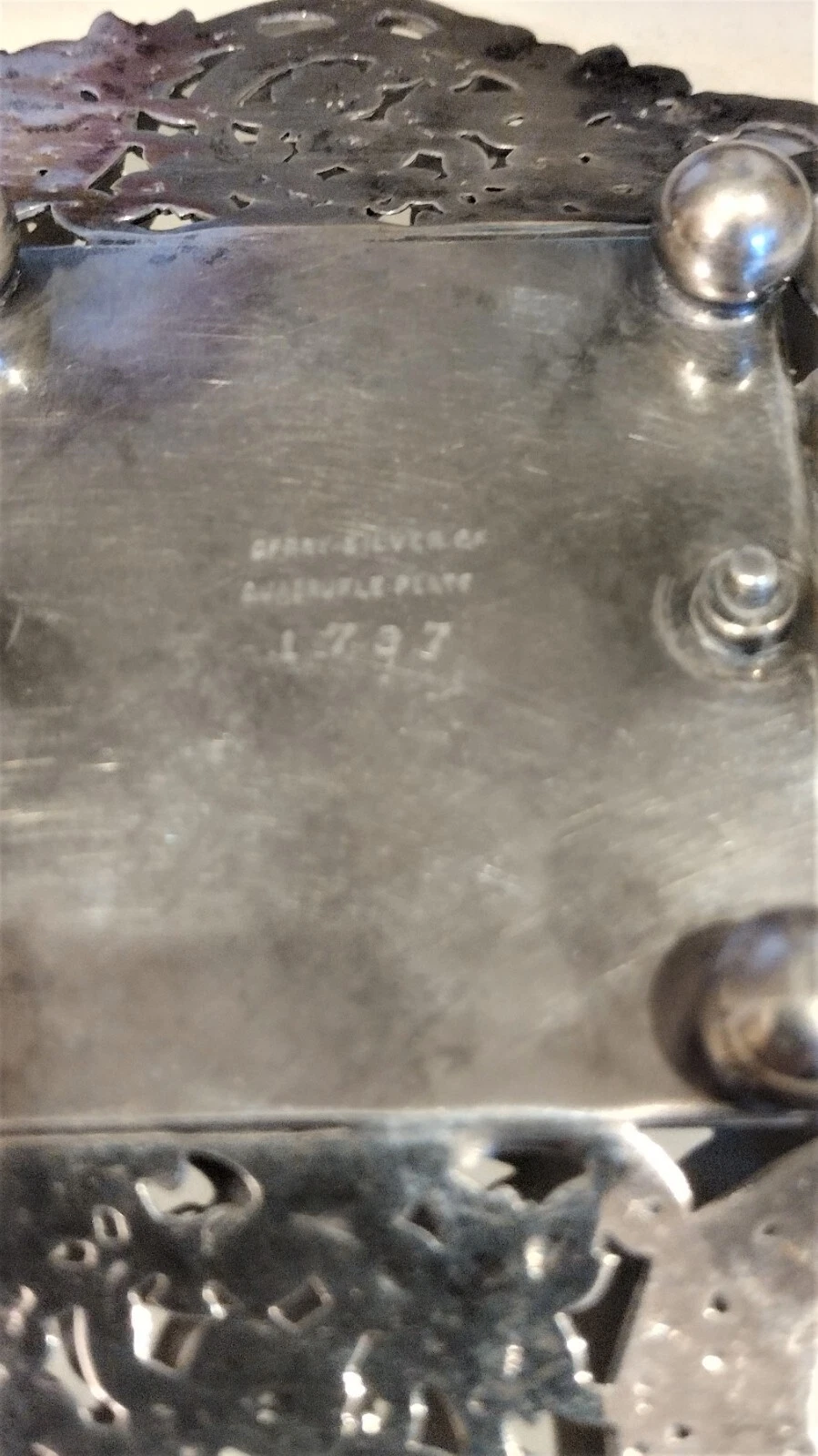
- Model Number: 1737 (This is a factory catalog or pattern number).
- Estimated Date: Circa 1880–1898.
- The “Derby Silver Co.” mark was primarily used between the company’s founding in 1872 and its merger into the International Silver Co. in 1898. Pieces made after 1898 usually included “International Silver Co.” or were marked as “Factory B.”
- The highly ornate, pierced style is hallmark to the Aesthetic Movement and late Victorian period (1880s).
Background: The Derby Silver Company
The Derby Silver Company was a major player in the famed “Silver Valley” of Connecticut during the late 19th century.
- Founding: Established in 1872 in Derby, Connecticut, by Edwin DeForest Shelton and others. In 1877, they moved across the river to a larger factory in Shelton, CT.
- “Quadruple Plate”: This was a marketing term used by American manufacturers to denote high-quality silverplate. It signified that the piece had been plated with four times the amount of silver used for “standard” plating (usually 8 troy ounces of silver per 144 teaspoons). While it was more durable than cheaper plate, it is still a thin layer of silver over a base metal.
- Product Range: They were famous for “holloware” (bowls, tea sets, and inkstands) and “toilet ware” (mirrors and brushes). Their work was known for being technically excellent and highly decorative, often winning awards at world fairs, including the 1876 Centennial Exposition.
- Consolidation: In 1898, the company became one of the founding members of the International Silver Company, a massive conglomerate. The Derby plant continued to operate as “Factory B” until it finally closed in 1933 during the Great Depression.
Sold for $89 in January 2026
Content disclaimer. The information posted is the owner’s best knowledge and may not have been vetted by the SOIC. We welcome comments, corrections, and additions, working to make our website information comprehensive and accurate.
Join the Society of Inkwell Collectors (SOIC) – it’s free!
Founded in 1981 as a non-profit organization,
we are documenting inkwells (and accessories).
We’re here to help and inform!