








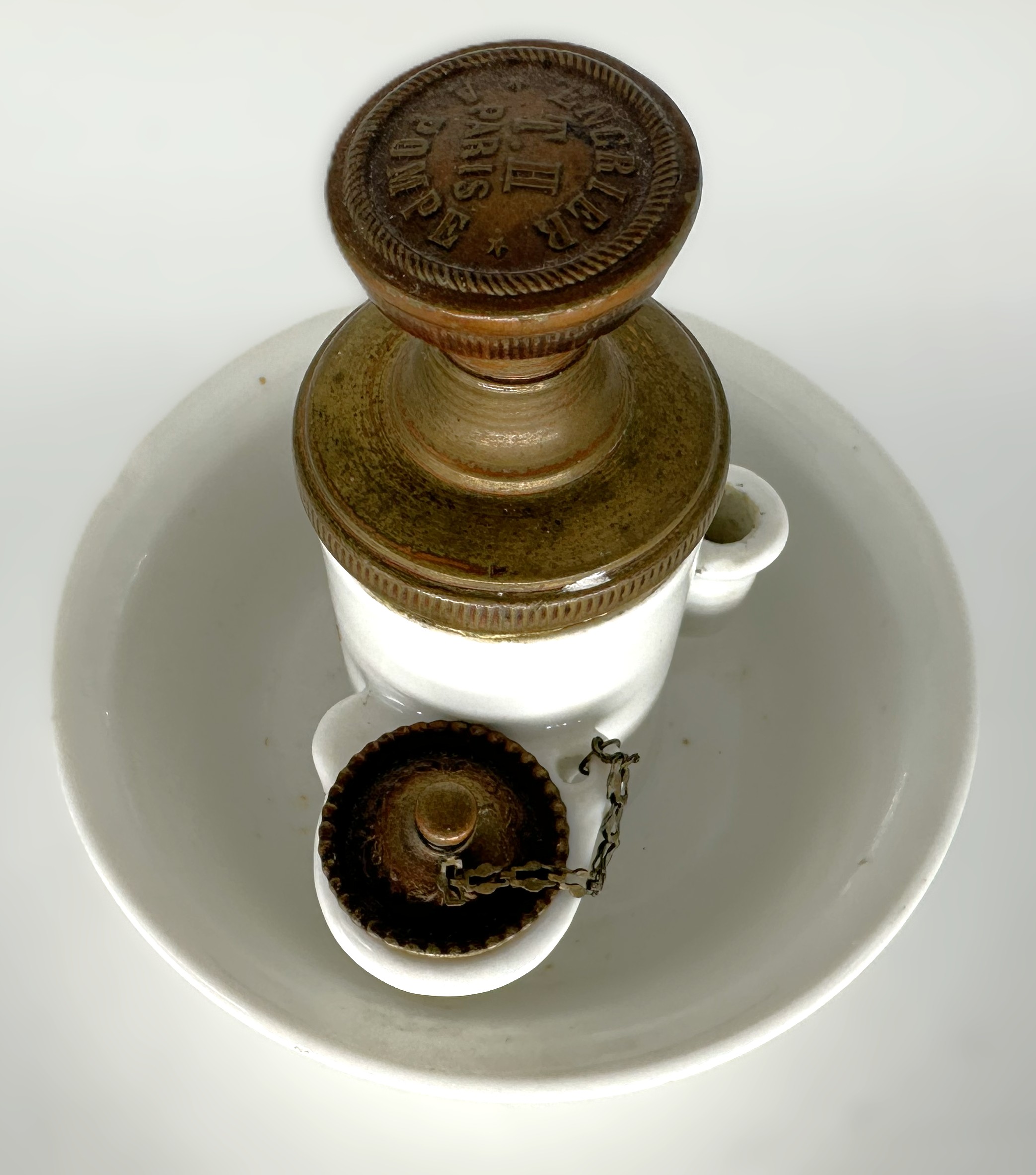
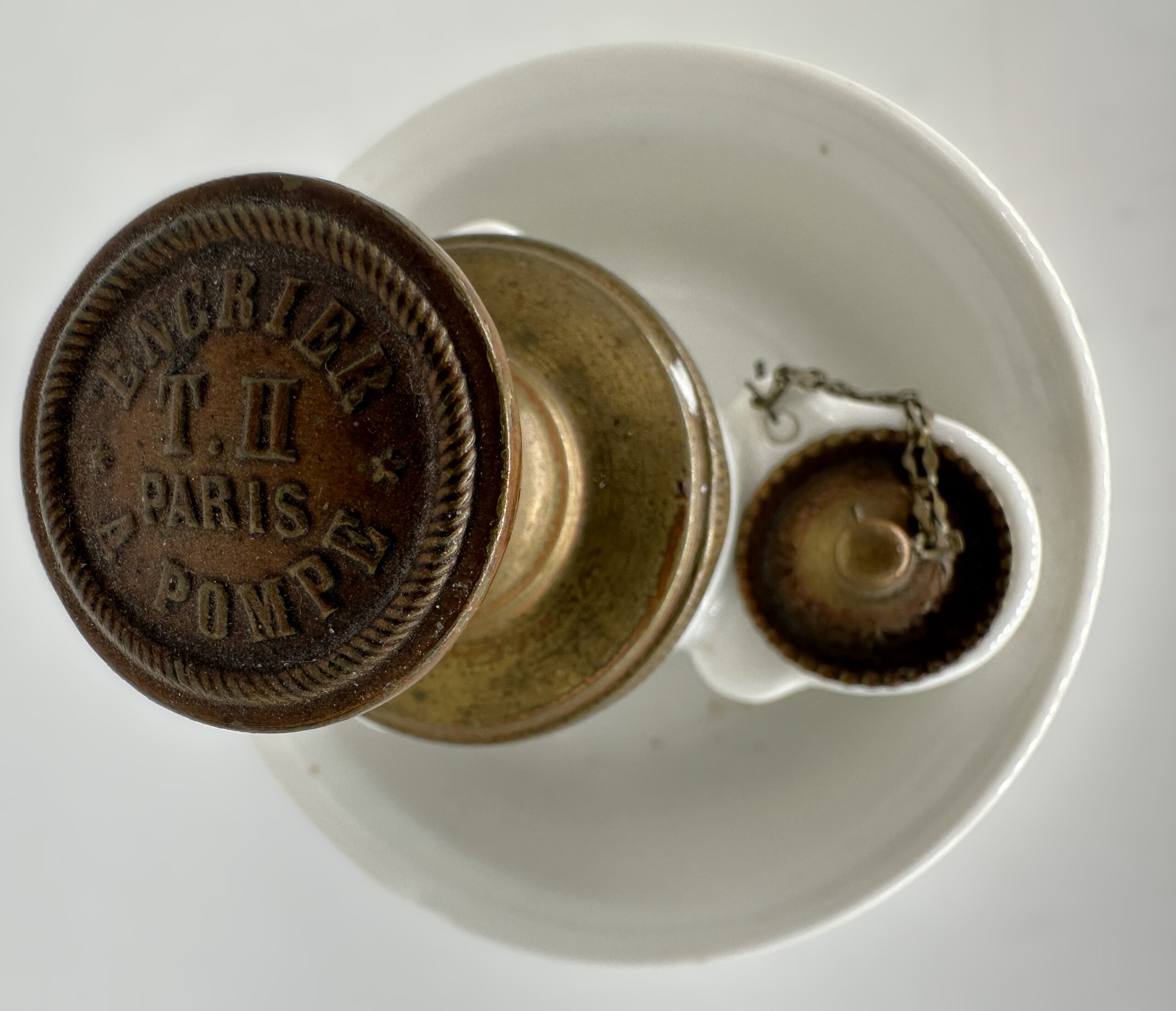

Pump Inkwell – “ENCRIER – T.H. – PARIS – A POMPE”
| Categories | Mechanical - Pump / Siphon |
| Type | Pump |
| Material | Porcelain |
| Markings | See Narrative |
| Origin | France |
| Date or Era | circa 1885 |
| Measuring | Large: 7” diameter; 5 ¾” high – Small: 4” diameter; 4” high |
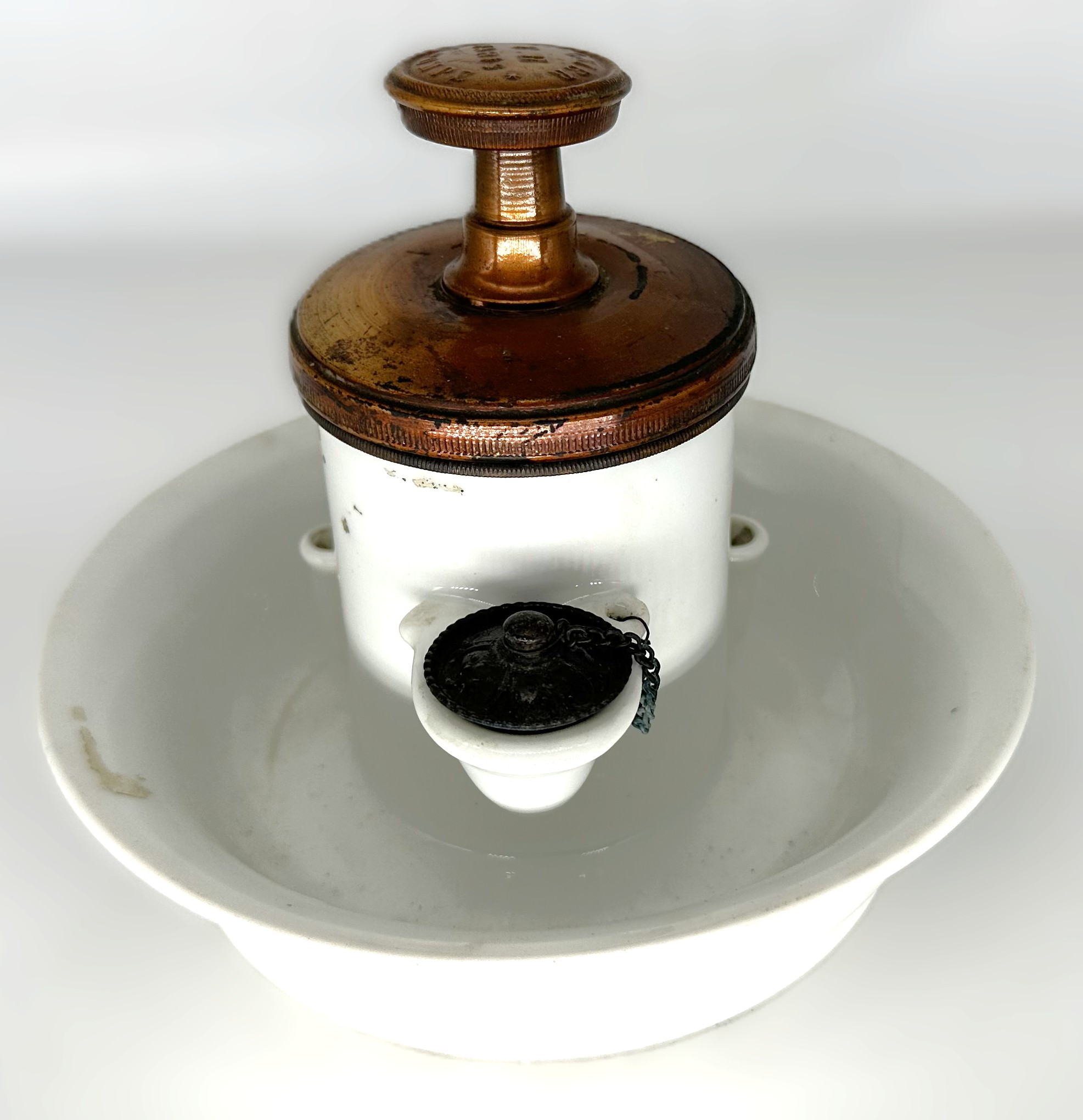
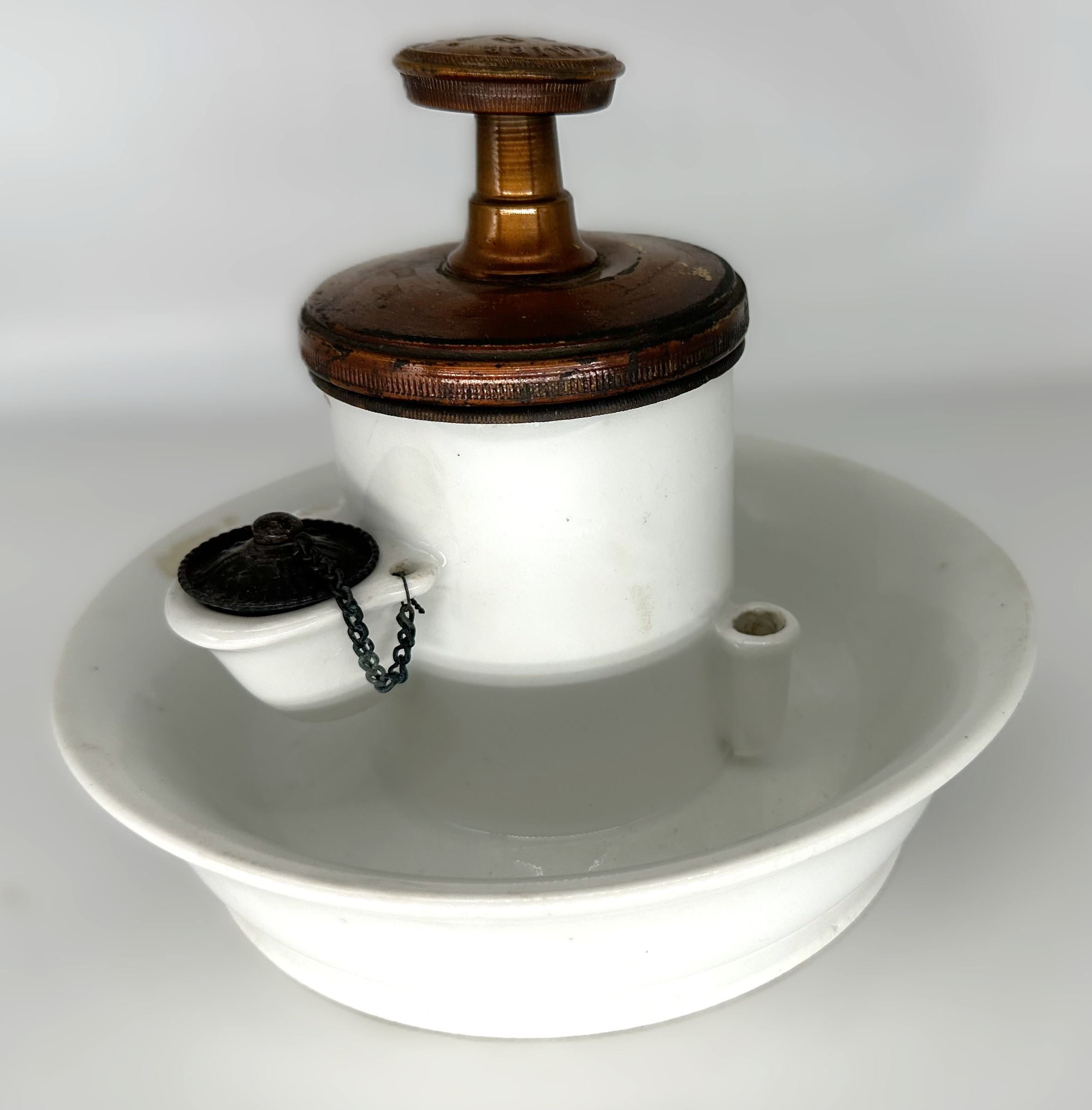
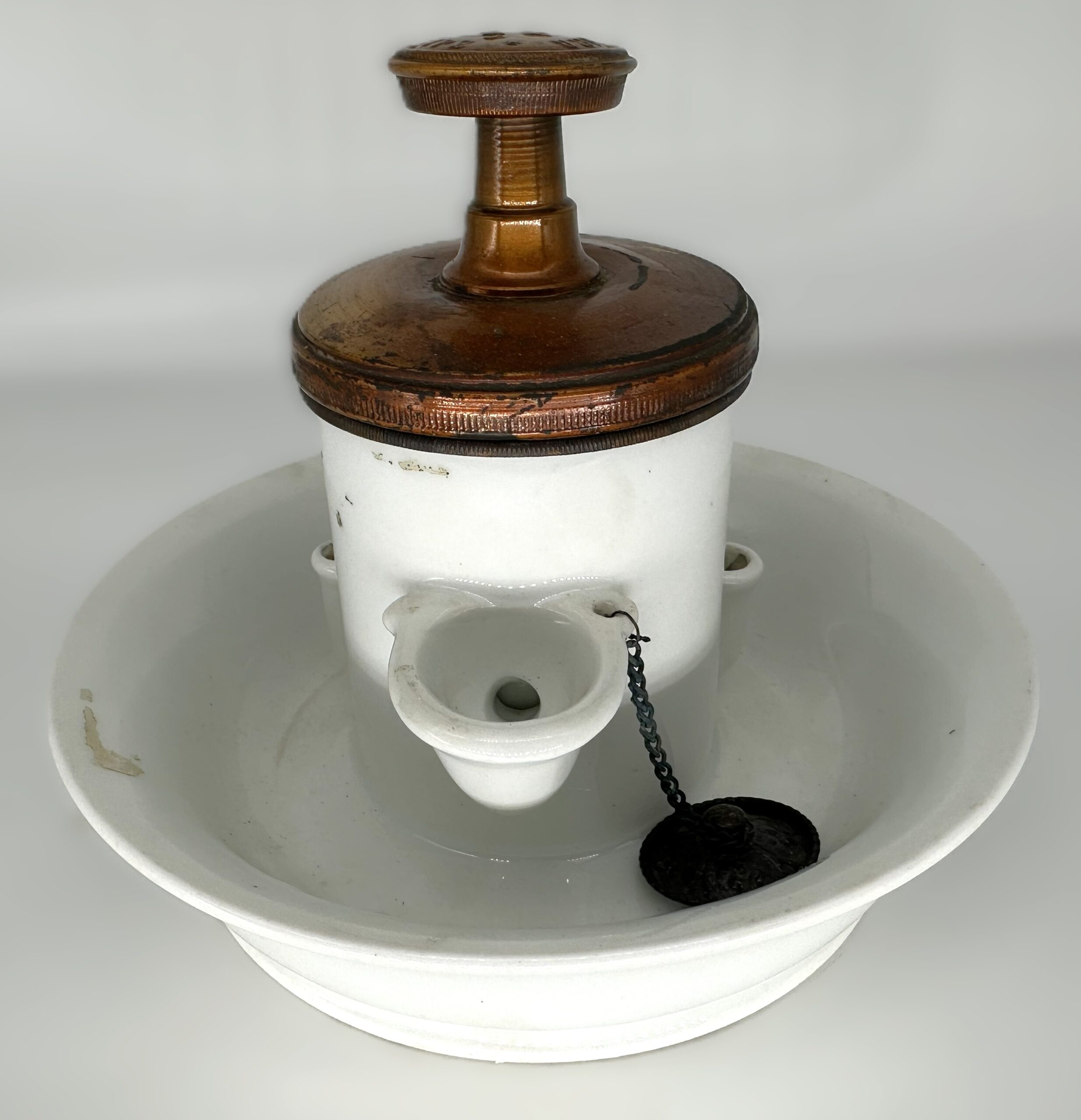
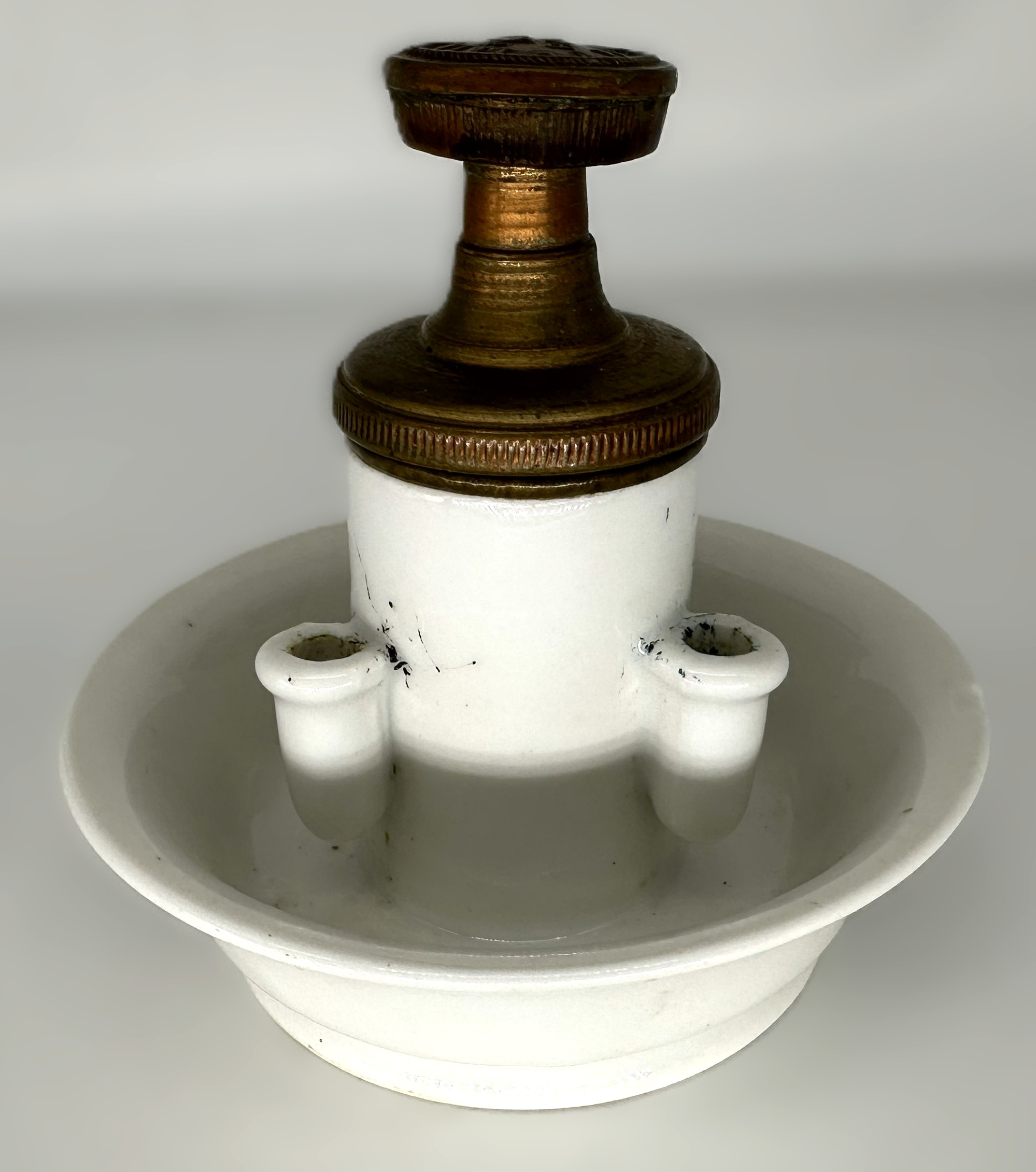
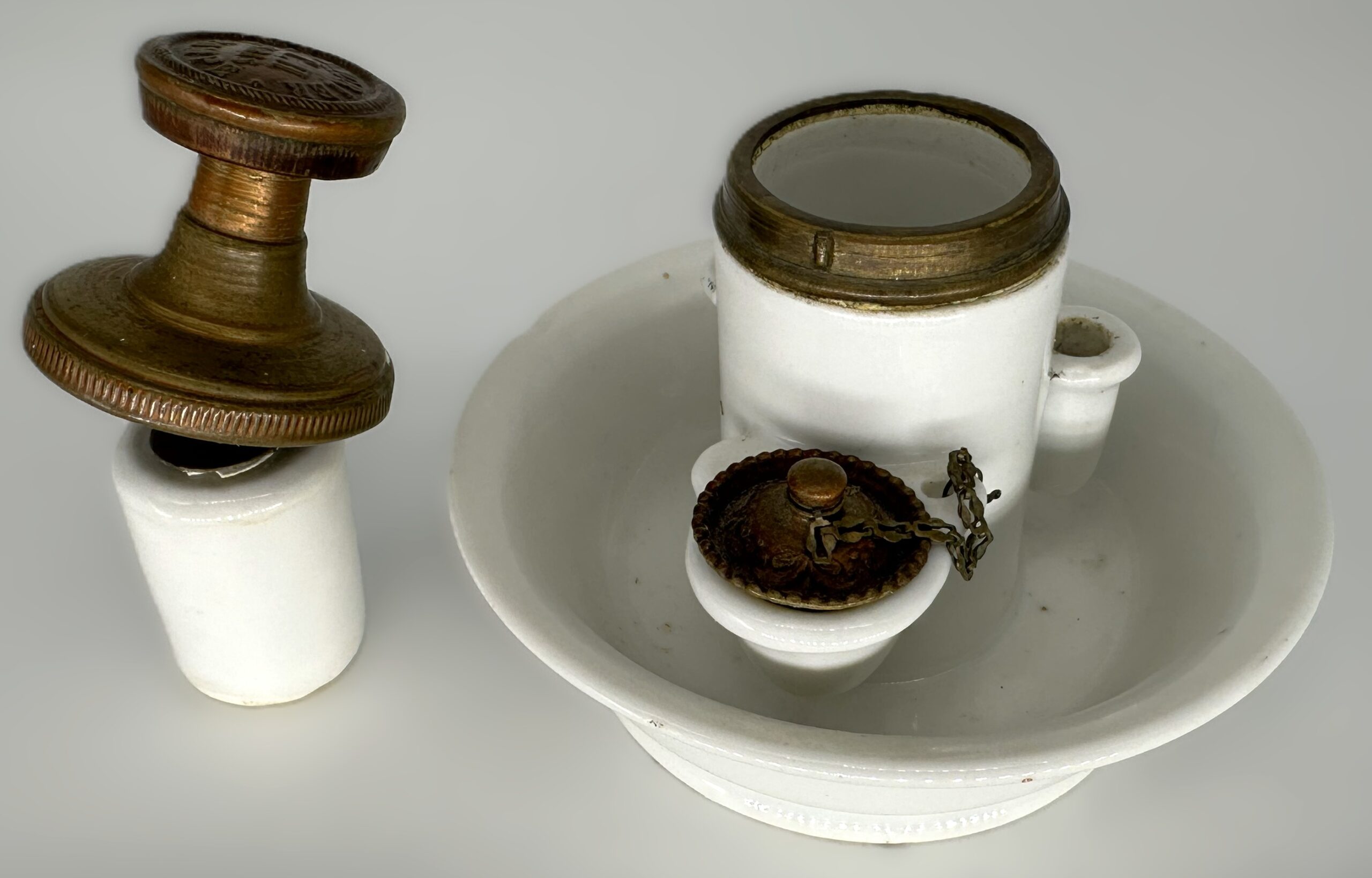
These white porcelain “pump” inkwells are specialized pieces of 19th-century French desk equipment, designed to regulate ink flow through a manual piston mechanism. Two examples are pictured – one large, one small.
Physical Description and Components
- The Main Unit: The inkstand consists of a central cylindrical porcelain reservoir mounted permanently within a wide, integral saucer base.
- The Pump Mechanism: A heavy porcelain plunger (or piston) is attached to a brass turn-knob handle at the top. This plunger fits snugly into the main ink container to create the necessary pressure.
- The Font: On the front of the cylinder is a small, protruding porcelain font from which the user would dip their pen.
- The Lid: The font is protected by a dark-patinated brass lid, which is permanently attached to the main body by a small safety chain to prevent loss.
- Quill/Pen Holders: The saucer base features two small, upright porcelain tubes (holes) positioned on either side of the main cylinder, designed to hold quills or dip pens vertically when not in use.
How the Pump Works
This is a manual piston-fed inkwell. Unlike gravity-fed wells, this model allows the user to control the exact amount of ink available for dipping:
- Priming: When the top knob is turned or pushed downward, the porcelain plunger descends into the main reservoir.
- Displacement: As the plunger moves down, it displaces the liquid ink, forcing it to rise through an internal channel and out into the small font at the front.
- Regulation: This mechanism ensures that the writer always has a shallow, fresh supply of ink in the font, while the bulk of the ink remains protected and airtight within the main cylinder to prevent evaporation.
Manufacturer and “T.H.” Identification
The piece was manufactured in France, specifically marked from Paris. The initials “T.H.” point to a French manufacturer specializing in patented mechanical desk ware. During the mid-to-late 19th century, several Parisian inventors patented variations of the encrier à pompe—most notably makers like Thomas Haron (a prolific French maker of mechanical pump inkwells who held patents for these exact style displacement systems). The porcelain itself is a fine hard-paste porcelain, heavily decorated in the style of Vieux Paris (Old Paris) porcelain, which frequently utilized vibrant pink borders, extensive gilding, and bright botanical motifs.
The Core Patent: Louis Honoré Boquet (1839)
The mechanism is a direct evolution of the 1839 Paris Médaille d’Argent patent awarded to Boquet. His “improvement in siphon inkstands” solved the problem of ink drying out and debris entering the reservoir.
- The Innovation: Boquet’s patent detailed the “plunger and cylinder” system, where a vertical screw-driven piston (plunger) moves within an airtight chamber.
- Pressure vs. Gravity: Unlike standard gravity-fed wells, this mechanism uses positive displacement to “pump” a small, fresh amount of ink into the external font for immediate use.
How the “T.H.” Mechanism Functions
Based on the mechanical design of this “Encrier à Pompe”:
- The Piston (Plunger): Turning the top knob rotates a threaded brass rod, which forces the internal porcelain plunger downward.
- Positive Displacement: As the plunger descends, it displaces the ink in the main reservoir, forcing it up through a small internal tube and out into the front font.
- Regulated Supply: This allows one to supply just enough ink to the font to submerge the pen nib, keeping the remaining bulk of the ink protected from the air inside the main cylinder.
Why “T.H.” is Significant
- Théodore Haviland (T.H.): By the late 19th century, the Haviland family had become a global powerhouse in porcelain. While they are most famous for “Haviland Limoges” dinnerware, Théodore established a workshop in Paris specifically for high-end “Office Novelties” and technical porcelain pieces.
- Parisian Branding: The “Paris” mark on the knob indicates the retail or assembly location, as Paris was the global center for luxury stationery and patented “gadget” inkwells during the Belle Époque era.
Catalog and Retail Context
- High-End Stationers: These pump inkwells were typically featured in catalogs of prestigious Parisian retailers like Benn-Lévy or Maison Alpha, which specialized in “Objets de Bureau” (office objects) and mechanical novelties.
- The “T.H.” Brand: Theodore Haviland used the “T.H.” mark on these specialty items to differentiate his Parisian “Office Novelty” line from the traditional “Haviland Limoges” dinner sets.
- Exposition Influence: Manufacturers of “Encriers Mécaniques” (mechanical inkwells) frequently advertised their “Medaille d’Or” (Gold Medal) or “Medaille d’Argent” (Silver Medal) wins from the Paris Universal Expositions of 1867, 1878, and 1889 to attract professional buyers.
Key Advertising Features
In the rare advertisements for these “siphon” or “pump” models from the 1880s, the following selling points were highlighted:
- “Encre Toujours Fraîche” (Always Fresh Ink): Ads emphasized that the pump mechanism kept the bulk of the ink airtight, preventing the evaporation and thickening common in open wells.
- “Propreté Absolue” (Absolute Cleanliness): Because the plunger only forced a small amount of ink into the font, advertisements promised a dip experience free from the “ink-stained fingers” caused by submerging a pen too deeply.
- Material Quality: The use of fine Parisian porcelain was marketed as a superior alternative to glass or metal, as it was non-reactive to the acidic inks of the period.
- To see how a pump inkwell works, check out this video: French pump inkwell – YouTube
Estimated Value: $100 to $125
Content disclaimer. The information posted is the owner’s best knowledge and may not have been vetted by the SOIC. We welcome comments, corrections, and additions, working to make our website information comprehensive and accurate.
Join the Society of Inkwell Collectors (SOIC) – it’s free!
Founded in 1981 as a non-profit organization,
we are documenting inkwells (and accessories).
We’re here to help and inform!