



Portuguese Pewter Inkstand
| Categories | Pewter / Tin |
| Material | Pewter |
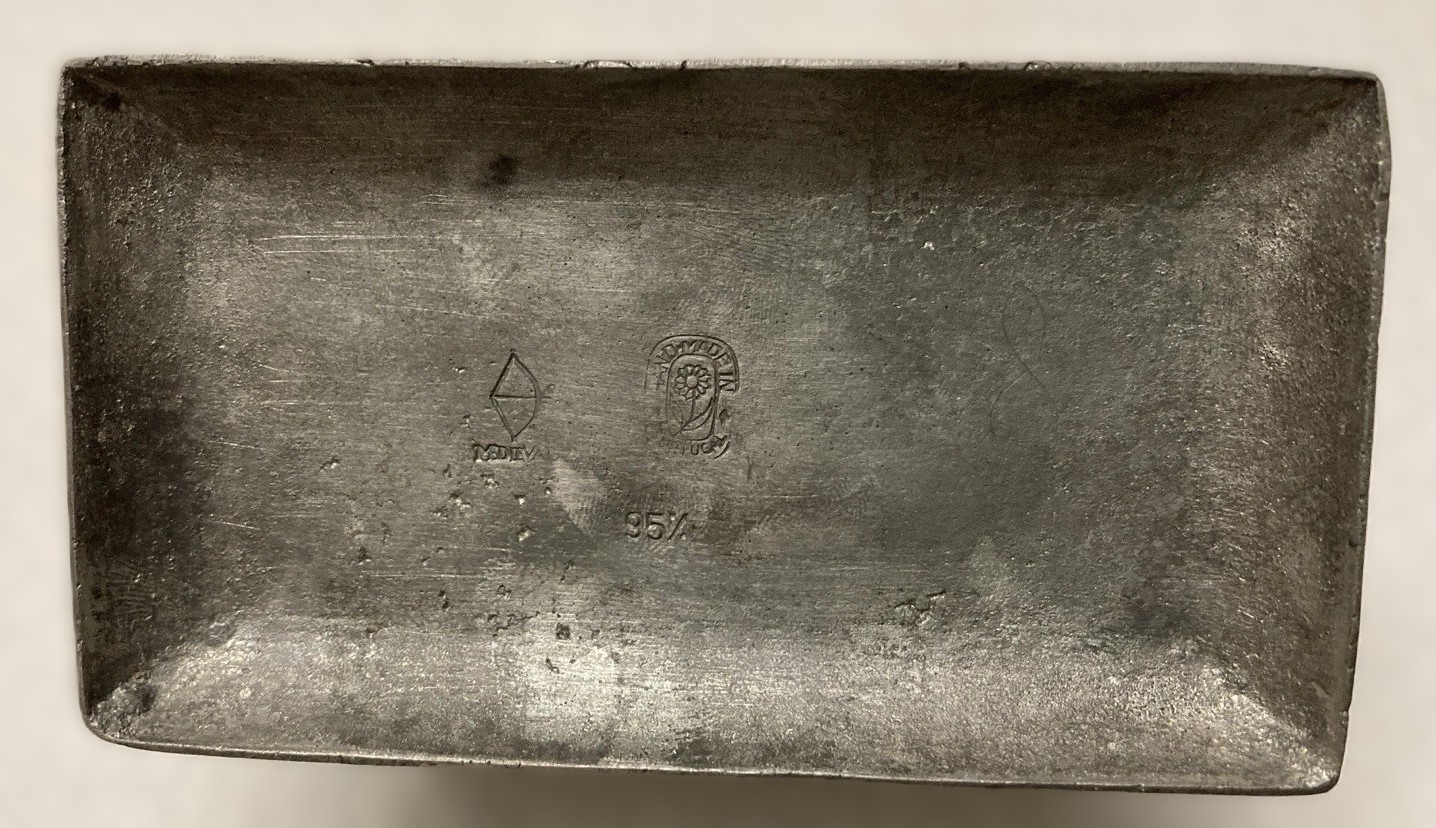
| Markings | See Narrative |
| Manufacturer | Undetermined |
| Origin | Portugal |
| Date or Era | circa 1900 |
| Measuring | 4 ½” x 2 ½” x 4” high |
This is a Portuguese Pewter Inkstand (or tinware), likely dating from the late 19th to early 20th century.
Inkstand Description
This is a rectangular, single-well desk stand featuring a central inkwell, a sander, and storage, constructed entirely of pewter.
- Material: Pewter, a tin alloy (indicated by the “95%” mark).
- Inkwell: Central, large, and fitted with a glass insert. It has a hinged lid that is raised via a thumbpiece.
- Sander (Pounce Pot): A small, detachable, perforated pot used to sprinkle pounce (a fine powder like sand or cuttlefish bone) over freshly written ink to absorb excess moisture and speed drying. The square-shaped sander is housed next to the inkwell.
- Storage/Drawer: A small, shallow, pull-out drawer is located in the base, intended for storing nibs, seals, or small items like stamps.
Marks and Identification
The marks provide information about the material and origin.
| Mark | Interpretation | Significance |
| 95% | Denotes the purity of the metal alloy: 95% Tin. | This confirms the material is high-quality pewter (tinware), as it contains a very high proportion of tin, with the remainder being primarily copper, antimony, or bismuth. |
| Flower Mark | A common element in European, and specifically Portuguese, pewter marks. | While a specific factory cannot be named without a reference chart, this is a characteristic style of touchmark often used in Portugal. |
| “MEDEVL” | This is possibly a marking of a Portuguese manufacturer. | Without a specific pewter mark reference for Portugal, it’s difficult to pinpoint the exact maker, but it confirms a Continental European (Portuguese) origin. |
Dating and Historical Context
Based on the style, function, and materials, the inkstand is estimated to be from the late 19th to early 20th century.
- Period of Popularity (Late 19th Century): The combined inkwell and sander design was most common during the period when quills and dip pens were still in widespread use (before the mass adoption of the fountain pen). The sander became largely obsolete after the 1870s/1880s but remained a traditional feature on inkstands well into the 1900s.
- Continental European: We’ve seen the same pewter inkstand (stove-shaped, thumbpiece lid, square sander, pull-out drawer) marked on the bottom “”Les Etains de Paris” (“The Pewter of Paris).”
- Pewter Revivals (1890s-1920s): Pewter experienced several revivals in Europe, including an Art Nouveau period, but this piece’s simple design places it generally within the late Victorian/Edwardian era.
- Conclusion on Age: The combination of the pewter material, the 95% tin content (high quality), and the traditional components (sander, inkwell, drawer) suggest a date between 1880 and 1920.
Use this link to see a similar pewter inkstand: Rectangular Box-Form Pewter Inkstand – The Society of Inkwell Collectors (SOIC)
Sold for $95 in September 2025
Content disclaimer. The information posted is the owner’s best knowledge and may not have been vetted by the SOIC. We welcome comments, corrections, and additions, working to make our website information comprehensive and accurate.
Join the Society of Inkwell Collectors (SOIC) – it’s free!
Founded in 1981 as a non-profit organization,
we are documenting inkwells (and accessories).
We’re here to help and inform!