


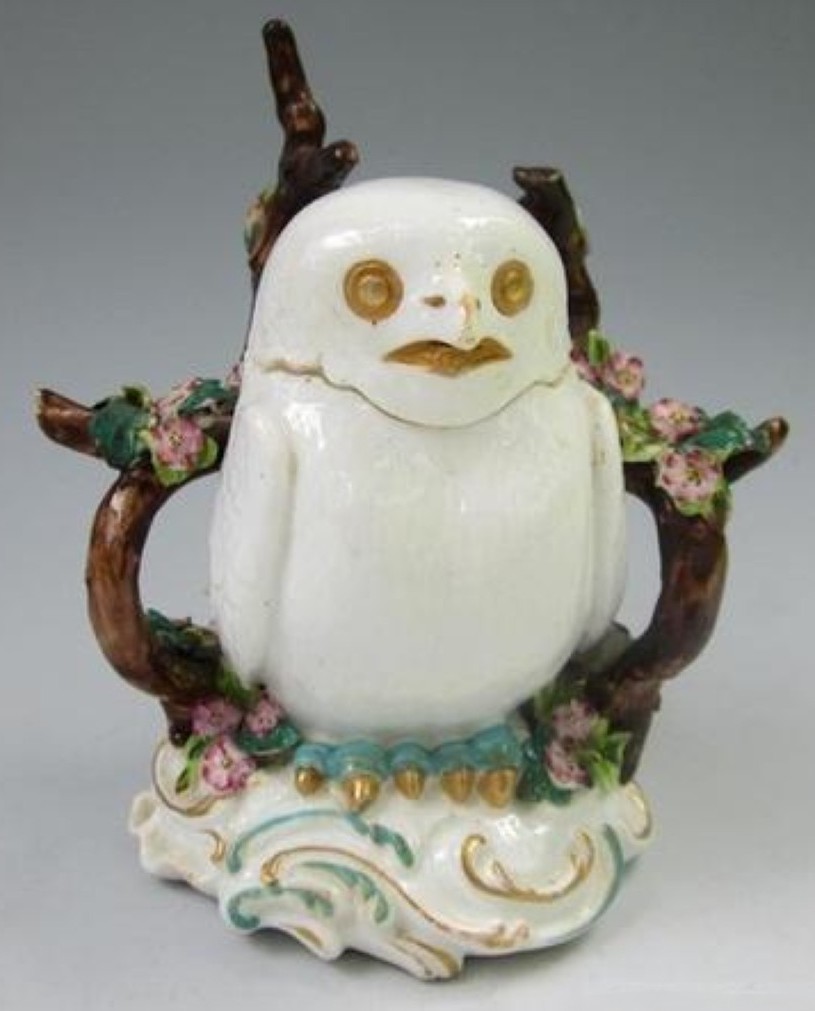


Porcelain Owl
| Categories | Ceramics/Porcelain Figural |
| Type | Owl |
| Material | Porcelain |
| Markings | Unmarked |
| Manufacturer | Undetermined |
| Origin | Undetermined |
| Date or Era | circa 1875 |
| Measuring | 7” high |
Description
The Figural Owl
The central figure is a stylized, majestic owl—likely a Snowy Owl given the choice of a stark white, heavy lead-glazed or tin-glazed porcelain base.
- The Hinge/Lid: The head acts as the functional lid, seamlessly cutting across the upper chest to reveal the ink pot below when opened.
- Eyes and Beak: The intense, round eyes and curved beak are highlighted with rich, hand-painted gold gilt, which mimics the piercing gaze typical of Victorian novelty bird pieces.
The Setting and Foliage
The owl is framed by an elaborate, organic structure:
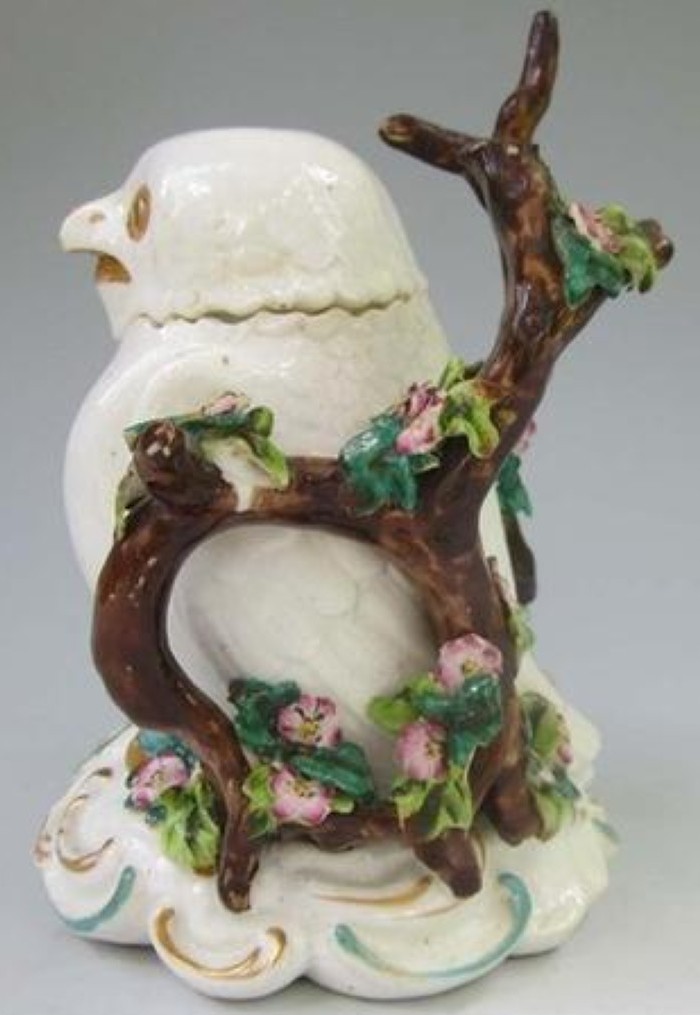
- The Branch Framework: It sits perched on a heavily textured, hand-molded brown branch that loops around both sides, forming natural handles before rising into a high, gnarled tree stump behind the bird.
- Flower Encrustations: The branches are heavily embellished with multi-petaled, three-dimensional apple blossoms or wild rosebuds. These are painted in a soft pink and white polychrome enamel with vibrant green leaves.
- The Base: The entire piece rests on a heavy, asymmetrical, rococo-revival scrollwork base featuring applied turquoise/seafoam green accents and elegant gilt highlights.
Origin and Attribution: Who Made It?
While it lacks a factory mark, its design language, the specific technique of the flower encrustations, and the modeling of the porcelain point to two primary possibilities: Jacob Petit (Paris) or the English Porcelain Houses (Derby/Minton).
- The Strongest Contender: Jacob Petit (Paris Porcelain / Vieux Paris)
This piece shares an undeniable DNA with the work of Jacob Petit (1797–1868), whose firm remained highly influential through the late 19th century.
- The Style: Petit was famous for his flamboyant, colorful, and deeply eccentric Rococo-revival styles. He heavily favored figural porcelain (perfume bottles, inkwells, and clocks) featuring animals perched amidst hyper-realistic, encrusted branches and bright, vivid enamels.
- The Base: The heavy, swirling rococo scrollwork base with turquoise and gilt trim is a classic signature of mid-to-late 19th-century French Vieux Paris (Paris Porcelain) makers, heavily led by Petit’s design choices.
- Lack of Marks: Petit’s workshop often marked pieces with a blue underglaze “JP,” but countless contemporary French workshops produced work in his exact style completely unmarked, or the marks were lost under heavy glaze.
- The English Connection: Crown Derby or Minton
Both Crown Derby and Minton were heavily inspired by continental styles (Meissen and Sèvres) and excelled at creating high-quality, flower-encrusted porcelain during the Victorian era.
- Derby frequently produced “Frill Vases” and novelty inkwells with similarly delicate, hand-applied blossoms.
- However, English pieces of this specific caliber from the 1870s were typically strictly marked due to rigid registry and trademark acts. The asymmetrical, heavily scrolled base and the highly stylized, bold molding of the owl lean slightly more toward the dramatic, theatrical flair of French porcelain rather than the typically more restrained English molding of the period.
Age and Production Date
Estimated Era: circa 1870–1880.
Sold for $270 in December 2013
Content disclaimer. The information posted is the owner’s best knowledge and may not have been vetted by the SOIC. We welcome comments, corrections, and additions, working to make our website information comprehensive and accurate.
Join the Society of Inkwell Collectors (SOIC) – it’s free!
Founded in 1981 as a non-profit organization,
we are documenting inkwells (and accessories).
We’re here to help and inform!