


Perryian Gravitating Inkstand
| Categories | Mechanical - Snail / Pivoting |
| Material | Bronze, Cast iron |
| Markings | See Narrative |
| Manufacturer | Perry & Co. |
| Origin | England |
| Date or Era | circa 1842 |
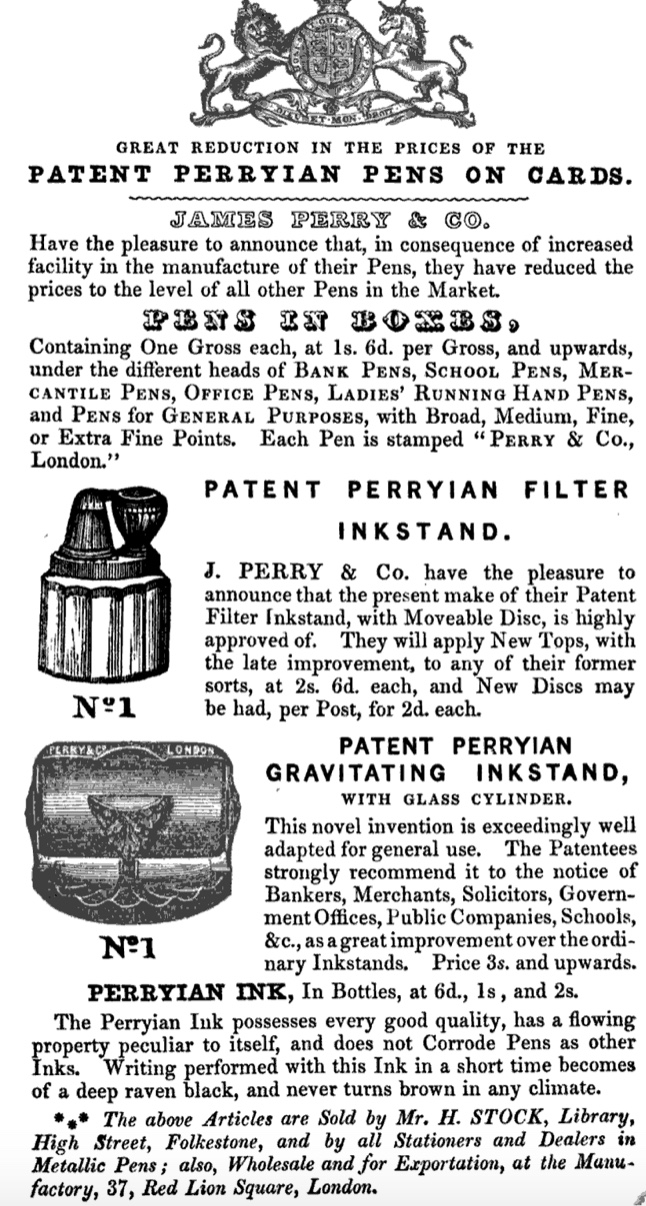
This Patent Perryian Gravitating Inkstand was manufactured by James Perry & Co. of London. Based on the features and markings, this piece dates to the early Victorian era, specifically between 1842 and 1850.
Physical Description
- Form: The inkstand features a cylindrical drum (the reservoir) suspended within a sturdy, curved metal frame. It is designed to pivot or “gravitate” forward for use and backward for storage.
- Materials: The base and frame are made of cast iron, which provide the necessary weight for stability. The drum and the decorative medallions are made of bronze. Internally, this model contains a thick glass cylinder to hold the ink, as metal would eventually corrode from the acidity of 19th-century inks.
- Markings: The top of the drum is stamped: “PATENT PERRYIAN GRAVITATING INKSTAND PERRY & Co LONDON.”
- Condition: The greenish patina (verdigris) on the bronze parts and the oxidation on the iron base are consistent with a mid-19th-century object that has aged naturally.
How It Works: The “Gravitating” Action
The “gravitating” name refers to the mechanical movement used to preserve the ink.
- In Use: You rotate the drum downward. This movement brings the internal ink supply forward into a small, integrated “dipping cup” (the scalloped area.
- Storage: When writing is finished, you rotate the cylinder upward. Gravity helps the ink flow back into the main reservoir, and the dipping cup is sealed against the frame.
- The Benefit: This mechanism was intended to solve two major problems of the day: it prevented ink from evaporating and kept dust out of the reservoir, ensuring the ink remained clear and fluid for longer periods.
Historical Context & Insignia
The insignia on the side and front provide clues about the manufacturer’s prestige:
- The Prince of Wales’s Feathers: Located under the word “PATENT” on the drum, this insignia consists of three ostrich feathers and the motto “ICH DIEN” (German for “I Serve”). This tells us that Perry & Co. held a Royal Warrant or claimed patronage from the Prince of Wales (at this time, the young Albert Edward, later King Edward VII).
- The Royal Coat of Arms: The circular medallion on the side features the Lion and the Unicorn with the word “PATENT.” This confirms the item was legally protected under British patent law and further emphasized the company’s status as a top-tier London stationer.
Advertising and Dating
The “Gravitating Inkstand” made its debut around late 1842. While many “Patent Perryian” products were associated with James Perry’s various patents for steel pens (starting in 1830), the gravitating inkwell itself was heavily marketed as a “novel invention” in the early 1840s.
Advertisements from 1842, such as those in Bent’s Literary Advertiser and The Morning Herald, featured glowing testimonials:
“We are writing at this moment by the aid of Perry and Co.’s Patent Gravitating Inkstand… which excludes both air and dust… The invention is both simple and useful.” — Morning Herald, Dec. 3rd, 1842.
Another ad from 1843 specifically recommended the inkstand to “Bankers, Merchants, Solicitors, and Government Offices” for its ability to keep ink in a perfect state for months. This piece is an authentic survivor from the peak of this marketing campaign, representing the high-water mark of Victorian desk-side engineering.
Sold for $211 in February 2026
Content disclaimer. The information posted is the owner’s best knowledge and may not have been vetted by the SOIC. We welcome comments, corrections, and additions, working to make our website information comprehensive and accurate.
Join the Society of Inkwell Collectors (SOIC) – it’s free!
Founded in 1981 as a non-profit organization,
we are documenting inkwells (and accessories).
We’re here to help and inform!