


Ottoman Divit
| Categories | Middle East / Africa |
| Type | Qalamdan / Divit |
| Material | Brass, Silver |
| Markings | See Narrative |
| Manufacturer | Undetermined |
| Origin | Syria |
| Date or Era | circa 1890 |
| Measuring | 13 ¾” long |
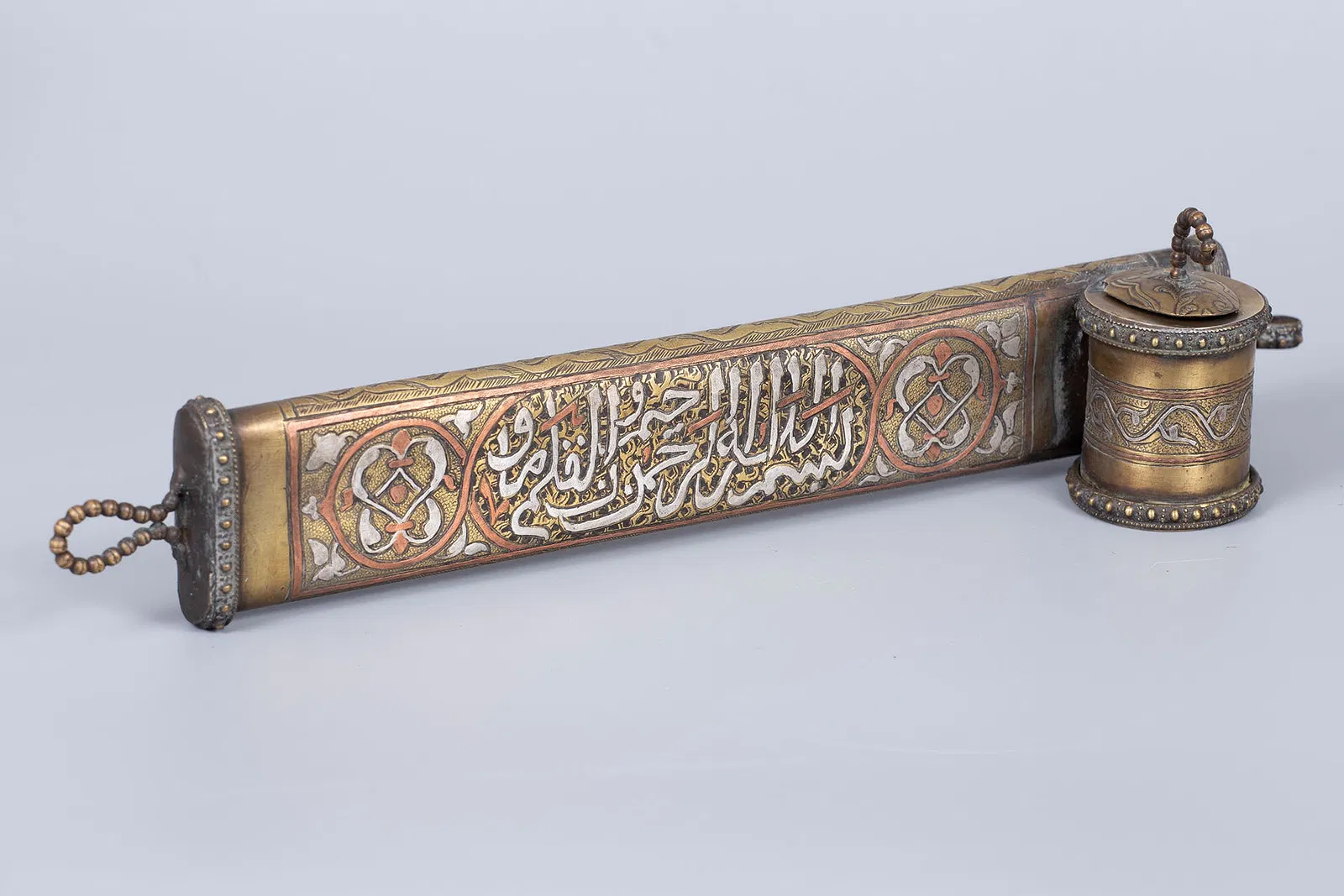
This is a nice example of a Divit (also spelled divit or divit qalamdan), the specific Ottoman Turkish term for this type of portable, combined inkwell and pen case.
Description
- Type: Portable Scribe’s Pen Case and Inkwell (Divit).
- Origin: Likely Damascus, Syria or Cairo, Egypt.
- Period/Date: Late 19th Century (c. 1880–1910). This period saw a major “Mamluk Revival” in metalwork, where artists in Damascus and Cairo recreated the intricate silver and copper inlay styles of the 14th-century Mamluk Sultanate to appeal to both local elites and the burgeoning European tourist market.
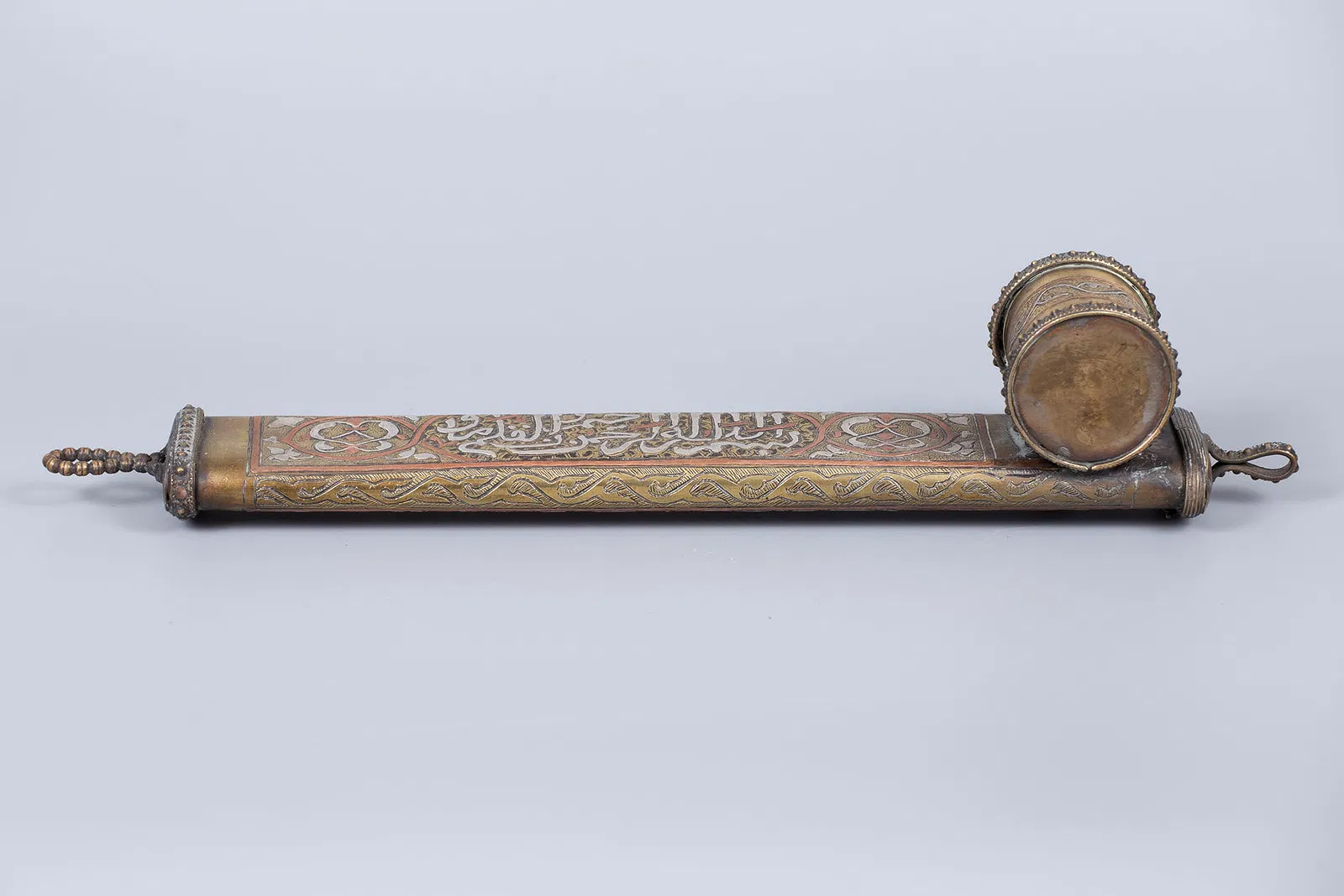
- Materials: Brass body inlaid with silver and copper. This technique is often called Damascene or Ajem work. It involves incising the brass and hammering thin wires or sheets of precious metal into the grooves.
- Composition:
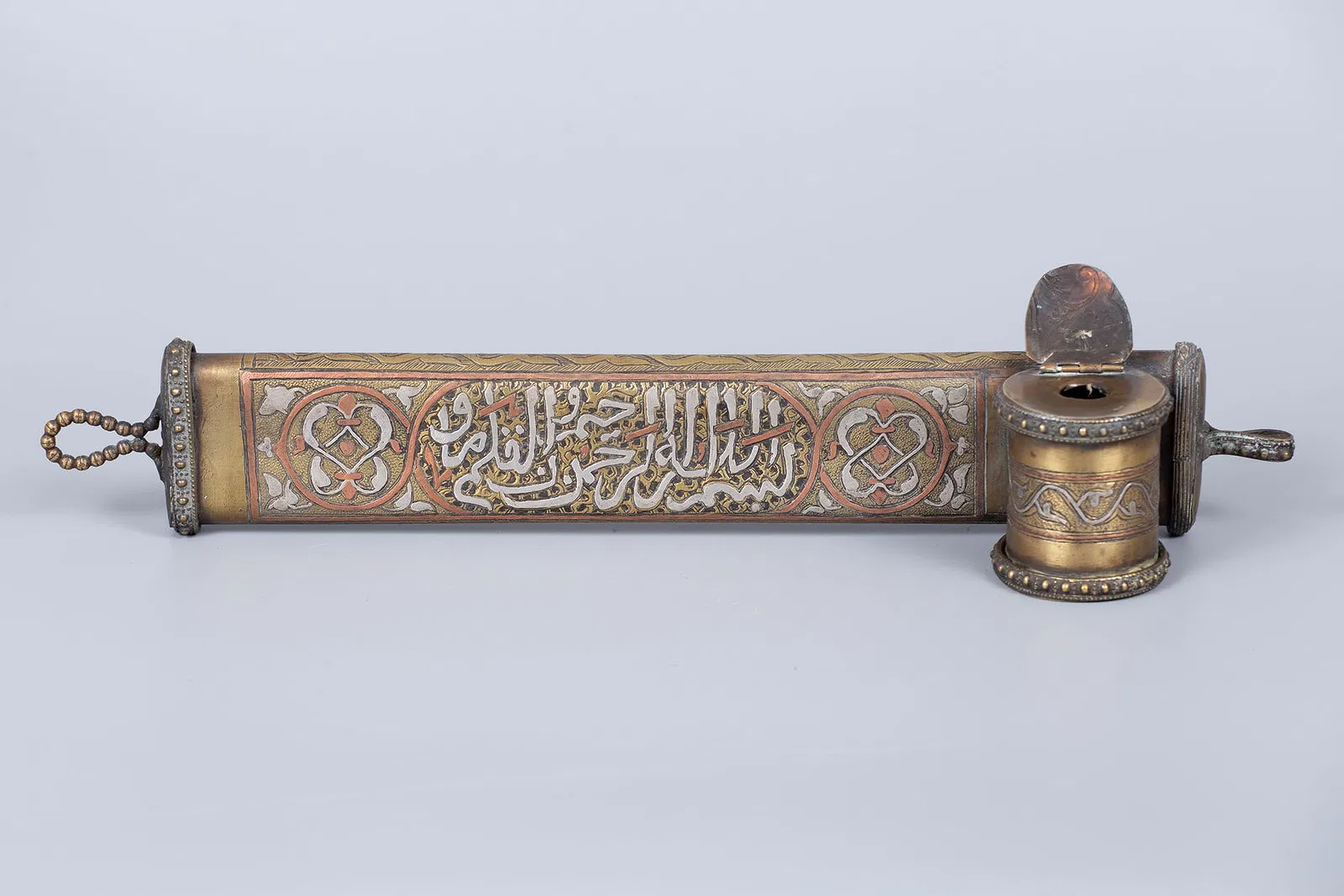
- The Pen Box (Kalamdan): The long, rectangular tubular section held the kalam (reed pens or quills). Note the beaded or “pearl” border at the finial end.
- The Inkwell (Hokkha): The cylindrical, drum-shaped pot attached to the side. It features a hinged lid and was designed to be watertight.
Translation of the Calligraphy
The calligraphy is executed in a flowing Thuluth script, typical of late Ottoman decorative arts.
- Front: The central cartouche contains the Basmala:
Bismi-llāhi r-raḥmāni r-raḥīm (“In the name of God, the Most Gracious, the Most Merciful”)
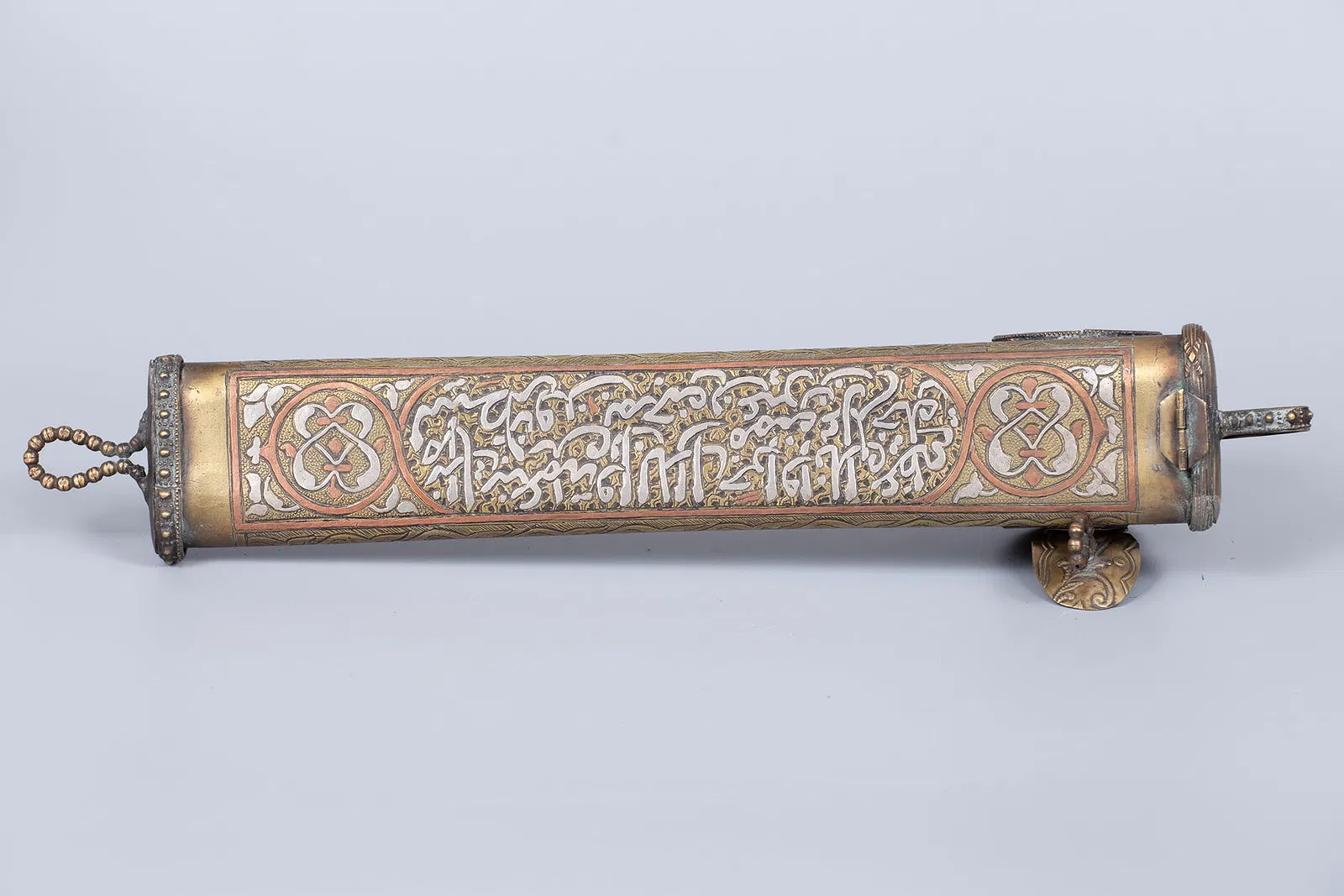
- Back: This side typically contains a continuation of a prayer or a blessing upon the Prophet. It appears to read:
wa-ṣallā Allāhu ‘alā sayyidinā Muḥammad (“And may God bless our Master Muhammad”)
- Decorative Borders: The cartouches are flanked by scrolling foliage and interlace patterns known as arabesques, symbolizing the infinite nature of creation.
Functional Use & History
In the 19th century, these were the “laptops” of the Middle Eastern world. They were used by professional scribes (katip), government officials, and wealthy merchants.
- Portability: The divit was designed to be tucked into a sash or silk belt (kusak) worn around the waist. The inkwell would sit on the outside of the belt, preventing it from sliding through.
- The “Lika” Secret: Inside the inkwell, a scribe would place a small clump of raw silk fibers (called lika). This acted like a sponge; it held the ink by capillary action so that if the lid accidentally popped open or the scribe moved quickly, the ink wouldn’t pour out. When the pen was dipped, it would only take up the necessary amount.
- The Finial: The small loop or beaded chain at the end was often used to help pull the case from the belt or to attach it to a cord for extra security.
Condition
This piece shows a “stable” patina. The silver inlay appears intact, which is a sign of high-quality craftsmanship. In the late 19th century, Damascus was famous for “Jewish work”—Jewish metalworkers who were the primary masters of this specific tri-metal (brass, silver, copper) inlay style.
Sold for $260 in April 2026
Content disclaimer. The information posted is the owner’s best knowledge and may not have been vetted by the SOIC. We welcome comments, corrections, and additions, working to make our website information comprehensive and accurate.
Join the Society of Inkwell Collectors (SOIC) – it’s free!
Founded in 1981 as a non-profit organization,
we are documenting inkwells (and accessories).
We’re here to help and inform!