




Neoclassical Urn-Shaped Bronze Inkstand
| Categories | Figural - Mythology; Literature; Religion; Fictional |
| Type | Mythology |
| Material | Bronze |
| Markings | Unmarked |
| Manufacturer | Undetermined |
| Origin | Undetermined |
| Date or Era | circa 1870 |
| Measuring | 5 ¾” x 5 ¾” x 6” high |
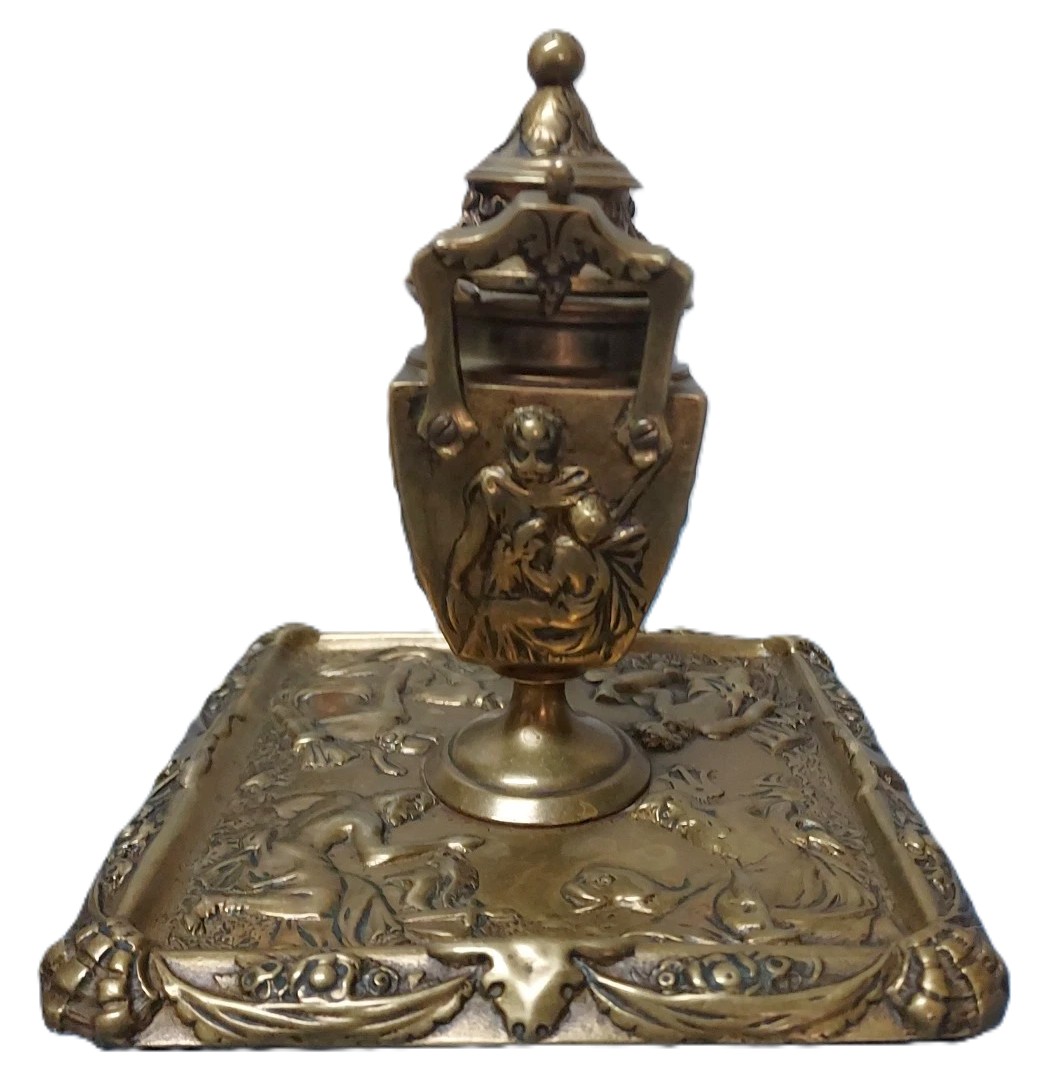
This ornate Neoclassical cast bronze inkstand is an example of high-end 19th-century desk items, likely originating from a premier French or Italian foundry around 1870. Based on its stylistic hallmarks, it was likely produced by an atelier such as Ferdinand Barbedienne or Sommer, which specialized in the “Grand Tour” style—creating high-quality bronze reproductions of classical antiquities for the Victorian market.
The Urn: A Study in Mythological Contrast
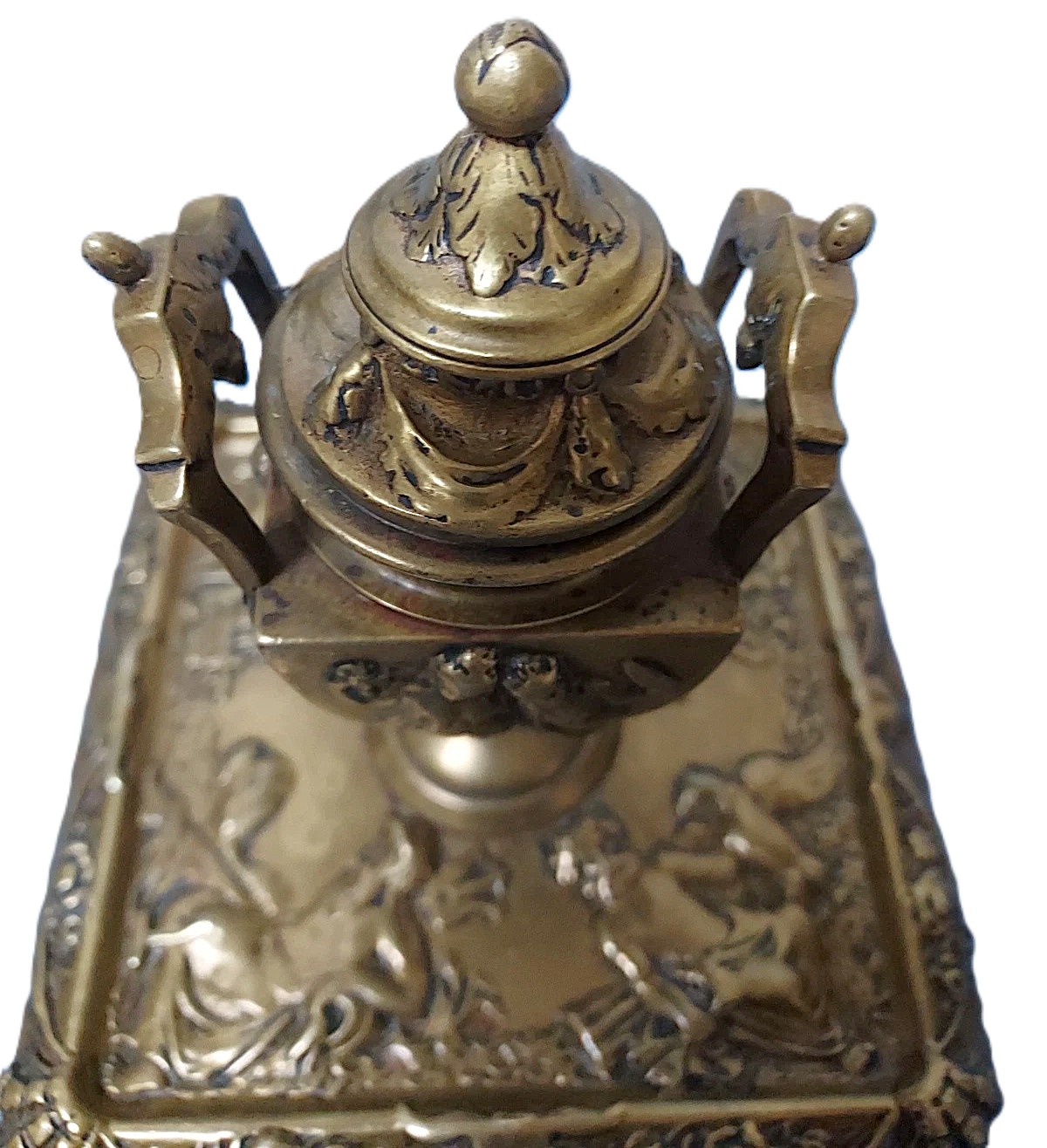
The centerpiece of the inkstand is a bronze inkwell shaped like a classical lekythos (urn), featuring a pedestal foot, high-set handles, and a hinged, domed lid topped with a spherical finial. The urn serves as a canvas for two distinct mythological reliefs that explore the balance between strength and grace.
Side A: Hercules and Omphale
This side depicts the muscular Hercules in a rare state of “domestication”. Following his twelve labors, Hercules was famously required to serve Omphale, the Queen of Lydia. The scene captures a classic “Role Reversal” theme: Omphale is often shown wearing the hero’s lion skin and carrying his massive club, while Hercules sits nearby, sometimes holding her spinning tools. This narrative was a favorite in Neoclassical art for its playful exploration of intimacy and power.
Side B: The Muses
On the opposite side, the tone shifts to a serene display of two female figures in flowing classical drapery. One figure holds a wreath or a mirror, while the second gestures toward her. These figures represent the Muses or attendants of the arts, providing a thematic counterweight to the robust Hercules scene. Together, the two sides of the urn symbolize the nineteenth-century ideal of a balanced life—tempering physical strength with the cultivation of beauty and the arts.
The Base: The Four Elements
The square base is densely embossed with a narrative cycle featuring Putti (Cupids) or young satyrs. These vignettes represent the Four Elements, a standard decorative program intended to provide a “worldview in miniature” on a gentleman’s desk:
- Fire: Represented by figures crouched over a flaming brazier or small altar.
- Earth: Depicted by a figure seated with a hunting dog or hound.
- Air: Shown as a reclining figure interacting with the sky or a bird.
- Water: Traditionally represented by a figure with a fishing net or an overturned water jug.
Technical Details and Markings
The craftsmanship indicates a high level of bronze-working skill, using the sand-casting method.
- The Lid: The domed cover is intricately decorated with acanthus leaves and floral swags.
- The Markings: The indentation on the underside of the base is not a manufacturer’s mark. Instead, it is a casting defect known as a “sprue” or “gate” mark, where the molten bronze was poured into the mold. In 19th-century foundries, these areas were frequently left unfinished as they were not intended to be visible.
Summary of Specifications
| Attribute | Description |
| Material | Heavy Cast Bronze |
| Style | Neoclassical / Grand Tour |
| Origin | France (Paris) or Italy |
| Age | Circa 1860–1880 |
| Components | Urn-form inkwell with hinged lid, square tray base |
Sold for $144 in February 2026
Content disclaimer. The information posted is the owner’s best knowledge and may not have been vetted by the SOIC. We welcome comments, corrections, and additions, working to make our website information comprehensive and accurate.
Join the Society of Inkwell Collectors (SOIC) – it’s free!
Founded in 1981 as a non-profit organization,
we are documenting inkwells (and accessories).
We’re here to help and inform!