

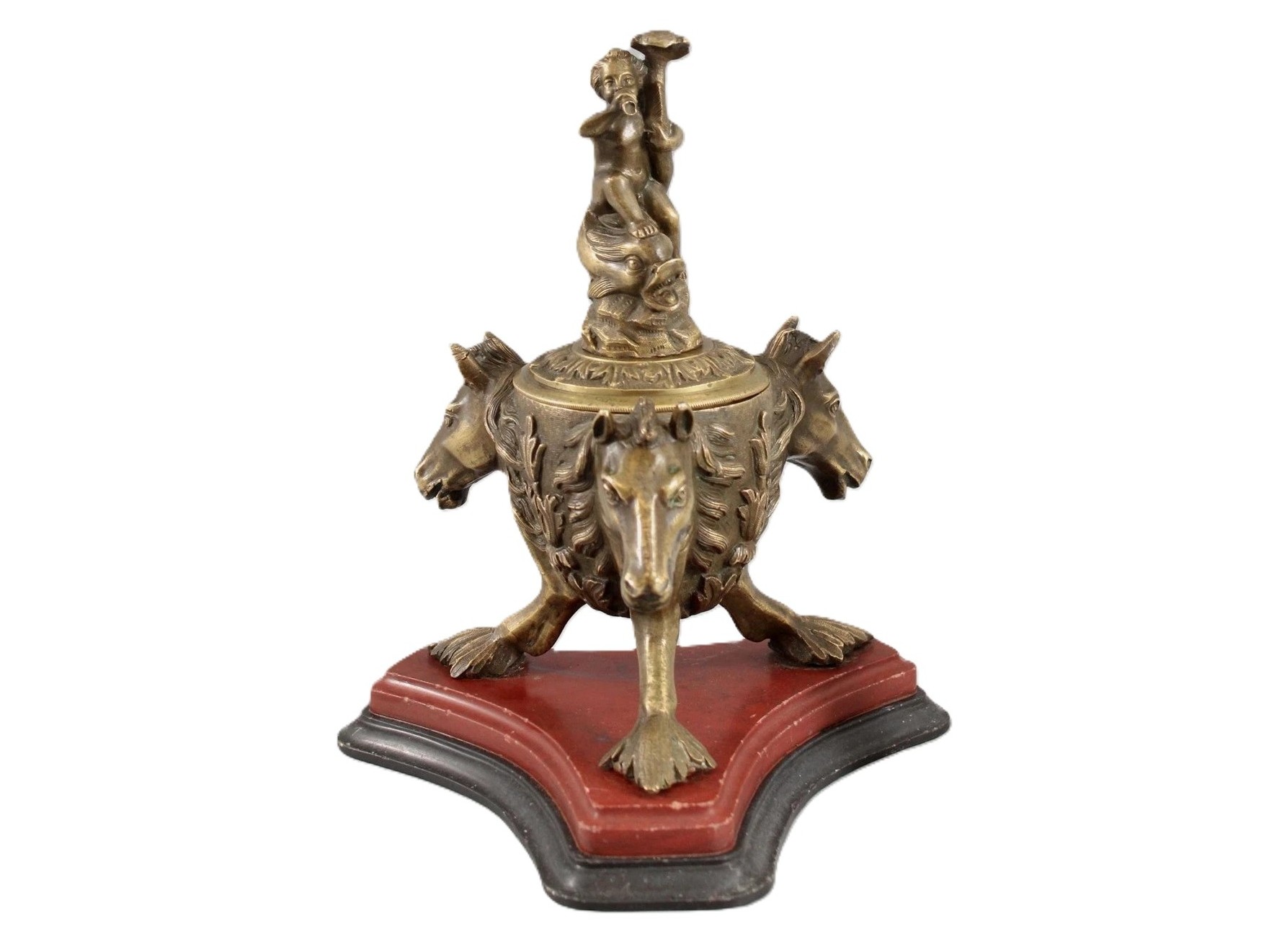
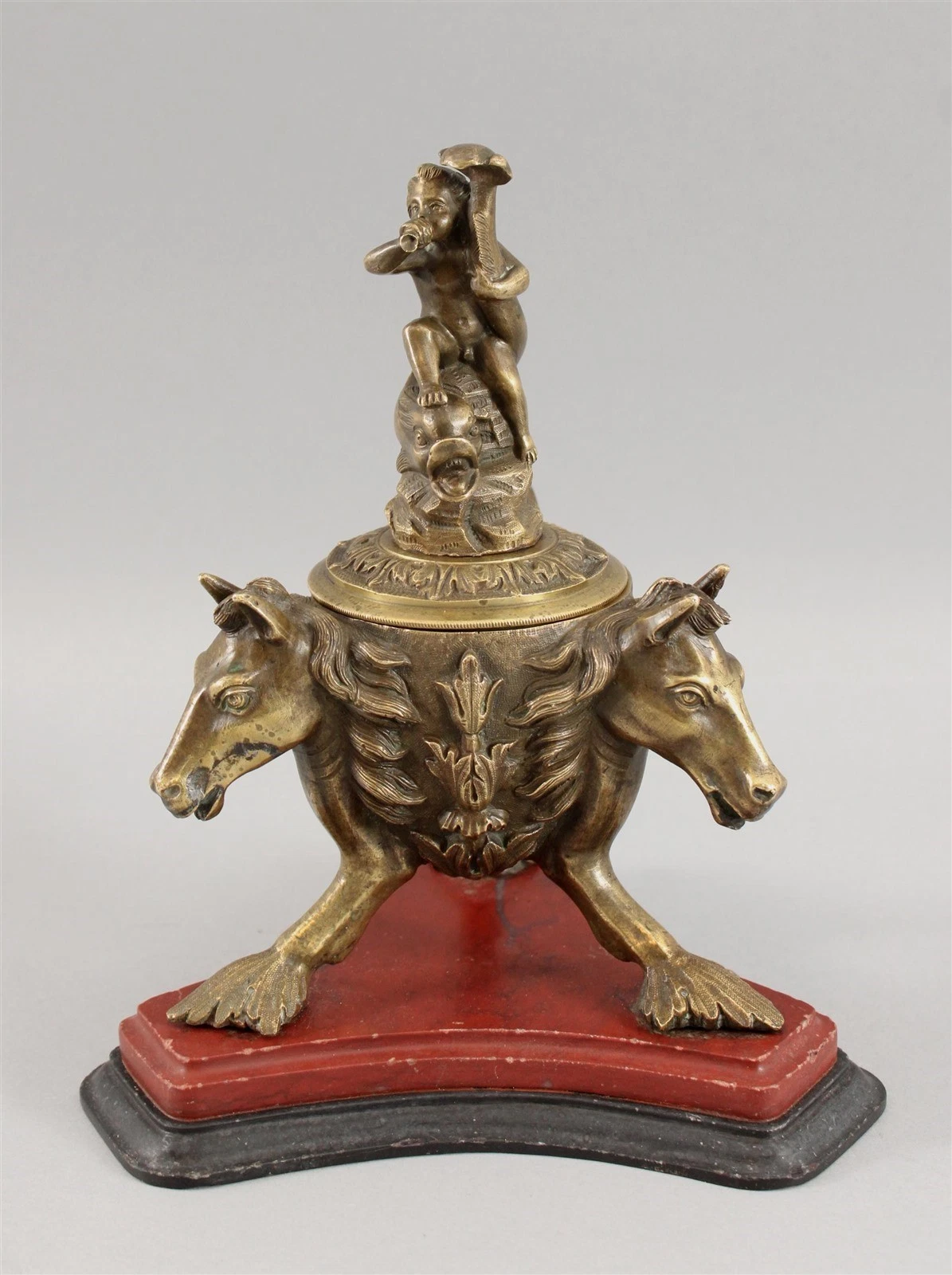
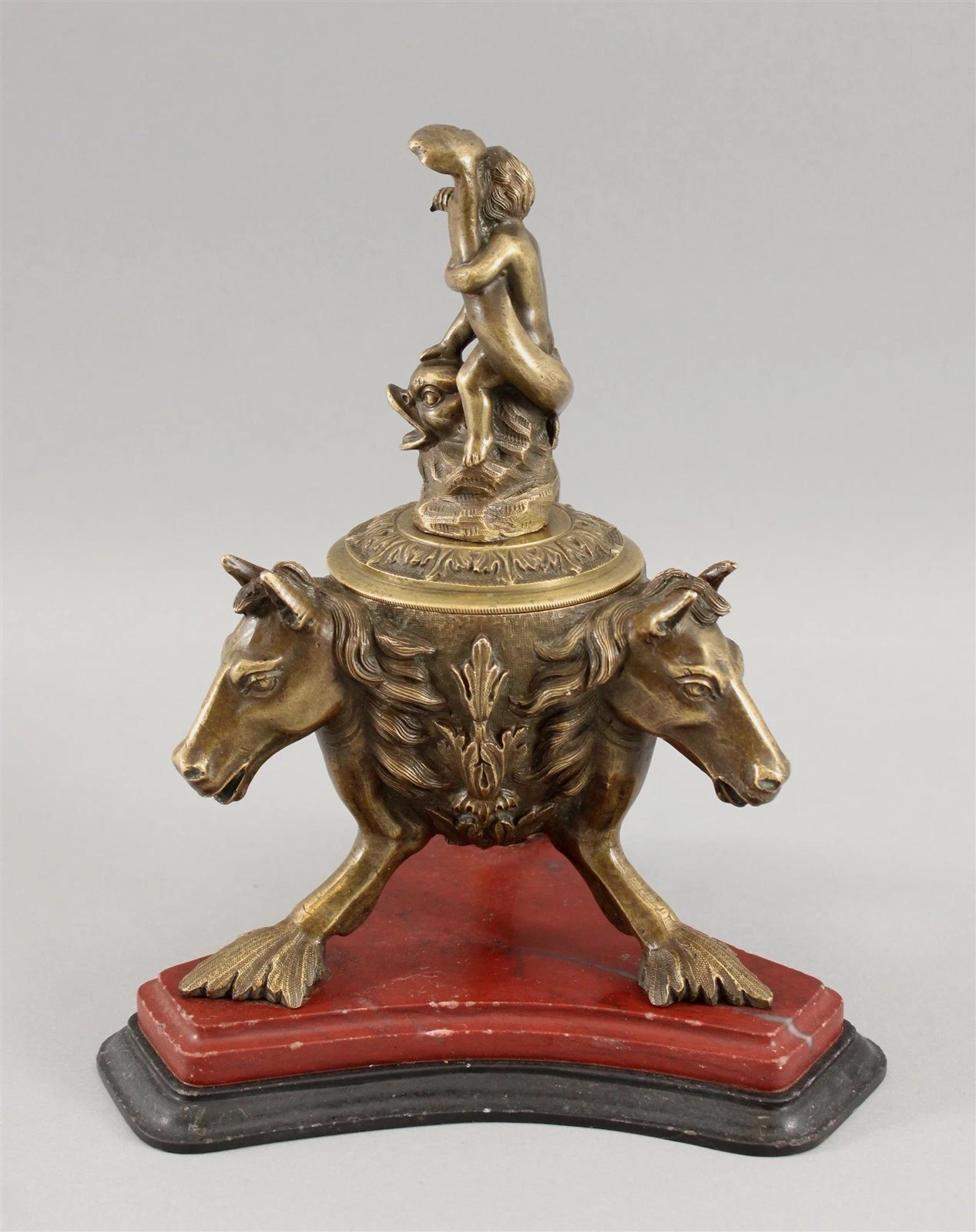
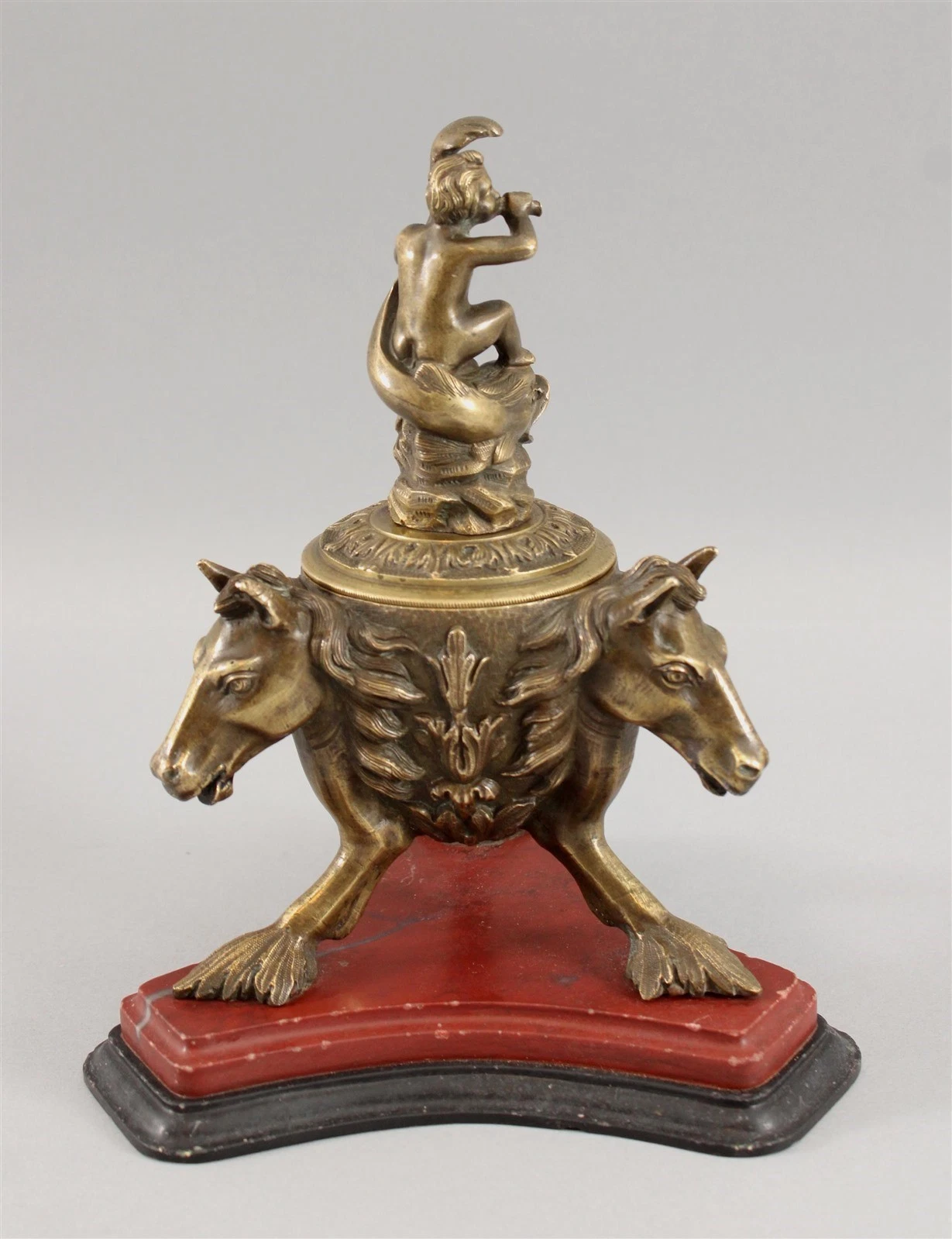
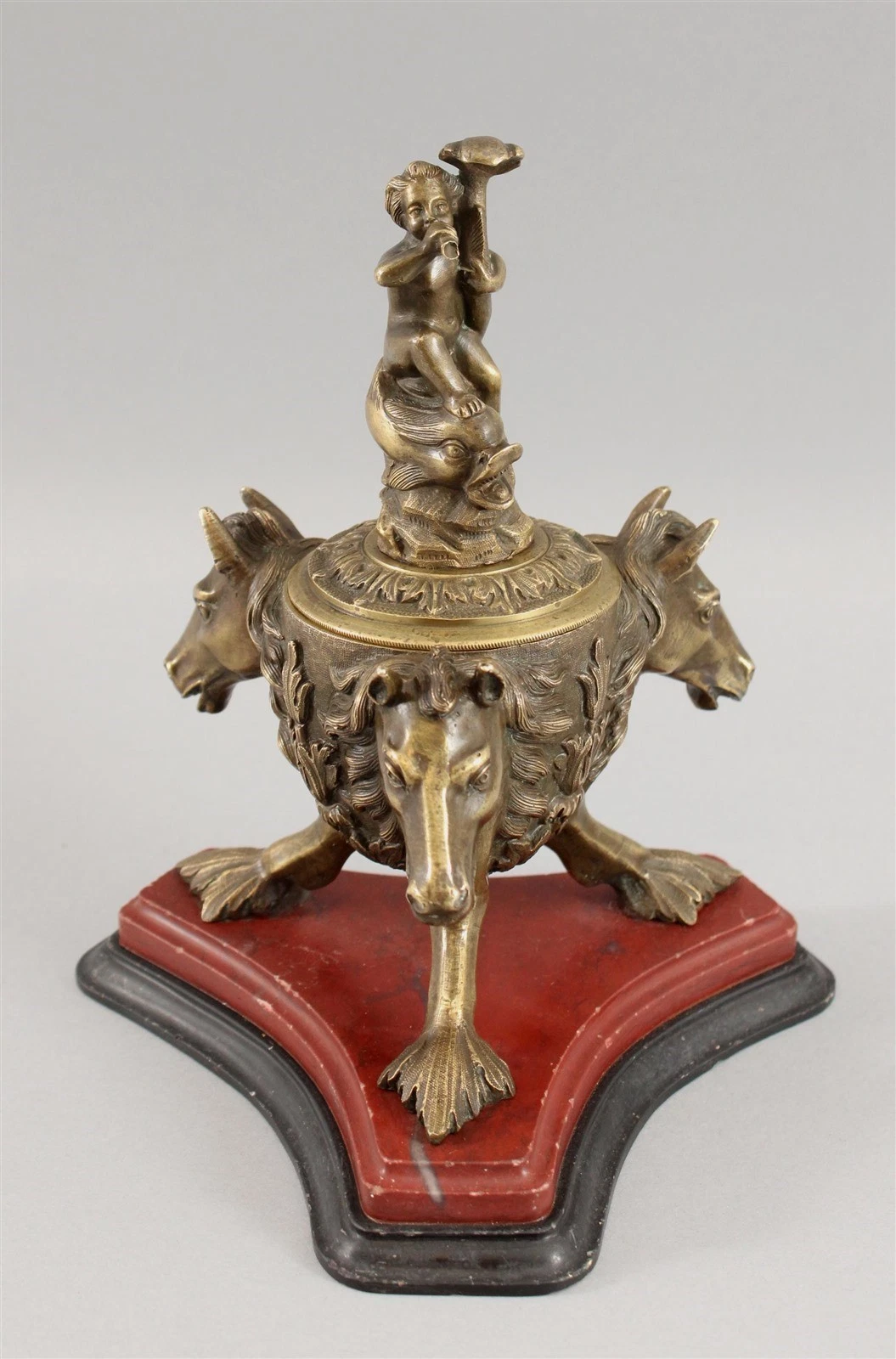
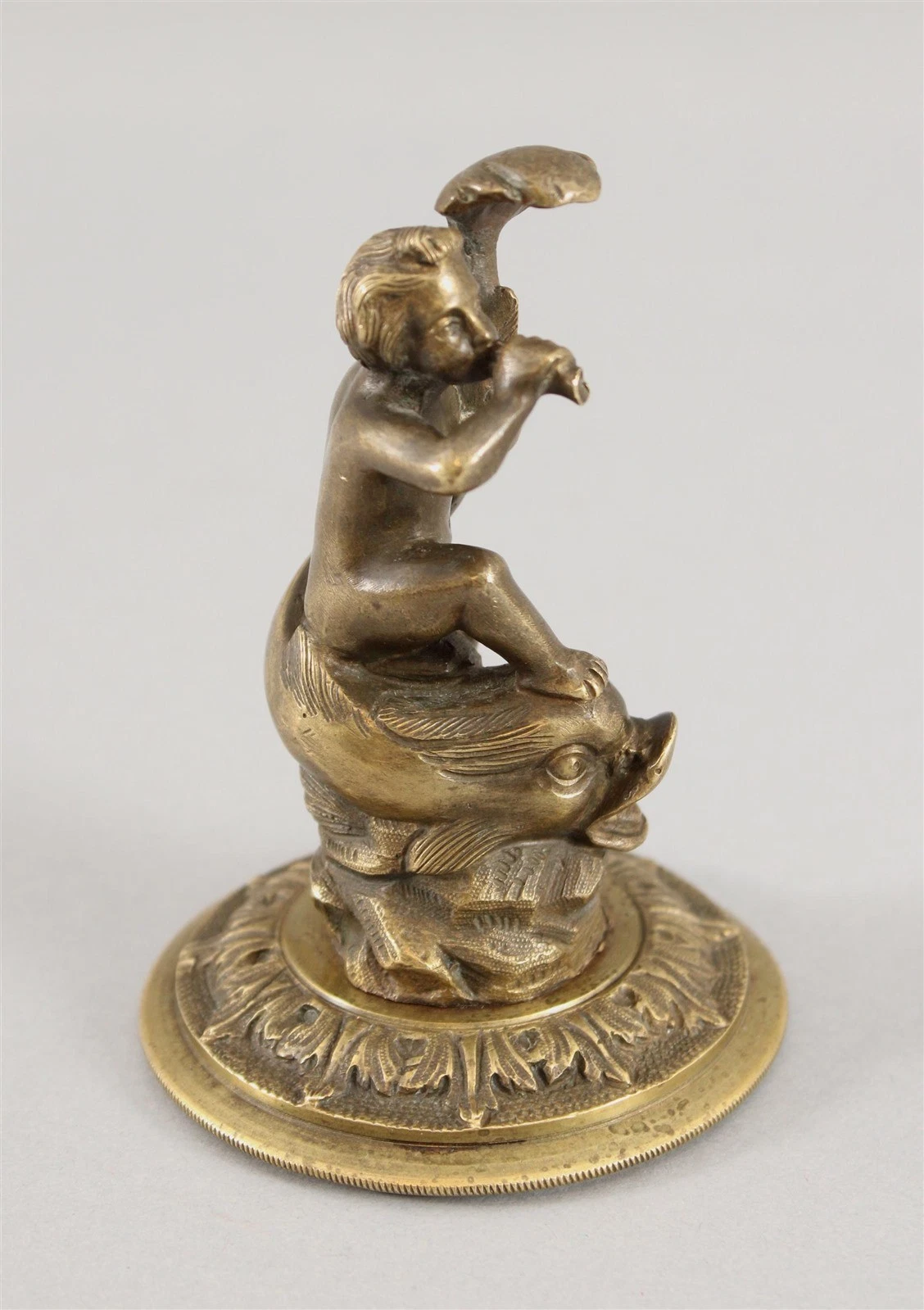
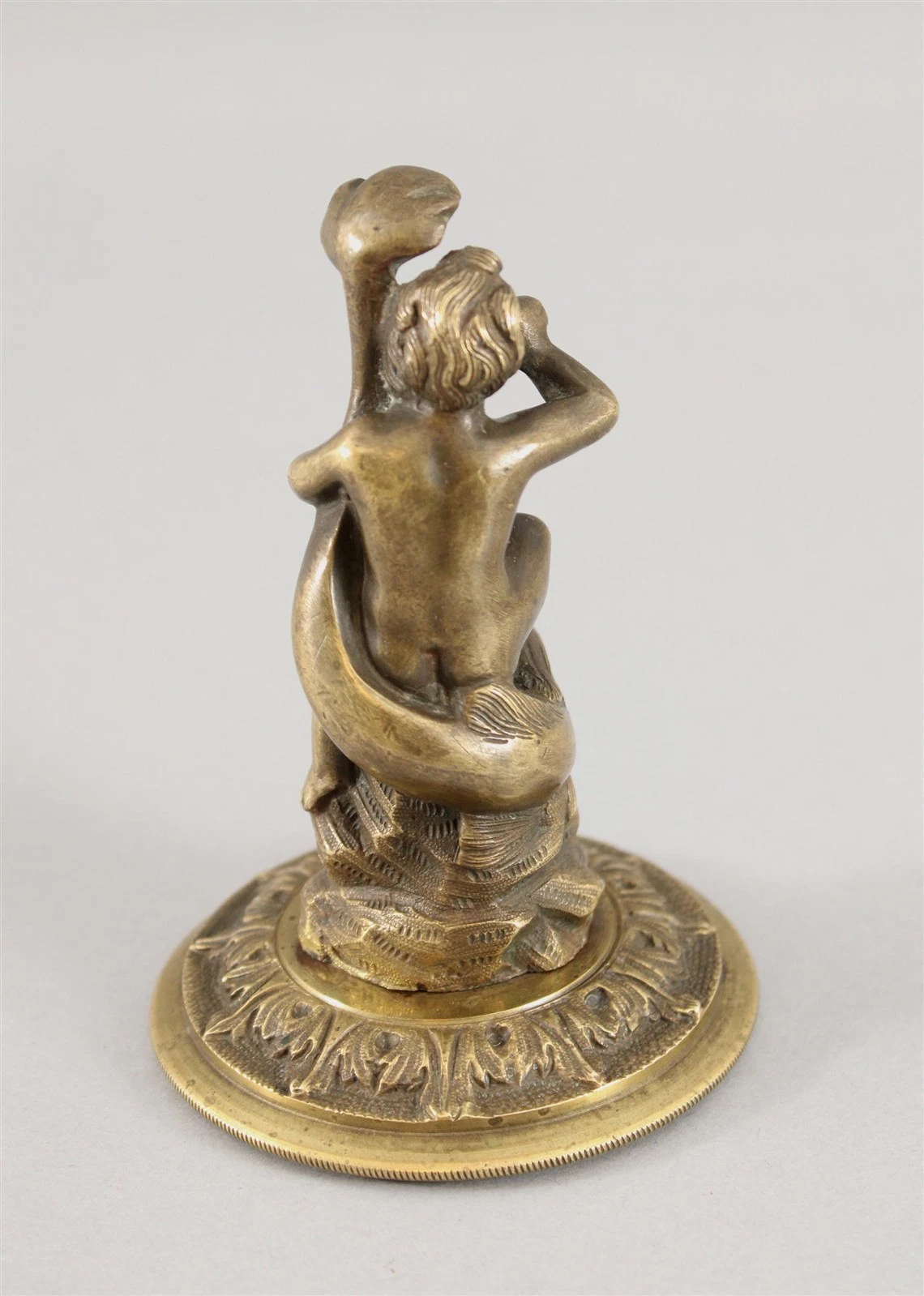
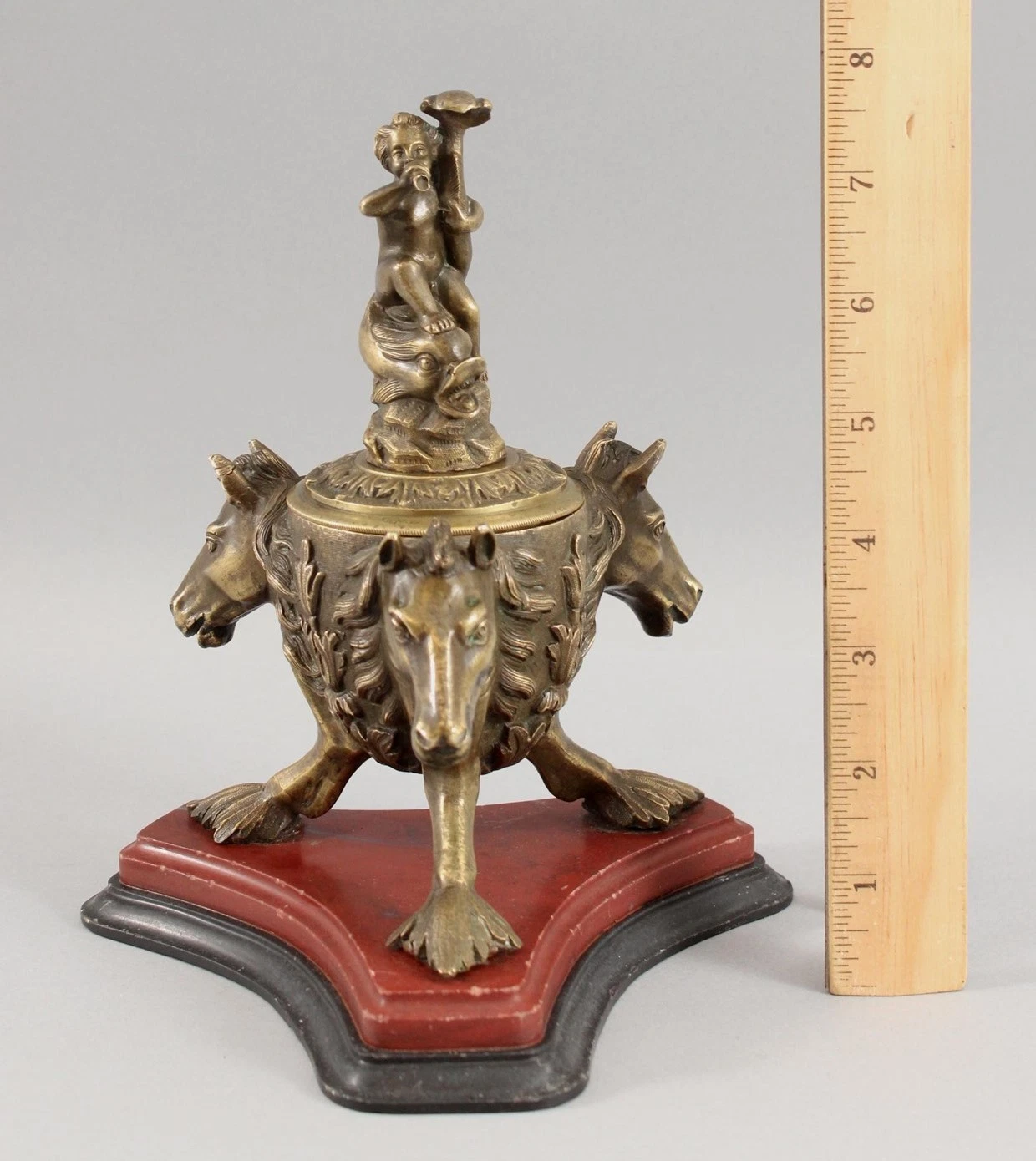
Neoclassical Bronze Inkstand with Triton Putto & Marine Horses
| Categories | Figural - Mythology; Literature; Religion; Fictional, Souvenir |
| Type | Grand Tour, Mythology |
| Material | Bronze, Marble |
| Markings | Unmarked |
| Manufacturer | Undetermined |
| Origin | Undetermined |
| Date or Era | circa 1880 |
| Measuring | 6 ½” wide; 7 ½” high |
Iconography and Cultural Significance The imagery on this desk piece merges several classical mythological motifs:
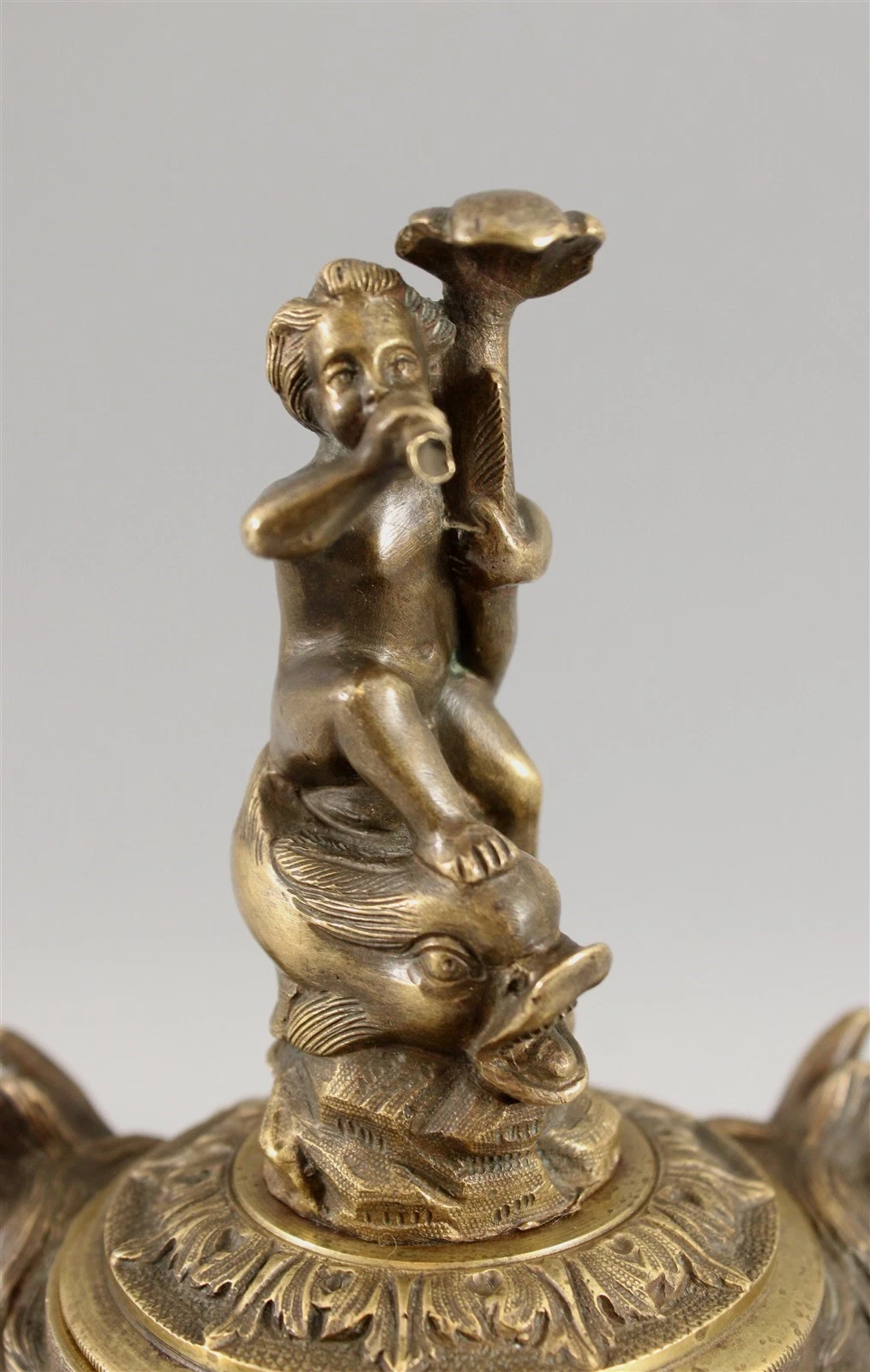
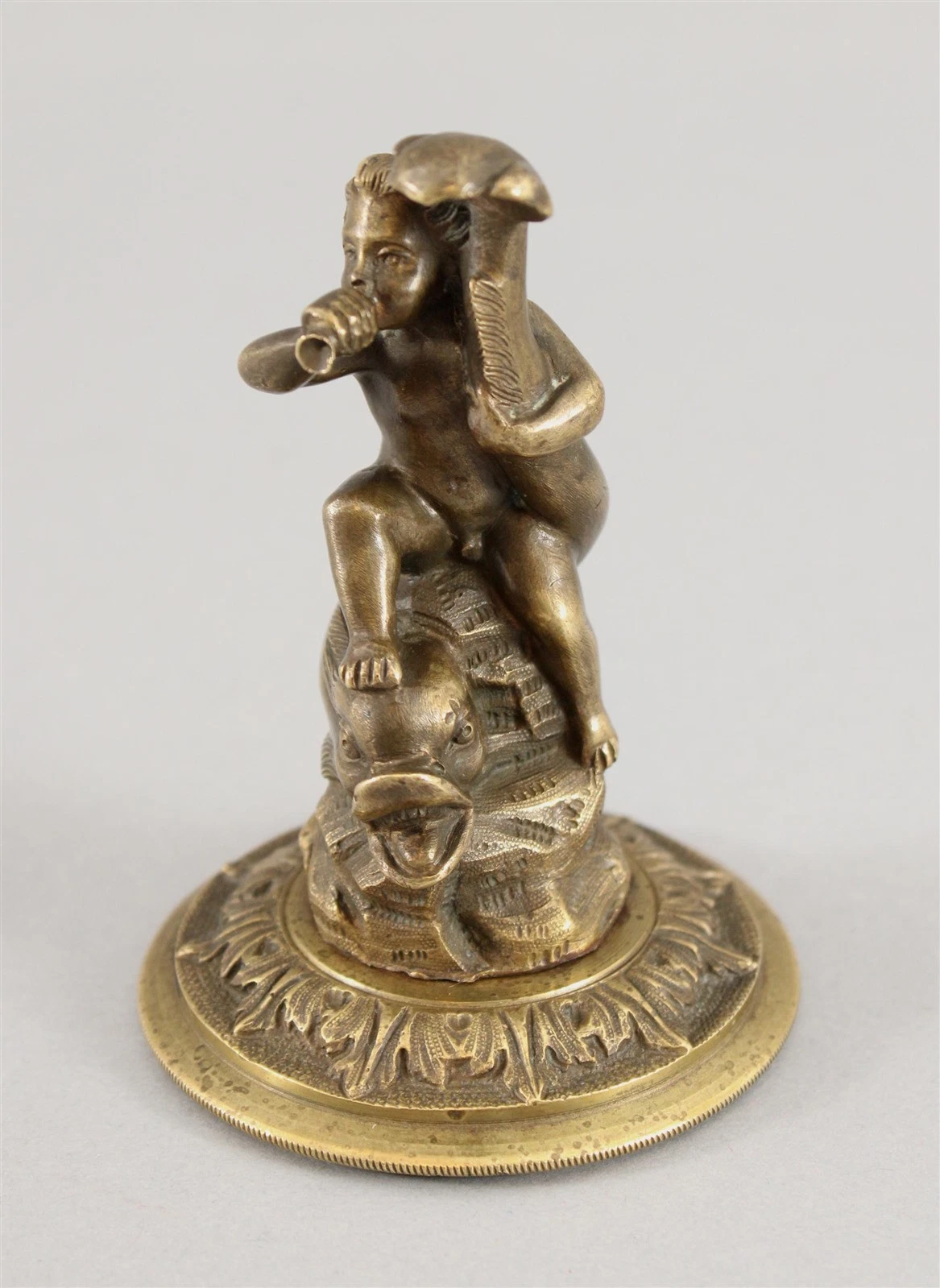
- Putto with Dolphin and Horn: The finial depicting a nude putto riding a dolphin is a classic Renaissance and Neoclassical motif. The putto represents innocence or divine love (Cupid/Eros), while the dolphin—traditionally seen in classical antiquity as a friend to humanity, a guide across waters, and a symbol of good fortune—often doubles as a fountain motif. The character blowing a conch shell or horn invokes Triton, a herald of the sea who calms or stirs the waves with his horn.
- Hippocamps / Marine Horses: The body is supported by three figural horse heads extending down to finned, webbed, or acanthus-leafed hooves. These represent hippocampi (mythological sea-horses with the upper body of a horse and the lower extremity of a aquatic creature), which pulled the chariot of Poseidon/Neptune.
- Acanthus Leaf Foliage: Flaring acanthus foliage adorns the central vessel and the legs. A staple of Classical Greek and Roman architecture (Corinthian order), acanthus symbolizes enduring life, rebirth, and enduring strength.
“Grand Tour” Tradition During the 18th and 19th centuries, wealthy European travelers—particularly young British aristocrats and upper-class tourists—embarked on the “Grand Tour” across mainland Europe (primarily Italy and France) to study classical art, history, and culture.
- High-end foundries in cities like Florence, Rome, Naples, and Paris created decorative bronze souvenirs that drew direct stylistic inspiration from classical antiquities and Renaissance masterpieces (such as Verrocchio’s famous Putto with Dolphin in Florence).
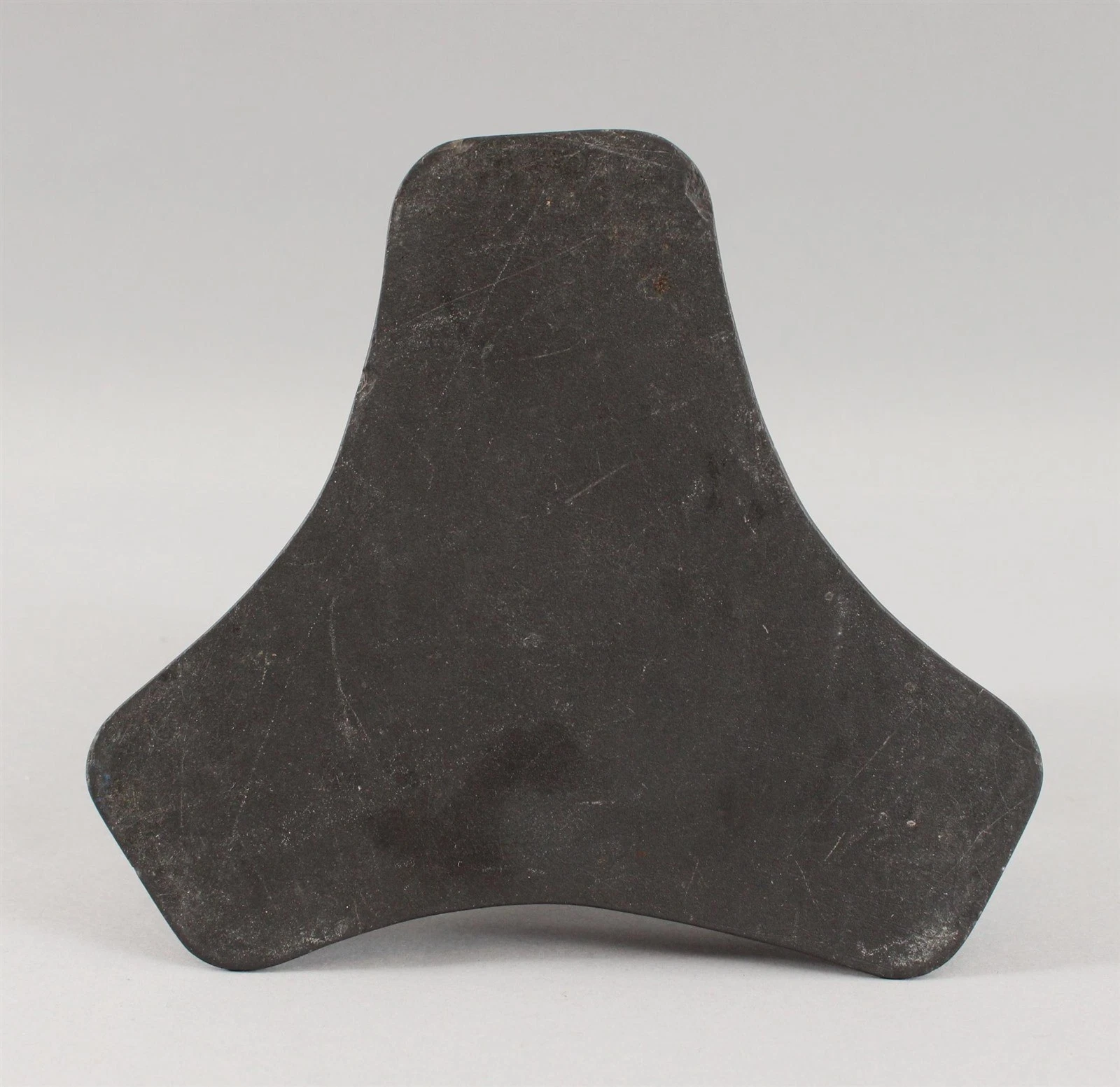
- The use of mixed classical marbles—specifically the shaped tier of rich red marble (likely Rosso Levanto or Rosso Antico) mounted over a black slate plinth—was a signature feature of 19th-century Grand Tour desk objects produced in Continental Europe.
Origin, Maker, and Periodization
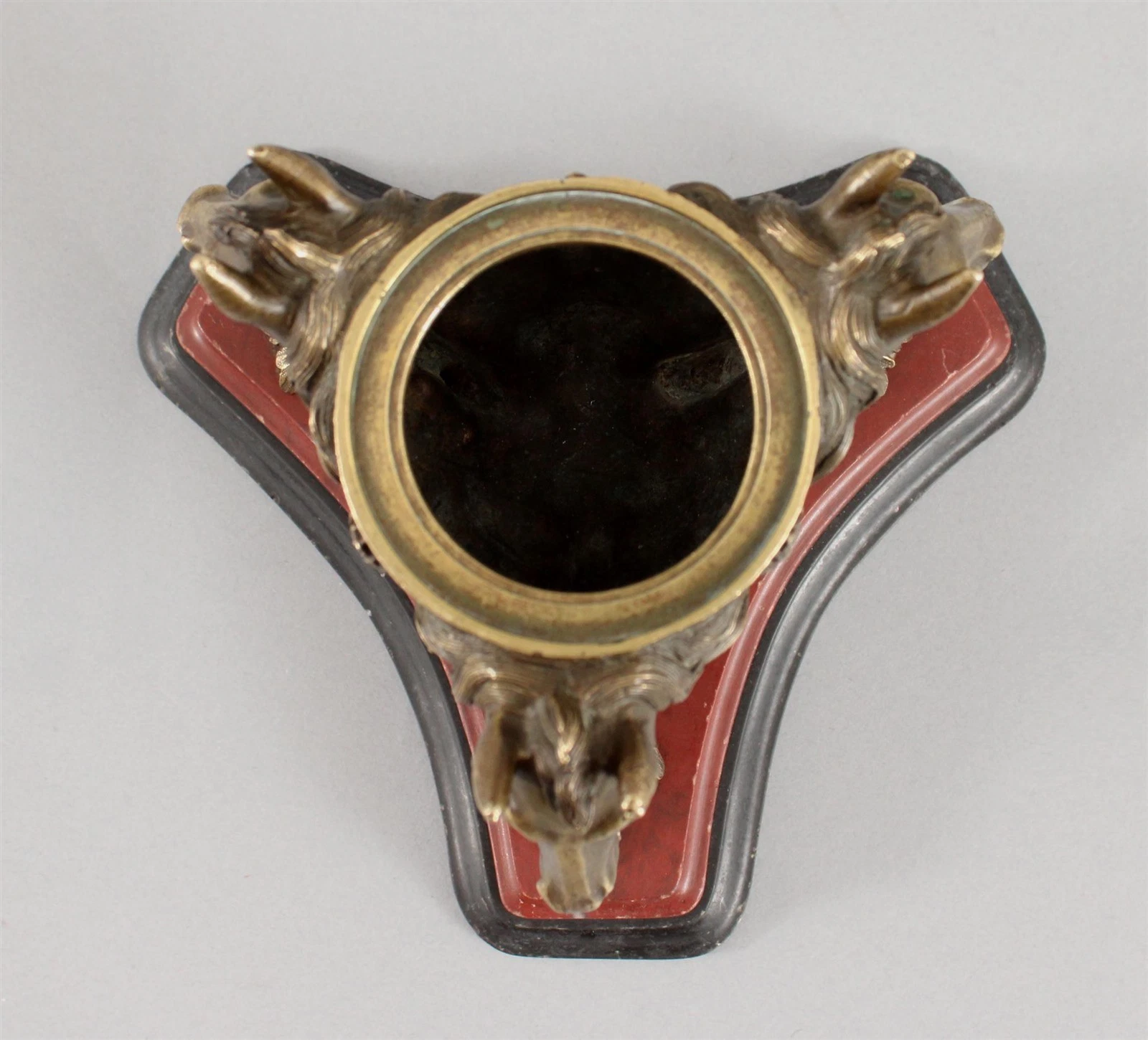
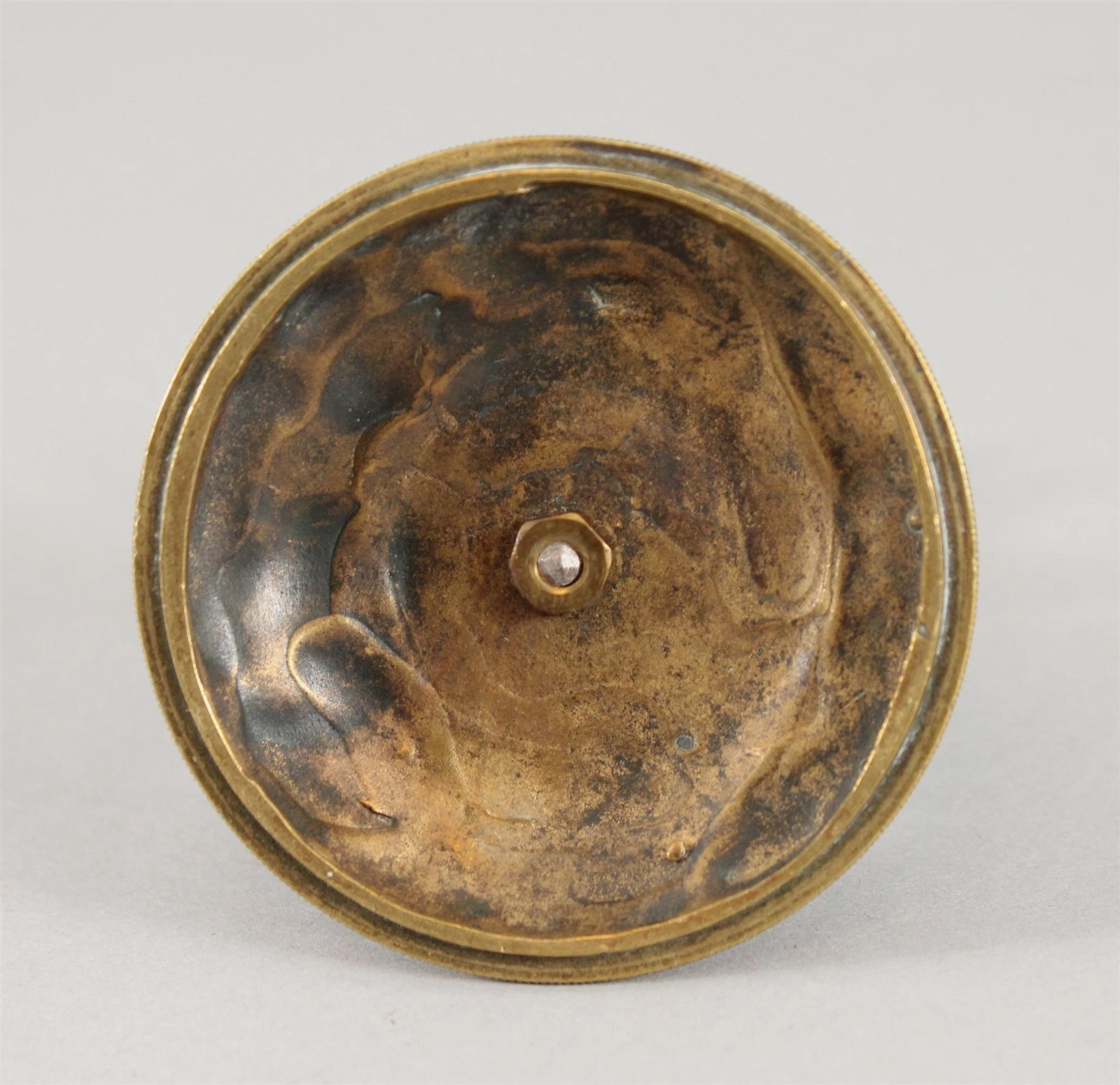
- Estimated Date: Circa 1870–1890 (Late 19th Century). The underside reveals a modern threaded bolt/nut assembly securing the central bronze component through the stone plinth, which is characteristic of late 19th-century bench manufacturing rather than Renaissance sand-casting.
- Probable Origin: Italy or France. Italian foundries (particularly in Florence or Rome) specialized heavily in mythological tripod inkstands, while French Parisian foundries produced very similar gilt and patinated Neoclassical bronzes during the Napoleon III / Third Republic period.
- Maker: Unattributed / Unmarked. Pieces of this nature were typically produced by art foundries or workshop craftsmen for commercial sale to international tourists and high-end retailers, rather than signed by a single celebrated sculptor.
Sold for $277 in August 2026
Content disclaimer. The information posted is the owner’s best knowledge and may not have been vetted by the SOIC. We welcome comments, corrections, and additions, working to make our website information comprehensive and accurate.
Join the Society of Inkwell Collectors (SOIC) – it’s free!
Founded in 1981 as a non-profit organization,
we are documenting inkwells (and accessories).
We’re here to help and inform!