





Neoclassical Bacchic Double Inkstand
| Categories | Figural - Mythology; Literature; Religion; Fictional |
| Type | Mythology |
| Material | Brass |
| Markings | Unmarked |
| Manufacturer | Undetermined |
| Origin | France |
| Date or Era | circa 1880 |
| Measuring | 21 ½” x 7 ¾” x 7 ½” high |
Description
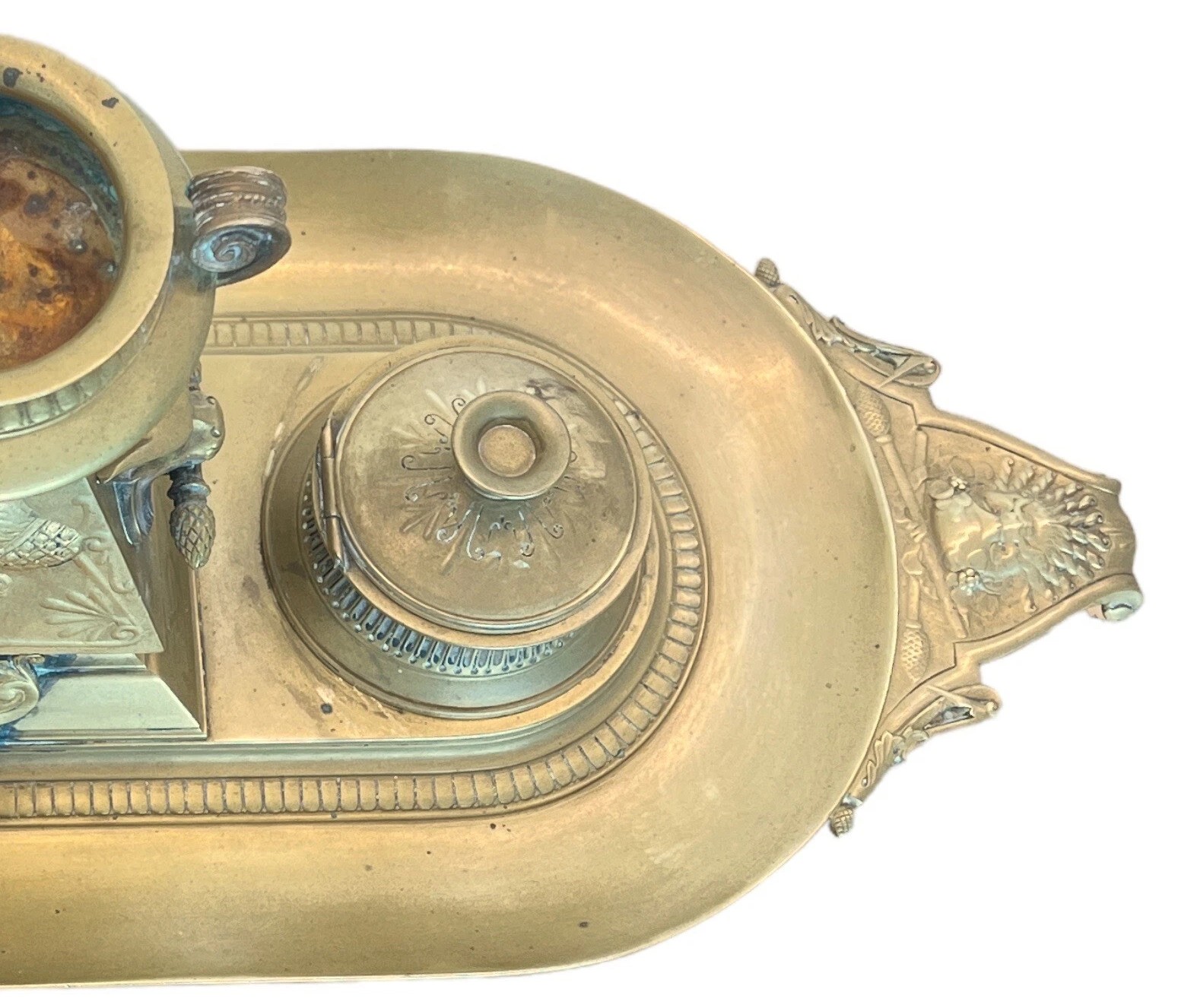
This double inkstand is an example of French Neoclassical design (Empire style) from the late 19th century (circa 1870–1890). The entire piece is constructed from heavy, finely cast brass with an aged patina.
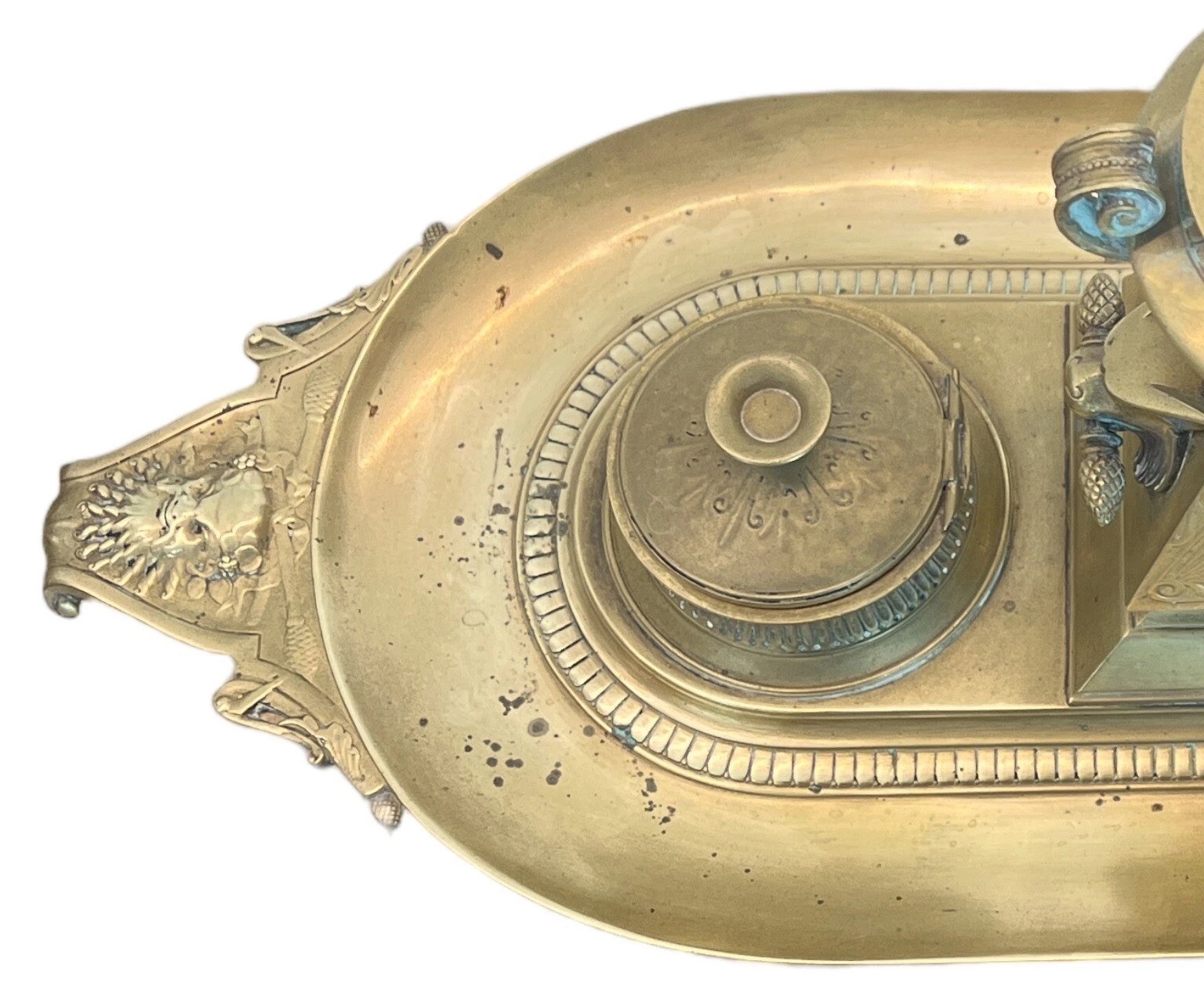
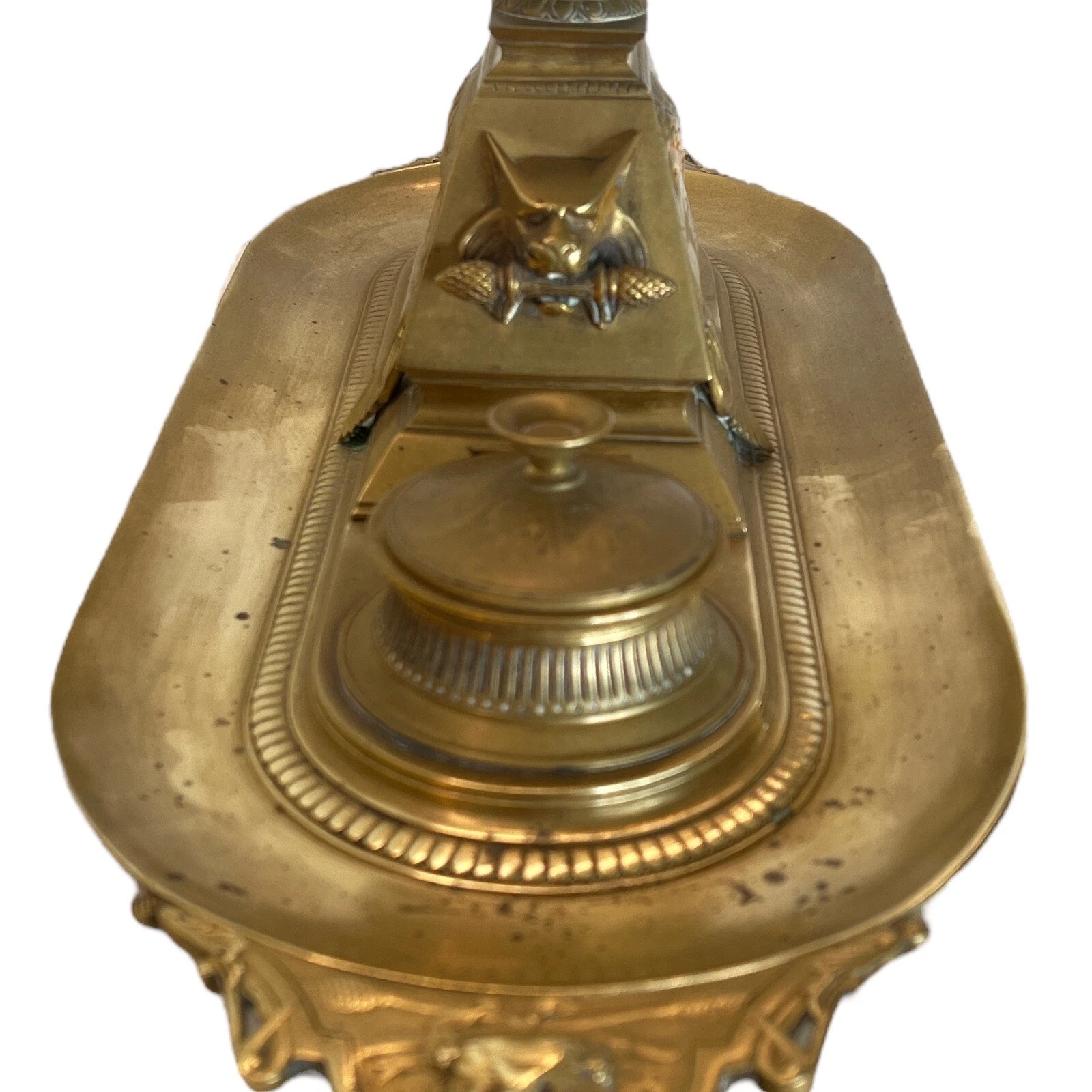
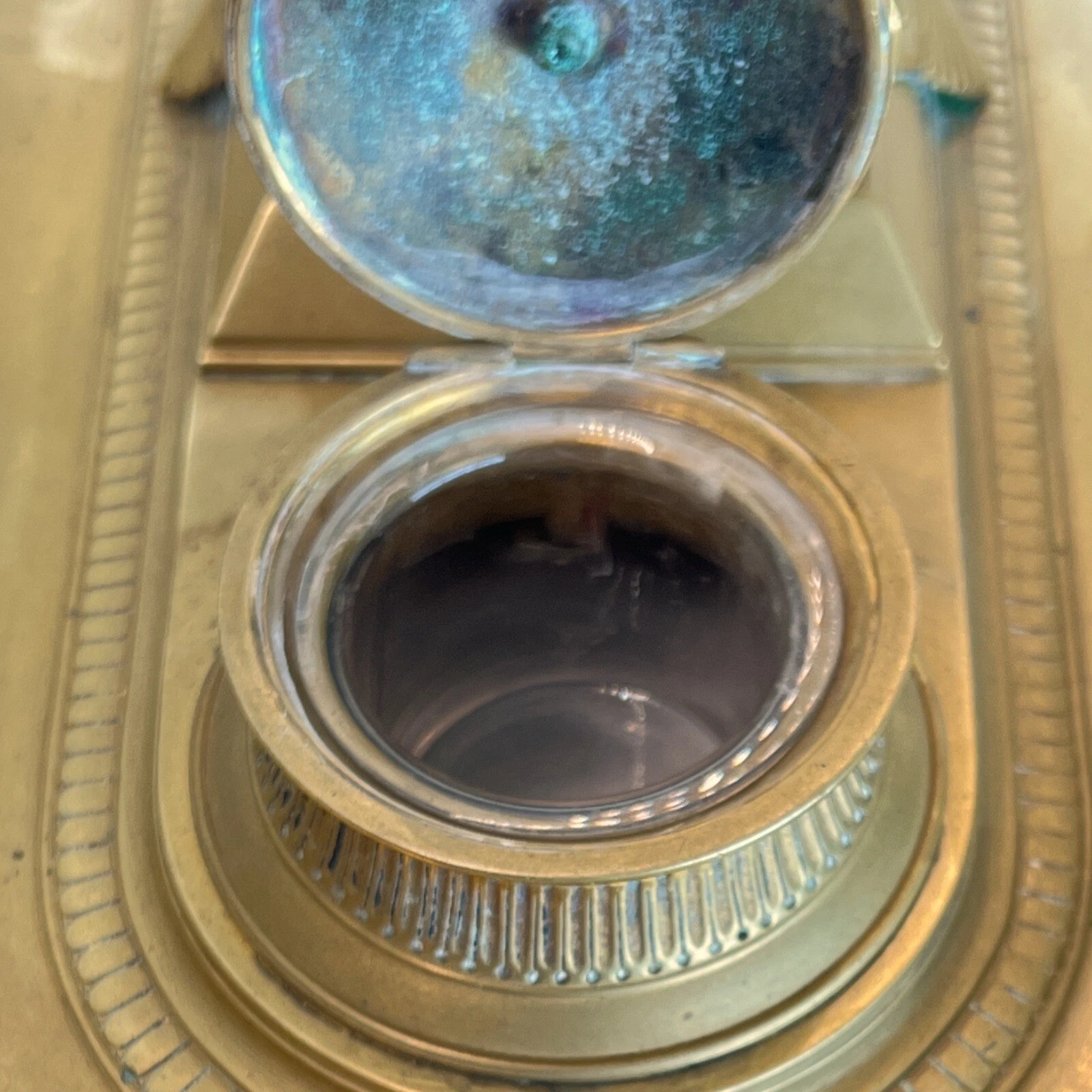
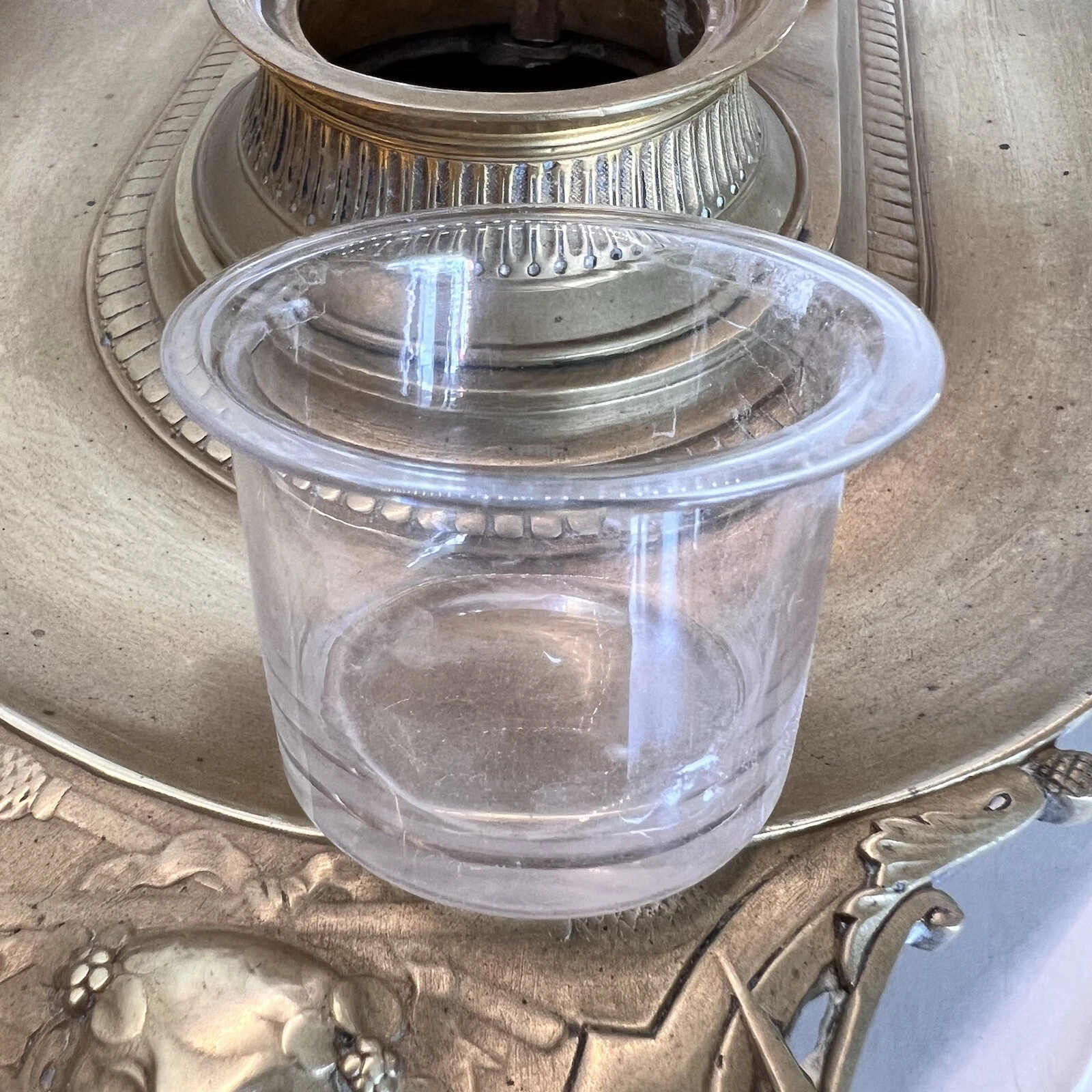
The foundation consists of an elongated, oval-shaped tray featuring an elegant gadrooned (or beaded) border tracing its inner rim. Set into the tray are two matching, fluted circular inkwells equipped with hinged, domed lids. These lids lift to reveal removable clear glass inserts.
Dominating the center of the tray is a stepped, pyramidal plinth base. Mounted atop this central pedestal is a wide, shallow classical urn or tazza flanked by two tightly scrolled loop handles. This central urn may have held a small sponge for wiping steel pen nibs.
Iconography & Classical Markings
The piece is decorated with sophisticated Greco-Roman motifs that break away from generic neoclassical themes to tell a specific mythological story centered around the entourage of Bacchus (Dionysus), the god of wine, festivity, and intellectual inspiration.
- The Classical Head (Front & Back): Featured in high relief on the primary faces of the central pyramid is the profile of a classical deity or muse. The figure features a distinct, intricately braided hair arrangement (krobylos) bound by a structured tiara or headband. This academic motif symbolizes the arts, literature, and intellect.
- The Bacchic Creatures & Thyrsus (Sides): The flanking sides of the central pyramid feature stylized, mischievous creatures reminiscent of a classical grotesque, lynx, or panther (the sacred companions of Bacchus). These figures are characterized by prominent, long, pointed ears and sharply angular, dramatic facial features. Clutched firmly in the jaws of each creature is a rod tipped with a pinecone on both ends. This instrument is a thyrsus, the ancient, sacred staff carried by Bacchus and his followers.
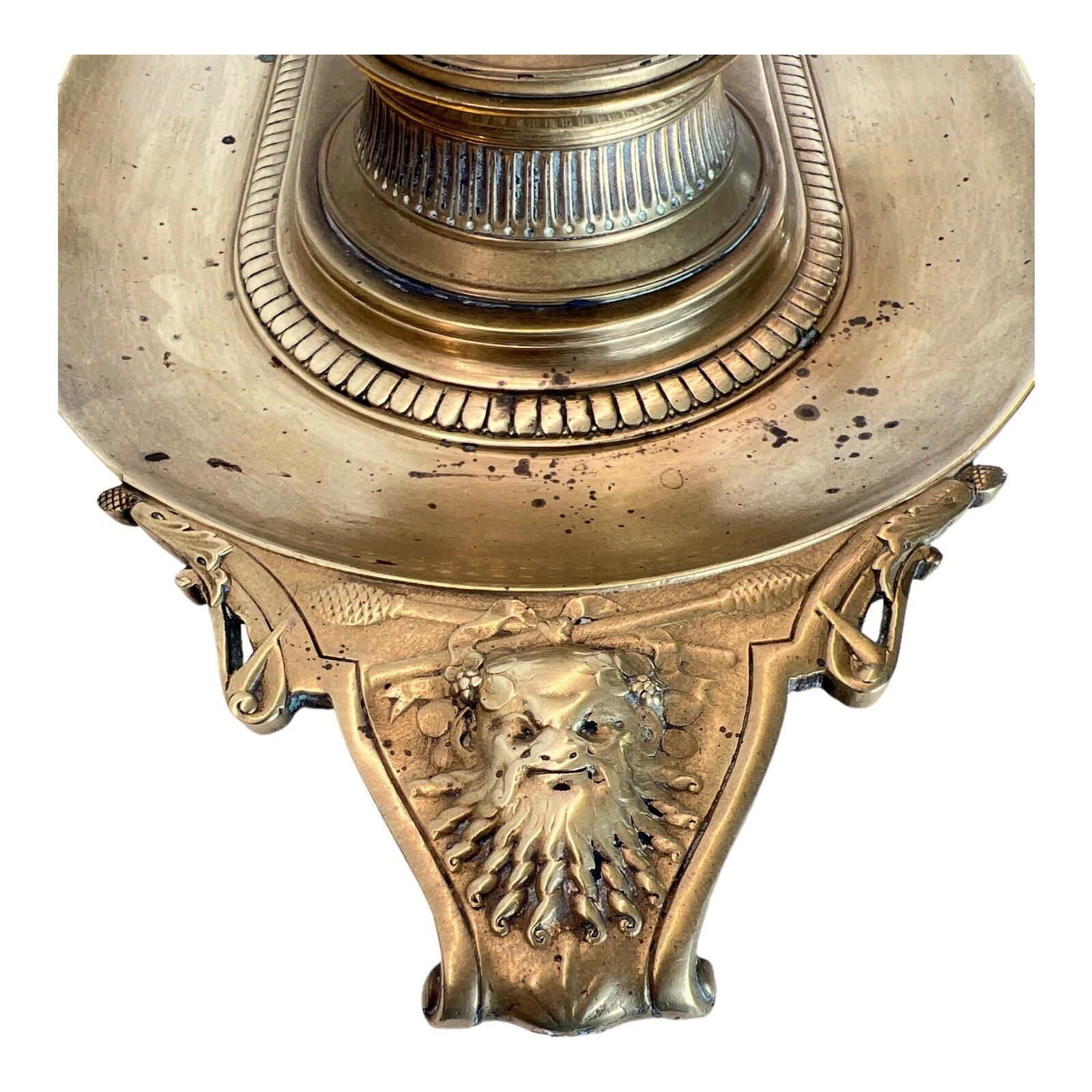
- The Silenus Mascarons (Handles): At the far left and right extremities of the tray, the integrated handles terminate in highly expressive, stylized faces. These classical mascarons depict Silenus (the wise, dynamic tutor of Bacchus) or a satyr, crowned with grape leaves and clusters of berries.
- Architectural Accents: Framing the lower edge of the central pyramid is a cast palmette and anthemion leaf scroll motif, anchoring the structural geometry of the pedestal to the fluid lines of the tray.
Historical & Style Context
The juxtaposition of rigid, geometric forms (the stepped pyramid and linear tray) with expressive, organic mythical masks is the quintessential signature of late 19th-century French bronziers. During the French Second Empire and the early Third Republic, foundries in Paris catered to a booming upper-middle class by reviving the heroic Empire style of the Napoleonic era.
By utilizing a cohesive Bacchic and theatrical theme—from the panther-like grotesques with their pinecone thyrsi to the grape-crowned Silenus handles—this inkstand was meticulously crafted to bring an air of academic prestige, classical mythology, and sophisticated taste.
Sold for $270 in May 2026
Content disclaimer. The information posted is the owner’s best knowledge and may not have been vetted by the SOIC. We welcome comments, corrections, and additions, working to make our website information comprehensive and accurate.
Join the Society of Inkwell Collectors (SOIC) – it’s free!
Founded in 1981 as a non-profit organization,
we are documenting inkwells (and accessories).
We’re here to help and inform!