




Multinational Military Encampment
| Categories | Figural - Persons |
| Type | Military |
| Material | Bronze finish, Gilt Bronze |
| Markings | Unmarked |
| Manufacturer | Undetermined |
| Origin | Undetermined |
| Date or Era | circa 1865 |
| Measuring | 7 ¾” x 4 ⅝” x 5” high |
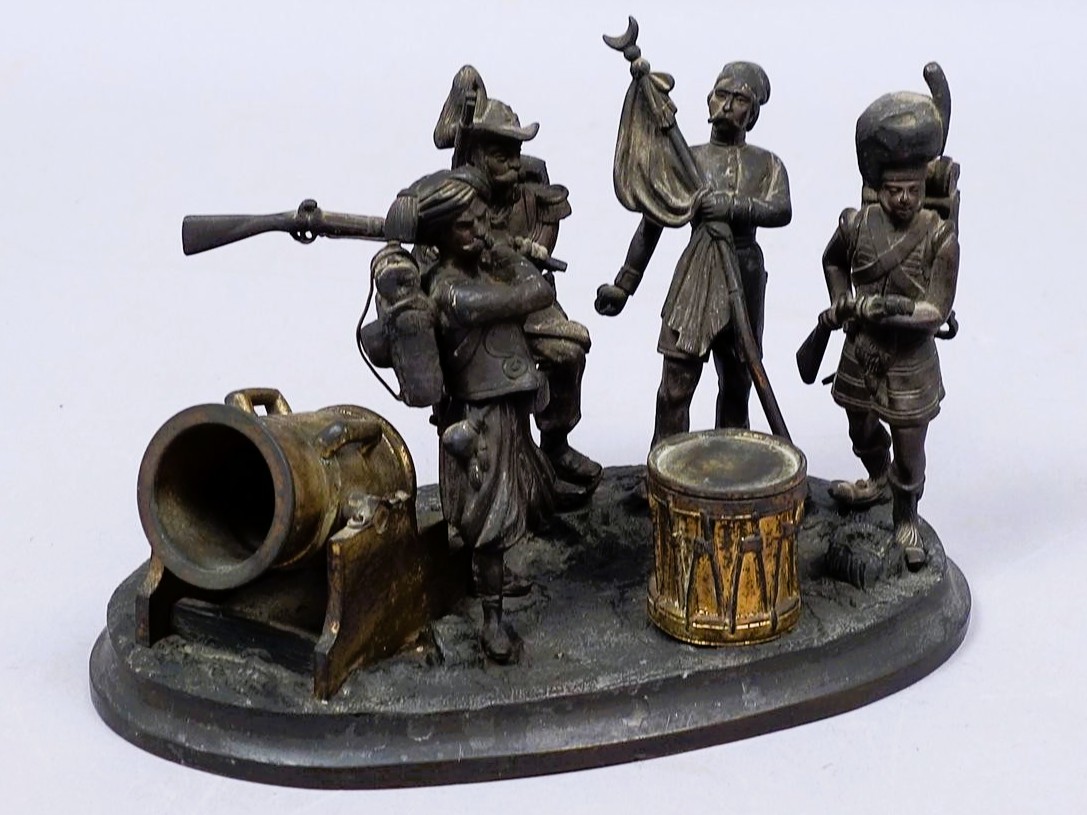
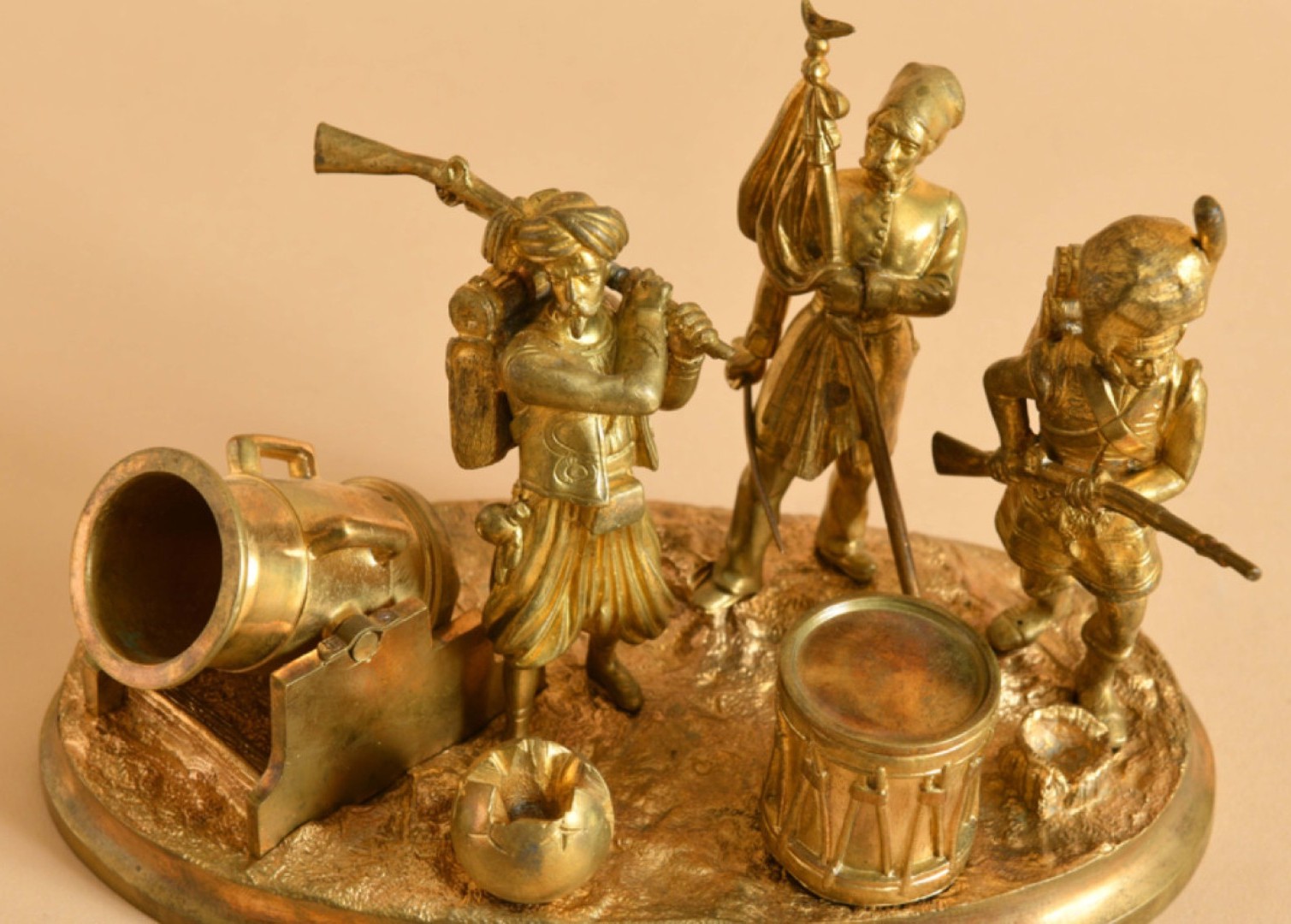
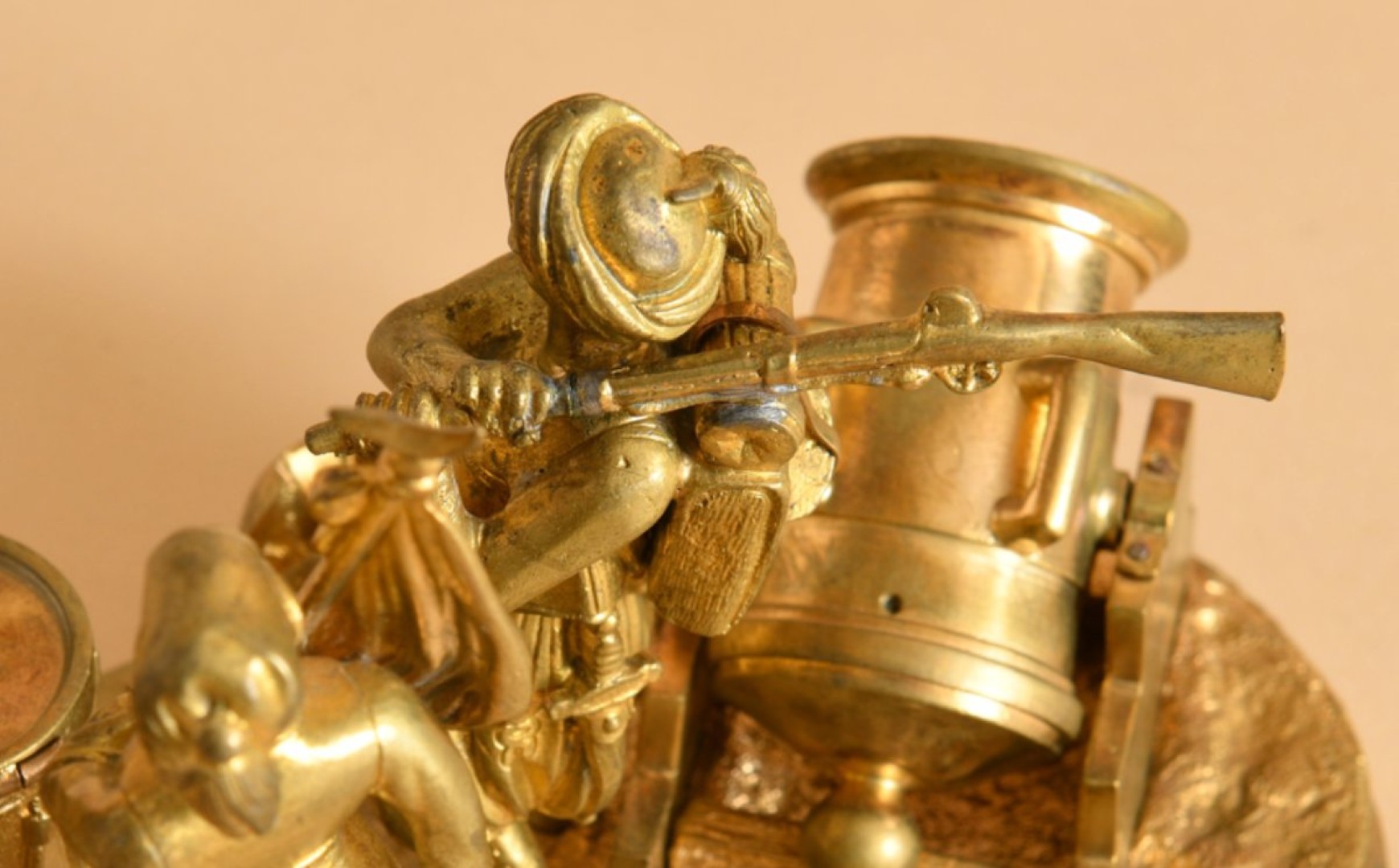
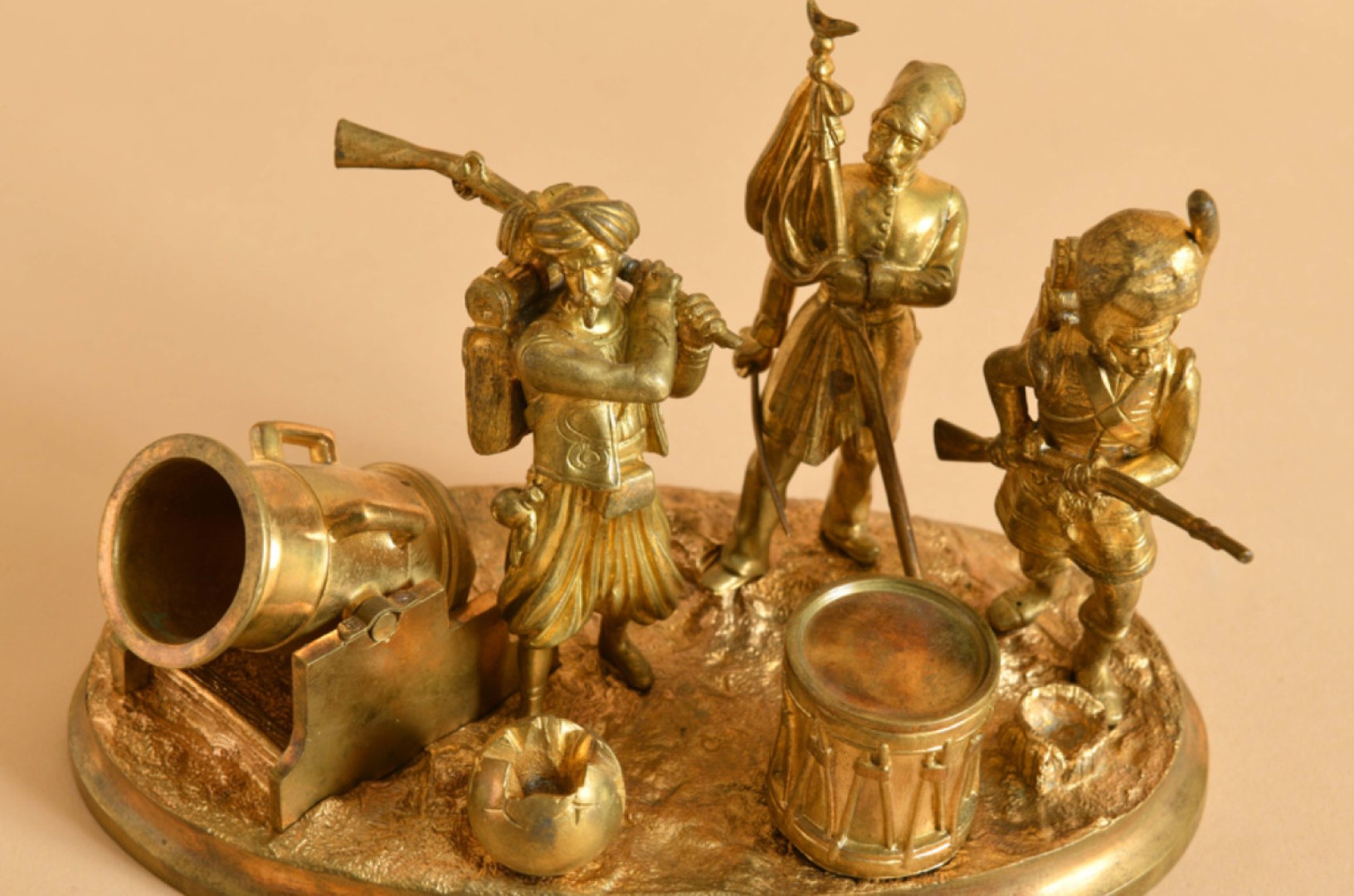
These two multi-figure inkstands are variations of the same highly detailed 19th-century military sculpture. The differences in finish, base details, and completeness highlight how these decorative desk pieces were produced and modified during the period.
The Subject Matter: A Multinational Military Encampment
Both inkstands present a stylized, romanticized “grand alliance” or international encampment scene typical of mid-to-late 19th-century European fascination with global military forces (particularly around the time of the Crimean War or international military exhibitions).
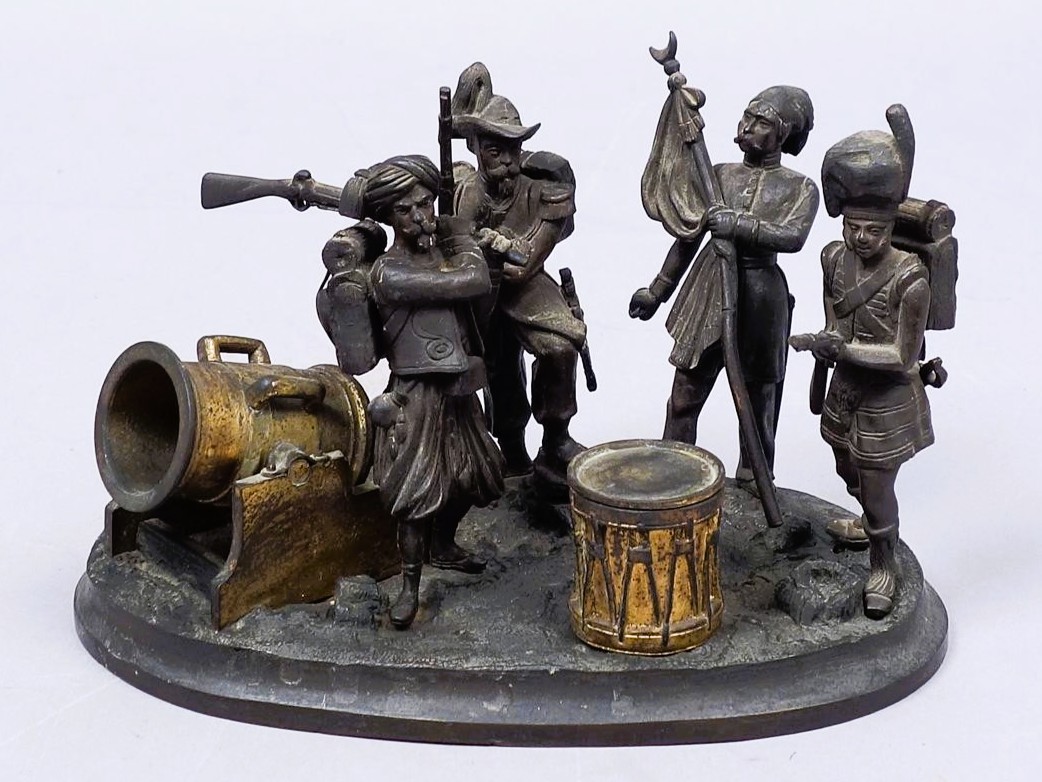
The scene depicts a specific ensemble of four distinct, highly detailed soldiers arrayed around a heavy smoothbore mortar cannon and a field drum:
- The Arabic / North African Zouave: Standing prominently in the front-left, wearing a draped turban, short braided jacket (veste de zouave), full, baggy harem trousers (seroual), and leggings. He stands with his arms crossed confidently.
- The European Infantryman / Officer: Positioned just behind the Zouave, wearing an early-to-mid 19th-century style shako or plumed cap with a distinct high crest, shoulder epaulets, and tall boots, leaning casually against his rifle.
- The Ottoman / Turkish Flag Bearer: Standing in the back-right, wearing a traditional Ottoman fez and a buttoned tunic, holding a staff topped with an iconic crescent-moon finial, the fabric of the flag draped around his arm.
- The Scottish Highlander: Standing on the far right, readily identifiable by his tall, diced feather bonnet (or busby), crossed leather chest straps over a doublet, a kilt, a sporran hanging in front, and patterned hose with gaiters. He holds a rifle across his waist.
Detailed Comparison of the Pieces
Inkstand #1 (First 4 images)
- Finish and Patina: Features a dark, rich bi-chromatic or dark-patinated bronze finish over cast metal. The figures and base are a deep charcoal brown, while the drum and mortar display an intentional, aged golden brass highlights to mimic distinct materials.
- Features: The mortar on the left is a hollow-barrel desk accessory meant for storing quill or dip pens. The field drum serves as the primary inkwell receptacle, featuring a hinged lid that opens to house a ceramic insert.
- Condition: This casting shows very crisp, fine textual work on the backpacks, the star emblem on the Highlander’s pack, and the facial details.
Inkstand #2 (Images 5 – 9)
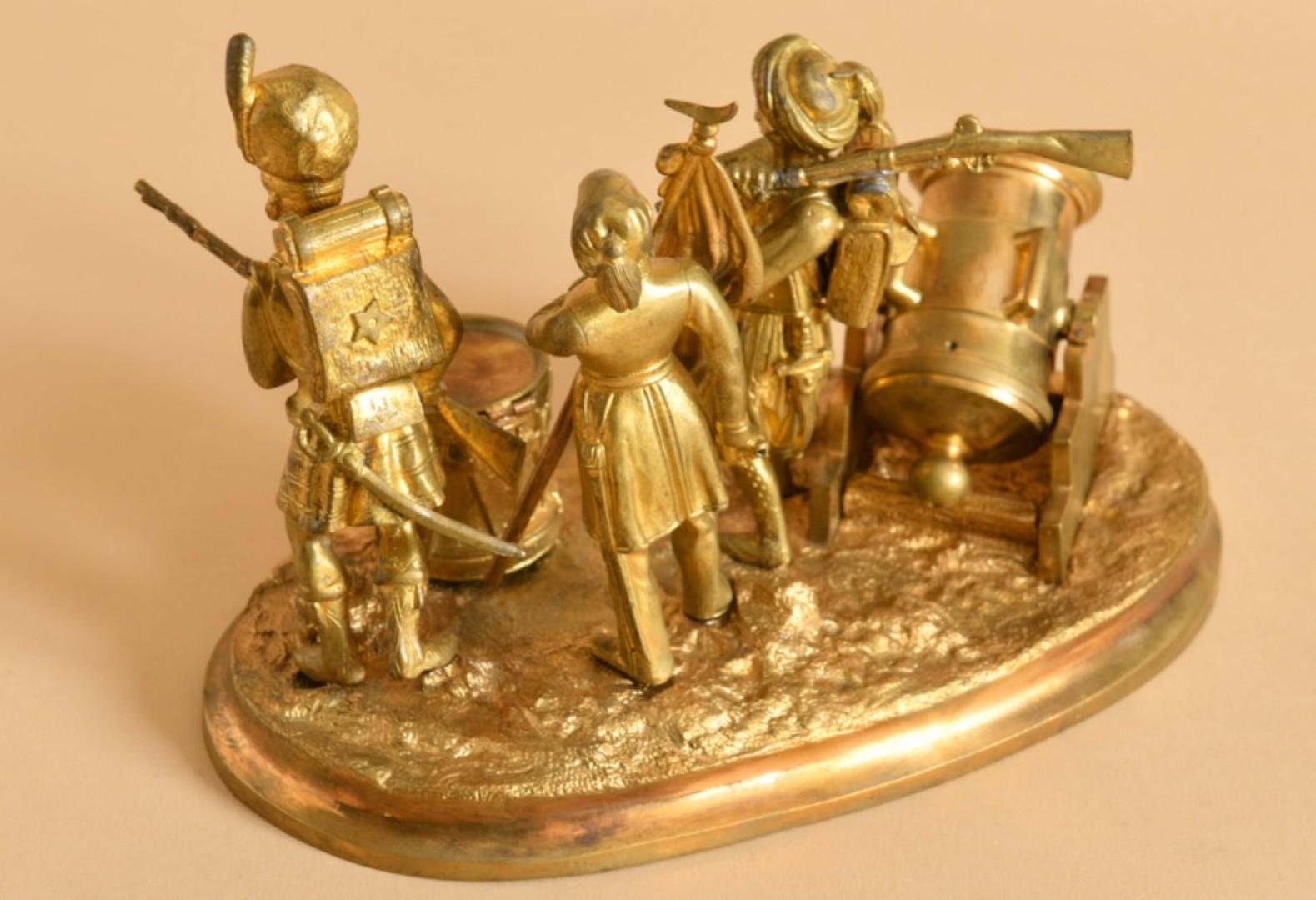
- Finish: Finished in a striking, bright gilt bronze (bronze doré) or gold-washed lacquer finish overall, giving it an opulent, uniform appearance.
- Key Differences and Component: The Match Holder / Pyrogen: In front of the central Zouave sits a small, cast-metal cannonball sphere with an open top. This was designed as a “pyrogen” (a match holder/striker).
- The Missing Figure: Looking behind the front Zouave, the European officer figure is completely absent. The casting reveals that this specific gilt version was produced with only three figures instead of four.
Manufacture: Who, Where, and When
- When: Circa 1855–1875. The composition relies heavily on the style of military uniforms popularized during the 1850s and 1860s (particularly the Crimean War era, where French Zouaves, British Highlanders, and Ottoman Turks fought as allies).
- Where: France (Paris) or Germany. France was the epicenter for high-quality bronze doré and patinated figural desk inkwells during the Second Empire period. However, prominent German foundries (such as those in Berlin or Nuremberg) also specialized in heavy, multi-figure zinc and spelter/bronze casting utilizing this exact style of detailed military genre imagery.
- Who: These were typically designed by noted commercial sculptors who specialized in militaria and animalier themes (such as designs in the style of Frémiet or Cumberworth) and cast by major industrial art foundries. Because these pieces were highly fashionable luxury desk items, they were manufactured in several tiers: premium heavy bronze, gold-plated bronze (doré), and sometimes cast iron or zinc alloy with a bronze finish to accommodate different markets.
Example #1 sold for $291 in December 2016. Sold for $218 in May 2026.
Example#2 is valued at $480.
Content disclaimer. The information posted is the owner’s best knowledge and may not have been vetted by the SOIC. We welcome comments, corrections, and additions, working to make our website information comprehensive and accurate.
Join the Society of Inkwell Collectors (SOIC) – it’s free!
Founded in 1981 as a non-profit organization,
we are documenting inkwells (and accessories).
We’re here to help and inform!