

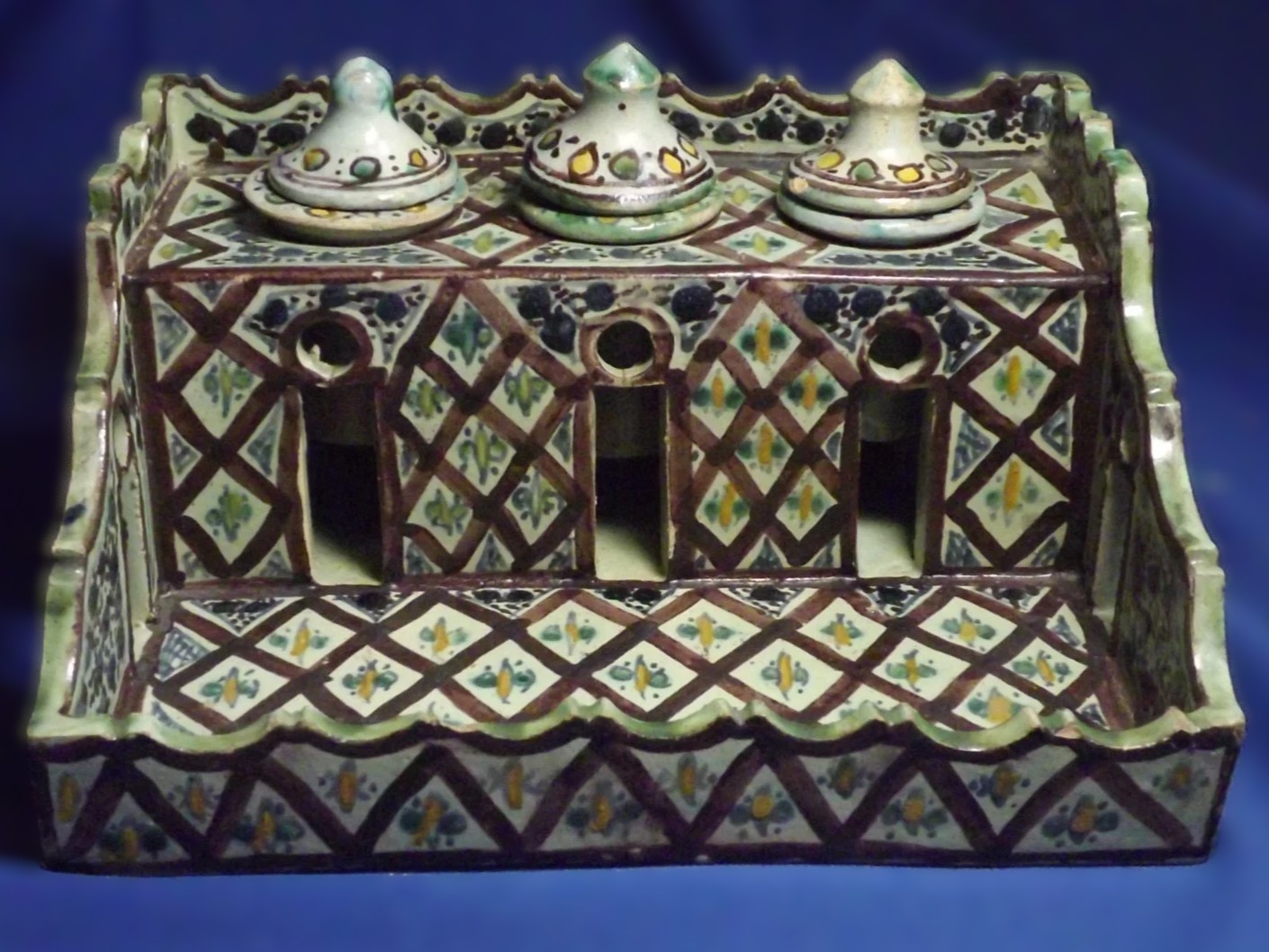


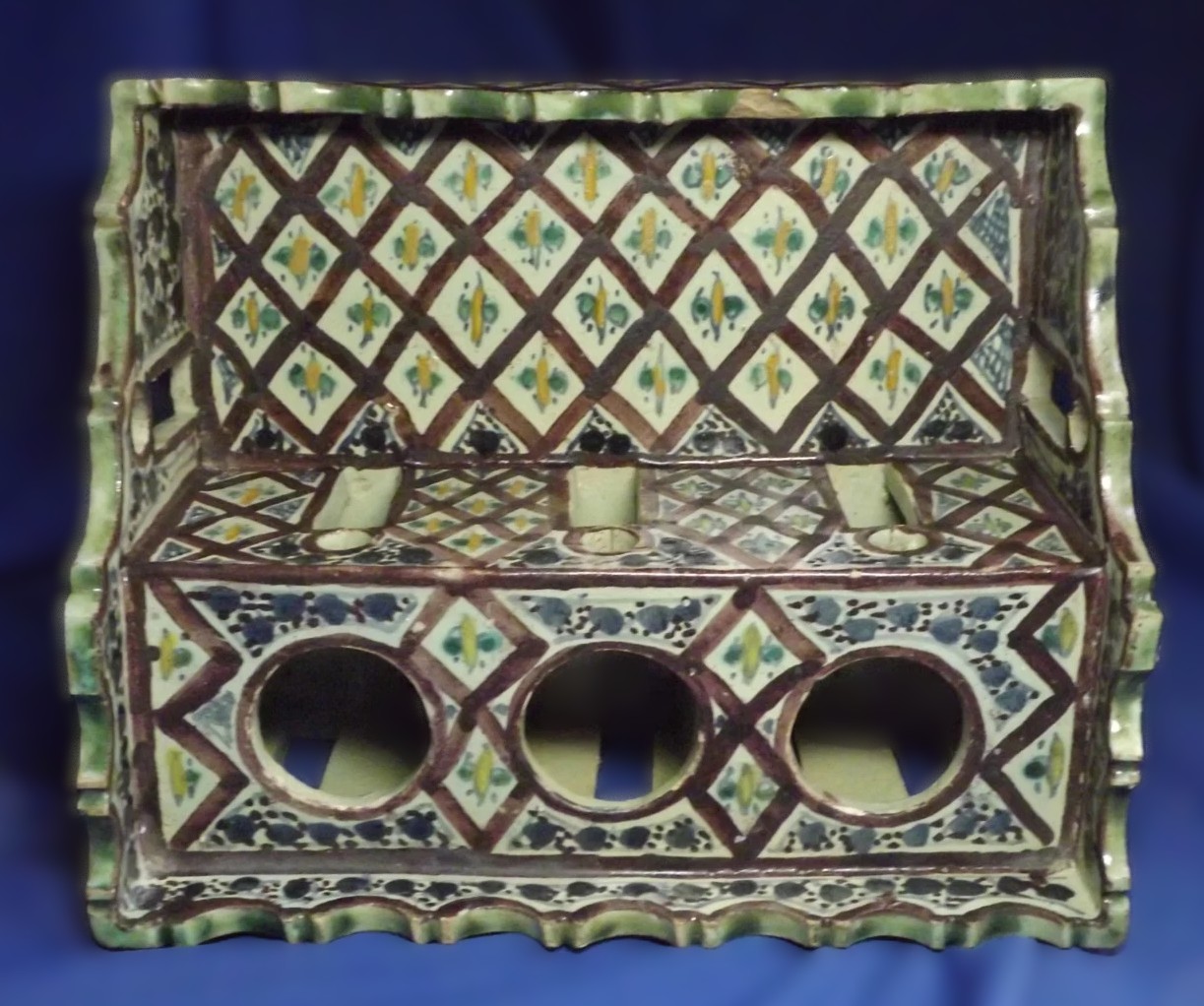

Moroccan Pottery Inkstand
| Categories | Middle East / Africa |
| Material | Earthenware |
| Markings | See Narrative |
| Manufacturer | Undetermined |
| Origin | Morocco |
| Date or Era | circa 1890 |
| Measuring | 8” x 6 ¾” x 4” high |
This inkstand is a beautiful example of traditional Moroccan pottery often associated with the city of Fez.
Description of the Moroccan Inkwell
The inkstand has the following characteristics:
- Material: Earthenware/Pottery (likely white clay) with an applied glaze.
- Form: It is a triple inkwell (or three-compartment inkstand) consisting of a rectangular body.
- Compartments (Inkwells): The top surface features three compartments for ink.
- Decoration: The inkwell is decorated in the style known as Fez pottery or Fassi ware.
Color Combination: Cobalt Blue and White
The palette of this inkstand is traditional:
- The White Base: The foundation of the piece is the tin-opacified white glaze applied to the earthenware. This white surface acts as a bright canvas, enhancing the brilliance and contrast of the painted designs. This technique was introduced to Morocco by Andalusian craftsmen, particularly after the Reconquista in the late 15th century.
- The Cobalt Blue: The intricate designs are painted using a rich, dark blue pigment derived from cobalt oxide. This specific blue, often called “Fez blue,” is what distinguishes Fassi pottery. Cobalt oxide maintains its rich, vibrant color during the high temperature firing process, resulting in the deep, intense hue seen on your inkstand.
- Why it can look Purple: While the intended color is blue, the glaze can sometimes appear to have a blue-violet or purplish-blue tint due to several factors:
- Glaze Chemistry: In ceramics, adding ingredients like magnesium oxide to a cobalt glaze can intentionally shift the color from a pure blue towards a beautiful purple or lavender. While the core Fez tradition aims for cobalt blue, variations in the local materials, the exact glaze formula, or the way the glaze was prepared can introduce nuances.
- Shade and Pigment Density: The depth of the color, determined by the density of the cobalt pigment in the glaze, can affect its appearance. A very deep, intense cobalt blue can sometimes have a purplish cast.
The Significance: This highly refined blue-and-white color scheme, particularly using cobalt blue, shows a direct link to the Islamic ceramic tradition that was heavily influenced by Chinese porcelain (via the Silk Road) and Spanish-Moorish techniques (Majolica/Hispano-Moresque ware). It represents the pinnacle of glazed ceramic art in Morocco.
Patterns and Motifs
The decoration is executed with fine, skilled brushwork, covering the entire surface, which is a hallmark of the high-quality Fez style.
- Primary Motif (Geometric): The decoration is dominated by intricate geometric patterns . This is a fundamental aspect of Islamic art, where repetitive, interlocking geometric designs are used to represent the infinite nature of the cosmos and God. On this piece, you can see fine lines forming:
- Lattice and Cross-Hatching: Used as background fill and border work to create texture and depth.
- Secondary Motif (Arabesque/Floral): Interwoven with the geometric structure are stylized floral or vegetal elements (arabesque). These flowing patterns are non-representational and are also a key feature of Islamic art, often symbolizing the beauty of the natural world.
Explanation of Terms
| Term | Meaning | Explanation |
| Douïa / Douaïa | The most common term for inkwell or inkpot. | This confirms the object’s primary use as a container for ink. |
| Mejma | Generally refers to a set or a tray/platter. | In this context, it describes the inkstand as a single object containing multiple wells, distinguishing it from a single inkpot. It refers to the whole piece. |
Signature/Mark on the Bottom
The mark on the bottom is typical of hand-painted potter’s marks from the Fez region.
- Interpretation: These are generally potter’s marks or factory signs, not standardized marks like those found on Western porcelain. They are often a stylized form of a signature or a simple symbol that identifies the workshop or artisan.
Estimated Age
Based on the traditional Fez blue-and-white style and the general wear and crazing, this piece likely dates to the late 19th or early 20th century (c. 1890 – 1920s).
- Style: The intricate, dark cobalt blue patterning is characteristic of the Fez pottery revival period, where traditional skills and aesthetics were maintained.
Sold for $118 in October 2025
Content disclaimer. The information posted is the owner’s best knowledge and may not have been vetted by the SOIC. We welcome comments, corrections, and additions, working to make our website information comprehensive and accurate.
Join the Society of Inkwell Collectors (SOIC) – it’s free!
Founded in 1981 as a non-profit organization,
we are documenting inkwells (and accessories).
We’re here to help and inform!