





Millefiori Glass Inkwell
| Categories | Glass - Non-figural |
| Type | Millefiori |
| Material | Glass |
| Markings | Unmarked |
| Manufacturer | Undetermined |
| Origin | France |
| Date or Era | circa 1890 |
| Measuring | 5 ½” high |
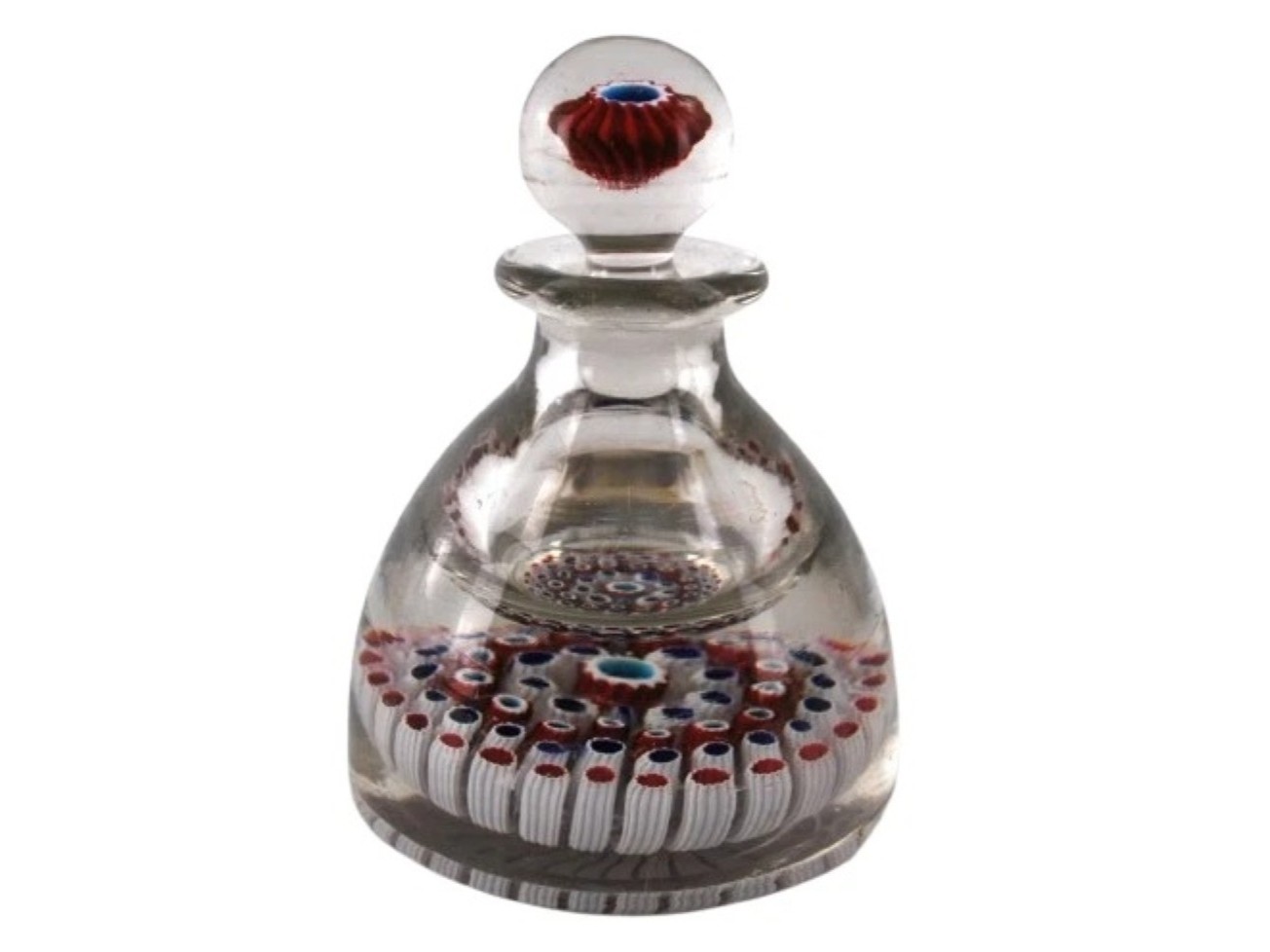
This millefiori glass inkwell has a style that marries function with the high artistry of paperweight making.
Description
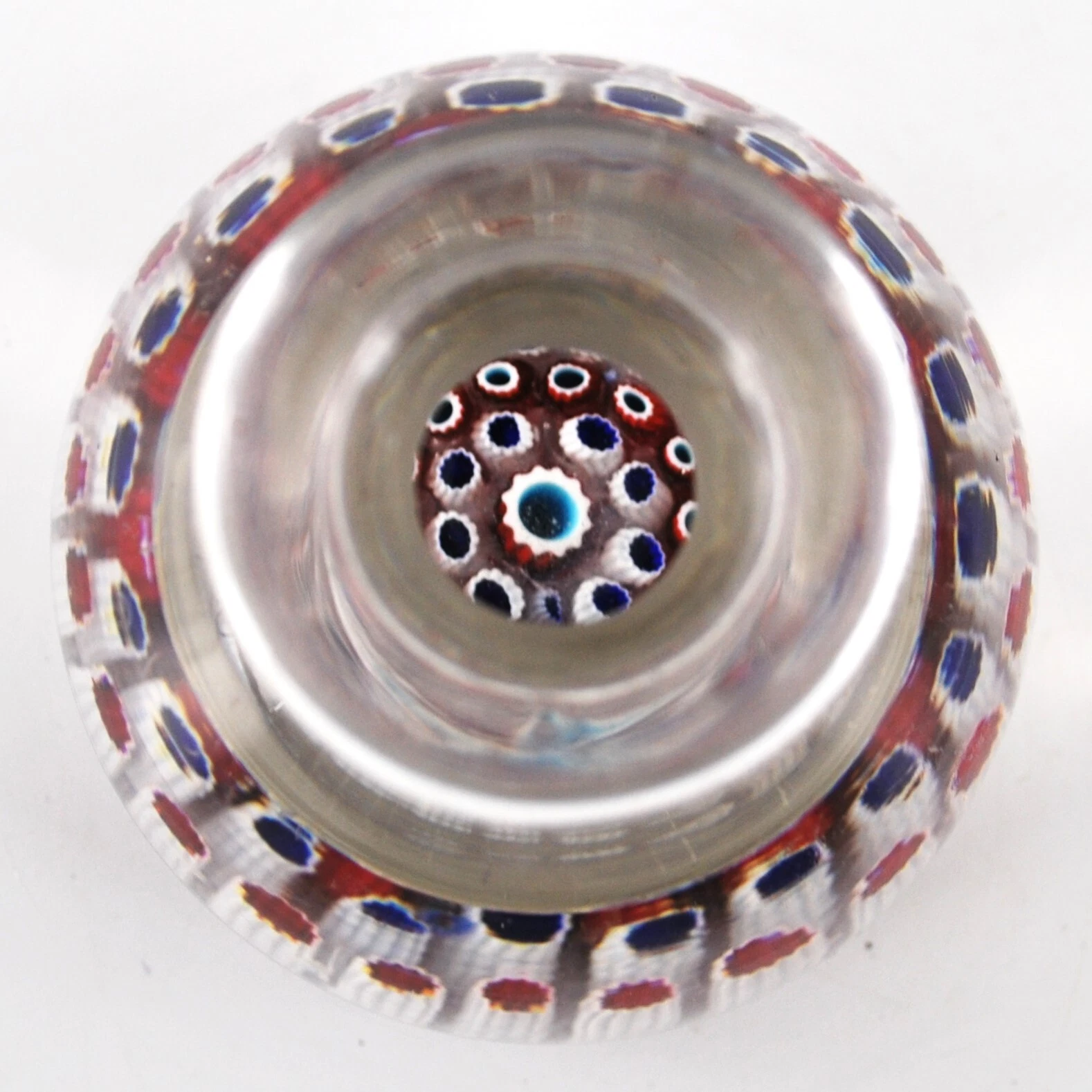
The inkwell features a clear glass body with a heavy, stable base. Inside the glass ground is a concentric millefiori pattern consisting of several rows of complex canes:
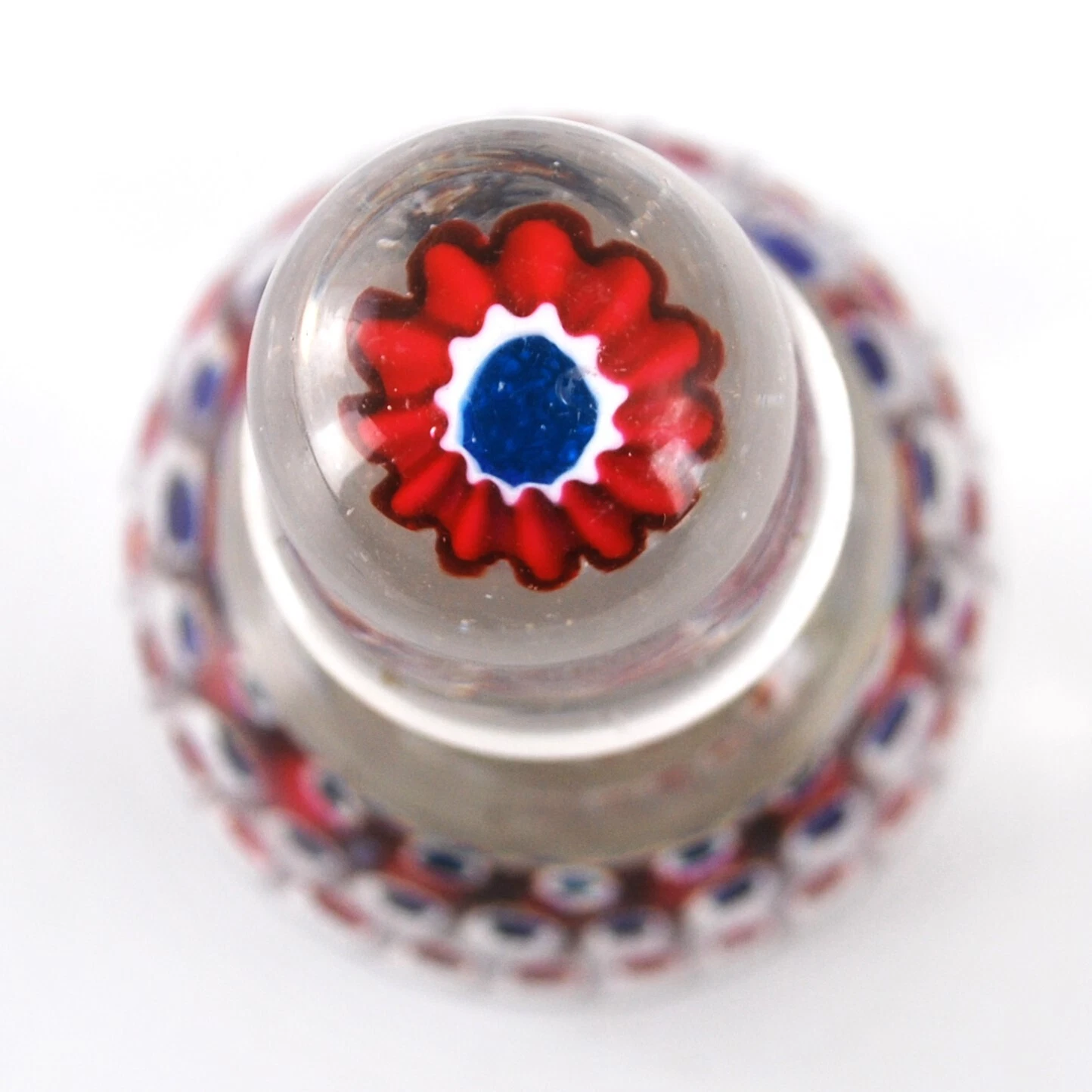
- The Canes: Each “cane” (the individual flower-like rods) is composed of a central blue core, surrounded by a white star or cogwheel layer, and encased in a ruffled red outer layer.
- The Arrangement: These canes are arranged in tight, circular rows. The rows alternate their color dominance or spacing to create a rhythmic, radiating effect from the center.
- The Stopper: The spherical stopper is “married” to the design, featuring a single, large, matching millefiori cane encased in clear glass.
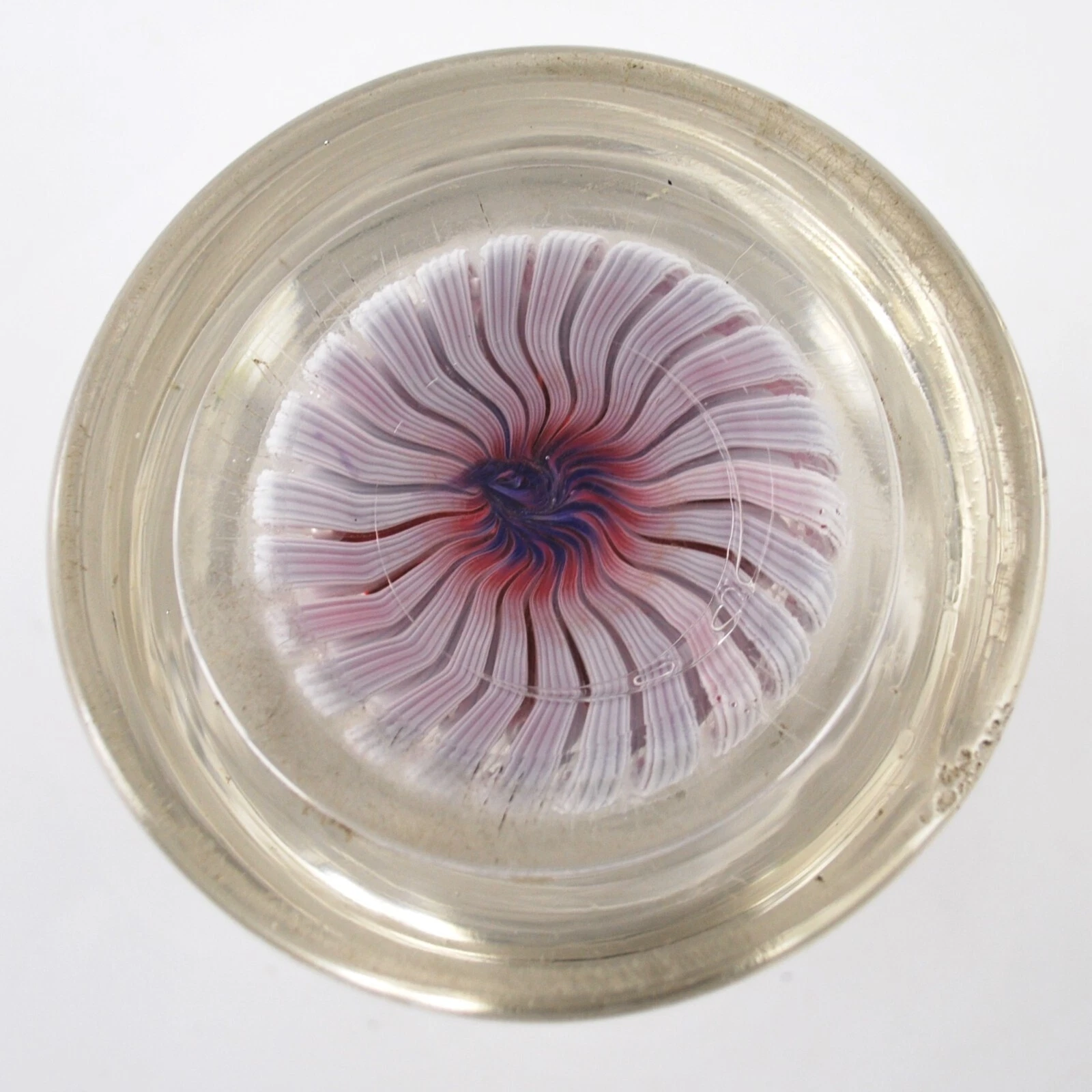
- The Base: The canes were gathered into a “pantomime” or cushion, then encased in the clear gather. The visible swirling at the center of the base is the pontil mark, where the piece was separated from the glassmaker’s rod and later ground smooth.
Creation Process: The Millefiori Technique
The term millefiori (Italian for “thousand flowers”) involves a complex, multi-step process:
- Cane Pulling: A glassblower creates a thick “starter” gather of colored glass, dips it into other colors, and uses star-shaped molds to create patterns. This thick rod is then pulled out until it is very thin, preserving the pattern in miniature throughout its length.
- Slicing: Once cooled, these long rods are sliced into tiny discs (the canes you see).
- The Setup: A master craftsman arranges these slices into a pattern inside a metal ring or “collet.”
- The Encasement: A gather of molten clear glass is picked up on a blowpipe and pressed onto the arranged canes. The heat causes the canes to fuse to the molten glass.
- Shaping: The glass is then blown and shaped into the inkwell form using wooden blocks and jacks, while the stopper is crafted separately to match.
Origins and Maker
While many European glasshouses produced millefiori, the specific profile and cane structure of this piece point toward Baccarat or Clichy (France), or potentially Whitefriars (England).
- Location: Most likely France (the epicenter of fine paperweight-style inkwells).
- Maker: Based on the ruffled, “pastry mold” style of the canes and the clarity of the glass, this is characteristic of Baccarat. Baccarat was famous for these concentric patterns. If there is no “B” and date (e.g., “B 1848”) hidden in one of the canes, it is likely an unsigned but high-quality piece from the mid-to-late 19th century.
- Age: This piece likely dates to the Classical Period of Paperweights (circa 1845–1860) or the Victorian Revival (circa 1880–1900).
Sold for $375 in January 2026
Content disclaimer. The information posted is the owner’s best knowledge and may not have been vetted by the SOIC. We welcome comments, corrections, and additions, working to make our website information comprehensive and accurate.
Join the Society of Inkwell Collectors (SOIC) – it’s free!
Founded in 1981 as a non-profit organization,
we are documenting inkwells (and accessories).
We’re here to help and inform!