




Lion’s Head in Relief Inkstand – Buyer Be Aware
One encounters this inkstand – a lion’s head in relief with two inkwells and a pen holder – for sale all over the internet. Some dealers have multiples for sale or quickly list another version after one has sold. What is unacceptable is that almost all are sold as “Victorian”, “Antique”, “Early 1900s”, “19th Century”, “French”, “Imperial German”. They likely were made in India. They are usually sold as bronze but are brass. Pictured are two examples – there are some differences between the two – but both are of modern production. BUYER BE AWARE!
Both of these brass lion-head inkstands appear to be mid-to-late 20th-century reproductions, likely manufactured in international brass hubs such as Moradabad, India.
Assessment of the Two Models
While both pieces utilize the same general “Renaissance Revival” lion motif, there are differences:
- “Lion #1” Analysis: This version is a “higher-end” reproduction, likely dating to the mid-20th century (circa 1970s).
- Features: It includes hinged lids and more ornate decorative casting on the well covers.
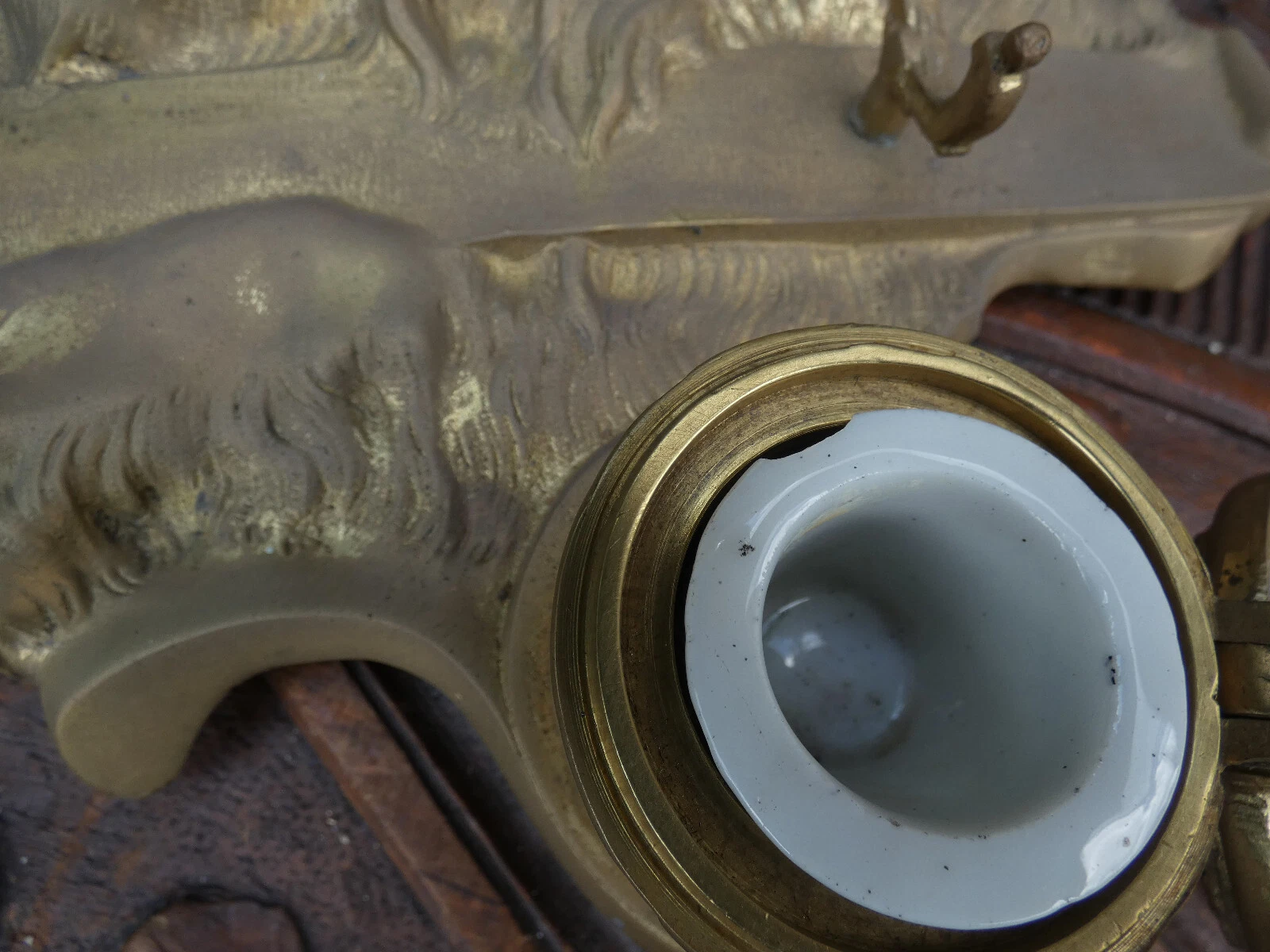
- The Inserts: The fact that the ceramic inserts do not fit perfectly is a common trait of mid-century “decorative” reproductions, where standard-sized liners were often paired with non-standard hand-cast housings. Or the seller may have deceptively added ceramic inserts.
- Underside: The underside shows a rough, “sandy” casting texture and a yellowish-gold finish, which is typical of sand-casting methods used in Indian brass workshops during that era.
- “Lion #2” Analysis: This version appears to be a modern production (late 20th century to present).
- Features: The lids are simplified, and the overall finish is much brighter and more uniform, suggesting a more recent chemical “antique” finish rather than natural age.
- Underside: The underside is notably cleaner and lacks the depth of oxidation seen in older brass, looking very “factory fresh”.
Origin and Manufacturer Information
These specific lion-head patterns have been in production since the 1970s, primarily as “Giftware” or “Office Decor”.
- The Maker: Most of these pieces are unbranded, as they were produced for the export market. They are closely associated with the brass foundries of Moradabad, India, which is known globally as the “Brass City” for its massive output of traditional and reproduction metalware.
- Availability: You will often find these listed on eBay or Etsy and are readily available.
Detecting Reproduction vs. Antique
If these were genuine 19th-century antiques, you would expect to see the following characteristics that are missing here:
- Earned Patina: A genuine antique has a soft, dark oxidation that settles into the deep recesses of the lion’s mane, which cannot be perfectly replicated by modern chemical washes.
- Screws and Hardware: Authentic 19th-century pieces used hand-cut or early machine-threaded screws with uneven heads.
- Precision of Casting: Genuine Victorian brassware typically features much sharper, more defined “chiseling” in the details of the face and mane. Both of these samples show the softened, “mushy” edges common in secondary casting (casting made from a mold of an original piece).
Conclusion: These are decorative objects, but they lack the hallmarks of 19th or early 20th century craftsmanship.
Content disclaimer. The information posted is the owner’s best knowledge and may not have been vetted by the SOIC. We welcome comments, corrections, and additions, working to make our website information comprehensive and accurate.
Join the Society of Inkwell Collectors (SOIC) – it’s free!
Founded in 1981 as a non-profit organization,
we are documenting inkwells (and accessories).
We’re here to help and inform!