


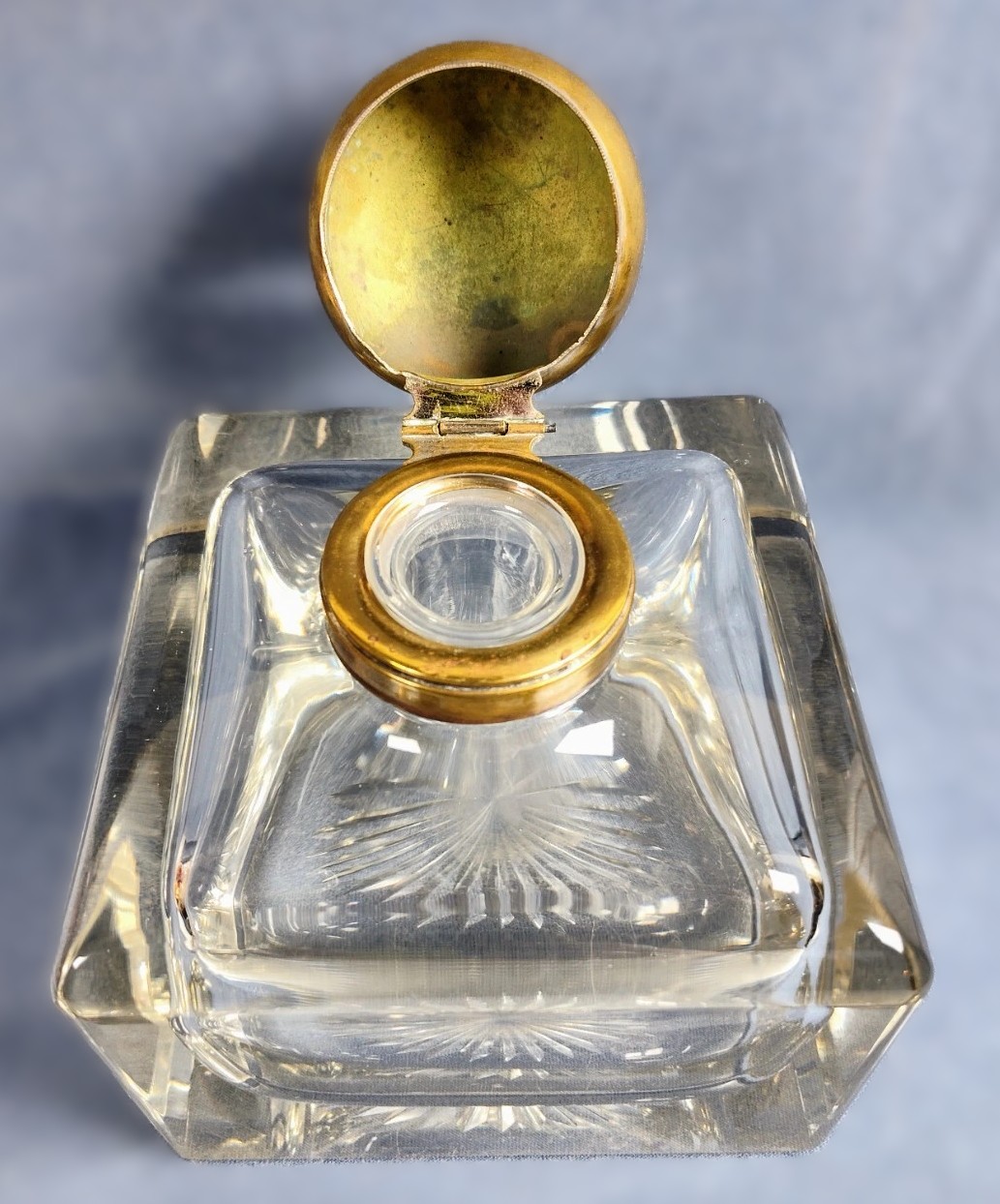

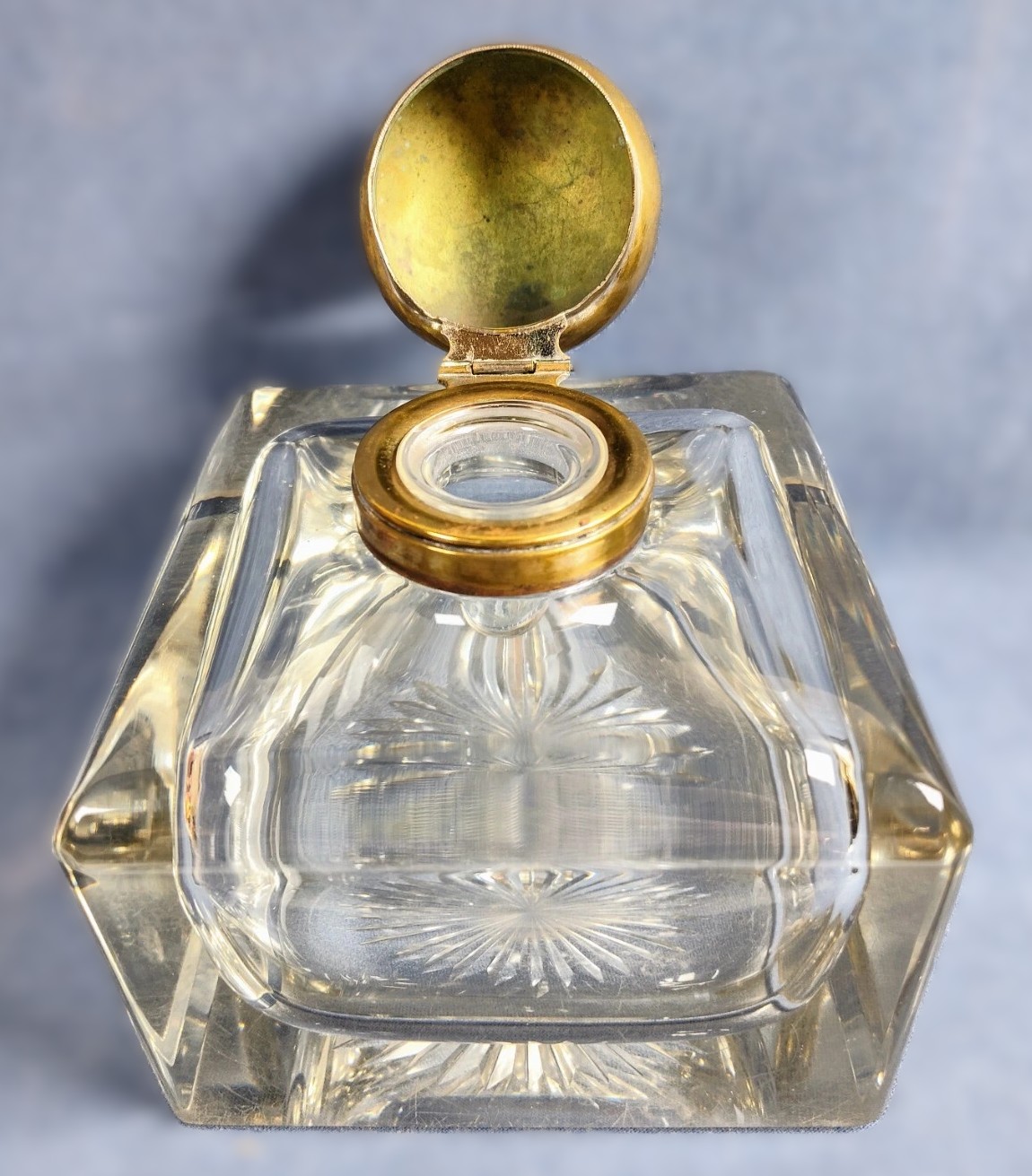



Large Glass Inkwell with Brass Lid
| Categories | Glass - Non-figural |
| Material | Brass, Glass |
| Markings | Monogrammed |
| Manufacturer | Undetermined |
| Origin | Undetermined |
| Date or Era | circa 1890 |
| Measuring | 6” x 6” x 6 ½” high |
This is a “monumental” or oversized desk inkwell, a high-status object from the late 19th or very early 20th century. Its sheer size (6” x 6” x 6 ½”) and weight suggest it was intended for a large library desk or a business house rather than a small personal writing desk.
Detailed Description
- The Glass: The body is crafted from heavy lead crystal, likely American Brilliant Period (ABP) or French (Baccarat). It features a deep, architectural block cut with beveled shoulders. The interior reservoir is a “well-within-a-well” design, visible through the thick walls.
- The Base: The bottom is decorated with a classic 24-point starburst (or “whirl”) pattern.
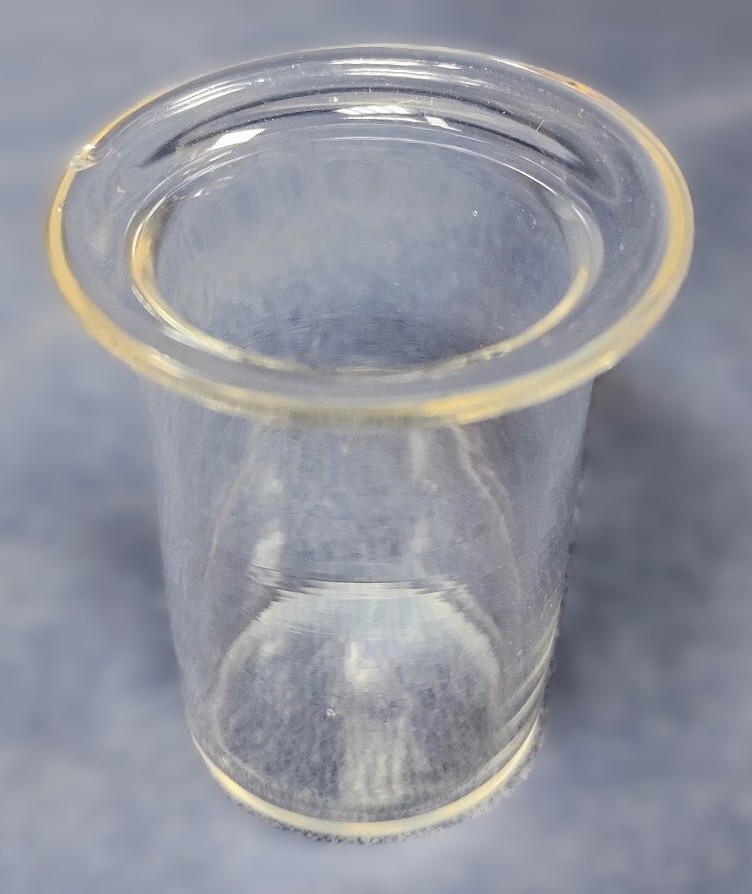
- The Insert: It has a removable clear glass liner.
- The Lid: The brass domed lid is hinged and features an ornate, intertwined Victorian-style monogram. This particular style of monogram is known as a “Cipher” or “Intertwined Script,” where the artist prioritizes the flow and balance of the lines over easy legibility. It was the height of fashion between 1885 and 1905.
- The Deciphered Initials
-
- The Center Letter: This is a clear, flowing capital “S”. In Victorian etiquette, the surname initial was almost always placed in the center and made slightly larger or more elaborate than the flanking initials.
- The Left Letter: This appears to be a capital “W”. You can see the characteristic three-pointed structure at the top, though it’s heavily stylized with loops.
- The Right Letter: This is most likely a capital “C”. It has a broad, open curve with a small terminal loop at the top and a flourish at the bottom.
- The Verdict: The initials are likely W. S. C. (with the person’s name being W**** C**** S*****).
A Note on the Engraving Style:
- The monogram isn’t just scratched in; it is bright-cut engraved. This involves using a small, sharp tool to “scoop” out a sliver of metal, which creates those reflective, angled facets that catch the light. This was a premium service offered by silversmiths and high-end stationers like Tiffany or Gorham.
Estimated Age & Origin
- Age: Circa 1880–1910. The heavy, geometric cutting style is characteristic of the American Brilliant Period (1876–1916), while the simple brass collar and monogrammed dome are classic late-Victorian hallmarks.
- Place of Manufacture: Most likely the United States or France.
- United States: With the glass being exceptionally clear and heavy, it could be the work of Mount Washington Glass Co. or C. Dorflinger & Sons. American makers were famous for these massive “block” inkwells.
- France: The French firm Baccarat produced similar high-quality, unmarked crystal blocks (often referred to as their Rosaces or Diamants patterns).
Note
Because it is unmarked, it was likely sold through a high-end luxury retailer like Tiffany & Co. or Gump’s, who often commissioned glass from major factories but had their own collars and lids fitted locally. A 6-inch cube inkwell is considered quite rare; most antique glass inkwells of this style are only 3 to 4 inches wide.
Sold for $132 in February 2026
Content disclaimer. The information posted is the owner’s best knowledge and may not have been vetted by the SOIC. We welcome comments, corrections, and additions, working to make our website information comprehensive and accurate.
Join the Society of Inkwell Collectors (SOIC) – it’s free!
Founded in 1981 as a non-profit organization,
we are documenting inkwells (and accessories).
We’re here to help and inform!