

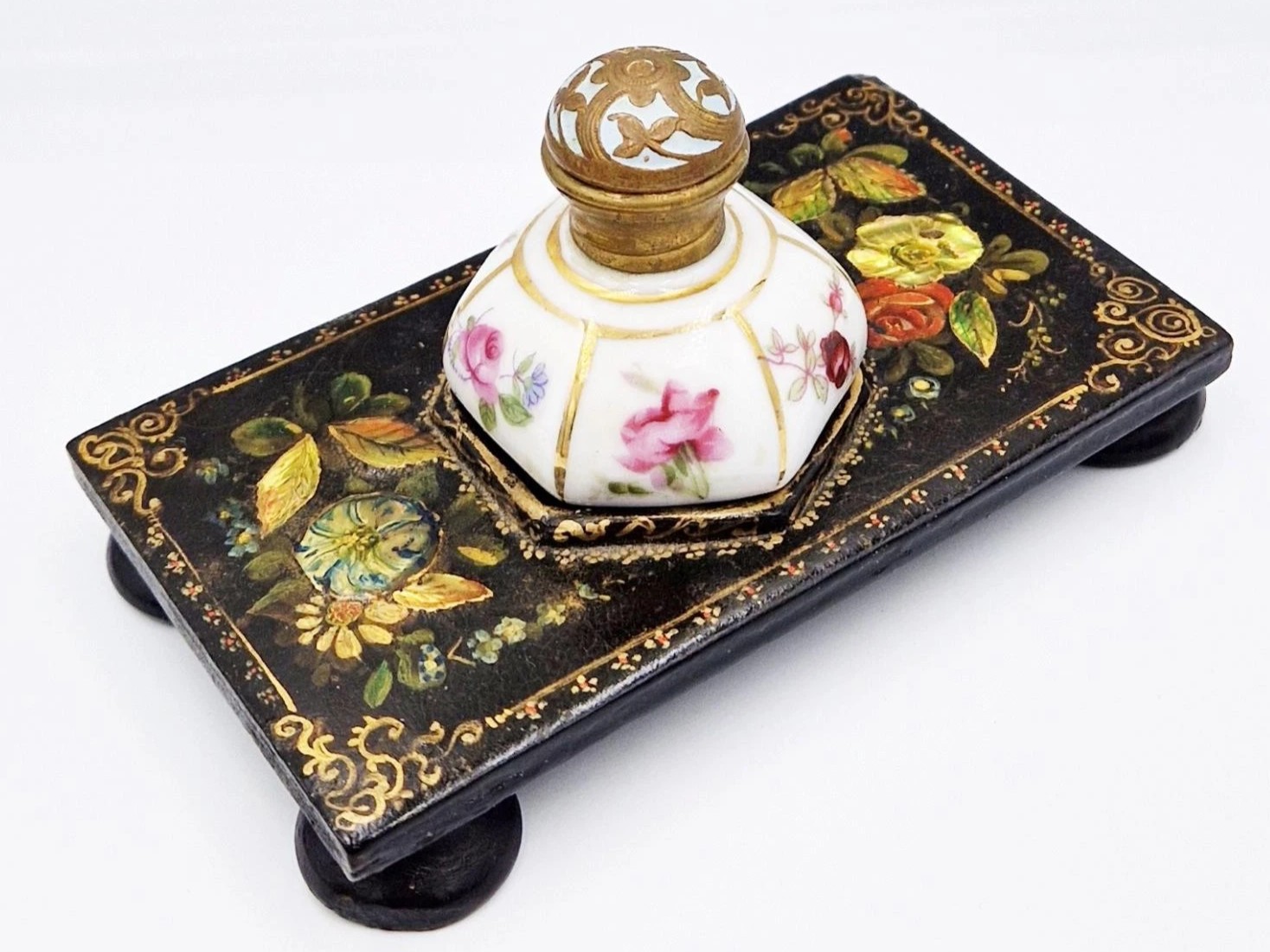
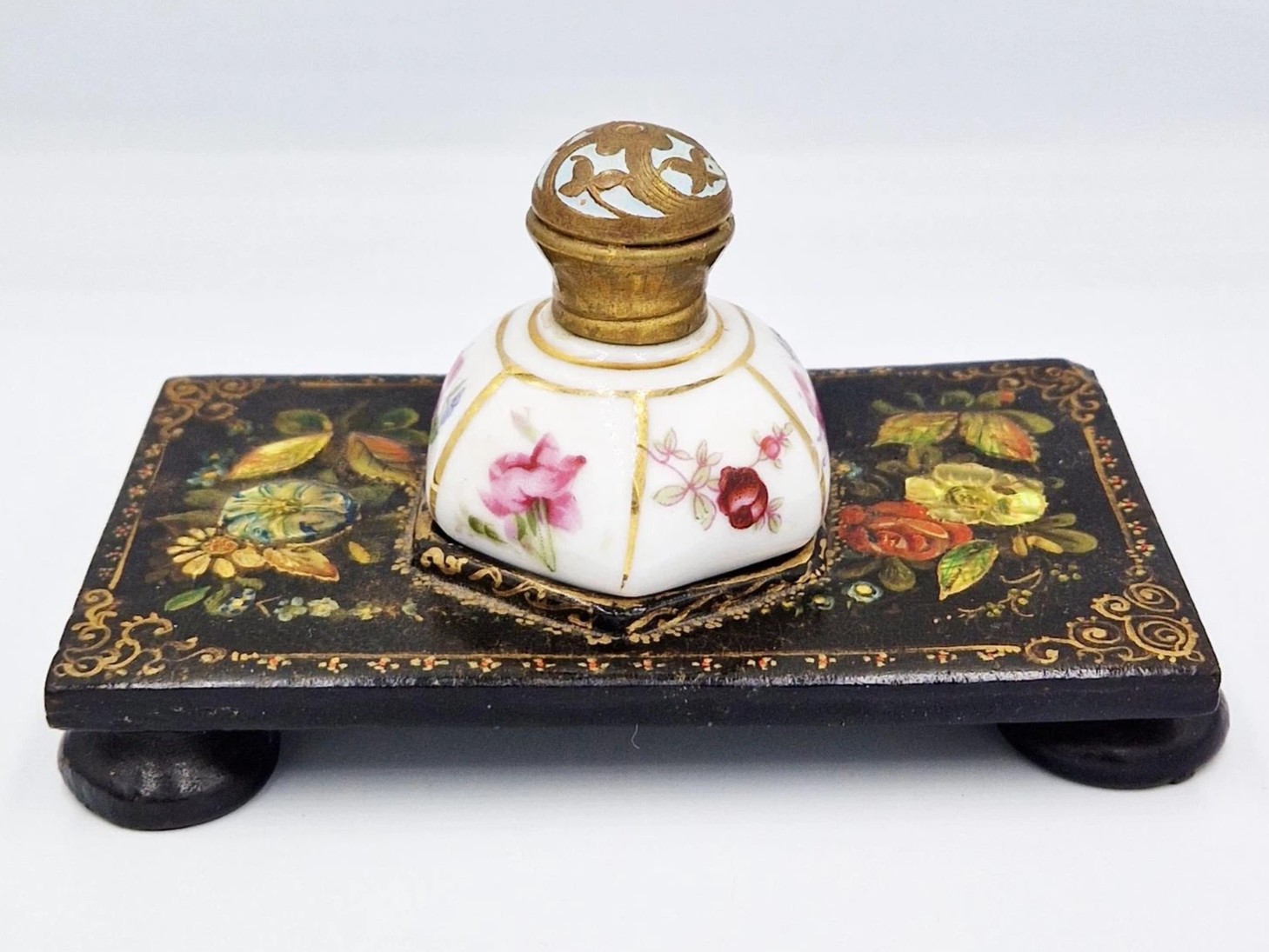


Lacquered Inkstand with Old Paris Porcelain Inkwell
| Categories | Ceramics/Porcelain non-Figural, Wood Inkstands |
| Material | Porcelain, Wood |
| Markings | Unmarked |
| Manufacturer | Jennens and Bettridge |
| Origin | England |
| Date or Era | circa 1855 |
| Measuring | 5” long |
Description
- The Lacquered Stand: The rectangular wooden base is finished in a black “japanned” lacquer, a technique developed in Europe to imitate East Asian lacquerware.
- Ornamentation:
- The Primary Bouquets: The large, central flowers are classic English garden roses in varying shades of pink and crimson.
- Accompanying Flora: The artist has included primroses (identifiable by their heart-shaped petals and bright yellow centers) and small, daisy-like blossoms.
- Gilt Foliage: The fine gold “dotted” work you see surrounding the flowers is a technique often used to mimic stardust or morning dew, adding a layer of depth to the flat black lacquer.
- The Feet: The stand is elevated on four turned, black-painted wooden “bun” feet.
- The Porcelain Inkwell: Sitting in a recessed hexagonal well is a hand-painted porcelain inkwell.
- Shape: It is a low, squat hexagonal form with gilded “ribs” separating each hand-painted floral panel.
- The Lid: the lid features a gilt-brass mount with light blue porcelain.
Origin and Manufacturer
The floral and gilt patterns on this inkstand are matches for the high-end output of Jennens and Bettridge, the most celebrated English firm for japanned and papier-mâché wares during the mid-19th century.
Matching the Floral Hallmarks
- The “English Bouquet” Style: Jennens & Bettridge was specifically celebrated for its “Naturalistic Botany” school of decoration. Their artists were often trained in local design schools to achieve a naturalistic, “painterly” depth that was rarely matched by smaller firms.
- The “Naturalistic” Shift: Top-tier artists at the firm were encouraged to move away from “Giftware” clichés like the forget-me-not. Instead, they focused on painting specific garden varieties—like the primroses on this inkstand—with botanical accuracy and painterly depth.
- Technical Markers: The “dotted” or stippled gilt scrollwork framing the floral panels is a documented technical signature of the firm. It was a labor-intensive method used to create a shimmering, textured border that reflected light differently than standard flat gilding.
- Hybrid Luxury: The firm frequently collaborated with Parisian porcelain workshops to create these hybrid sets. The fact that the porcelain inkwell features the same specific primrose palette as the inkstand confirms this was an integrated luxury product rather than a later assembly.
- Royal Influence: The Neo-Rococo scrollwork and heavy black japanned finish were perfected by the firm during their tenure as “Makers to the Queen,” specifically between 1845 and 1860.
The “Old Paris” Connection
The porcelain inkwell is almost certainly a piece of “Old Paris” (Vieux Paris) porcelain, produced in one of the independent workshops near the Marais district.
- Hybrid Luxury: It was common for Jennens and Bettridge to design their stands to accommodate premium French porcelain inserts, which were imported to Birmingham for the final assembly of high-end desk sets.
Sold for $140 in December 2025
Content disclaimer. The information posted is the owner’s best knowledge and may not have been vetted by the SOIC. We welcome comments, corrections, and additions, working to make our website information comprehensive and accurate.
Join the Society of Inkwell Collectors (SOIC) – it’s free!
Founded in 1981 as a non-profit organization,
we are documenting inkwells (and accessories).
We’re here to help and inform!