


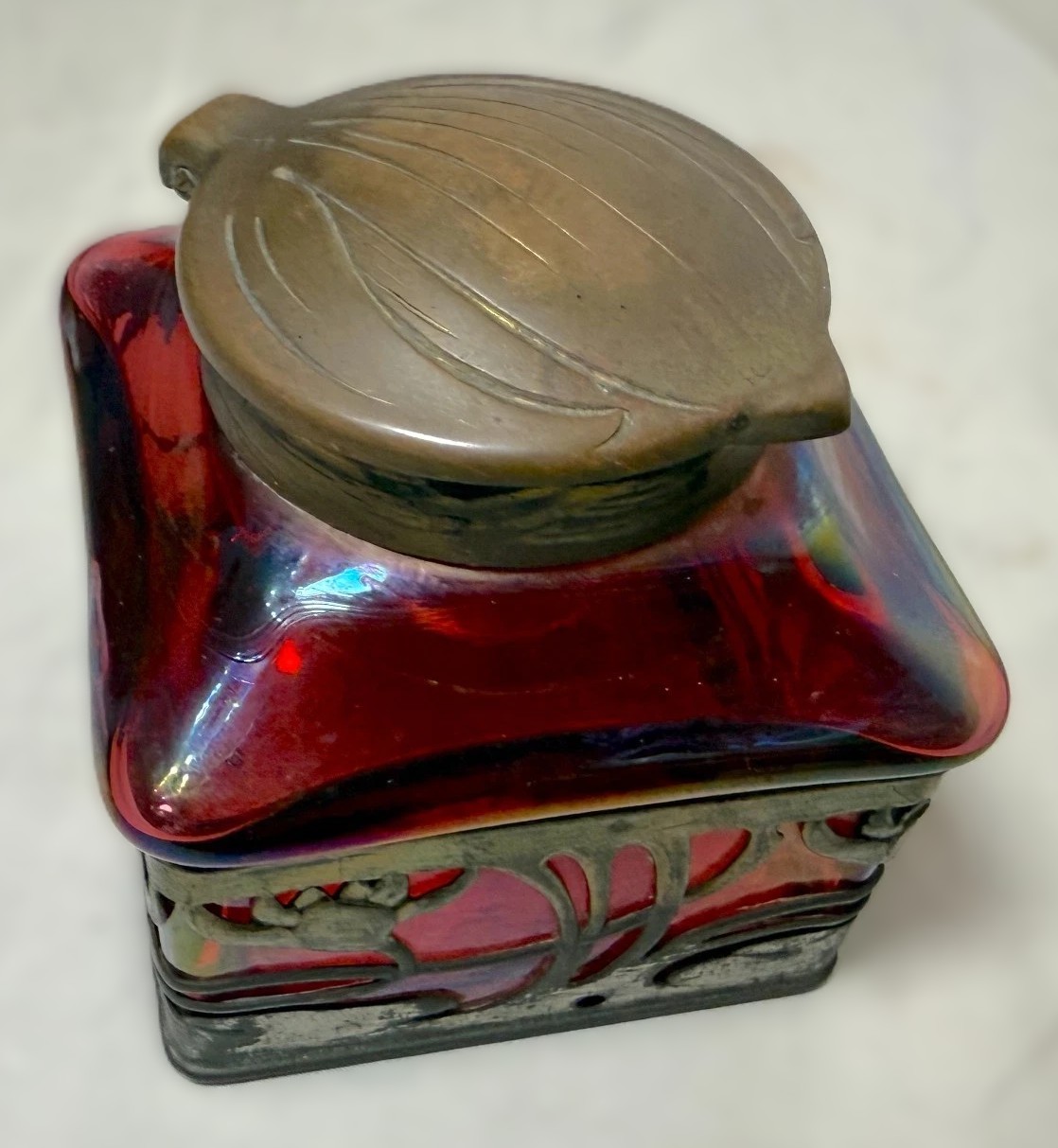


Kralik Iridescent Glass with Water Lily Overlay
| Categories | Bohemian Art Glass |
| Material | Glass |
| Markings | See Narrative |
| Manufacturer | Kralik |
| Origin | Bohemia |
| Date or Era | circa 1905 |
| Measuring | 3” x 3” x 3” high |
This inkwell balances organic movement with rich, metallic tones.
The Glass Base
- Form: The body features a squat, heavy square form with softly rounded corners that gracefully taper inward as it rises toward the shoulder and collar.
- Color and Finish: The base is crafted from a vibrant, cranberry-red art glass. Its surface has been treated with a striking reduction-fumed iridescent finish, giving the glass a lustrous, oil-slick sheen. Depending on how the light hits the faceted shoulders, the glass shifts dynamically, flashing brilliant undertones of peacock blue, violet, gold, and amber.
The Water Lily Overlay
- Technique: The inkwell uses a classic Bohemian “caged” technique. The molten red glass was blown directly into a pre-made, pierced metal armature, allowing the hot glass to expand slightly out of the open spaces, creating an integrated, sculptural depth.
- Design: The overlay forms a continuous decorative band of whiplash Art Nouveau lines. Sweeping, sinuous water lily tendrils and stylized lily pads anchor the bottom edge, while elongated stems curve upward to frame fully bloomed water lily blossoms on each of the four faces. The metal casing has an aged pewter-like patina that provides a stark contrast to the fiery red glass underneath.
The Mounts and Lid
- The Collar and Lid: Crowning the piece is a heavy copper-alloy collar fitted with a low-profile, hinged lid shaped like a stylized lily pad or a broad leaf. The surface of the lid features crisp, incised veins that radiate naturally toward the leaf’s point, completing the cohesive aquatic botanical theme of the desk piece.
Reading and Interpreting the Marks
The stamped marks on the underside of the copper-alloy lid read:
- O.E.P. 10385
- D.R.G.M. 168180 (Note: The final digit “0” is faint/partially obscured near the edge of the hinge curve)
The Interpretation:
- O.E.P. stands for Oesterreichisches Patent (Austrian Patent).
- D.R.G.M. stands for Deutsches Reich Gebrauchs Muster. This was a German Imperial design registry or “utility model” patent that offered quick, cost-effective design protection (usually lasting 3 to 6 years).
- These specific patent and registration numbers (O.E.P. 10385 and D.R.G.M. 168180) were granted right around 1901–1902 to protect the specific mechanical design of this leaf-shaped hinged collar assembly.
The Maker:
This inkwell was made by Wilhelm Kralik Sohn (commonly known simply as Kralik).
Why it is Kralik:
- The exact patent numbers O.E.P. 10385 and D.R.G.M. 168180 are famous, definitive identifiers used almost exclusively on metal-mounted inkwells produced by Kralik.
- Kralik was highly regarded for its iridescent glass finishes designed to compete directly with Loetz and Tiffany.
- This particular method—blowing a rich, vibrant iridescent glass directly into a pre-formed, pierced metal “cage” or overlay featuring whiplash Art Nouveau waterlilies—is a textbook Kralik production technique from the turn of the 20th century.
Age
- Production Date: Circa 1901–1905
Cross-reference: Bohemian Art Glass Inkwell with Water Lily Overlay – The Society of Inkwell Collectors (SOIC)
Sold for $276 in May 2026
Content disclaimer. The information posted is the owner’s best knowledge and may not have been vetted by the SOIC. We welcome comments, corrections, and additions, working to make our website information comprehensive and accurate.
Join the Society of Inkwell Collectors (SOIC) – it’s free!
Founded in 1981 as a non-profit organization,
we are documenting inkwells (and accessories).
We’re here to help and inform!