

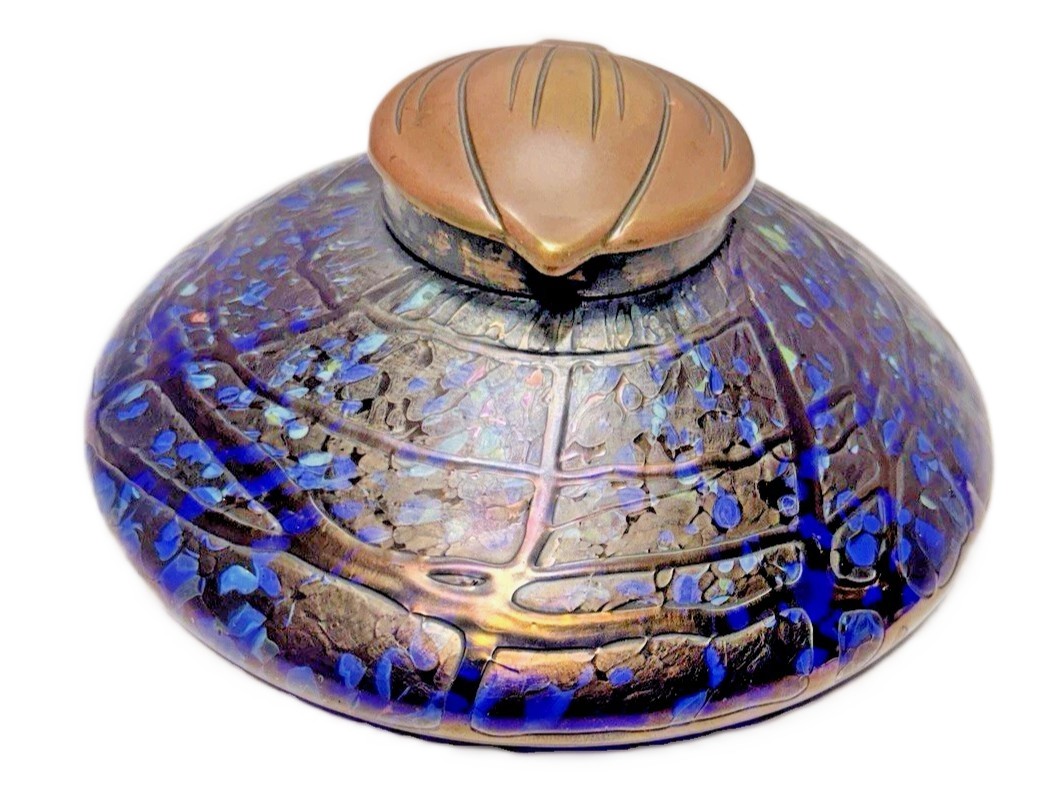
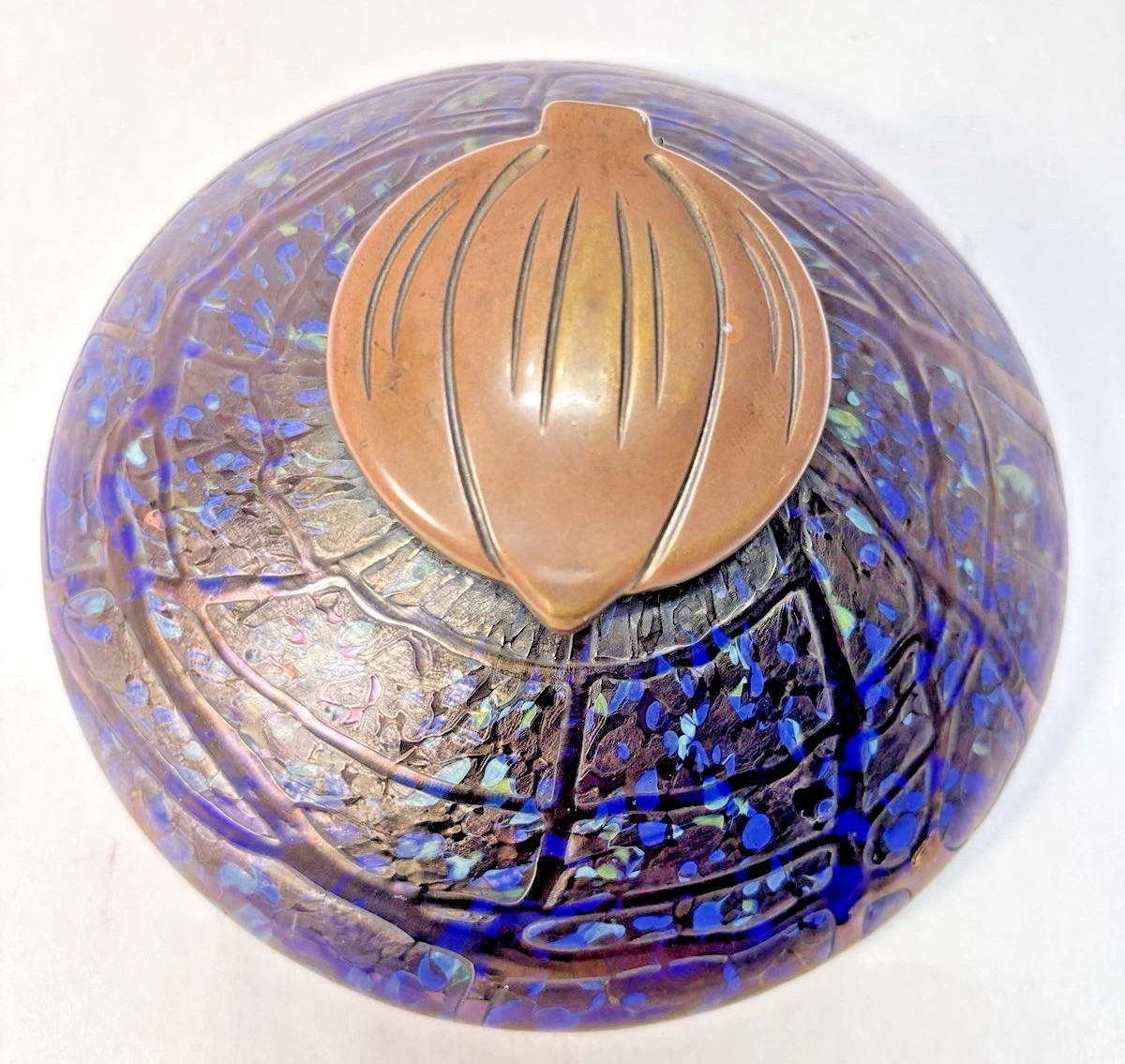
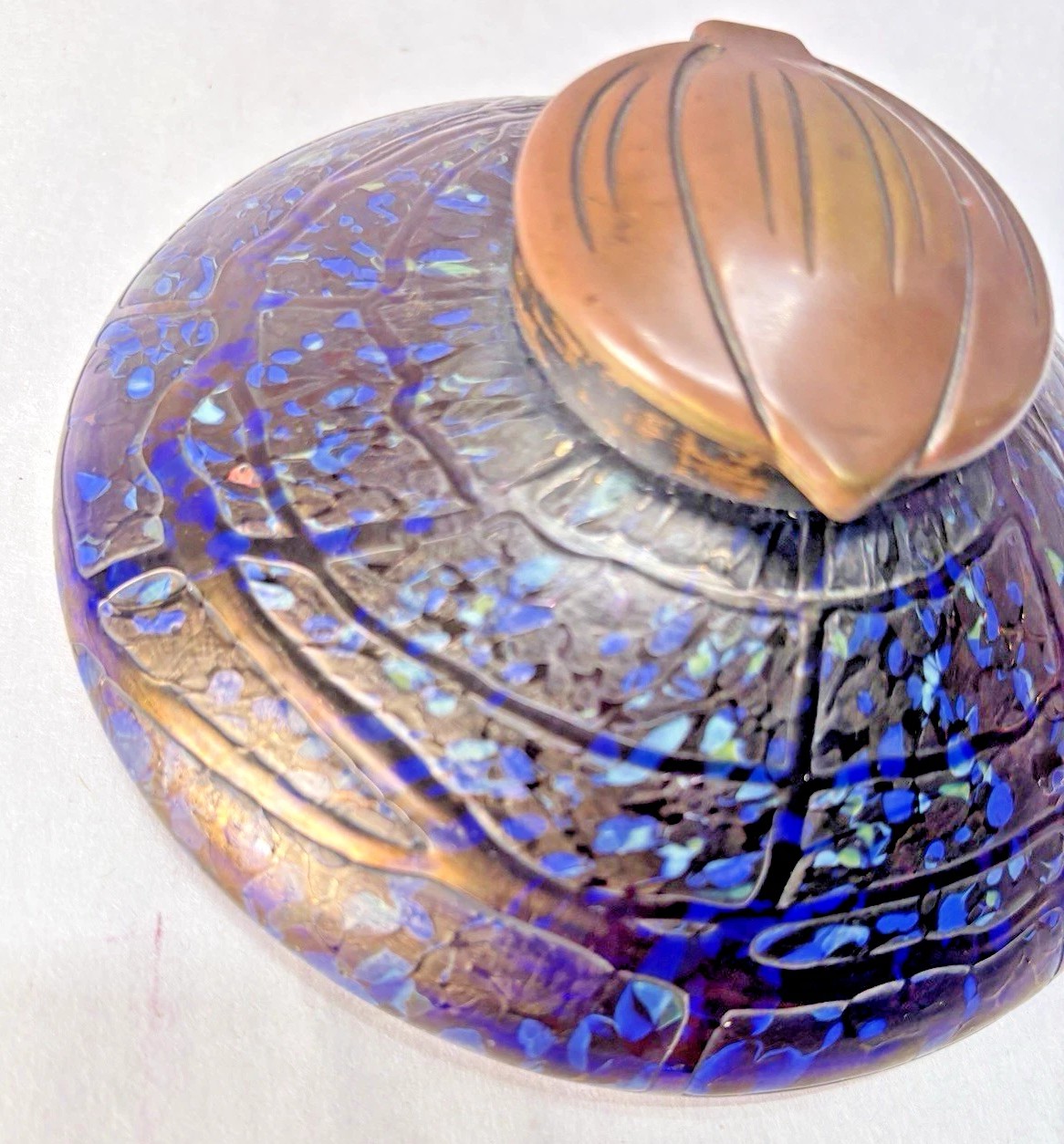


Kralik Iridescent Art Glass Inkwell
| Categories | Bohemian Art Glass |
| Material | Glass |
| Markings | Unmarked |
| Manufacturer | Kralik |
| Origin | Bohemia |
| Date or Era | circa 1905 |
| Measuring | 5 ½” diameter; 2 ¼” high |
That is a stunning example of Art Nouveau glass. This classic “Veined” or “Webbed” décor was a hallmark of several Bohemian glasshouses at the turn of the 20th century.
Identifying the Maker: Kralik vs. Loetz
While both firms produced iridescent glass with pulled webbing, the “O.E.P. 10385” and “D.R.G.M. 168180” marks are definitive clues.
- The Patent Mark: The D.R.G.M. 168180 is a known design registry number frequently associated with Wilhelm Kralik Sohn. While Loetz is often the first name people think of for Bohemian glass, Kralik produced a vast array of these “cracked” or “veined” iridescent inkwells.
- The Difference: Loetz glass tends to have a more refined, oily “sheen” with very smooth transitions between colors. Kralik’s “Veined” décor (often called Bacillus or Martelé in certain variations) typically features a more textured, “crackle” effect where the metallic webbing feels physically raised or deeply recessed against the glass body, as seen in your photos.
Glass Aesthetics: Color and Webbing
The glass body is a deep cobalt blue base, heavily saturated with metallic oxides to create a vibrant iridescence.
- Visual Effect: The surface mimics the look of peacock feathers or oil on water. The “web effect” creates a network of golden-bronze lines that “trap” the blue and green iridescent flecks, giving the piece a sense of organic movement—almost like a frozen liquid or a biological cell structure.
- Iridescence: This is a Favrile-style or “Lustre” finish, where the glass reflects light in a metallic, multi-colored spectrum including violet, gold, and emerald.
The Technical Process
Achieving this “webbed” look required a multi-step hot-glass technique:
- The Base: A gather of molten cobalt blue glass was blown into a basic shape.
- The Veining: While the glass was still red-hot, it was wrapped with thin strands of “glass thread” or dipped into a different colored frit.
- Expansion & Crackle: The piece was then re-heated and blown further. As the glass expanded, the outer “web” layer would stretch and break apart (or “crackle”), creating the distinct network of lines.
- Fuming: To get the metallic shine, the hot glass was exposed to metallic vapors (like stannous chloride or silver nitrate) in a reduction kiln. These vapors bonded to the surface, creating the thin, shimmering metallic film.
The Lid: Design and Markings
The lid is a beautiful example of Jugendstil (the German/Austrian Art Nouveau) metalwork.
- Stylized Design: Rather than a simple leaf, this is often interpreted as a stylized bud or a closed lotus. The vertical, slightly curved repoussé lines give it a ribbed, organic feel that complements the “veined” glass.
- Markings:
- O.E.P. 10385: Österreichisches Patent (Austrian Patent). This specific patent often refers to the hinge mechanism or the airtight seal design of the inkwell lid.
- D.R.G.M. 168180: This stands for Deutsches Reichs-Gebrauchsmuster. It was a way for manufacturers to protect a “utility model” or a design for 3–6 years without the full cost of a patent. This specific number is a known “Kralik” identifier.
Sold for $477 in January 2026
Content disclaimer. The information posted is the owner’s best knowledge and may not have been vetted by the SOIC. We welcome comments, corrections, and additions, working to make our website information comprehensive and accurate.
Join the Society of Inkwell Collectors (SOIC) – it’s free!
Founded in 1981 as a non-profit organization,
we are documenting inkwells (and accessories).
We’re here to help and inform!