

Inkipedia


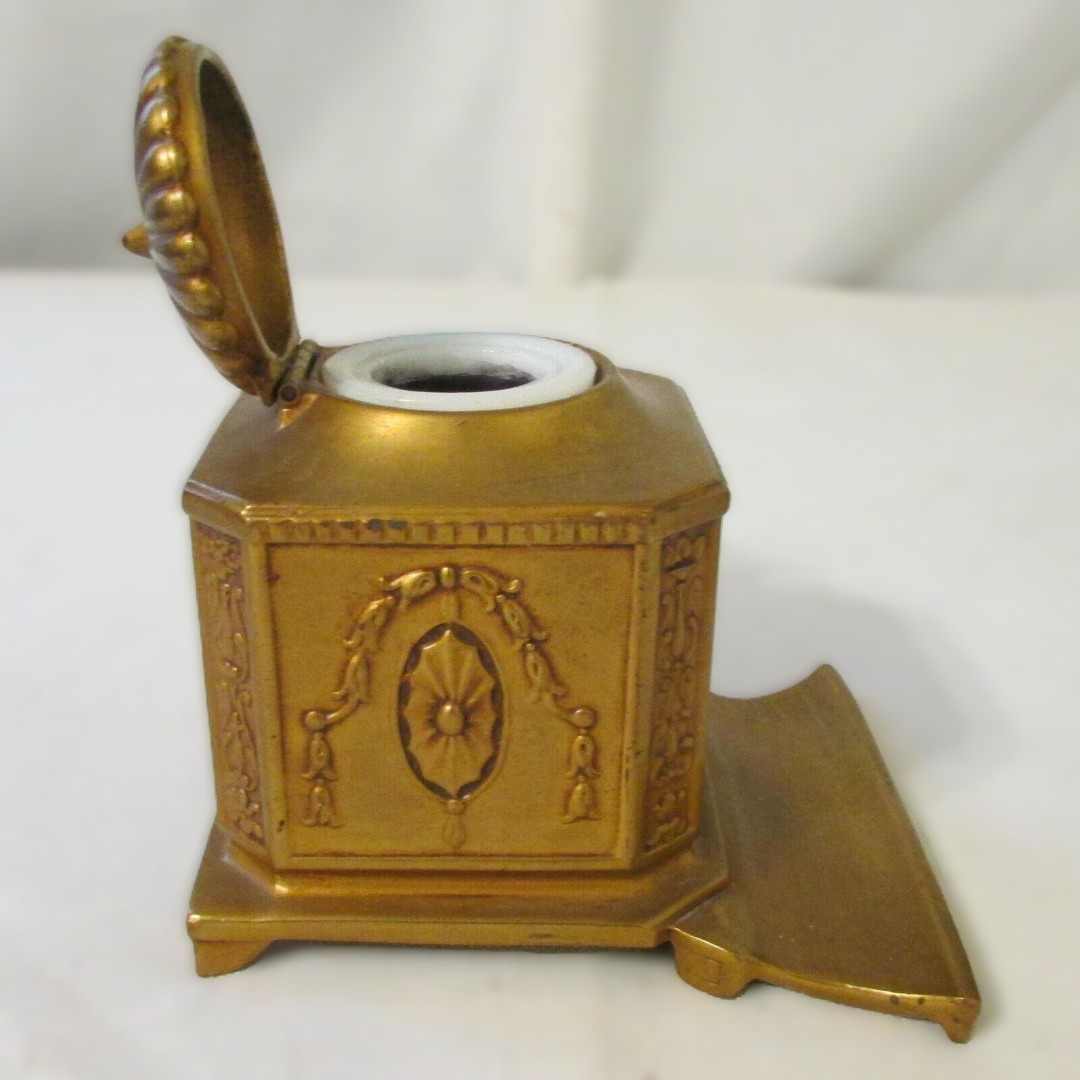


Jennings Brothers Inkstand
| Categories | Art Nouveau |
| Material | Spelter |
| Markings | JB 1622 |
| Manufacturer | Jennings Brothers |
| Origin | United States |
| Date or Era | circa 1910 |
| Measuring | 4 ⅛” x 3 ¾” x 3 ½” high |
- Identification and Description
This is a classic example of American Art Nouveau metalware, produced during the “Golden Age” of desk accessories.
- The Design: The inkwell features a square body with a domed, ribbed lid that mimics a melon or gourd shape. The front and side panels are decorated with high-relief oval medallions. Inside each medallion is a “Dancing Nymph” or Muse—a female figure in flowing, classical drapery, captured in mid-step.
- Decoration: Surrounding the central figure are neoclassical floral swags and garlands. The corners feature pilaster-like details with stylized vertical floral motifs, blending Art Nouveau curves with Beaux-Arts symmetry.
- Function: The front of the base extends outward to form a concave pen tray (pen rest). The hinged lid opens to reveal the original white milk glass insert.
- Material: Like most Jennings Brothers pieces, this is made of spelter (a zinc-based “white metal” alloy) that was heavily plated or painted with a gold (ormolu) finish. Jennings Brothers was famous for their ability to cast this metal with such precision that it looked like solid bronze.
- The inkwell is a part of a set of desktop items which included a letter holder, rocker blotter, and stamp box.
- Markings and Dating
- The Mark: The underside is stamped “JB” and “1622”.
- “JB”: Stands for Jennings Brothers.
- “1622”: This is the catalog model number.
- Date of Manufacture: Based on the Art Nouveau styling (the flowing female figure) combined with the Neoclassical symmetry (the garlands and square shape), this piece dates to circa 1900–1915. This was the peak of popularity for this specific aesthetic in American decorative arts.
- About Jennings Brothers (1890–1953)
The Jennings Brothers Manufacturing Company (J.B.) is one of the most respected names in antique American metalware.
- Origin: Founded in 1890 by three brothers—Erwin, Edward, and Henry Jennings—in Bridgeport, Connecticut.
- Reputation: Unlike many competitors who mass-produced cheap, hollow stamped metal items, Jennings Brothers specialized in high-quality casting. They employed talented sculptors and artists to create molds that were incredibly detailed.
- The “J.B. Look”: They were famous for their finishes. They developed techniques to make their zinc-alloy pieces resemble expensive luxury materials like French Ormolu (gold-plated bronze), silver, or dark patinated bronze. Their catalog included clocks, bookends, inkwells, and statues.
- Legacy: The company went out of business in the early 1950s (their molds were sold to a Philadelphia firm in 1953).
Sold for $56 in October 2023; Sold for $37 in November 2025
Content disclaimer. The information posted is the owner’s best knowledge and may not have been vetted by the SOIC. We welcome comments, corrections, and additions, working to make our website information comprehensive and accurate.
Join the Society of Inkwell Collectors (SOIC) – it’s free!
Founded in 1981 as a non-profit organization,
we are documenting inkwells (and accessories).
We’re here to help and inform!