

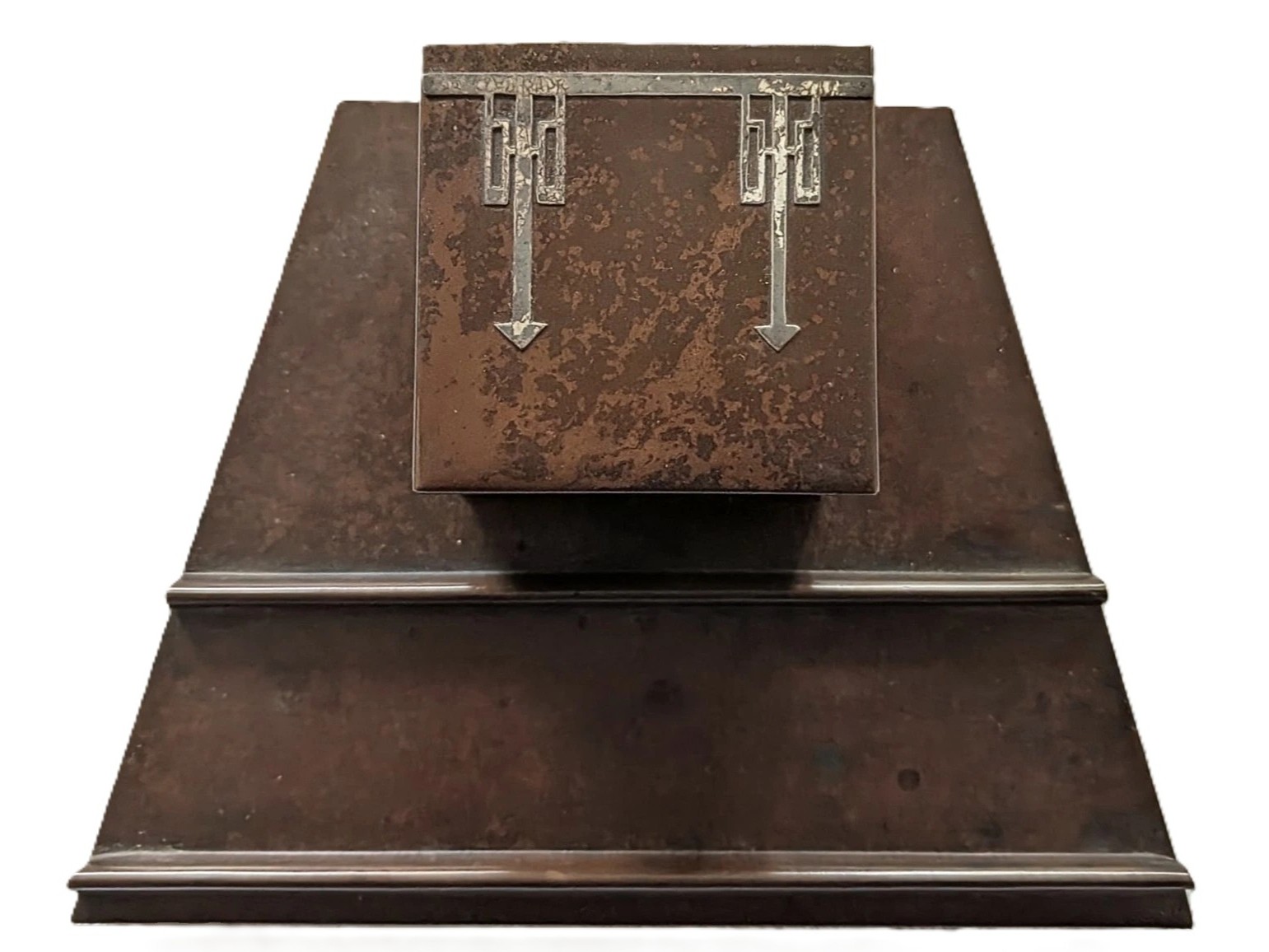
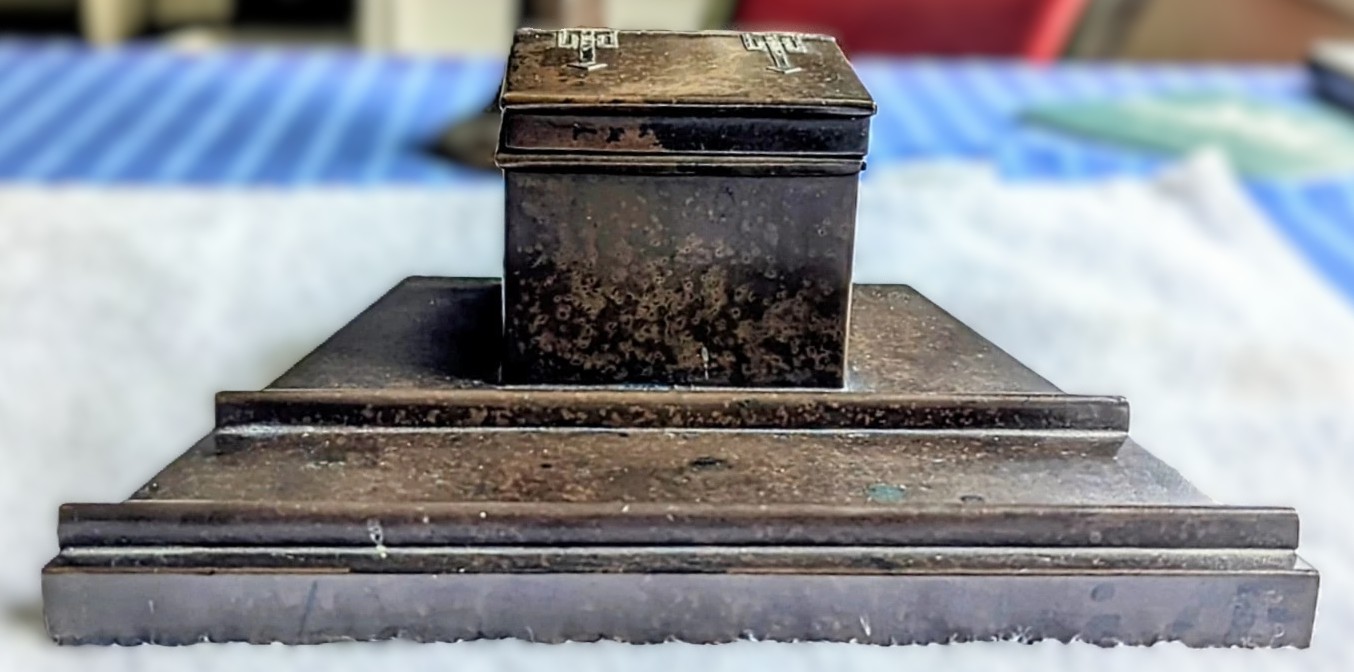
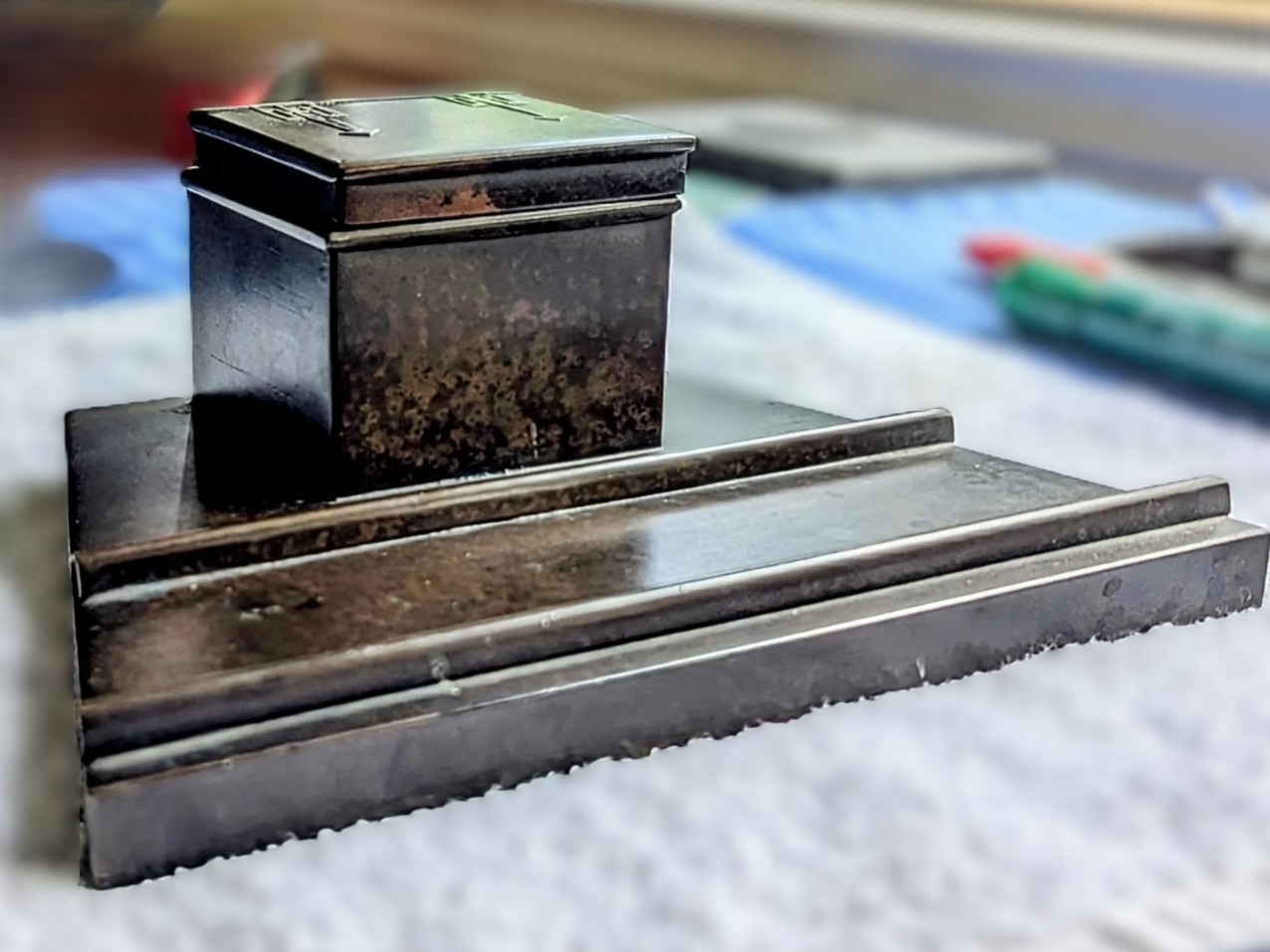
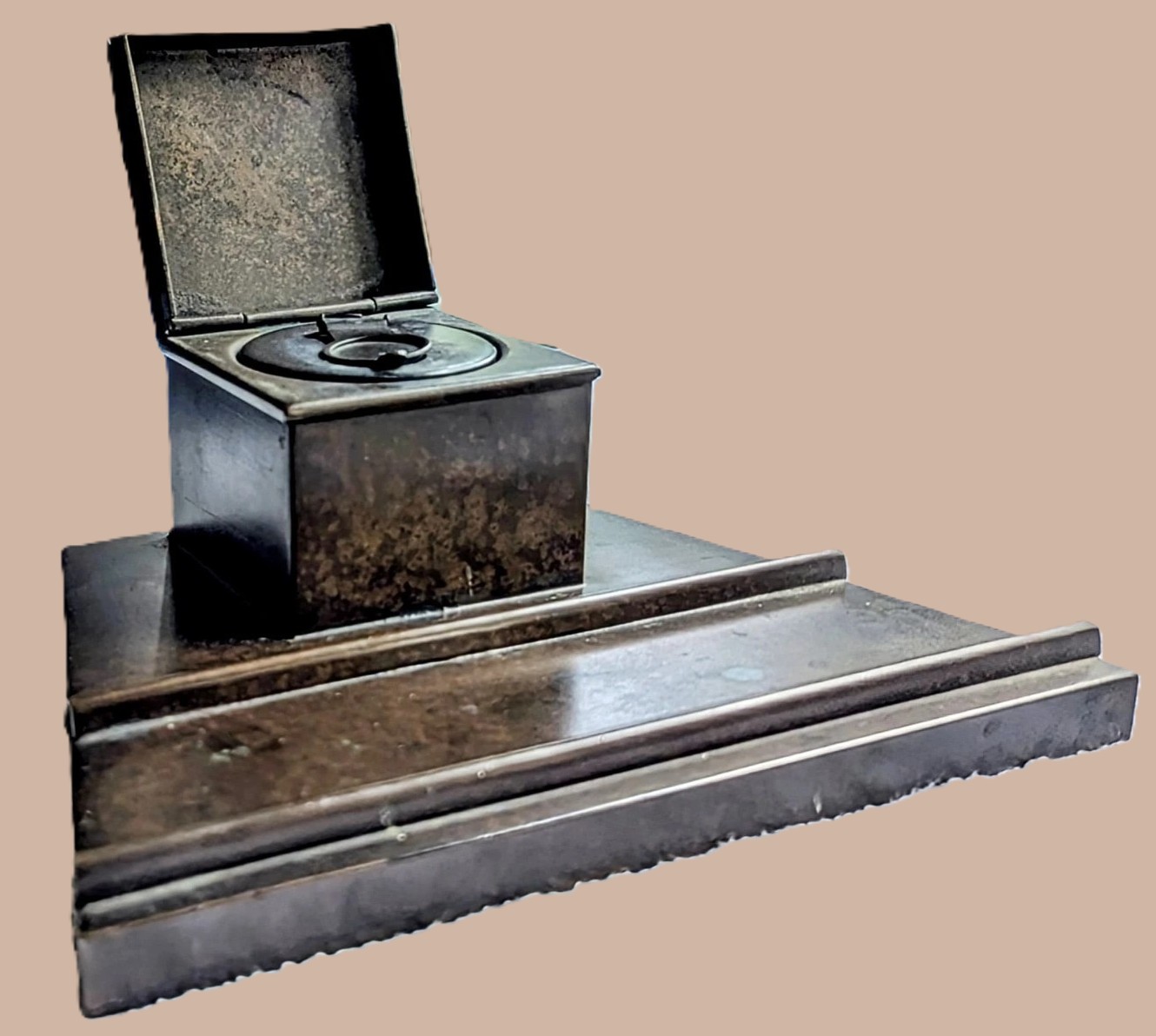
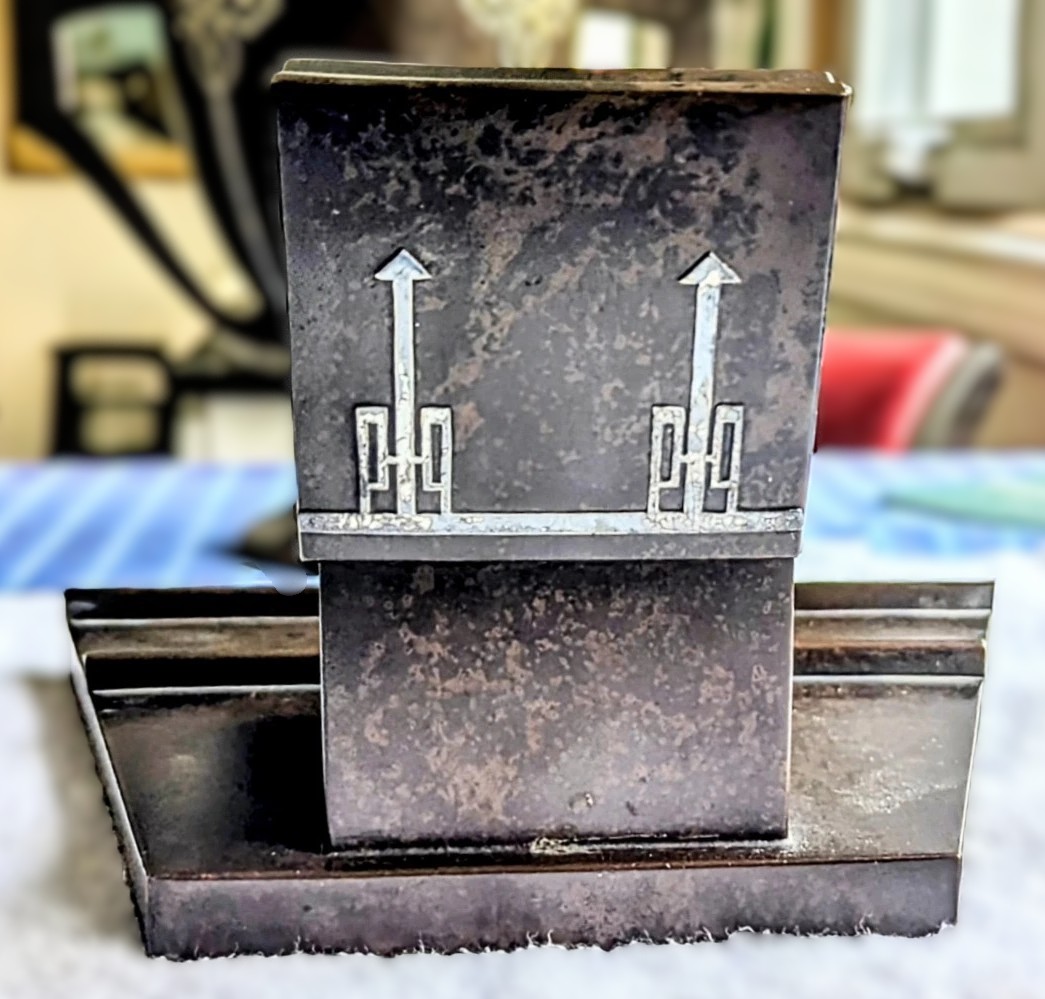
Heintz Art Metal Shop Inkstand with Pen Tray (Model #1162)
| Categories | Arts & Crafts |
| Material | Silver on Bronze |
| Markings | See Narrative |
| Manufacturer | Heintz |
| Origin | United States |
| Date or Era | circa 1920 |
| Measuring | 7 ¼” x 5 ½” x 2 ⅝” high |
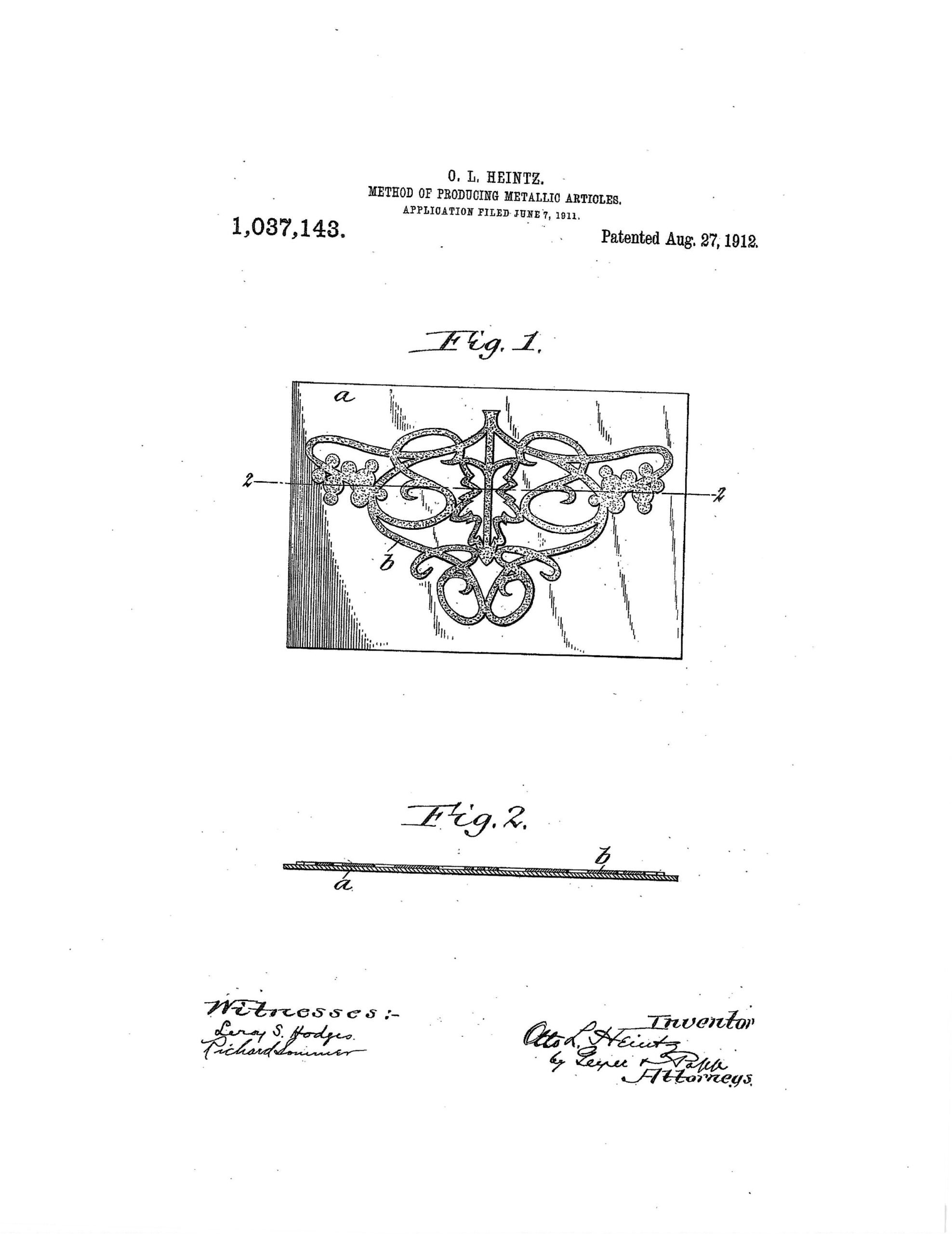
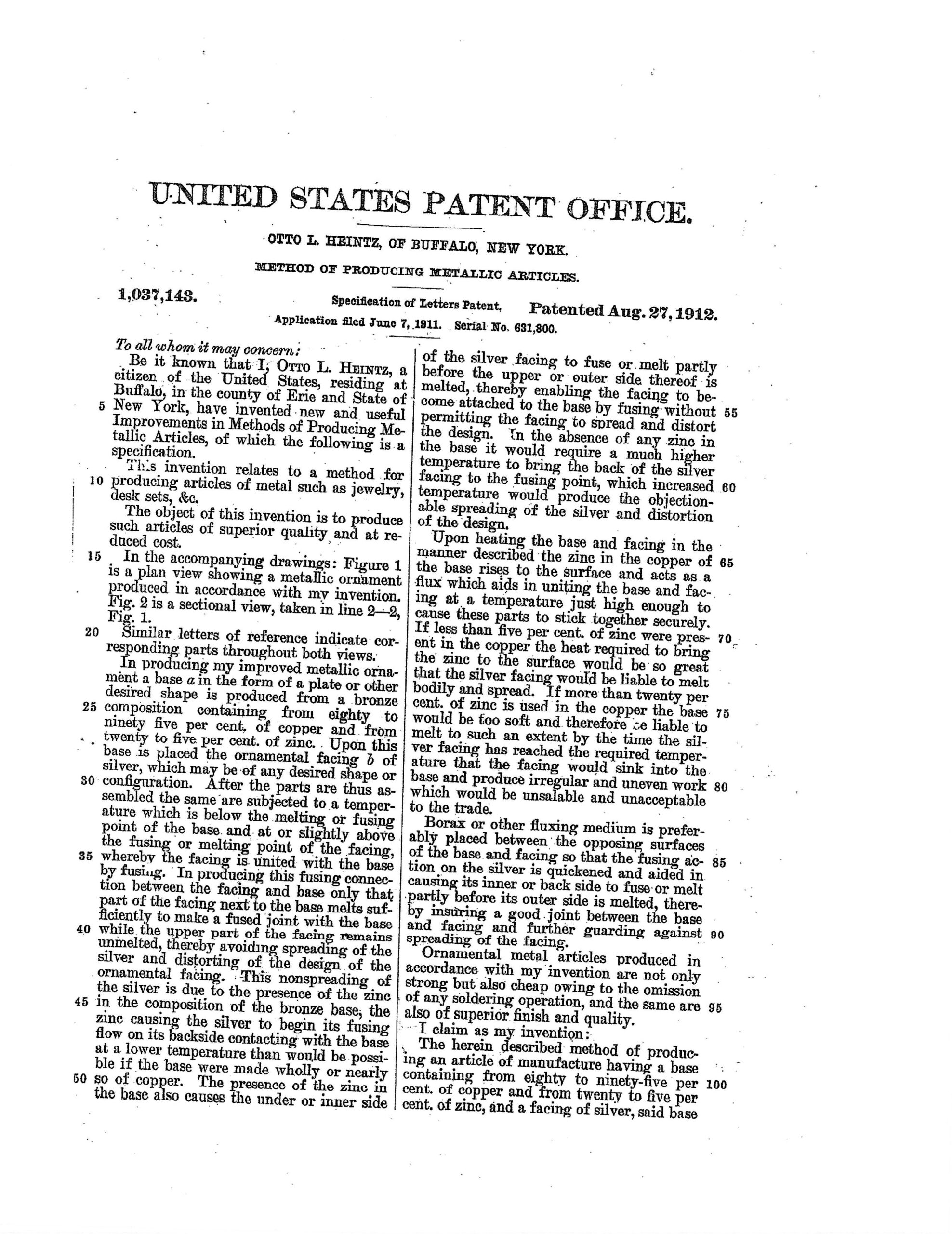
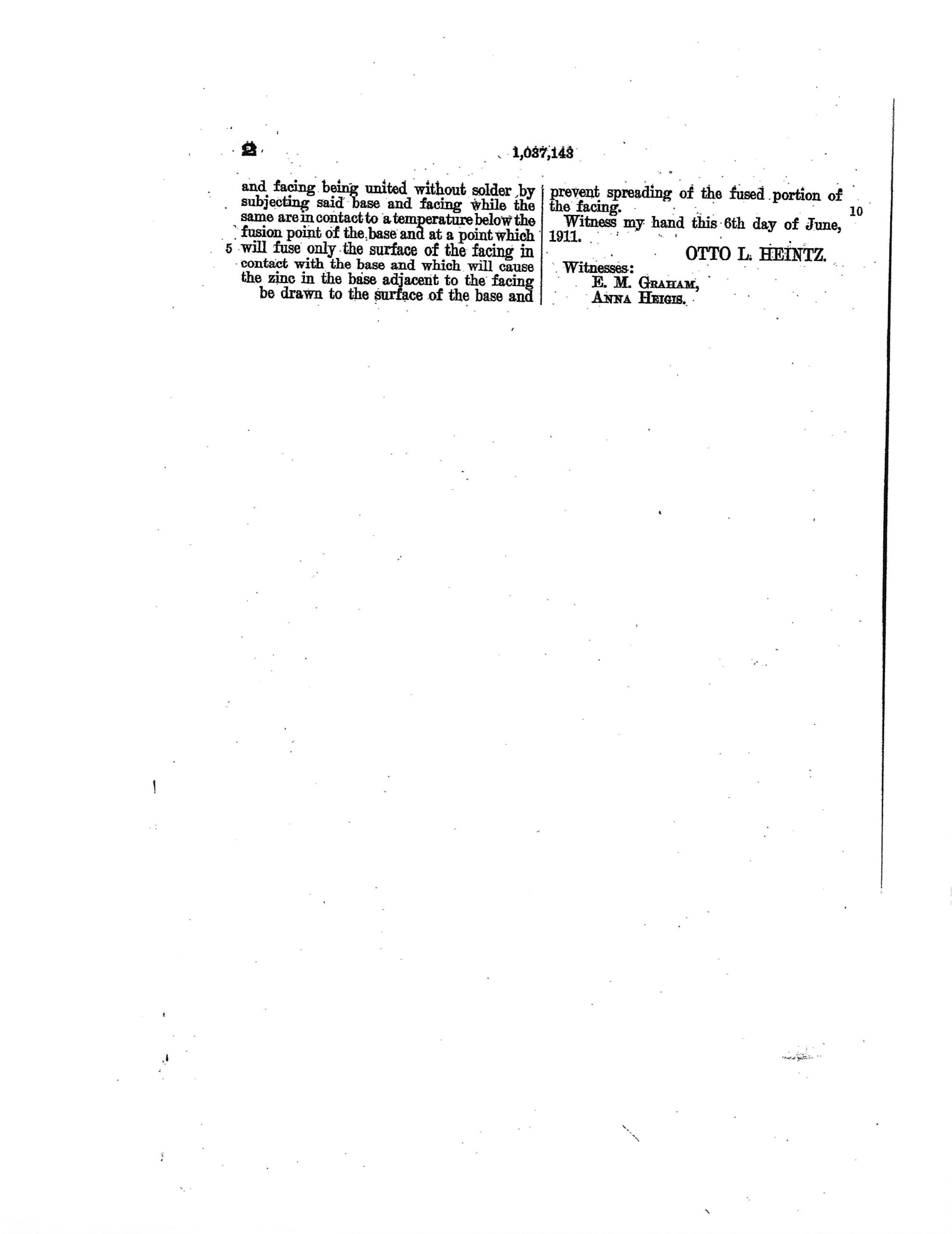
| Patent | U.S. Patent No. 1,037,143 - August 27, 1912 |
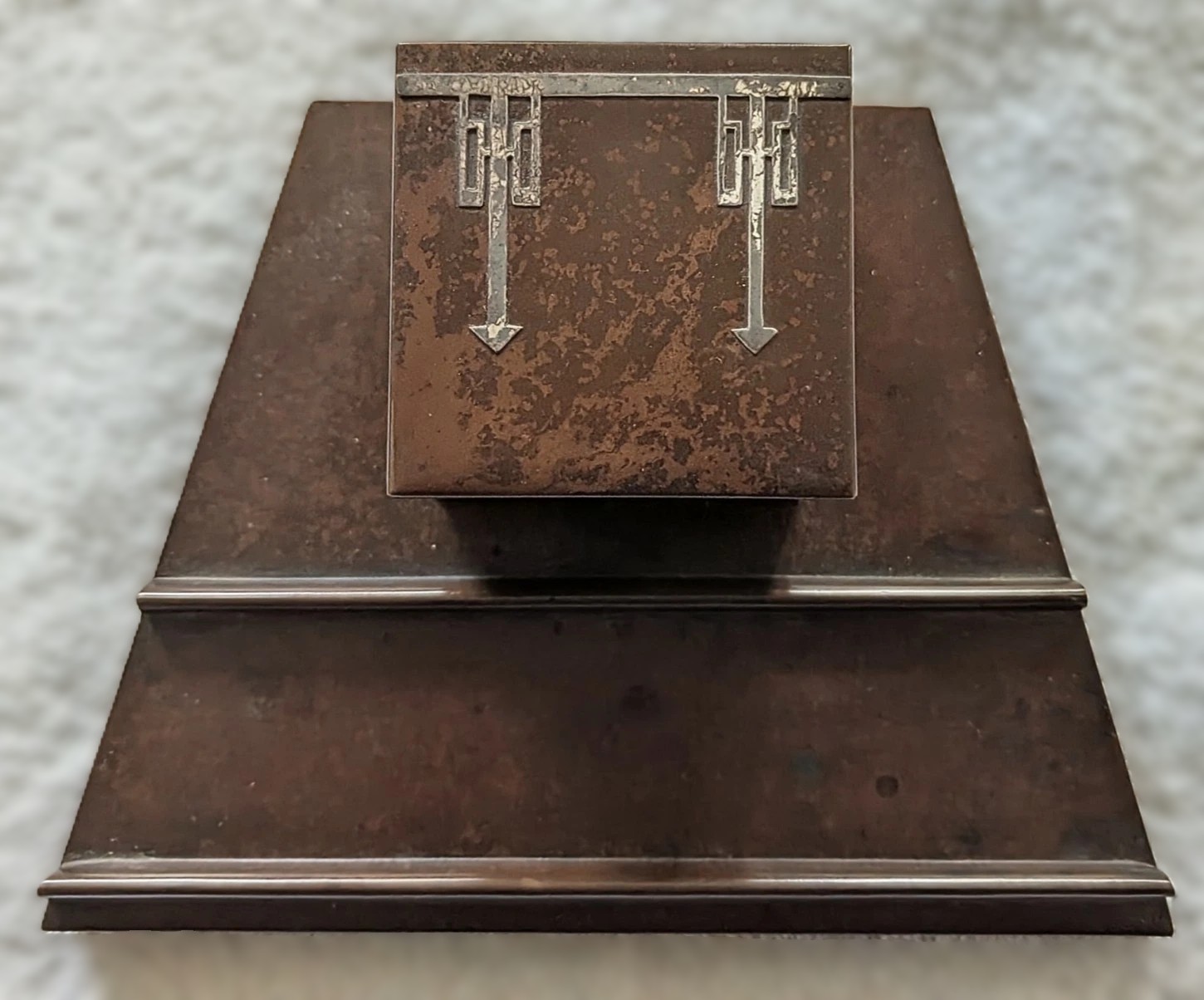
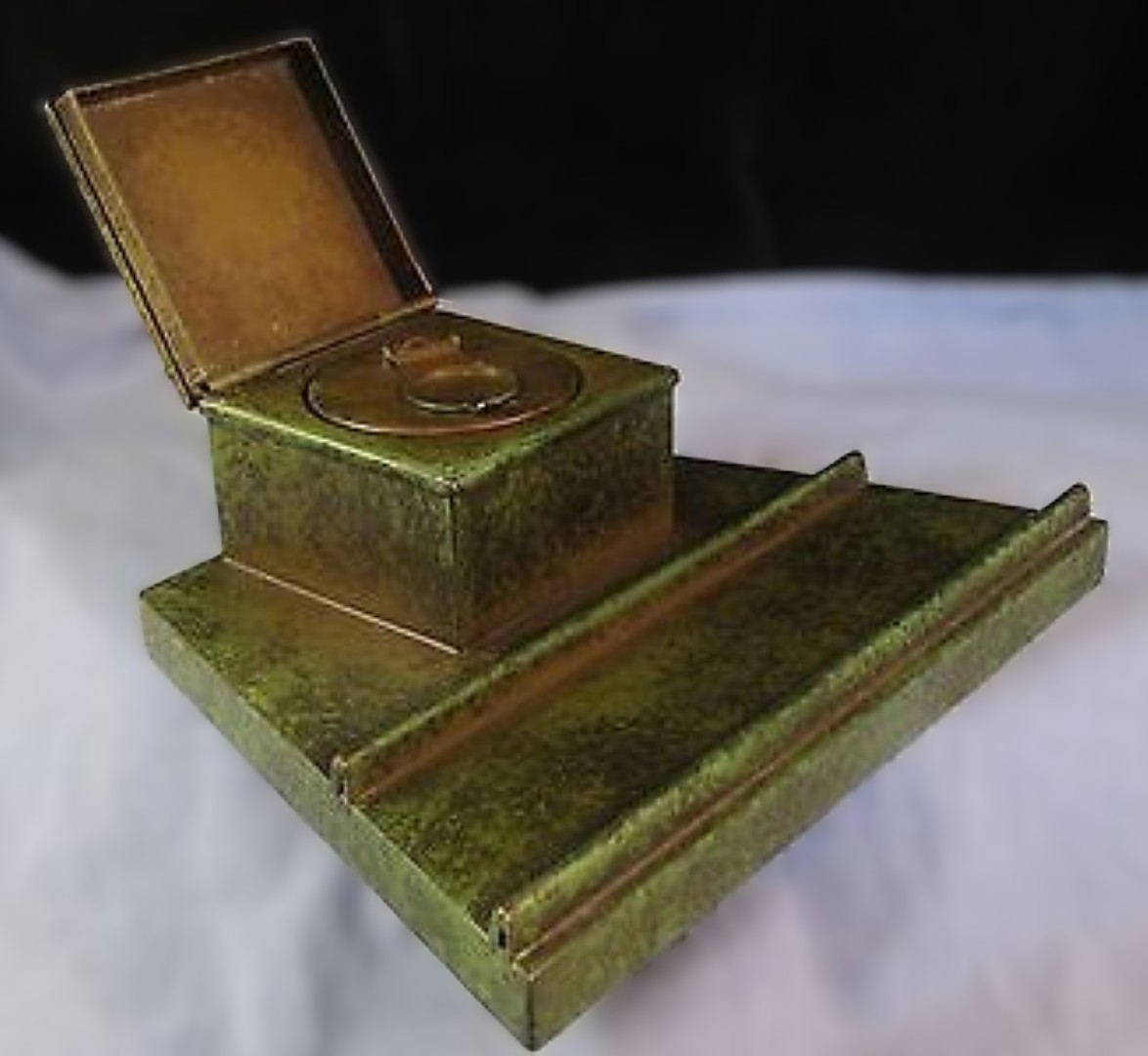
This original Arts & Crafts/early Art Deco inkstand was manufactured in Buffalo, New York, by the Heintz Art Metal Shop. Exhibiting Heintz’s signature rich bronze patina, the piece features clean geometric lines paired with fine sterling silver overlay.
Design & Structural Features
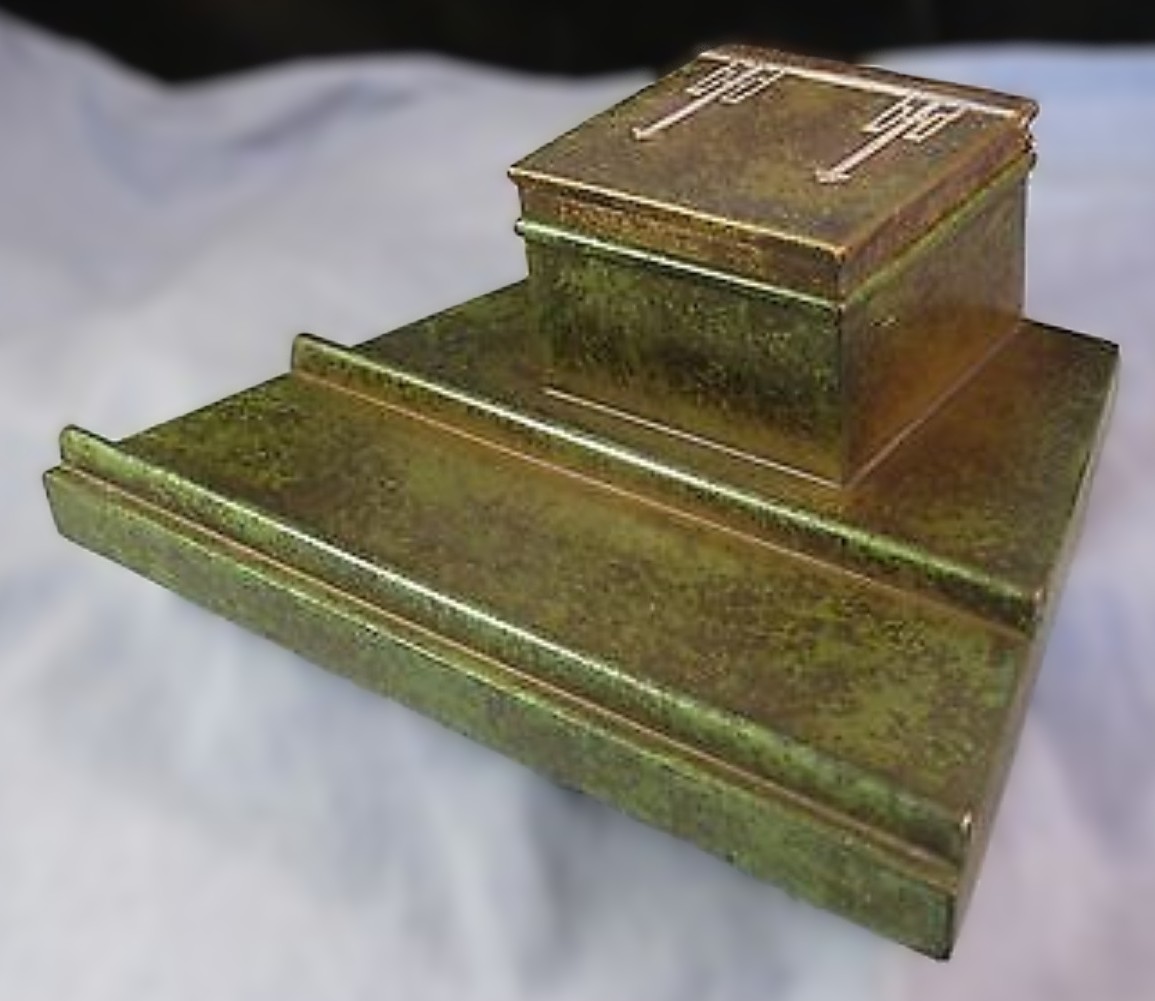
- Base & Pen Tray: A broad, trapezoidal stepped bronze base measuring 7.25″ wide at the front, 5.5″ deep, and 2.63″ high. The front features an integrated, full-width grooved channel designed to rest dip pens or styluses.
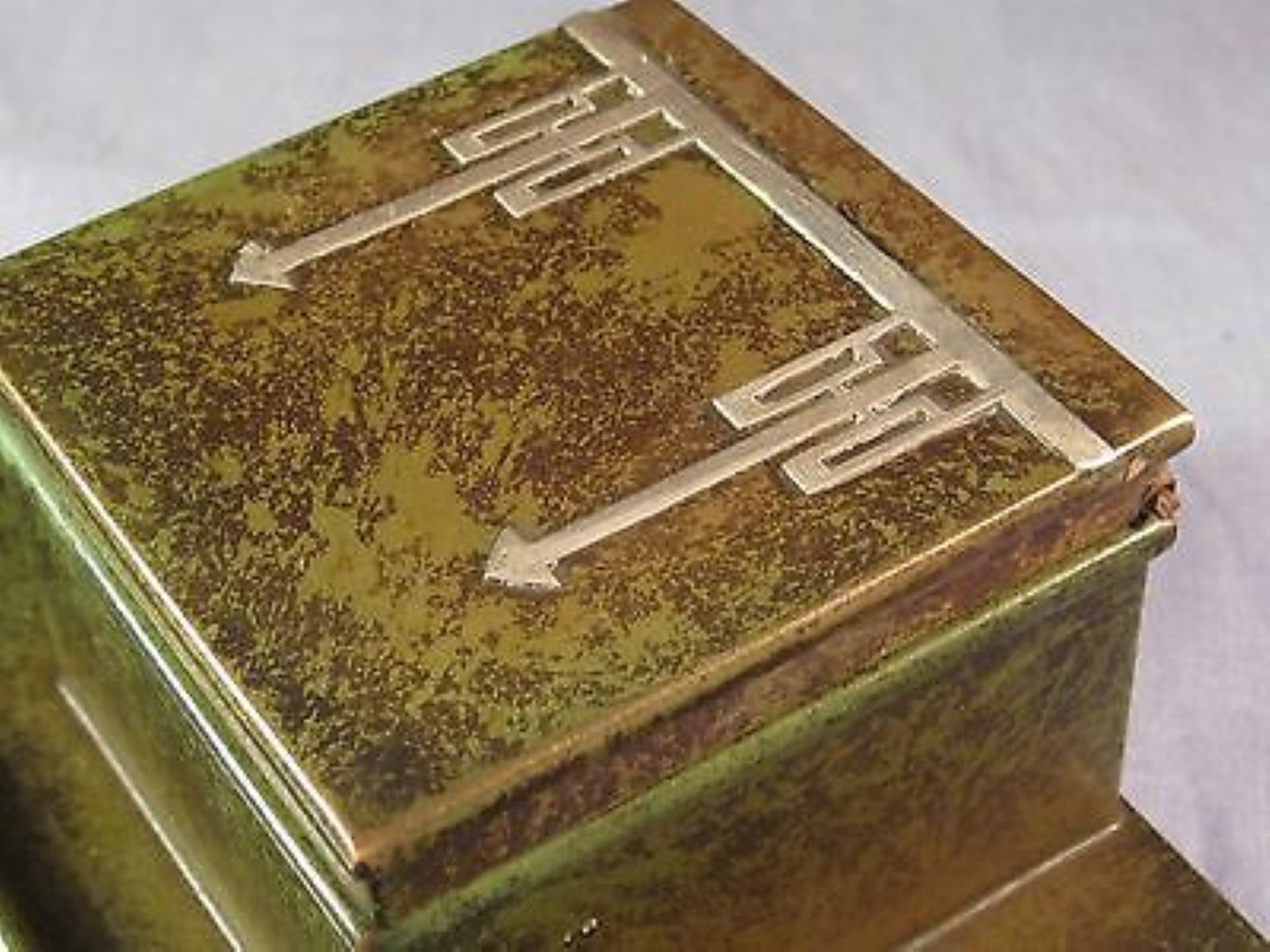
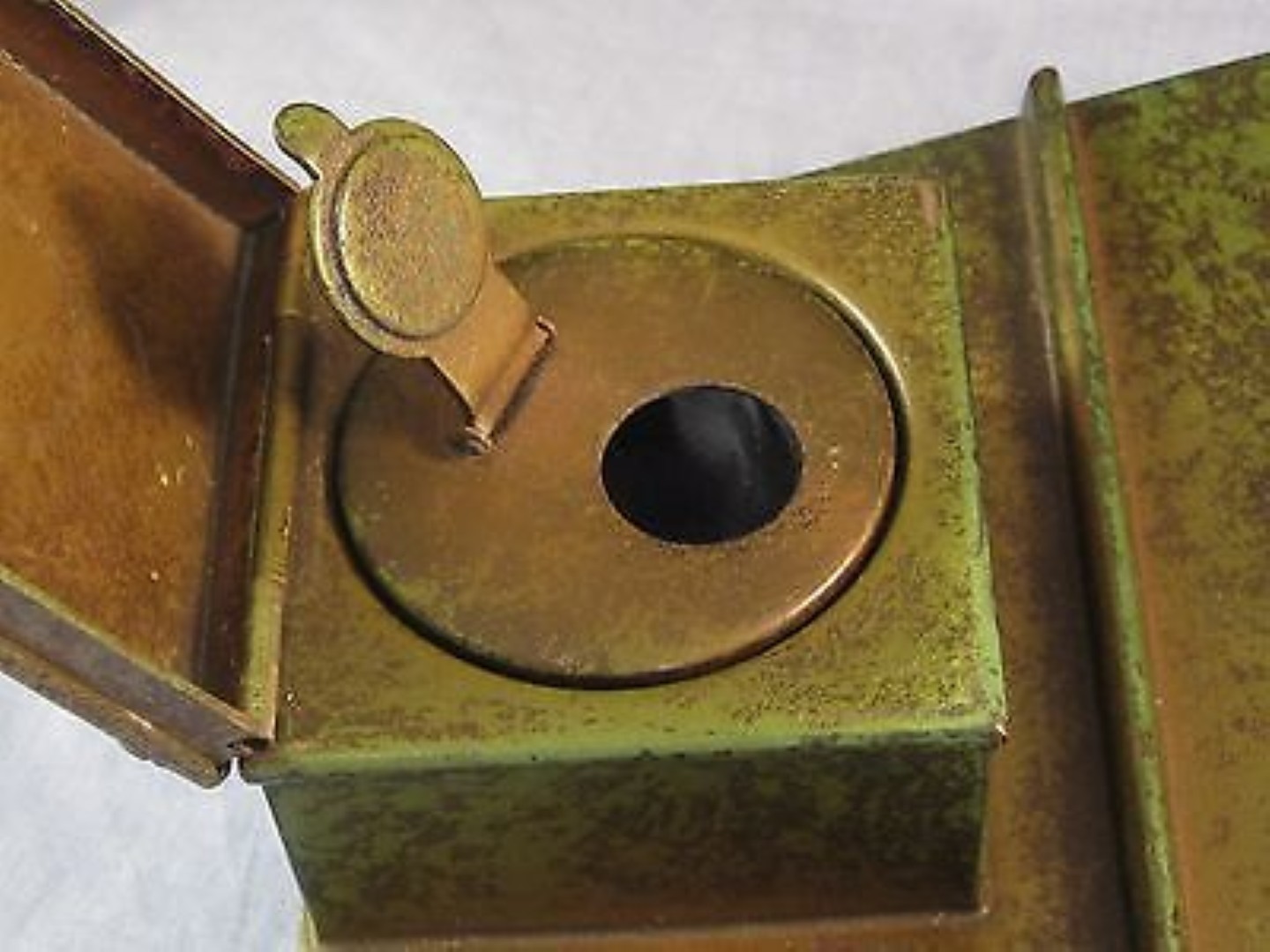
- Hinged Ink Box: A square bronze housing mounted at the back center with a flush-fitting hinged lid. The lid is adorned with a stylized, geometric Art Deco / secessionist silver overlay pattern depicting upward-pointing arrows flanked by open fretwork.
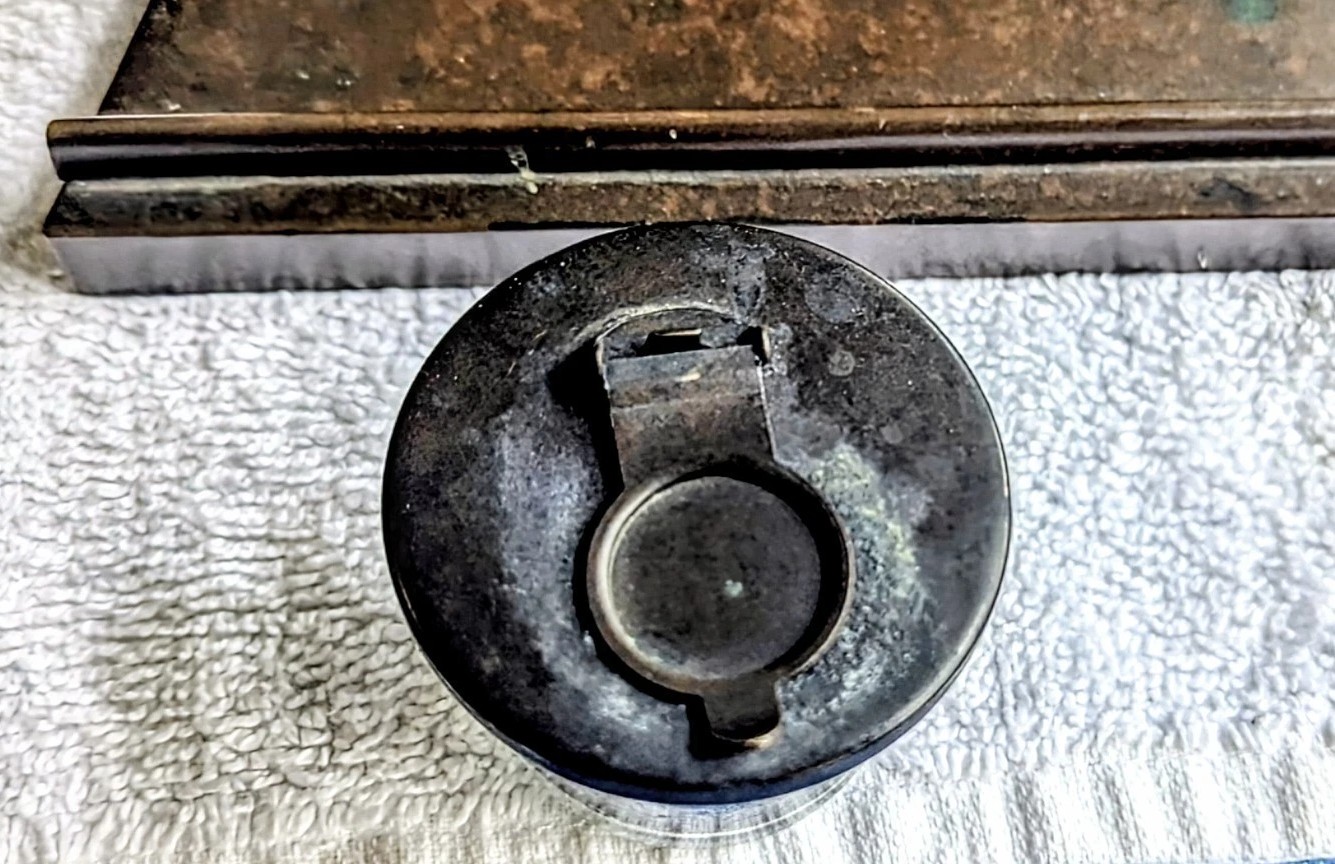
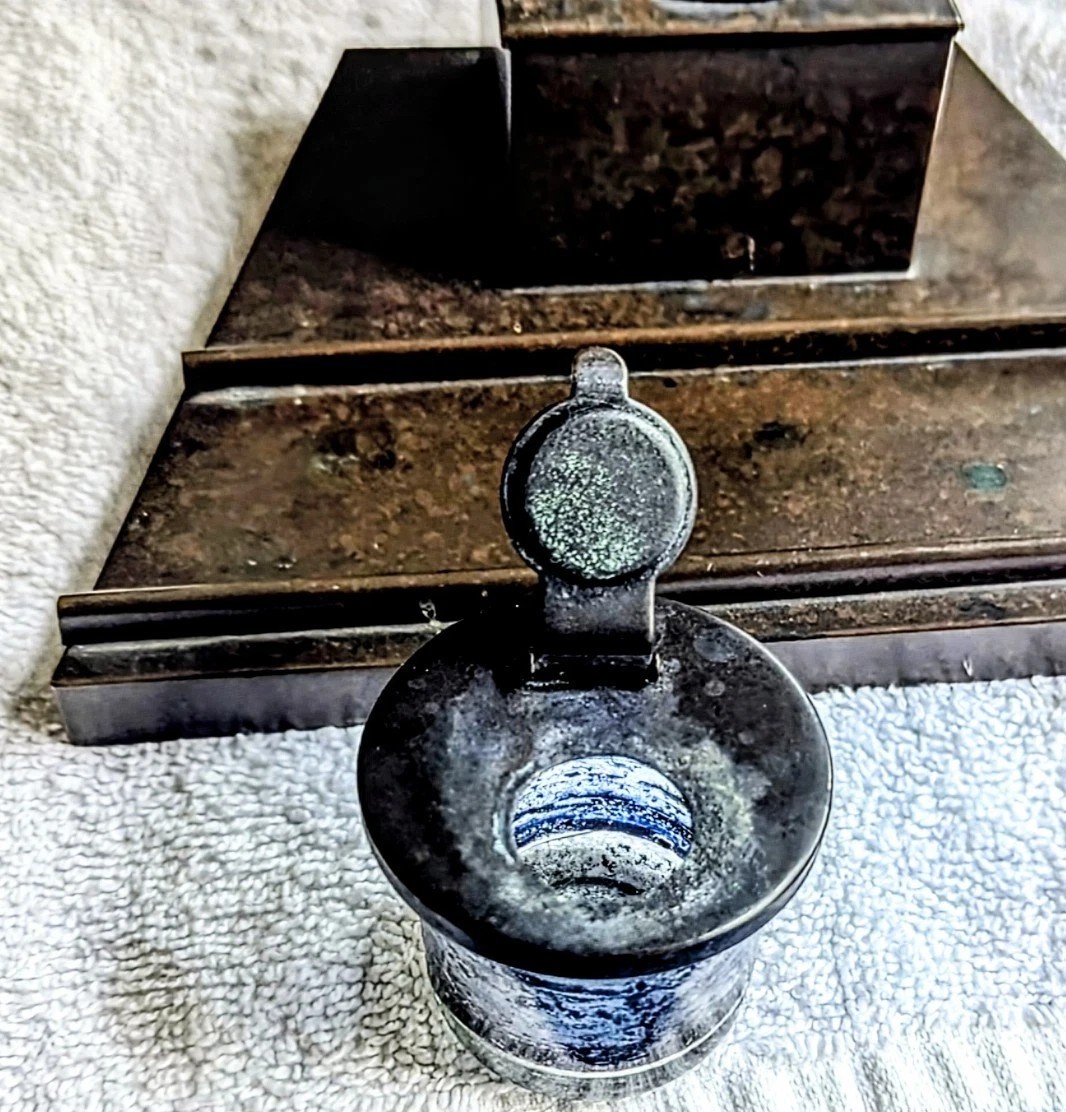
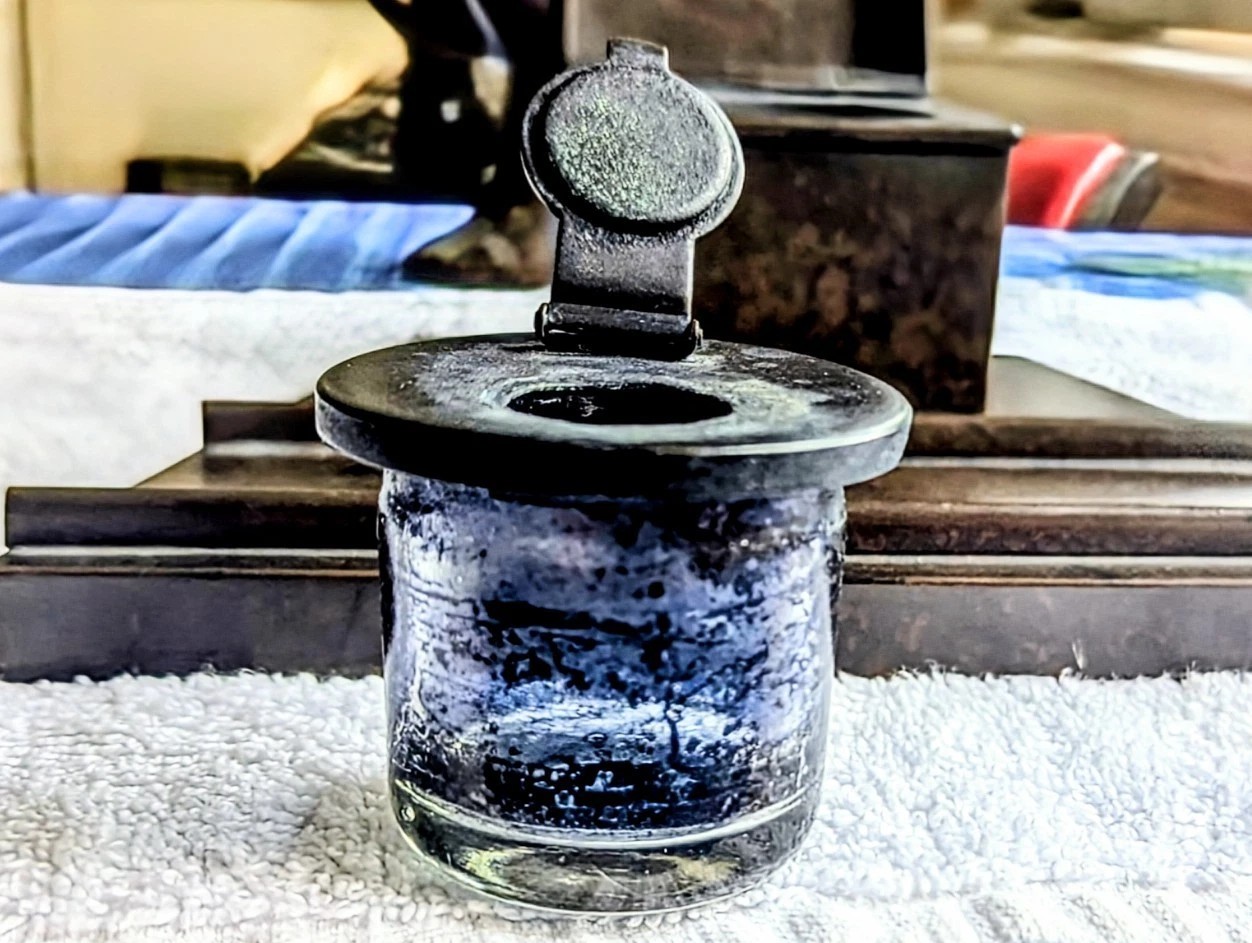
- Inkwell: Inside rests an original, removable glass inkwell fitted with a circular bronze collar and a small secondary hinged flip-cap, allowing dipping access while minimizing ink evaporation and spills.
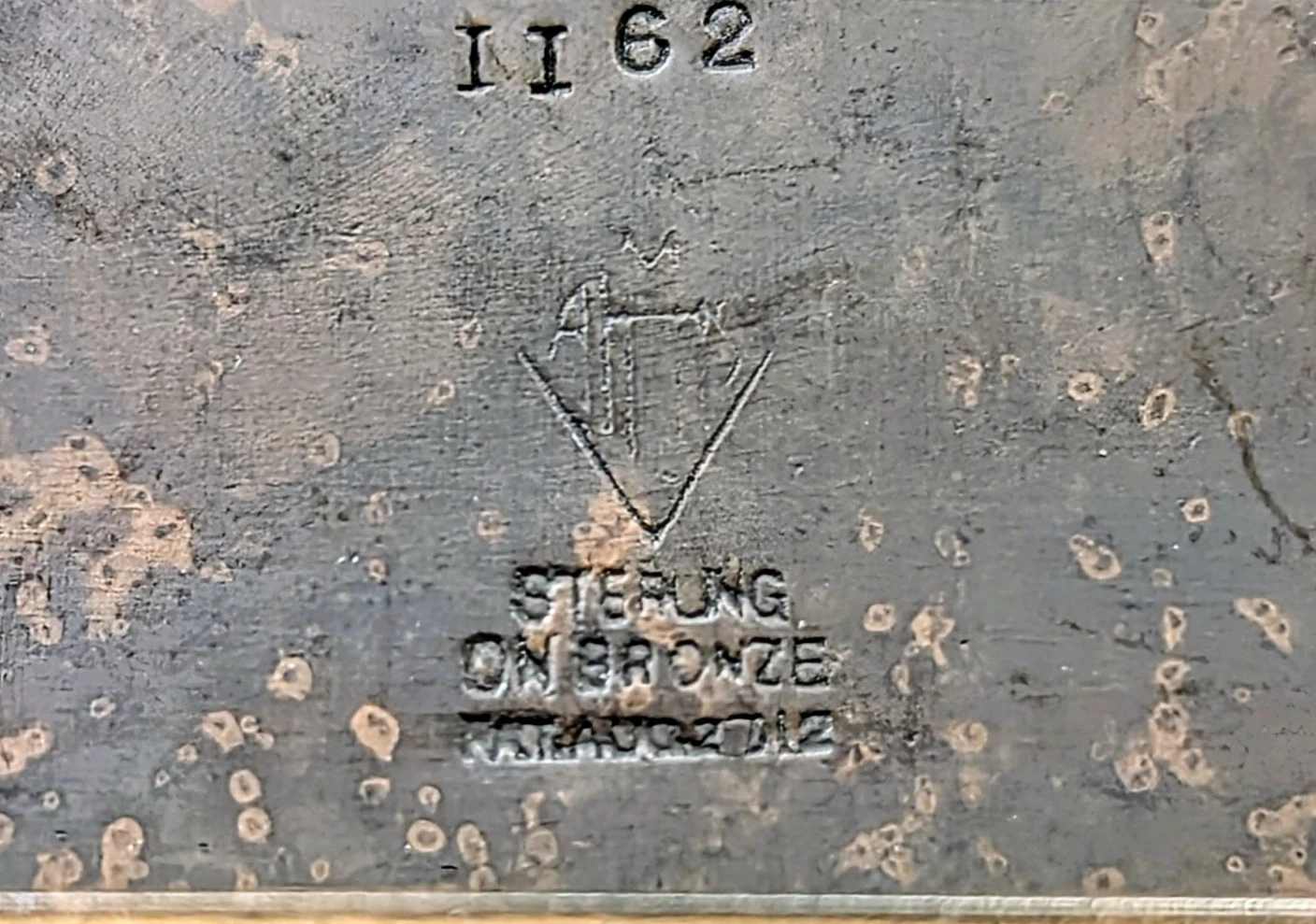
- Maker’s Marks: The underside is stamped with model number 1162, the Heintz diamond monogram (HAMS), “STERLING ON BRONZE,” and the patent date “PAT. AUG. 27. 1912.”
The Heintz Patent & Process The overlay on this piece relies directly on Otto L. Heintz’s milestone U.S. Patent No. 1,037,143 (Method of Producing Metallic Articles), granted on August 27, 1912 (filed June 7, 1911):
- Solderless Molecular Fusion: Prior to Heintz’s method, applying silver decoration to metal bases required messy solders that left visible seams, discolored the surrounding bronze, and deteriorated over time.
- Controlled Metallurgy: Heintz developed a bronze alloy specifically formulated with 80% to 95% copper and 5% to 25% zinc. When heated alongside a borax flux to a precise temperature—just above the melting point of the silver facing’s underside but below that of the bronze—the zinc drew to the surface, acting as a natural fusing agent.
- Flawless Presentation: This created an imperishable molecular bond between the sterling silver cutout and the bronze body without distorting fine detail or leaving solder lines, enabling the crisp, flat decoration characteristic of Heintz desk wares.
This inkstand dates to circa 1915–1925 (commonly cataloged as circa 1920).
How the Model Number and Markings Narrow the Date
- Catalog Series (1000–1200s): Heintz did not assign sequential serial numbers to individual pieces; instead, they used model ranges categorized by form. Numbers in the 1000–1200 series were dedicated specifically to desk sets, desk accessories, and inkstands. Lower numbers (1000–1050) were introduced earlier in production (early 1910s), while higher numbers like #1162 reflect mid-to-late shop production.
- Firm Post-1912 Production Date: The base stamp bears the full patent grant date (PAT. AUG. 27. 1912) rather than the earlier pre-patent mark PAT APD FOR (used between June 1911 and August 1912), confirming it was made after August 1912.
- Design Transition to Early Art Deco: Early Heintz designs (ca. 1906–1914) leaned heavily toward flowing Art Nouveau flora and classic Arts & Crafts motifs. Model #1162 features a geometric, arrow-and-fretwork overlay and a rectilinear, stepped base that reflect the transition toward early Art Deco, a style Heintz embraced during the World War I and post-war years before the shop ceased operations in 1930.
This inkstand can also be found with a green finish. The factory term for a Heintz piece with a green finish is Verde (often referred to as Verde Bronze or Verde Green).
Key Details About Heintz Finishes
- Production Difference: For their standard warm brown finish, Heintz flash-plated the yellow spun bronze with copper before applying the oxidizing patina. For the Verde finish, the bronze was not copper-plated, allowing the chemical patina to react directly with the base alloy to produce variegated, mottled dark green tones.
- Rarity: A 1916 Heintz trade catalog noted that “Brown patina will be furnished unless otherwise specified,” making original Verde finishes significantly less common than standard brown pieces.
- Other Heintz Patinas: Along with standard brown and Verde, the shop occasionally produced finishes in Royal Red (a rich iridescent copper-red), French Grey (stippled silver-plate), and Gold Doré.
Brown patina sold for $75 in August 2026.
Verde patina sold for $115 in December 2013.
Content disclaimer. The information posted is the owner’s best knowledge and may not have been vetted by the SOIC. We welcome comments, corrections, and additions, working to make our website information comprehensive and accurate.
Join the Society of Inkwell Collectors (SOIC) – it’s free!
Founded in 1981 as a non-profit organization,
we are documenting inkwells (and accessories).
We’re here to help and inform!