


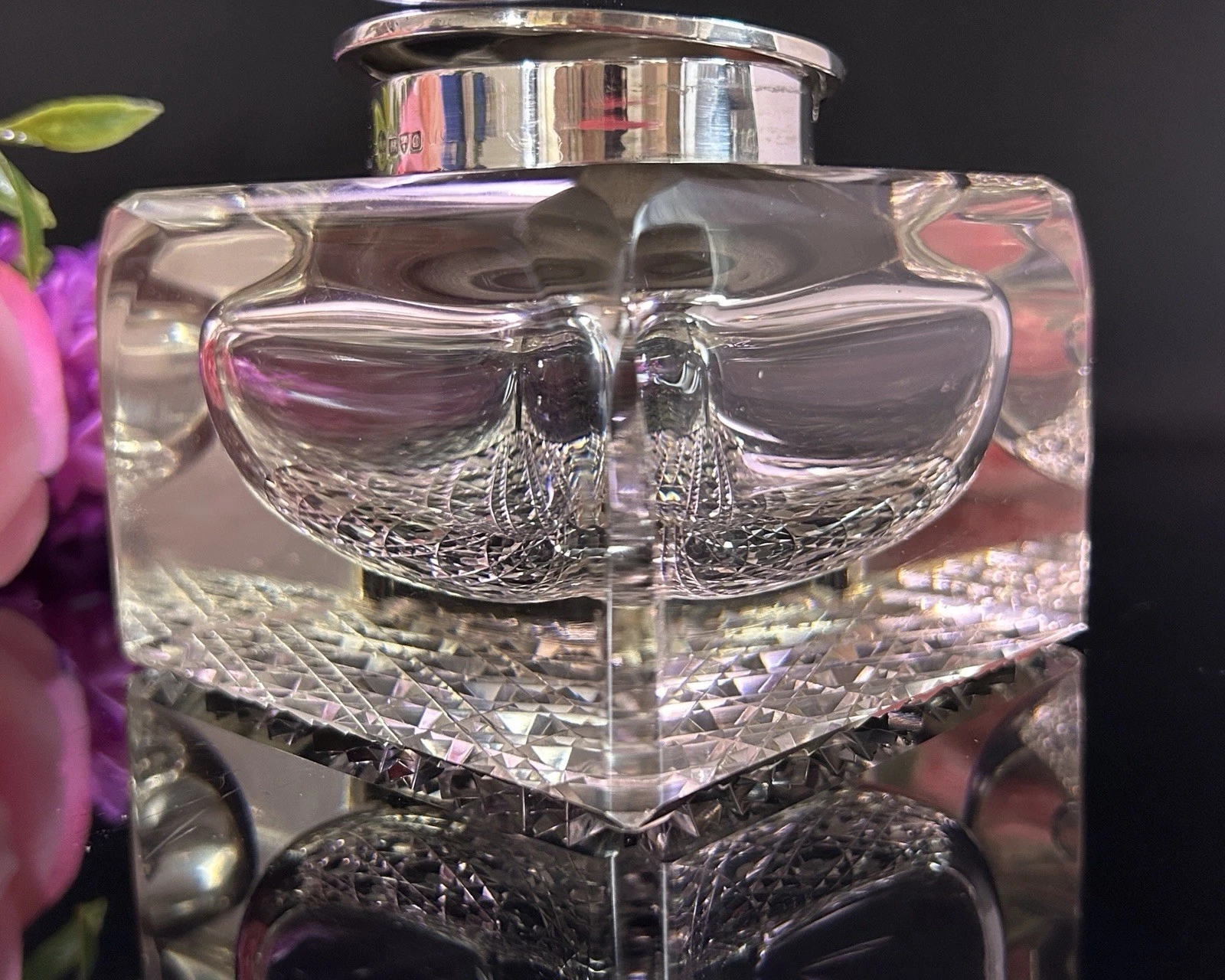


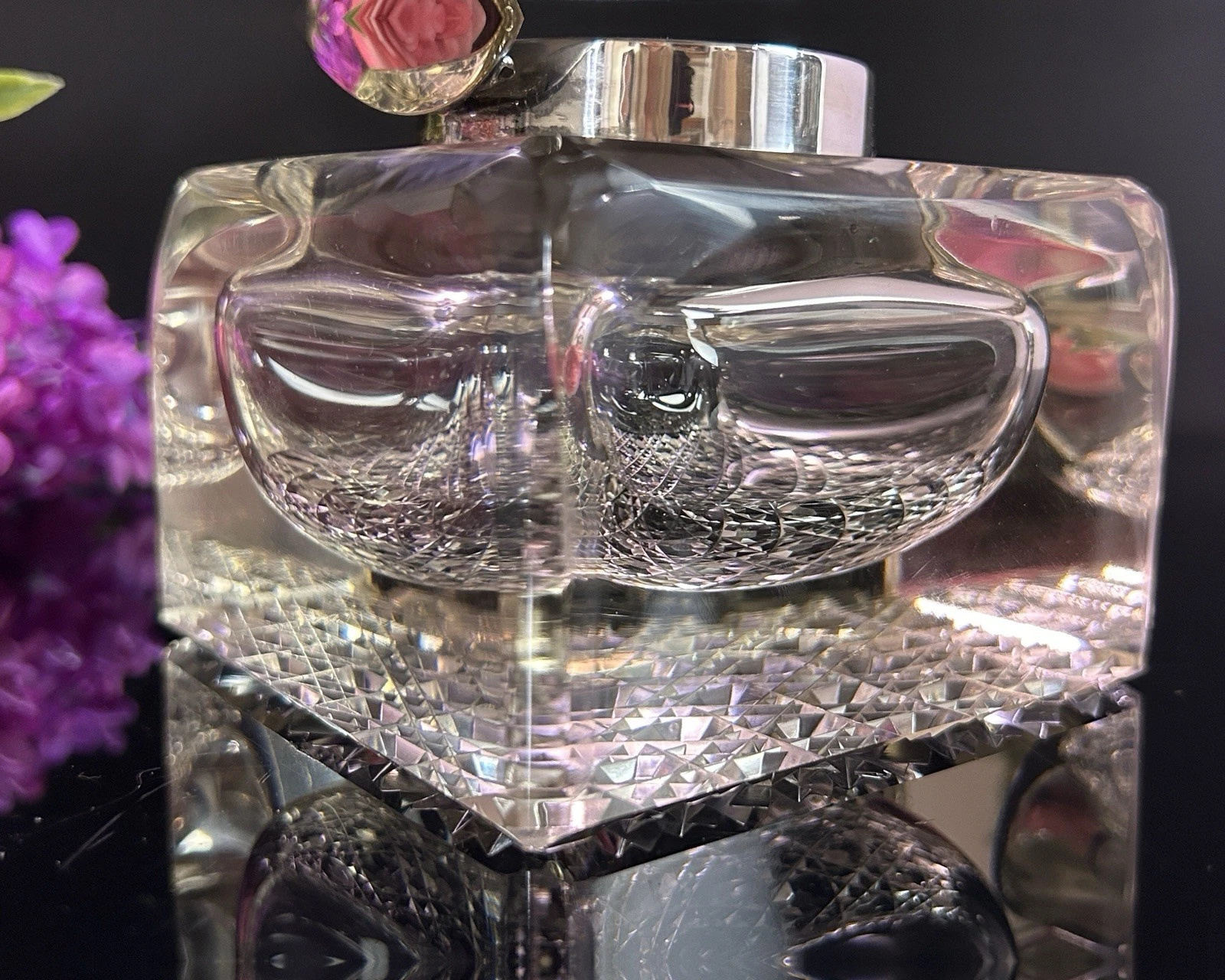


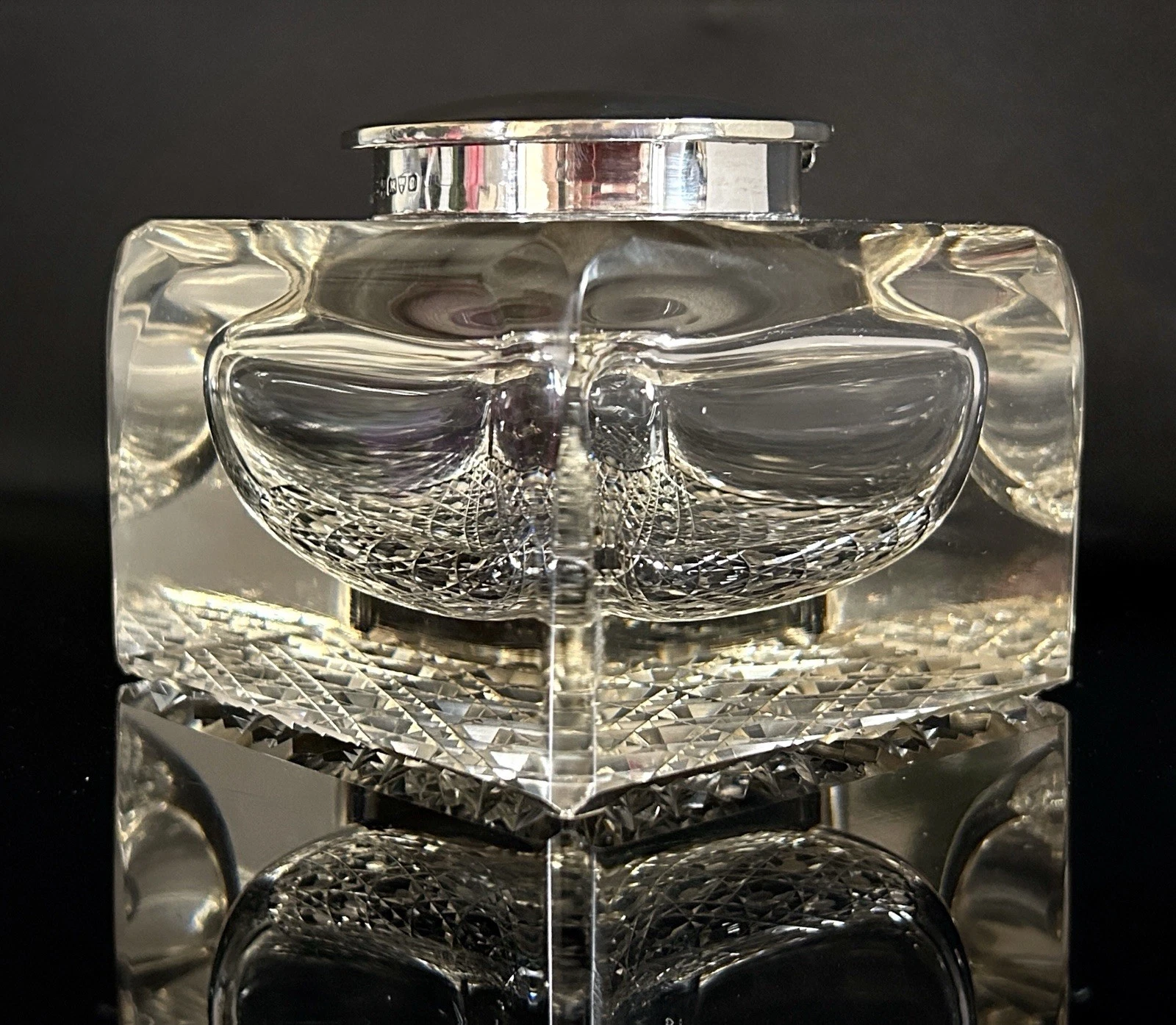



Heavy Cut Glass Inkwell with Sterling Silver Mounts
| Categories | Glass - Non-figural |
| Material | Glass, Silver |
| Markings | See Narrative |
| Manufacturer | Nathan & Hayes |
| Origin | England |
| Date or Era | circa 1904 |
| Measuring | 4” x 4” x 3 ¼” high |
This Edwardian inkwell combines the geometric precision of heavy cut glass with the refined craftsmanship of London silversmiths.
The Silver Mounts
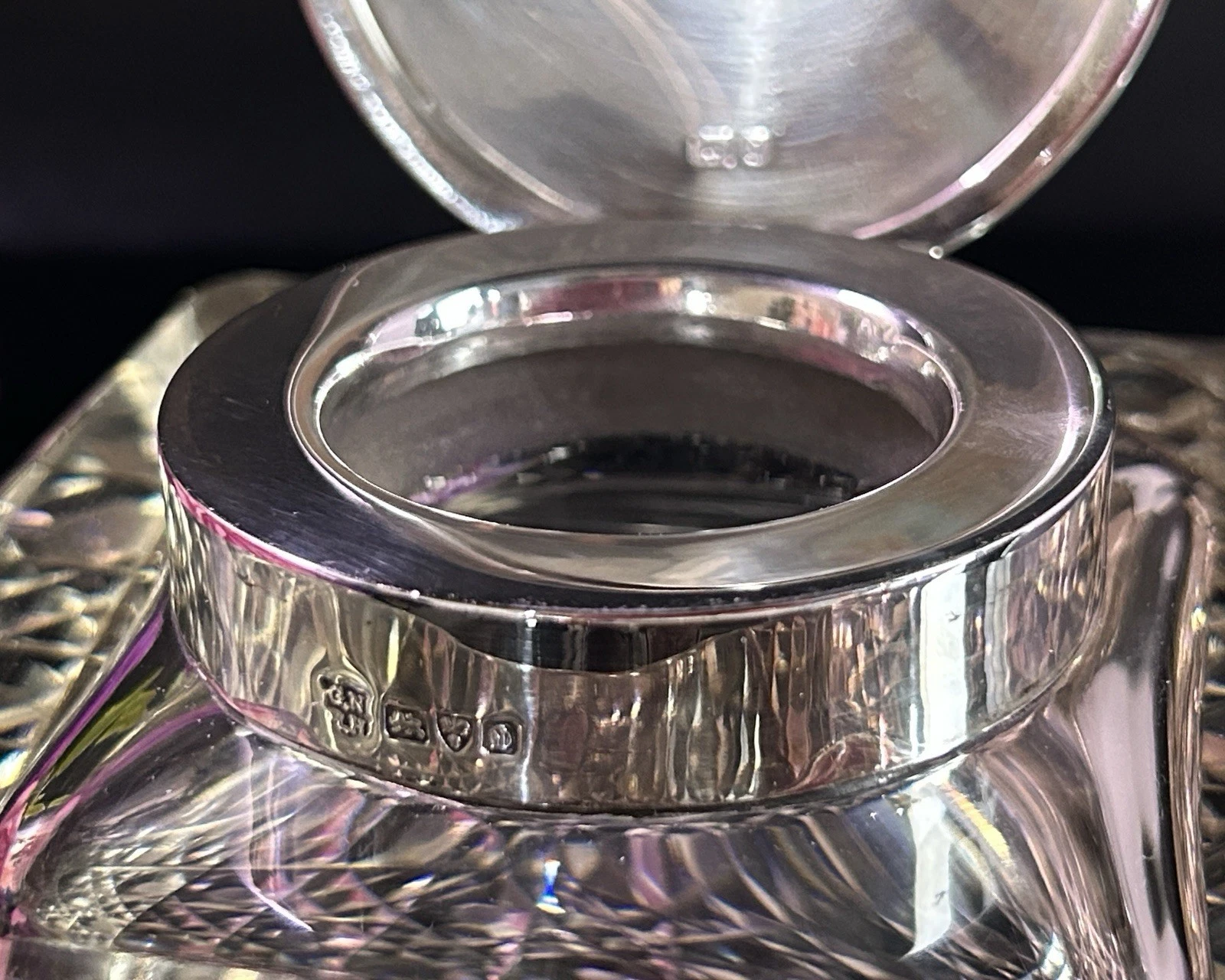
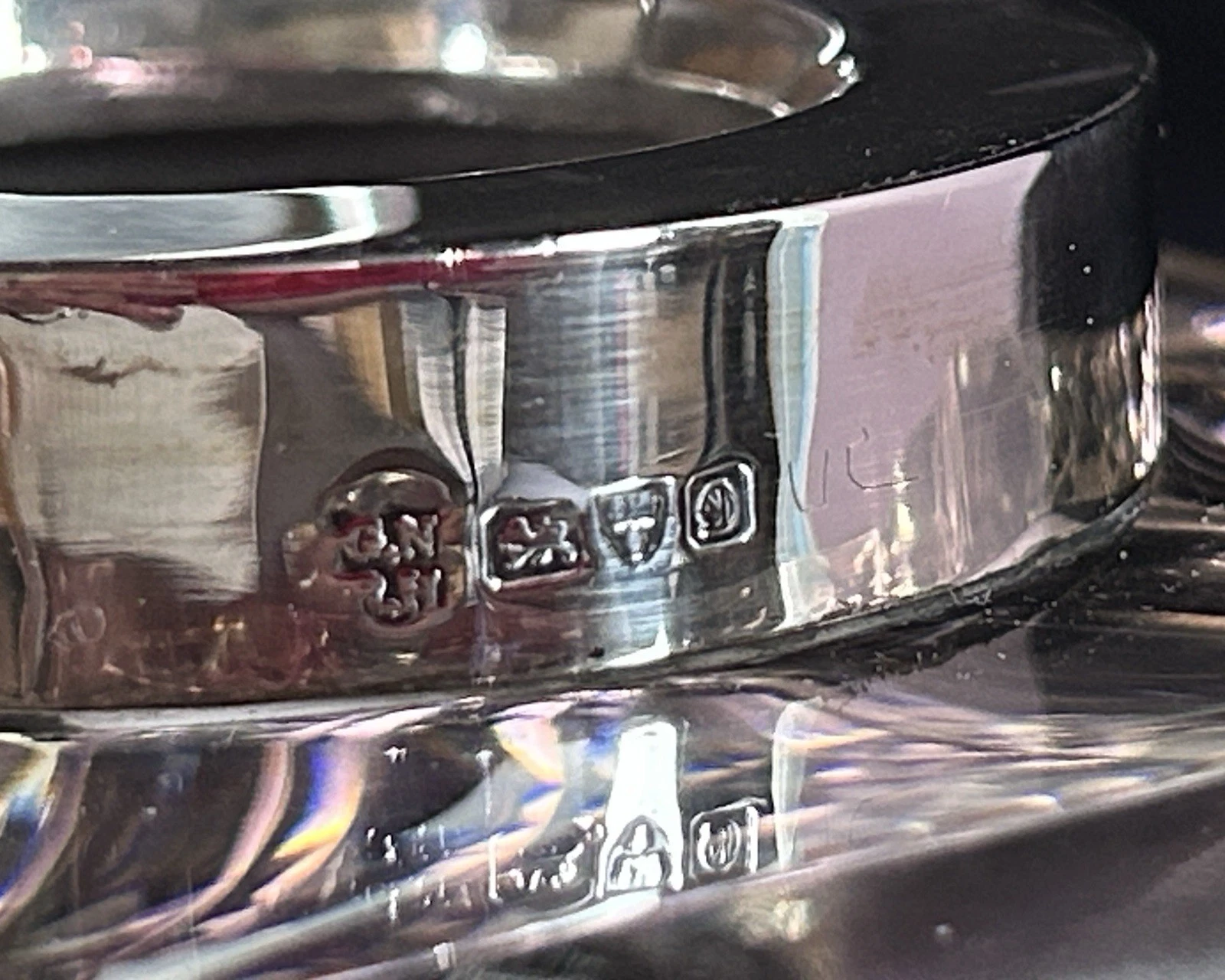
The inkwell features a circular, hinged sterling silver lid and a fitted collar. The silver is marked with a clear set of hallmarks on the exterior of the collar:
- Maker’s Mark: GN over RH for the prominent firm George Nathan & Ridley Hayes.
- Purity Mark: The Lion Passant, confirming the piece is English sterling silver (.925).
- Town Mark: The Leopard’s Head, indicating it was assayed in London.
- Date Letter: A lowercase “i” in a shield, dating the manufacture specifically to 1904.
The lid is designed with a simple, high-polish dome that provides a sleek contrast to the intricate glasswork below.
The Glass Body
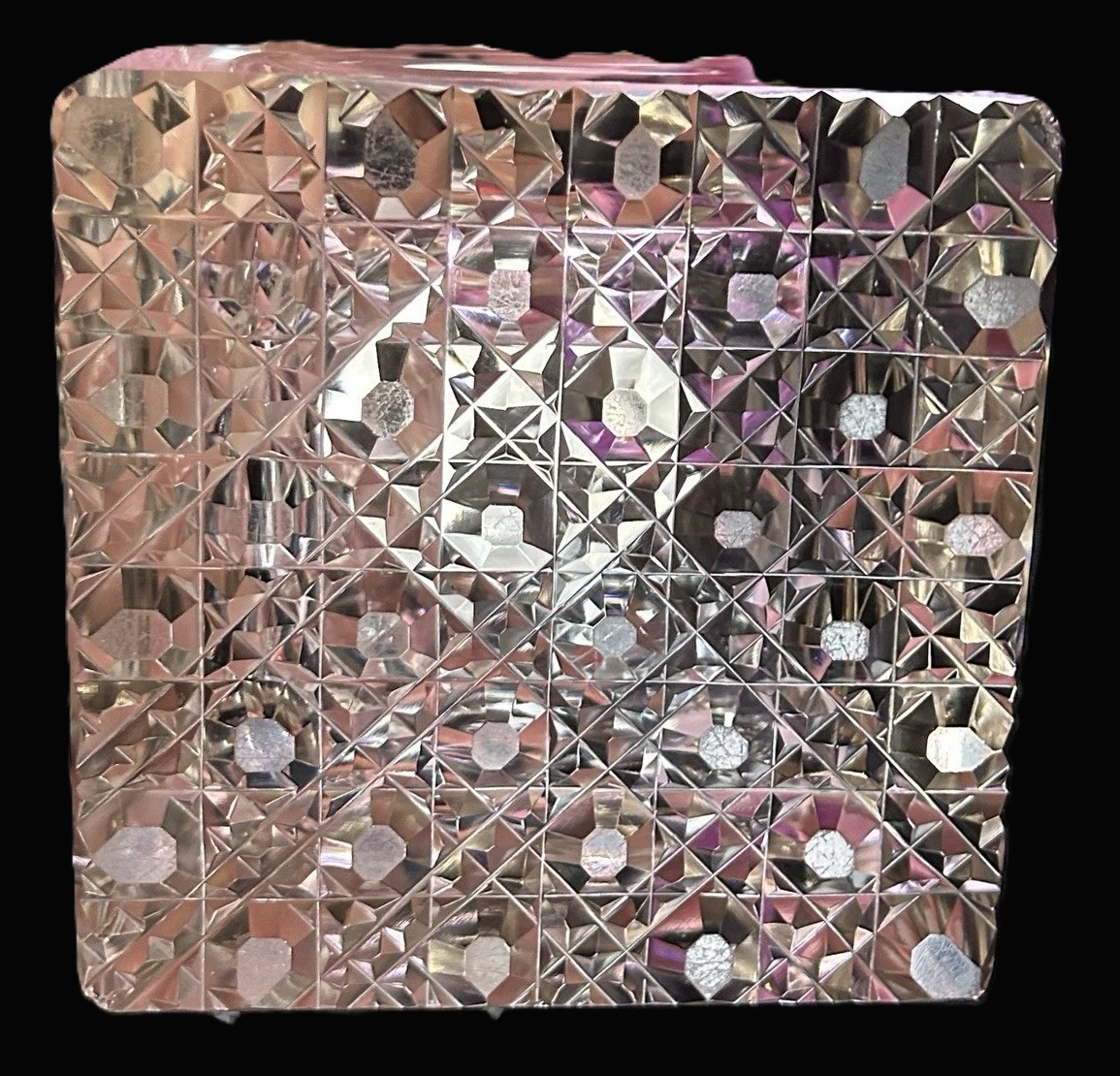
The body of the inkwell is crafted from thick, high-quality lead crystal, cut in a substantial square block form. The glass is decorated with a complex variety of traditional cutting patterns:
- Hobnail Diamond Cuts: The lower half and base of the well are covered in deeply cut “hobnail” patterns, which create a brilliant, multifaceted surface that catches and refracts light.
- Fluted Shoulders: The top corners of the square base are smoothed into elegant, rounded flutes that lead toward the central silver collar.
- Internal Reservoir: Visible through the thick glass walls is a rounded, suspended ink reservoir, a hallmark of “ink block” designs which give the illusion of the ink floating within a solid cube of ice.
- The Base: The underside features a star-cut base, a classic finishing detail used to enhance the brilliance of the piece.
This 1904 piece perfectly represents the transition between Victorian ornamentalism and the cleaner lines of the Edwardian era.
Around 1904, George Nathan & Ridley Hayes (trading as Nathan & Hayes) were at the height of their success, operating as a bridge between the industrial power of Birmingham and the luxury retail market of London.
The London Presence: Hatton Garden
While their main manufacturing base was in Birmingham (at the Institute Works on Howard Street), they maintained a vital London office and showroom in Hatton Garden.
In the Edwardian era, Hatton Garden was the undisputed epicenter of the British jewelry and silver trade. By having a presence there, Nathan & Hayes could directly supply the prestigious retailers of Bond Street and Regent Street. Their location allowed them to cater to the high-society demand for sophisticated, small-scale luxury goods—exactly like this heavy cut glass inkwell.
Specialty: The “Historical Revival” Movement
Nathan & Hayes carved out a specific niche in the market that made them favorites among Edwardian collectors:
- Arts & Crafts Influence: While many Birmingham firms were moving toward mass production, Nathan & Hayes leaned into the Arts & Crafts ethos. They specialized in “antique-style” silver, creating refined interpretations of 17th and 18th-century English designs.
- Archaeological Reproductions: They were famous for making silver replicas of ancient archaeological finds (such as items from Mycenae and Assyria). This “scholarly” approach to silver made their pieces popular with the educated middle and upper classes of London.
- High-End Deskware: Because of their focus on detail and historical aesthetics, they became one of the “go-to” firms for silver-mounted glass, desk sets, and presentation pieces.
The London Hallmark Strategy
It is interesting that this inkwell bears London hallmarks rather than Birmingham ones. In 1904, many Birmingham manufacturers intentionally sent their high-end pieces to the London Assay Office for two reasons:
- Prestige: A London hallmark carried more “social weight” for items destined for luxury shops in the capital.
- Efficiency: The Birmingham office was often overwhelmed with volume; the London or Chester offices were sometimes faster for smaller, high-value batches.
The End of an Era
The partnership remained prolific until Ridley Hayes disappeared from the records around 1912. George Nathan continued the business alone for a few years before retiring in 1917, at which point the firm was acquired by S. Blanckensee & Son Ltd, another major name in British silver.
This 1904 inkwell represents the firm at its absolute creative peak, reflecting the Edwardian obsession with combining “icy” heavy crystal with historically inspired silver.
Sold for $265 in February 2026
Content disclaimer. The information posted is the owner’s best knowledge and may not have been vetted by the SOIC. We welcome comments, corrections, and additions, working to make our website information comprehensive and accurate.
Join the Society of Inkwell Collectors (SOIC) – it’s free!
Founded in 1981 as a non-profit organization,
we are documenting inkwells (and accessories).
We’re here to help and inform!