

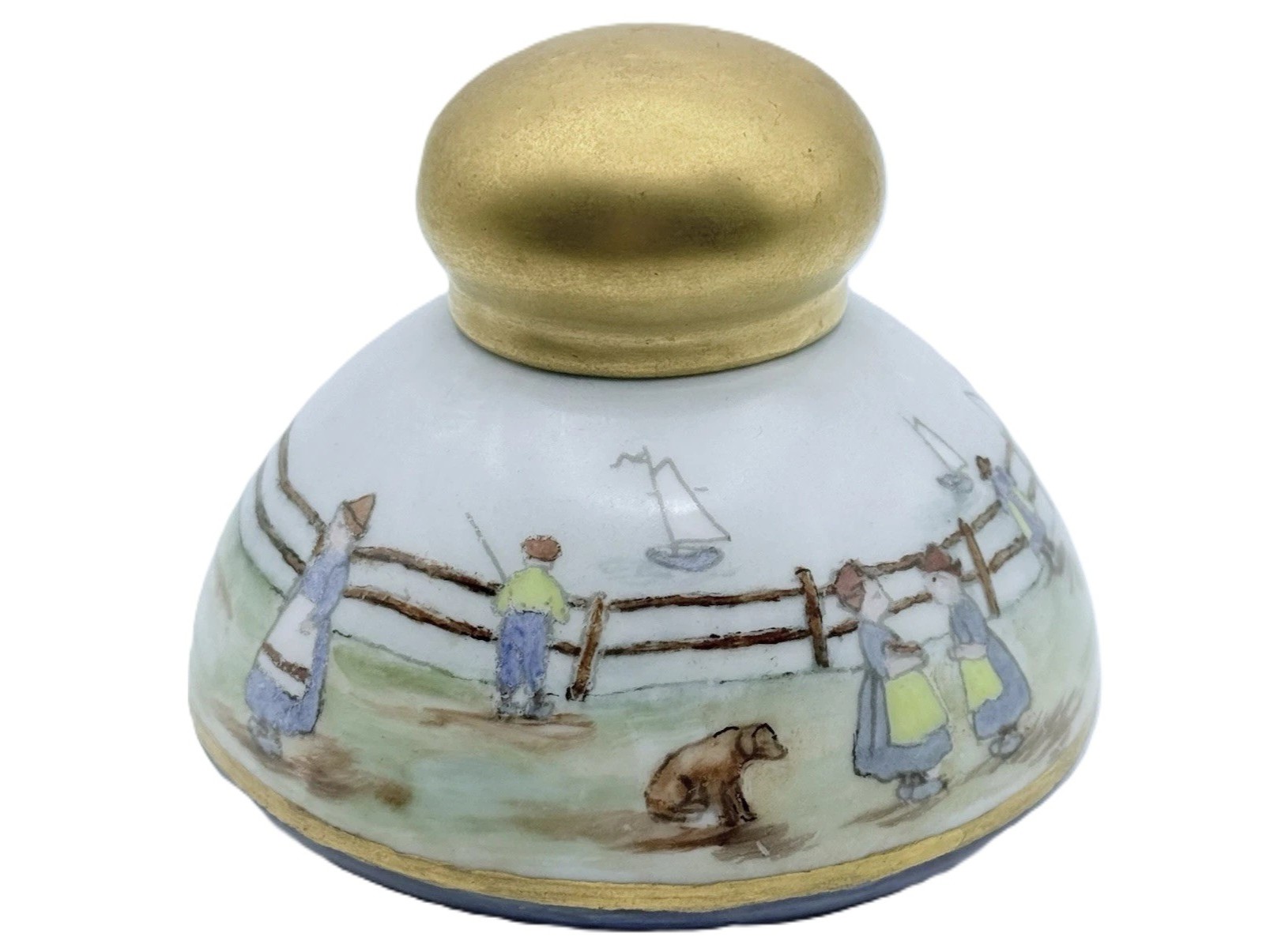
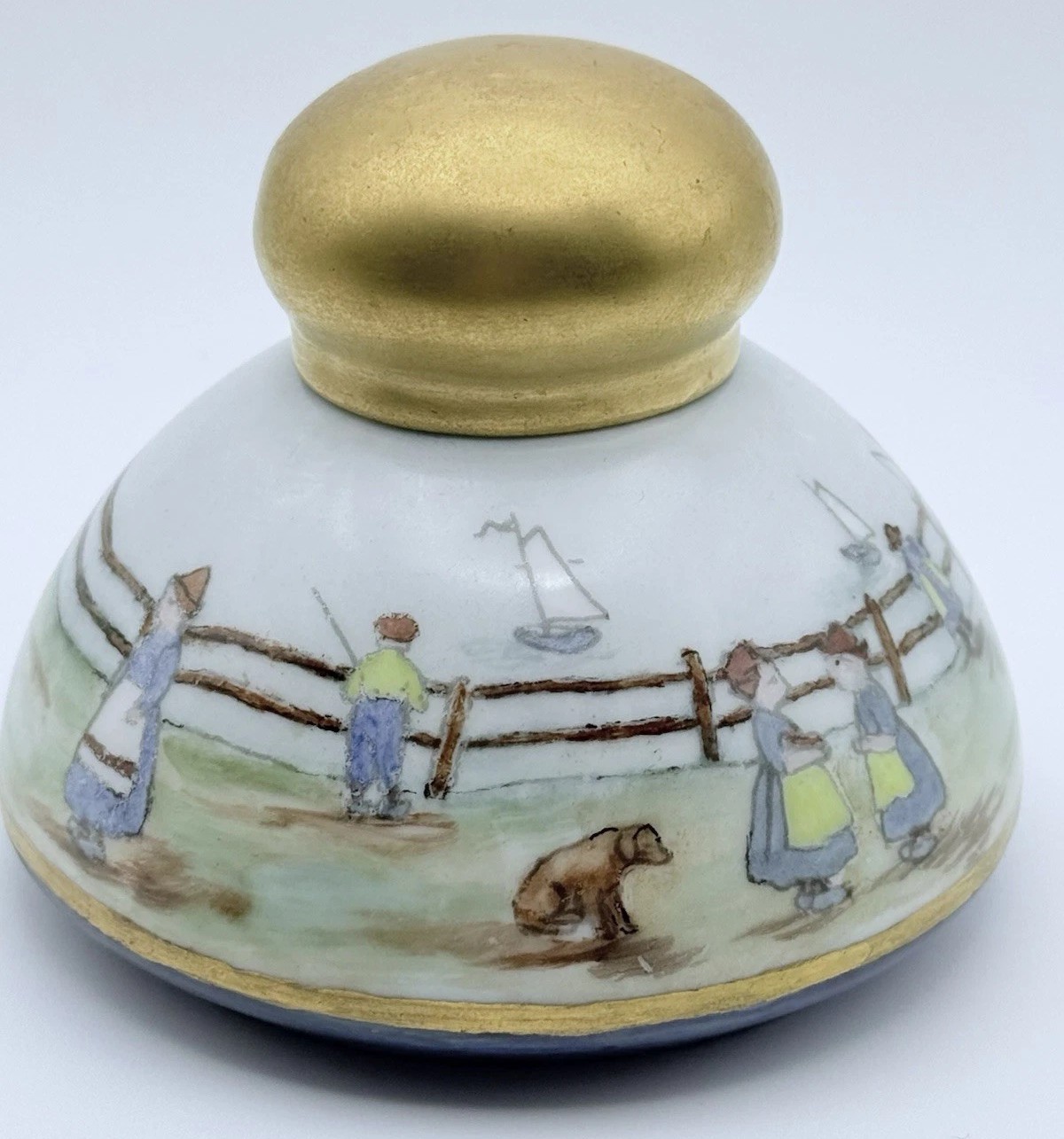
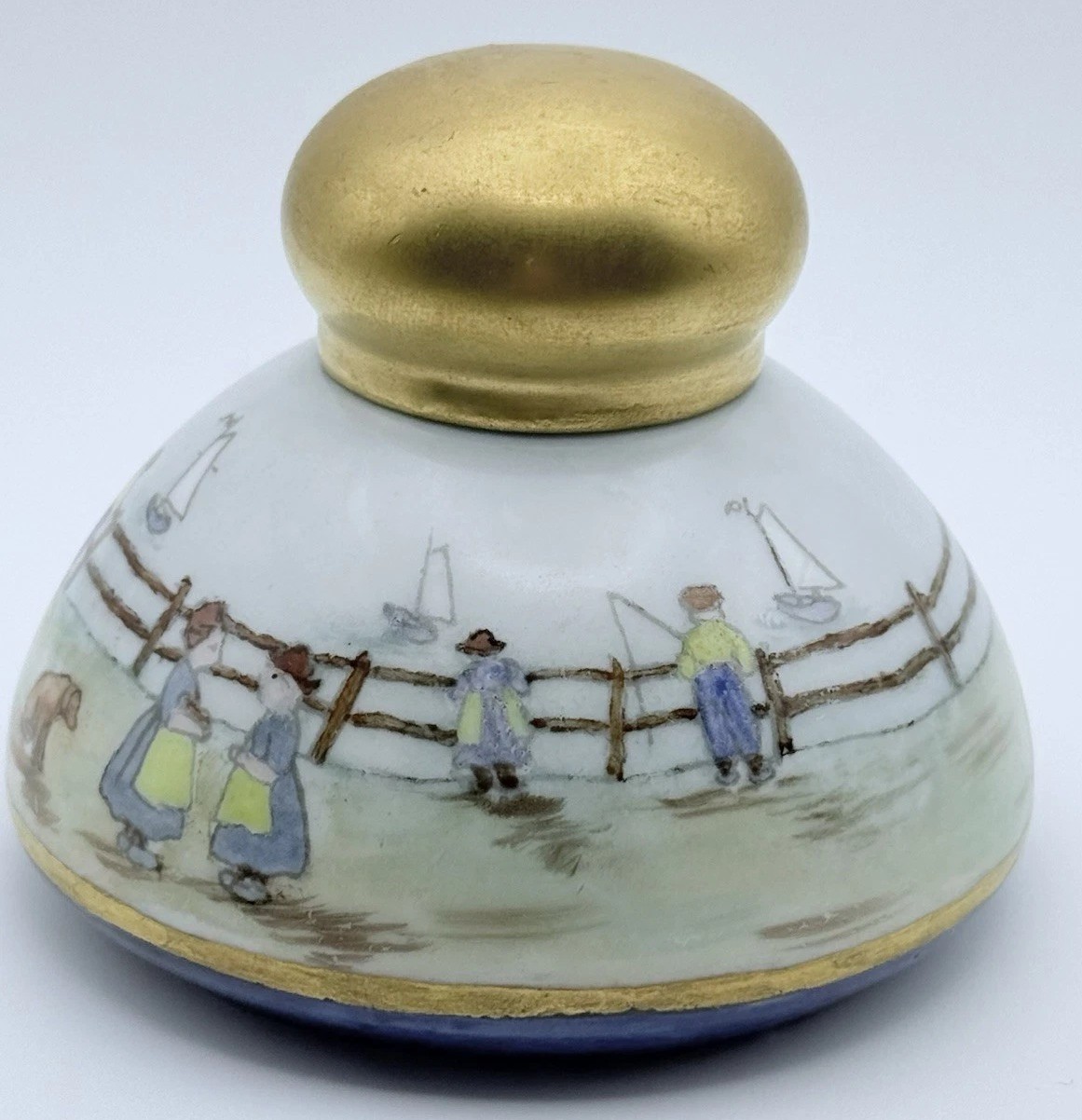
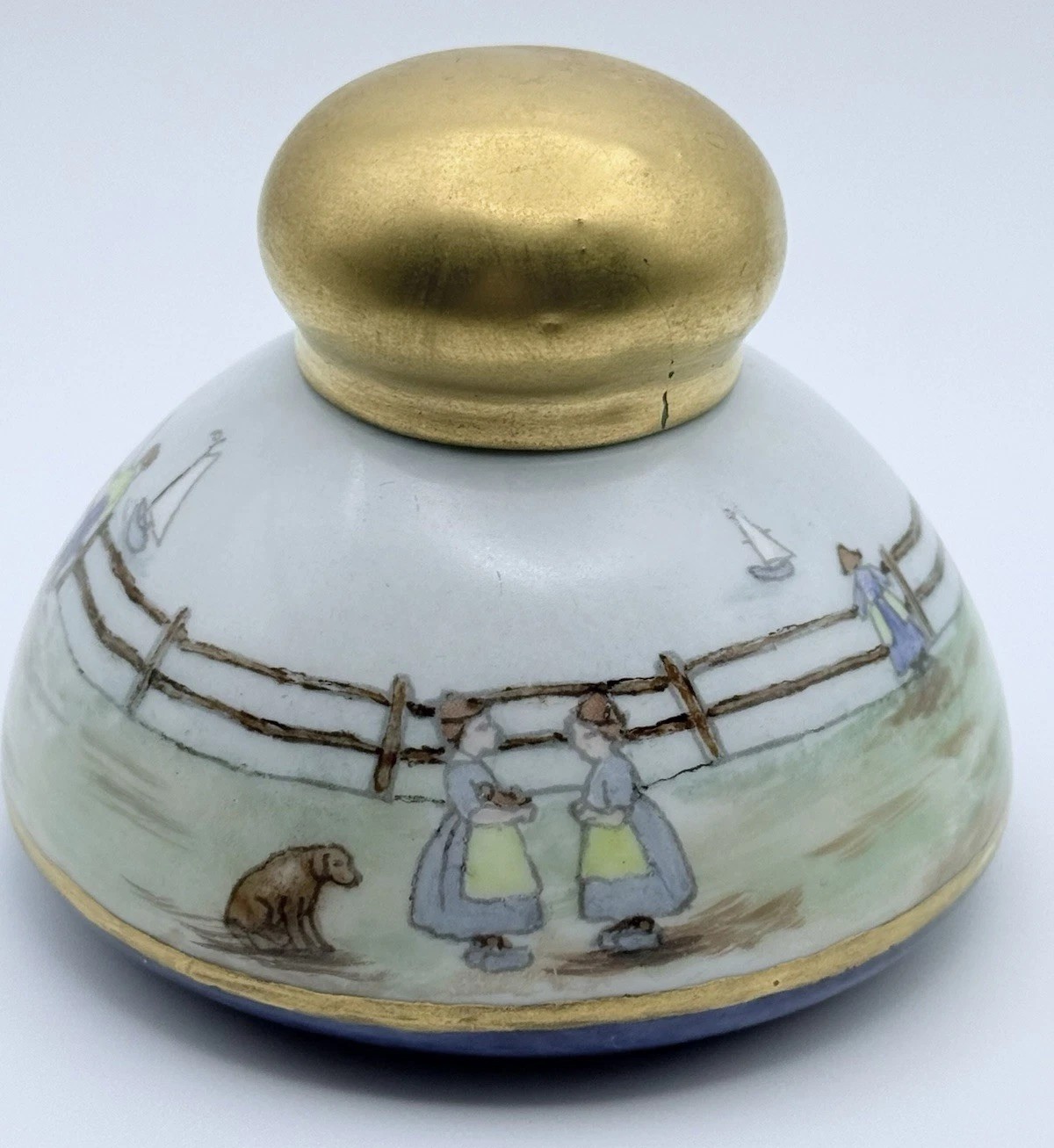
Hand-Painted Dutch Genre Scene Porcelain Inkwell
| Categories | Ceramics/Porcelain "Named" Makers |
| Material | Porcelain |
| Markings | See Narrative |
| Manufacturer | Royal Austria (O. & E. G.) |
| Origin | Austria |
| Date or Era | circa 1916 |
| Measuring | 3 ½” diameter; 3” high |
Overview
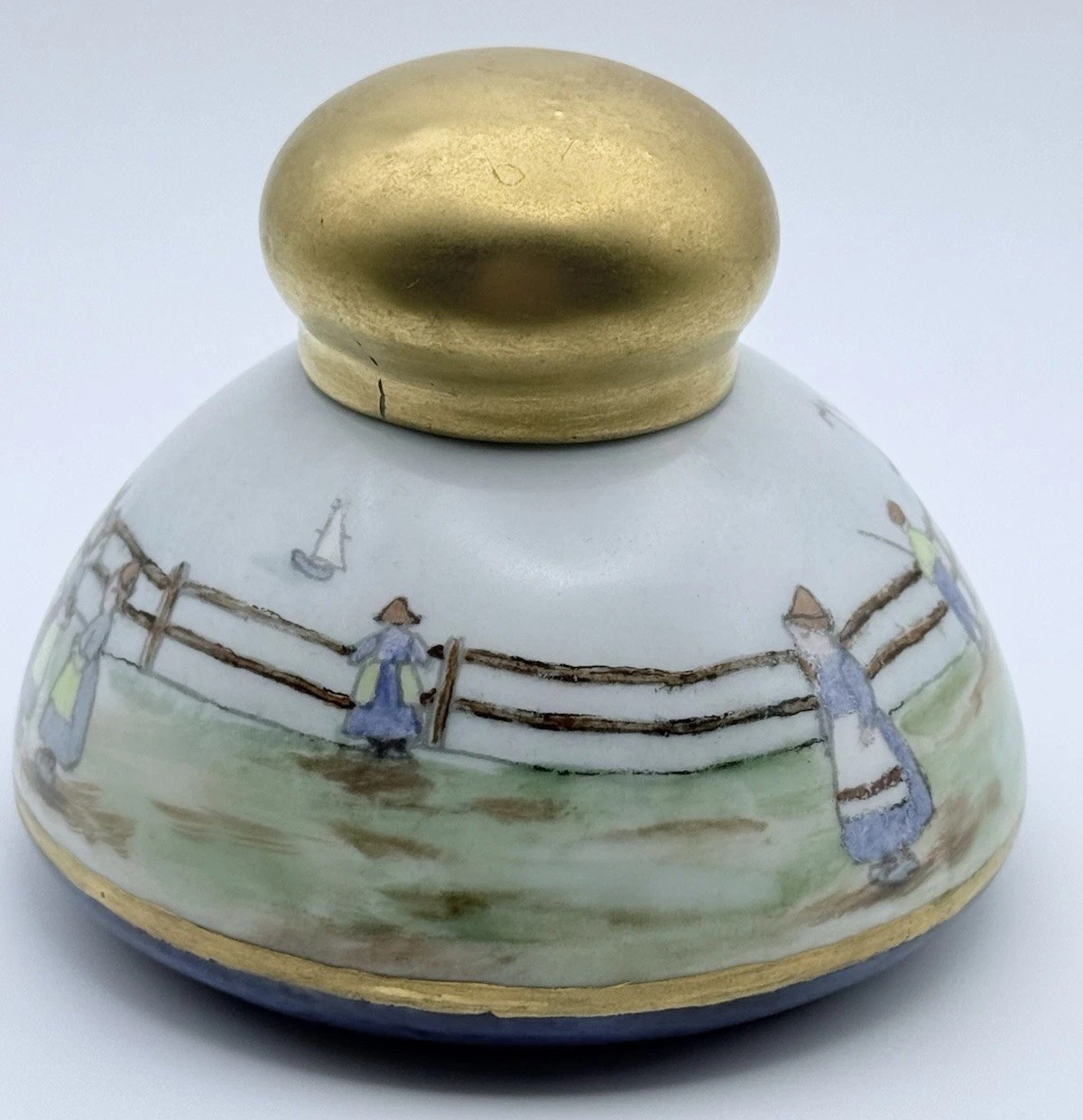
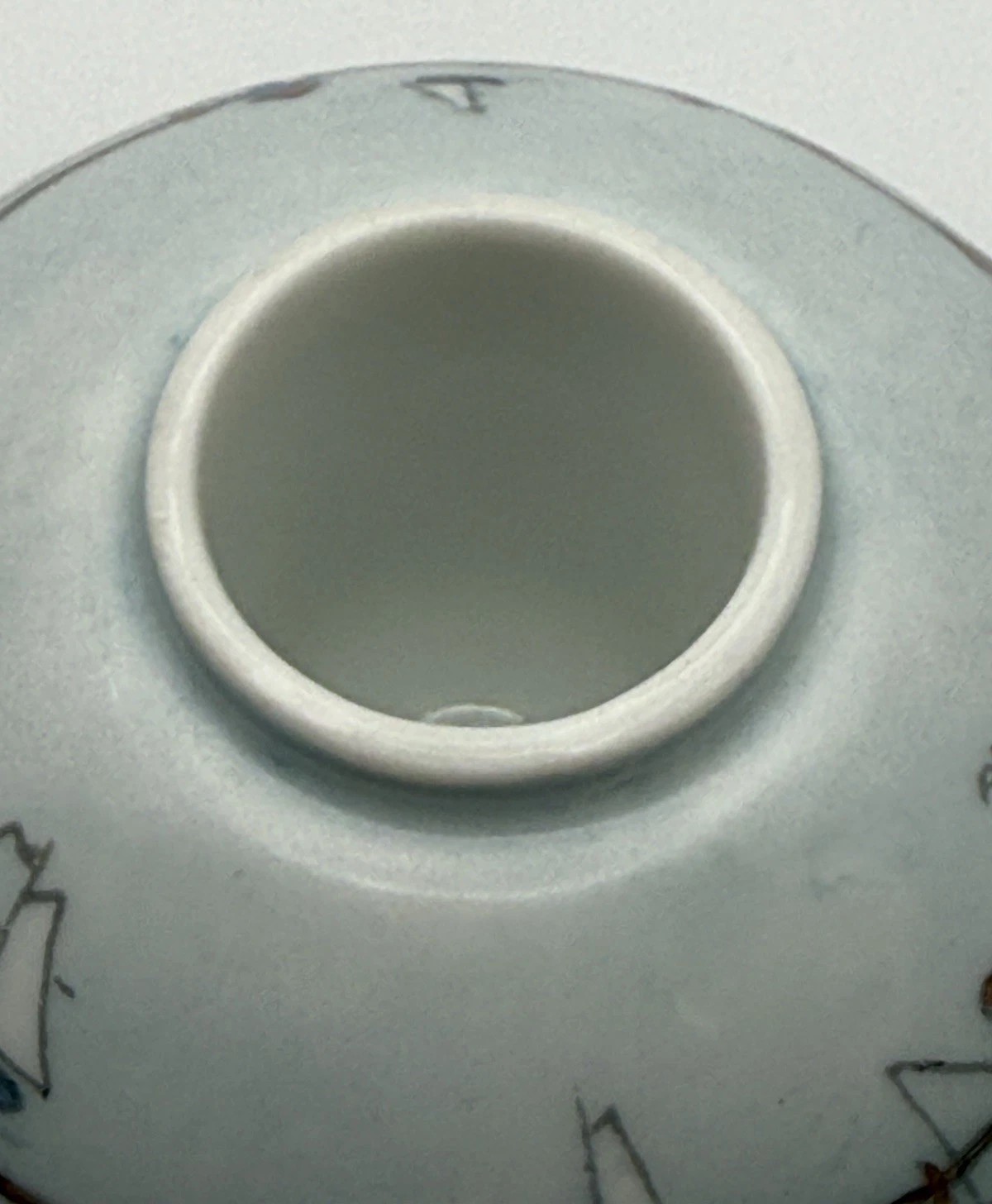
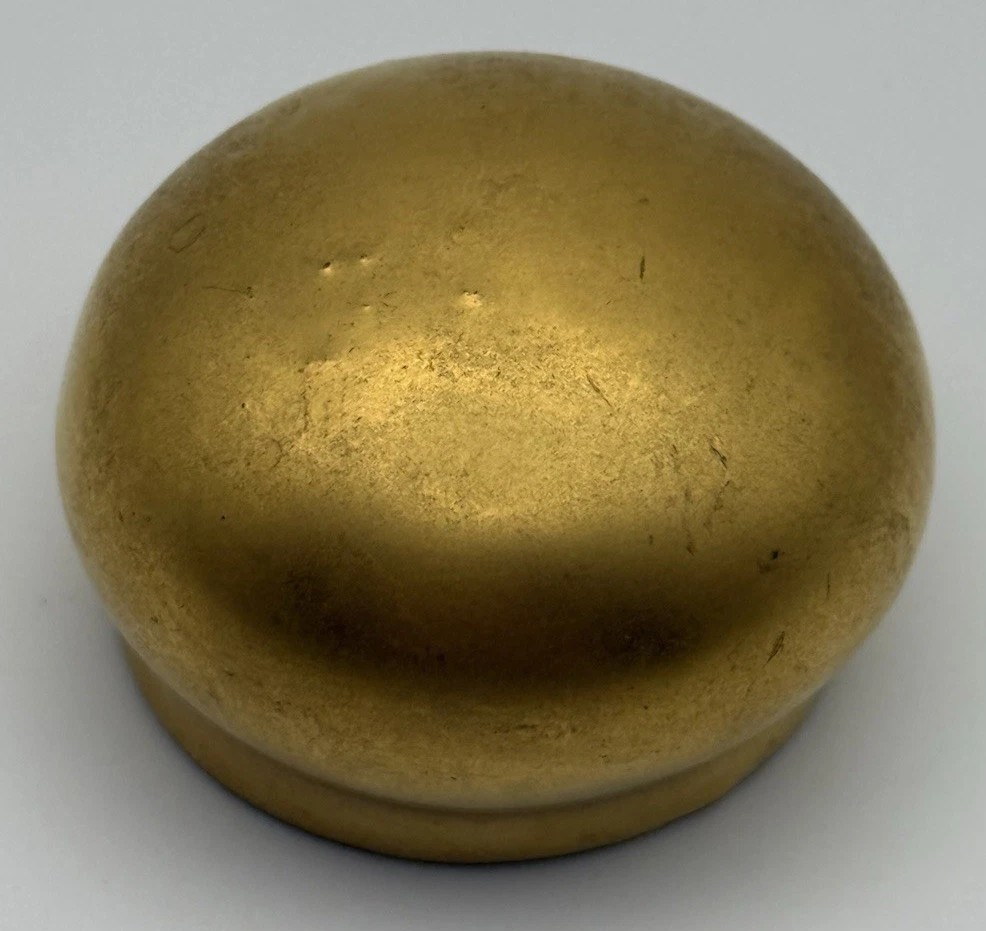
This dome-shaped porcelain inkwell features a continuous hand-painted pastoral scene circling the body, finished with a rounded, heavy gilt (gold-washed) ceramic lid and a mottled blue-and-white glazed base rim.
- Hand-Painted Scene: Encircling the bulbous porcelain body is a countryside landscape divided by a rustic wooden split-rail fence. The narrative vignettes include children in regional provincial attire, a loyal brown dog seated attentively on the grass, figures fishing near the fence line, and small sailboats gliding on the water in the background.
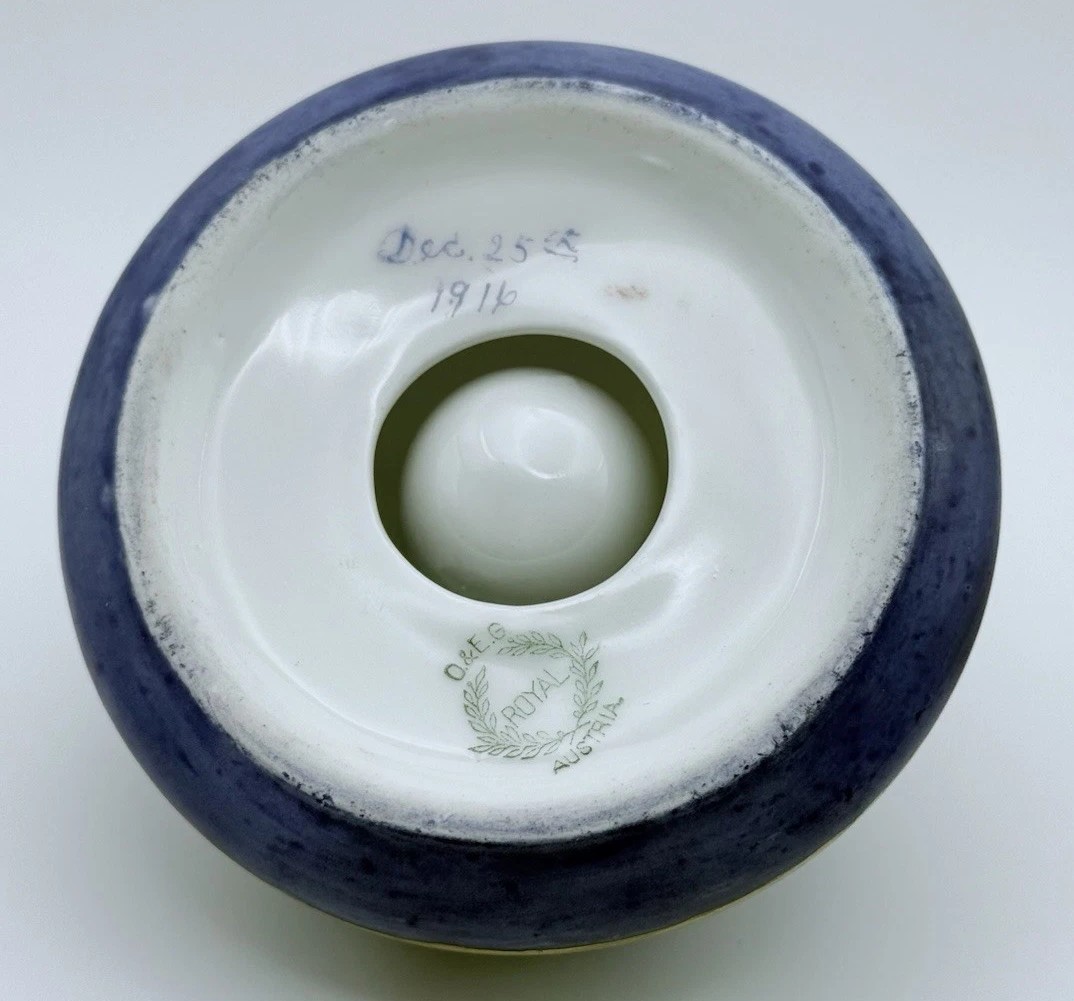
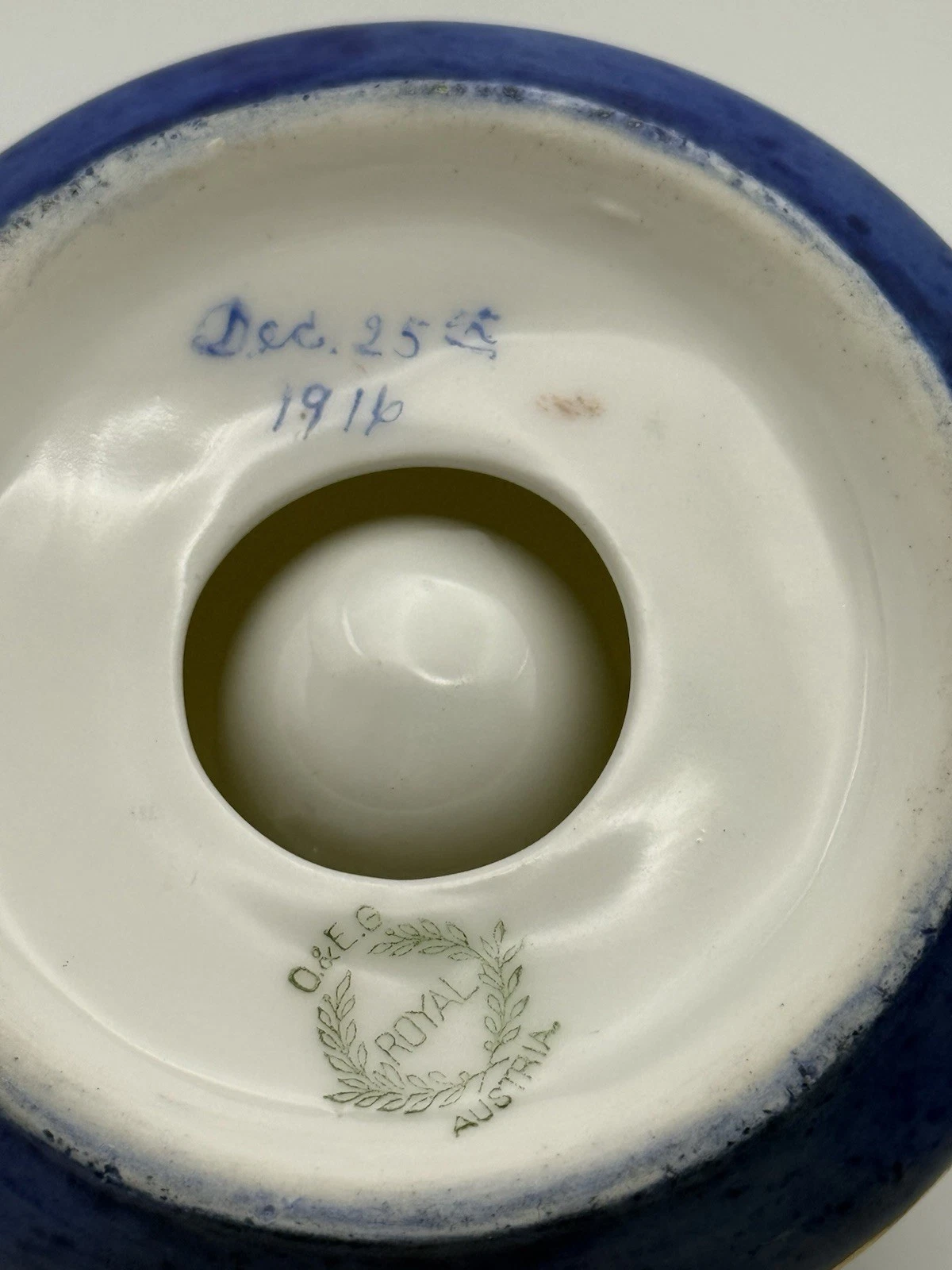
- Inscriptions and Markings: The underside is hand-lettered in blue script with the date “Dec. 25th 1916”, marking a specific Christmas Day gift.
The Maker: Royal Austria (O. & E. G.)
- Maker’s Mark: The green underglaze factory mark on the bottom features a laurel wreath framing the word “ROYAL” over “AUSTRIA”, with the initials “O. & E. G.” just above it.
- History: “O. & E. G.” stands for Oscar & Edgar Ginzkey, a well-known porcelain factory and decorating establishment located in Altnau, Austria (historically part of the Austro-Hungarian Empire, now within the Czech Republic region of Hohenelbe / Vrchlabí or surrounding Bohemian ceramics manufacturing hubs). The mark was used in the late 19th and early 20th centuries on fine porcelain blanks exported widely to Western markets, where many pieces were hand-decorated by professional studios or amateur artists.
Why a Dutch Scene? (The “Dutch Child” Craze)
- The Artistic Trend: The depiction of children in wooden clogs, aprons, bonnets, and peaked caps standing near canals, fences, and sailboats is not necessarily a reflection of the maker’s local geography. Instead, it represents the massive popularity of “Dutch-style” or “North Holland” genre painting that swept the decorative arts in Europe and America from the late 1880s through the 1920s.
- Cultural Fascination: Romanticized imagery of Dutch pastoral life—featuring windmills, wooden shoes, fishing boats, and children playing with dogs—became a staple of children’s book illustrations, postcards, and hand-painted porcelain souvenirs of the era. It evoked a sense of nostalgic simplicity, charm, and innocence, making it a favorite motif for decorative desk sets and gift pieces.
Where Was It Made?
- Manufacturing Origin: The porcelain blank was manufactured and marked in Austria-Hungary (Bohemian region) by Oscar & Edgar Ginzkey around the turn of the 20th century.
- Decoration & Customization: Because the date “Dec. 25, 1916” is hand-scripted in blue enamel rather than factory-printed, the piece was likely acquired as a blank or standard decorated line and personalized—or entirely hand-painted—as a special Christmas gift in 1916, right in the middle of World War I.
Sold for $68 in September 2026
Content disclaimer. The information posted is the owner’s best knowledge and may not have been vetted by the SOIC. We welcome comments, corrections, and additions, working to make our website information comprehensive and accurate.
Join the Society of Inkwell Collectors (SOIC) – it’s free!
Founded in 1981 as a non-profit organization,
we are documenting inkwells (and accessories).
We’re here to help and inform!