


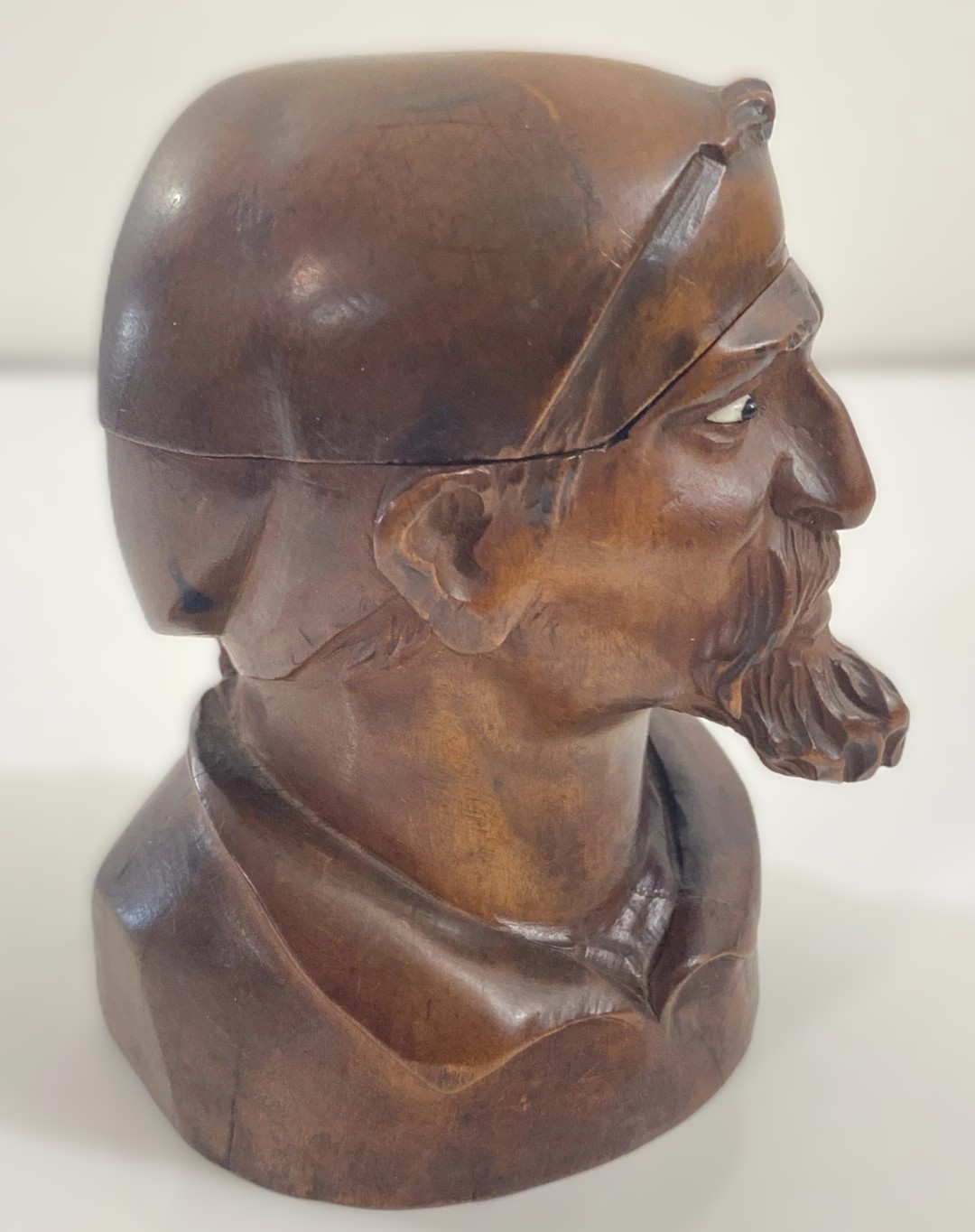

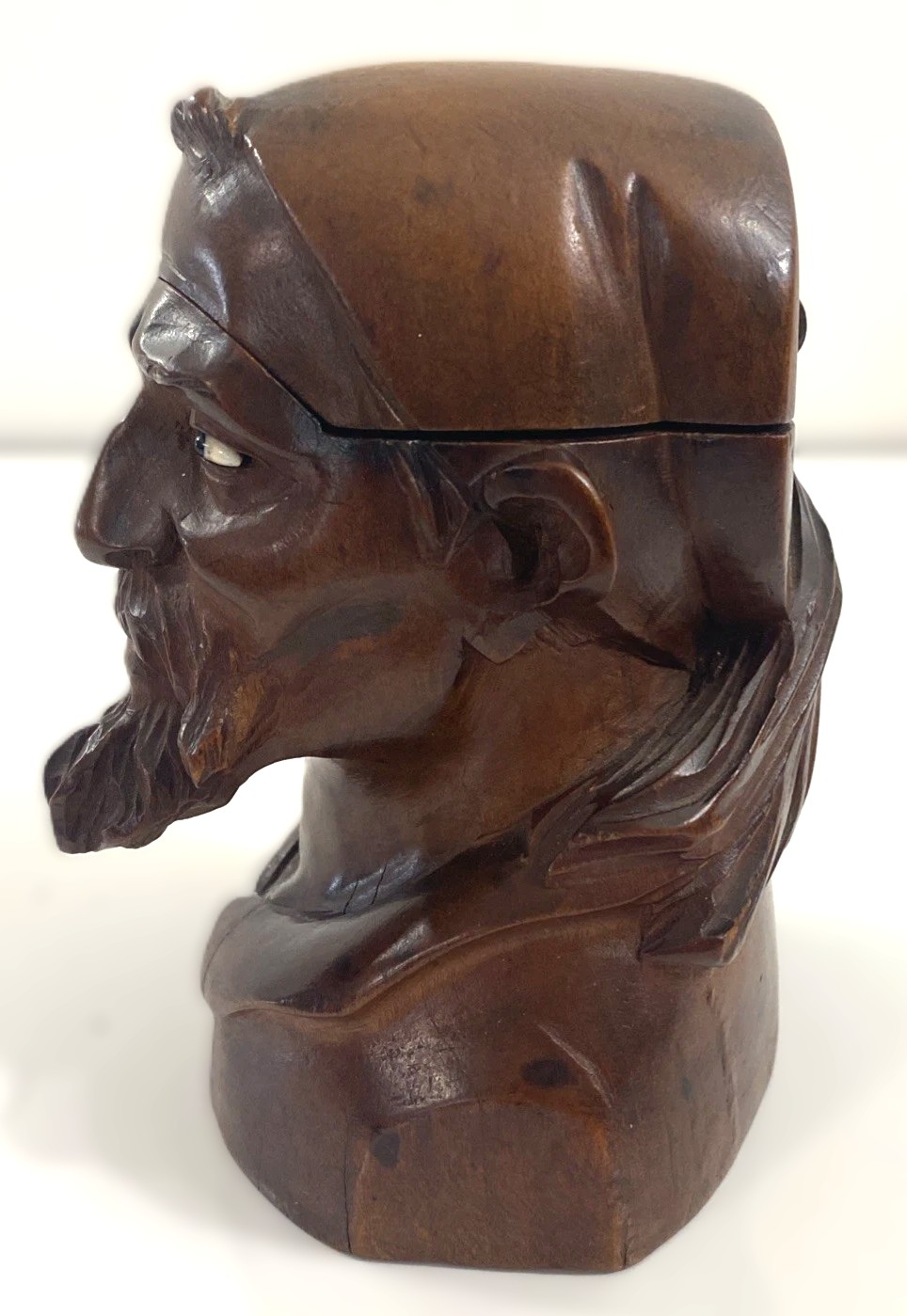



Hand-Carved Wooden Bust of a Man
| Categories | Figural - Mythology; Literature; Religion; Fictional |
| Type | Literature |
| Material | Wood |
| Markings | Unmarked |
| Manufacturer | Black Forest |
| Origin | Germany |
| Date or Era | circa 1890 |
Detailed Description
- Overall Form: A single, figural inkwell carved in the round, depicting the bust of a man.
- Material (Wood): The wood is a relatively soft, close-grained hardwood, which suggests Linden wood (Tilia) or possibly a soft fruitwood, both commonly used for intricate carving in the Black Forest region due to their cooperative texture. It features a dark stain or patina, applied to enhance the carved detail.
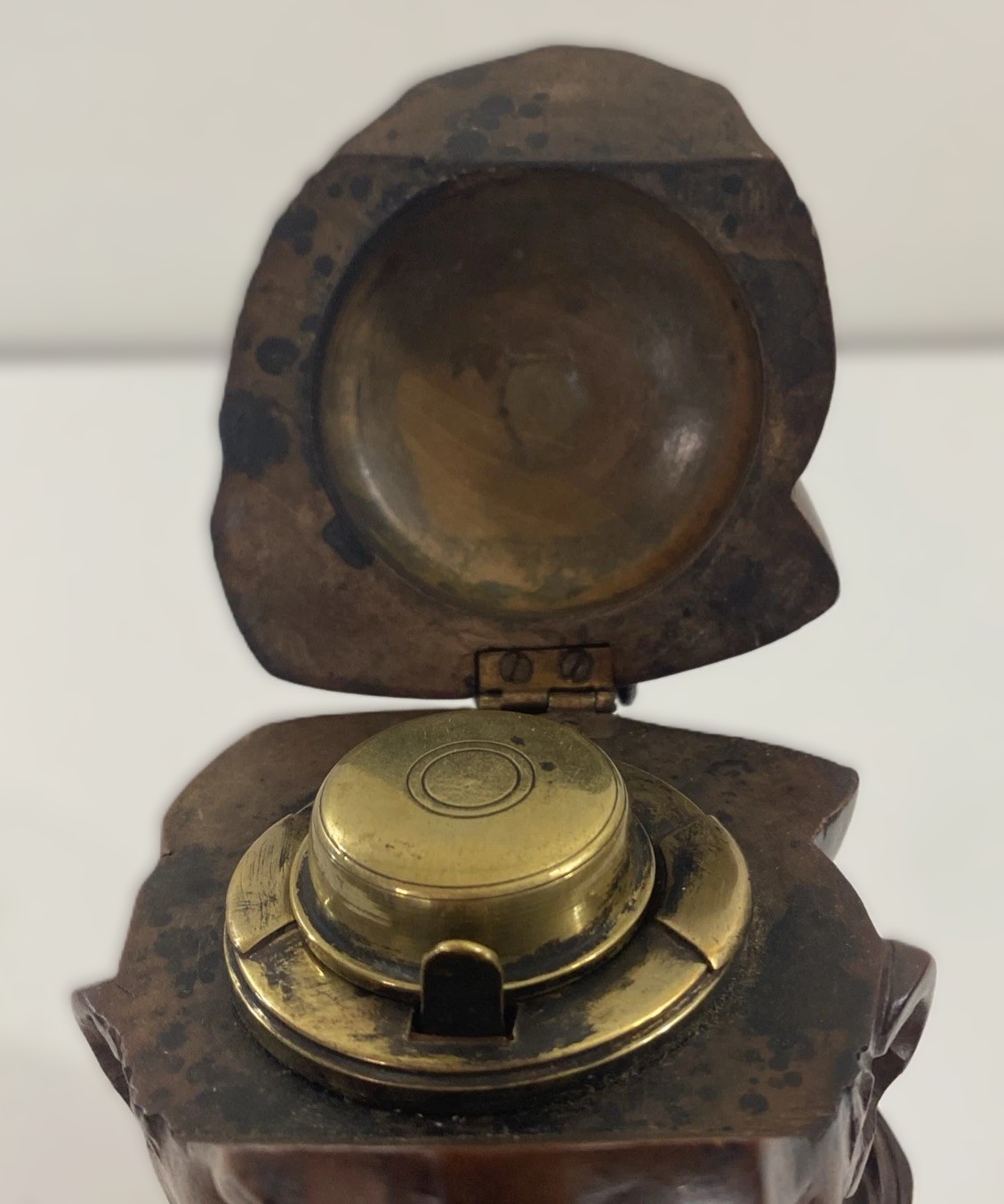
- Inkwell Mechanism: The structure is sophisticated for a wooden figural piece:
- Outer Lid: The top of the man’s head (skullcap) is carved separately and is attached with a metal hinge, serving as the primary lid.
- Inner Lid (Sealing Mechanism): Beneath the outer wooden lid is a spring-loaded, thumb-release metal lid. This internal metal mechanism is designed to provide an airtight seal for the ink, preventing evaporation and spills—a mark of quality in a portable or figural inkwell.
- Reservoir: The system is designed to hold a small, removable glass inkwell, which is currently missing.
- Figure and Detail:
- Glass Eyes: The use of glass eyes is a common feature in high-quality Black Forest carvings (both animals and humans) to give the piece a lifelike, arresting gaze.
- Facial Expression: The man has a distinct, expressive face—often characterized by heavy, furrowed features, a prominent mustache and beard, and a weary, intense, or even quizzical expression.
Identity of the Man
The man’s identity is the most compelling aspect of this piece.
Could the Carved Bust Be Shylock?
The suggestion that the figure could be Shylock from Shakespeare’s The Merchant of Venice is a plausible interpretation for a figural carving from the circa 1880–1915 period, for the following reasons:
Contextual Plausibility (The Time Period)
- Literary Figures were Popular: During the Victorian and Edwardian eras, figures from classical literature, opera, and Shakespeare were extremely popular subjects for decorative arts, including furniture carvings, statuettes, and novelty items like inkwells.
- The Merchant of Venice: Shylock is arguably one of Shakespeare’s most famous and recognizable characters, and carvings depicting him would have been commercially viable.
- The Stereotype: The carving style—with the pronounced beard, intense (almost stern) expression, and perhaps the shape of the nose—aligns with the theatrical and often highly stereotypical and anti-Semitic depictions of Shylock prevalent on European stages during the late 19th century. Carvers would have been translating the popular stage image into wood.
Visual Evidence from the Carving
- The Expression: The intense, slightly weary, and perhaps even suspicious gaze given by the glass eyes is highly fitting for the complex, often tragic, character of Shylock.
- The Hat/Headwear: While Shylock’s costume is often defined by a distinctive cap, the skull-cap section that hinges open on this carving could be designed to incorporate or represent a simple, close-fitting head covering often associated with the character’s traditional stage garb.
Assessment
Without a specific signature or inscription from the carver confirming the identity, it remains an informed theory. The figure might represent Shylock from Shakespeare’s The Merchant of Venice, a subject popular in decorative arts during the period (c. 1880–1915) in which this Black Forest-style inkwell was carved.
Age and Origin
- Origin: Highly consistent with carvings from the Black Forest region (Schwarzwald) of Germany or possibly Switzerland. The specific method of integrating the sophisticated, double-lidded metal inkwell mechanism into the wood is a hallmark of the craftspeople working there.
- Carving Date: This type of elaborate, well-executed carving with glass eyes and complex mechanical parts was most popular during the height of the Black Forest carving industry.
Sold for $100 in October 2025
Content disclaimer. The information posted is the owner’s best knowledge and may not have been vetted by the SOIC. We welcome comments, corrections, and additions, working to make our website information comprehensive and accurate.
Join the Society of Inkwell Collectors (SOIC) – it’s free!
Founded in 1981 as a non-profit organization,
we are documenting inkwells (and accessories).
We’re here to help and inform!