


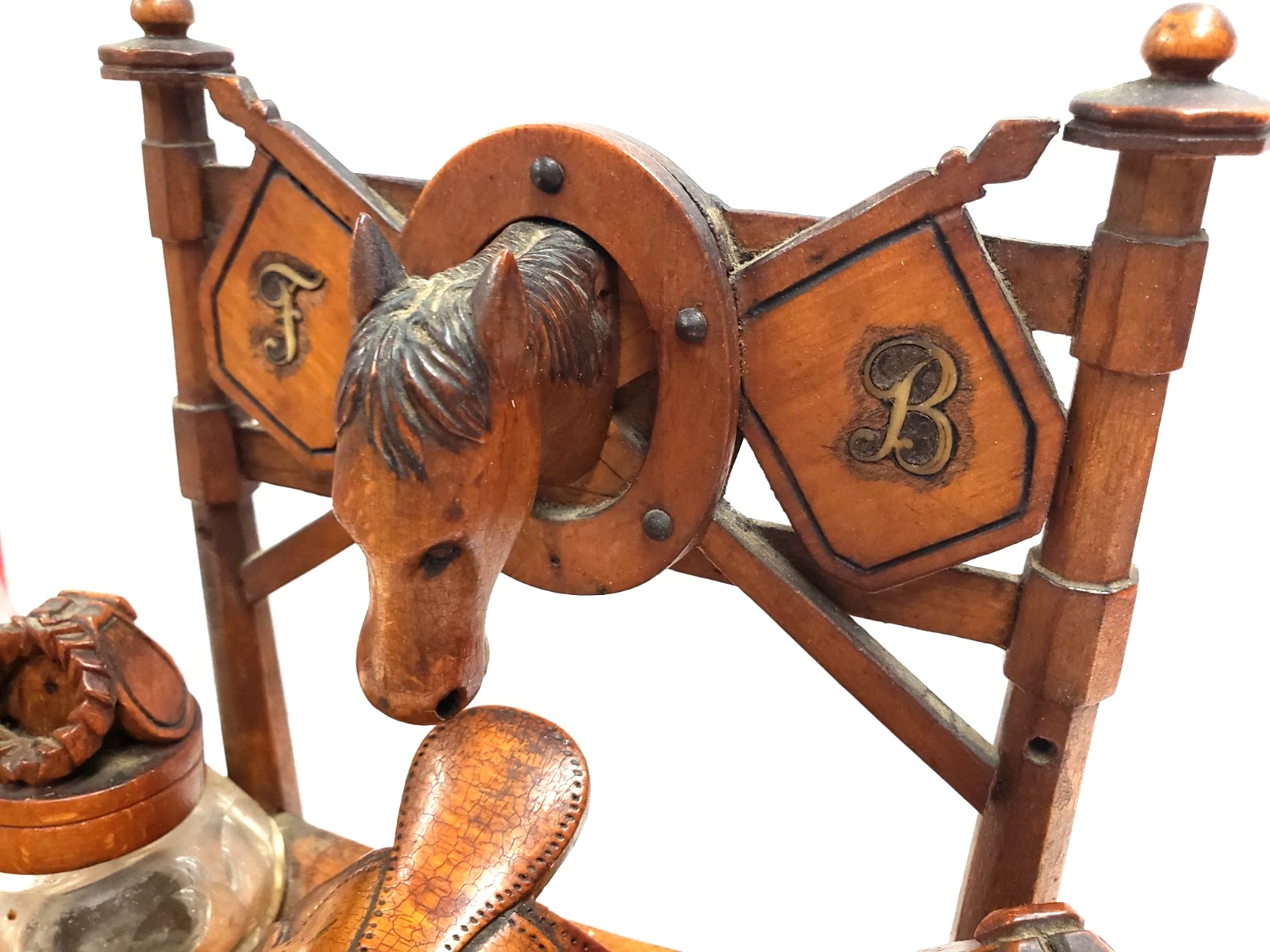

Hand-Carved Equestrian Inkstand
| Categories | Wood Inkstands |
| Type | Equestrian |
| Material | Wood |
| Markings | See Narrative |
| Origin | England |
| Date or Era | circa 1885 |
This is a Late Victorian hand-carved equestrian inkstand, dating to approximately 1885. While it has the intricate, naturalistic style often associated with the “Black Forest” carvings of Switzerland and Germany, this specific design is a classic example of English sporting art from the late 19th century, celebrating country estate life.
The Animal Under the Saddle
The animal is a Jack Russell Terrier (or a similar stable terrier). In 19th-century equestrian art, terriers were the constant companions of horses in the stables. They were kept to keep rats down and were often depicted “guarding” the horse’s tack. In Victorian “narrative” carvings, this was a common motif representing the loyalty of the rider’s companions (the horse and the dog) waiting together at the stables.
Equestrian Symbols & Equipment
This piece is dense with specific iconography related to 19th-century horsemanship and horse racing:
- The Jockey’s Medallion (Front Center): The carving on the front of the base features a jockey’s cap, two crossed riding crops (or whips), and a stirrup iron. This suggests the original owner may have had an interest in fox hunting or horse racing.
- The Horse’s Head (Top): The head is framed by a circular opening that mimics a stable stall window or a horseshoe.
- The Inkwell Lids: Look closely at the wooden tops of the glass inkwells; they are hand-carved to resemble stirrup irons with their accompanying leather straps coiled on top.
- The Base: The front features a deep, scalloped pen tray for resting dip pens.
Origin and Rarity
- Origin: Likely England. The mix of sporting symbols (jockey cap/crops) and the specific “F B” monogram style is very British Victorian.
- Material: It is hand-carved from a warm hardwood, likely walnut or linden wood, which allowed for the “micro-carving” seen in the dog’s fur and the leather texture of the saddle.
- Uniqueness: While similar themes exist, these were hand-made by master carvers, making no two exactly alike. The inclusion of the “hidden” dog and the specific monogram confirms this was a high-end, personalized desk accessory for a 19th-century study.
- The Shields (F & B): These are likely the initials of the original owner. High-quality pieces like this were often commissioned as one-of-a-kind gifts or trophies for prominent equestrian figures.
Based on the initials “F B” and the highly specific racing symbols, there are two high-profile candidates from the late 19th-century British horse racing world who would have owned such a “princely” piece.
The Most Likely “F B” Candidates
- Frank Bibby (1857–1923): This is the strongest candidate for a commissioned piece. He was a shipping magnate and one of the most prominent horse owners and huntsmen in Victorian England.
- The Connection: He was the Master of the North Shropshire Hounds and a major figure in the Jockey Club.
- Why it fits: He was known for his “princely” lifestyle and commissioned many high-end works of art. The inkstand could have been a gift from his hunting club or a trophy for one of his many racing successes.
- Fred Barrett (1867–1895): A “superstar” jockey of the 1880s.
- The Connection: He was the Champion Jockey of 1888 and won the Epsom Derby twice (1888 on Ayrshire and 1889 on Donovan).
- Why it fits: In the late 1880s, Barrett was a national celebrity. Commemorative items featuring his initials were common, though a hand-carved piece like this would have been an elite presentation gift—perhaps from a royal patron or a wealthy stable owner—to celebrate a major win.
Sold for $235 in February 2026
Content disclaimer. The information posted is the owner’s best knowledge and may not have been vetted by the SOIC. We welcome comments, corrections, and additions, working to make our website information comprehensive and accurate.
Join the Society of Inkwell Collectors (SOIC) – it’s free!
Founded in 1981 as a non-profit organization,
we are documenting inkwells (and accessories).
We’re here to help and inform!