

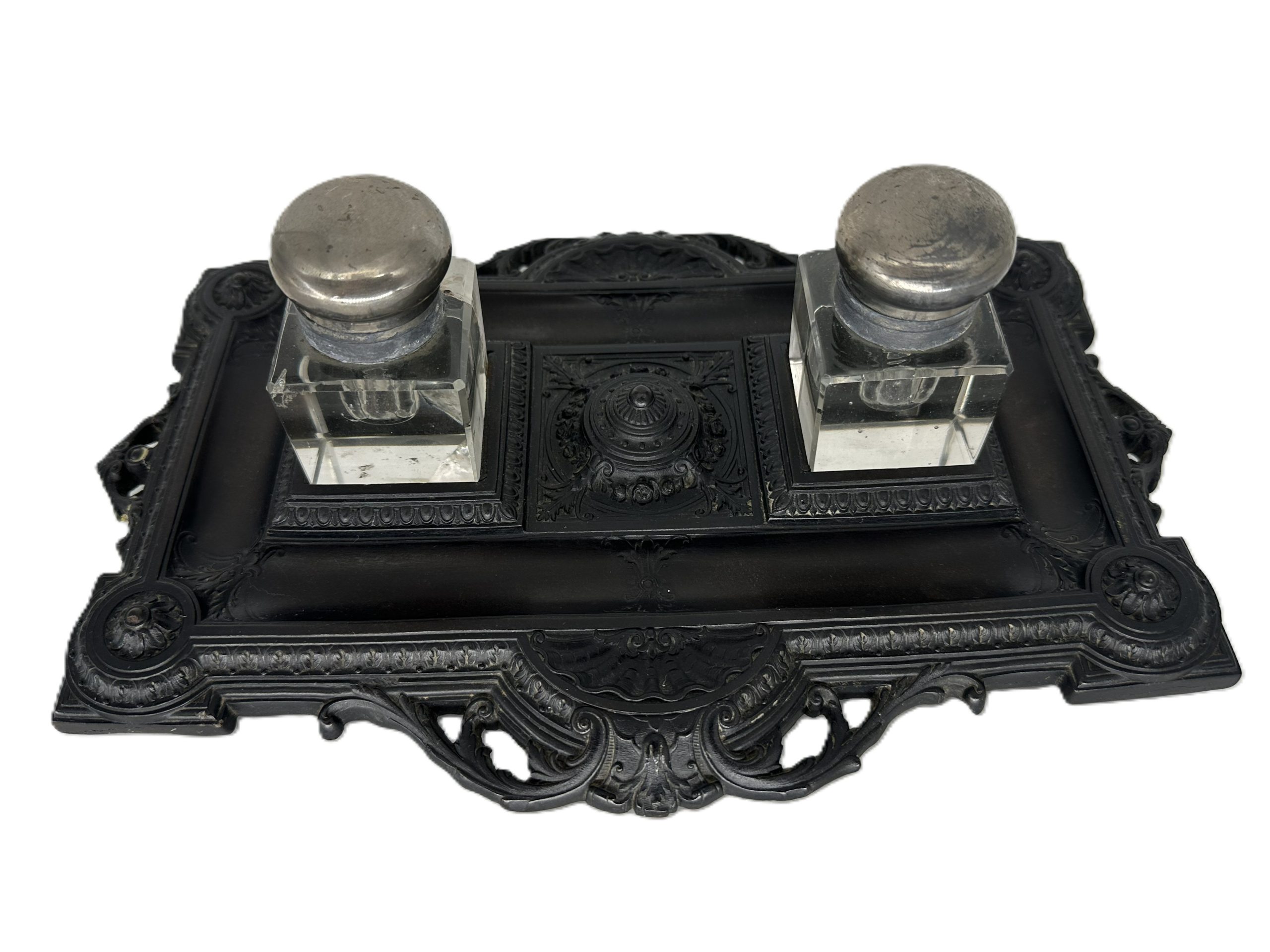
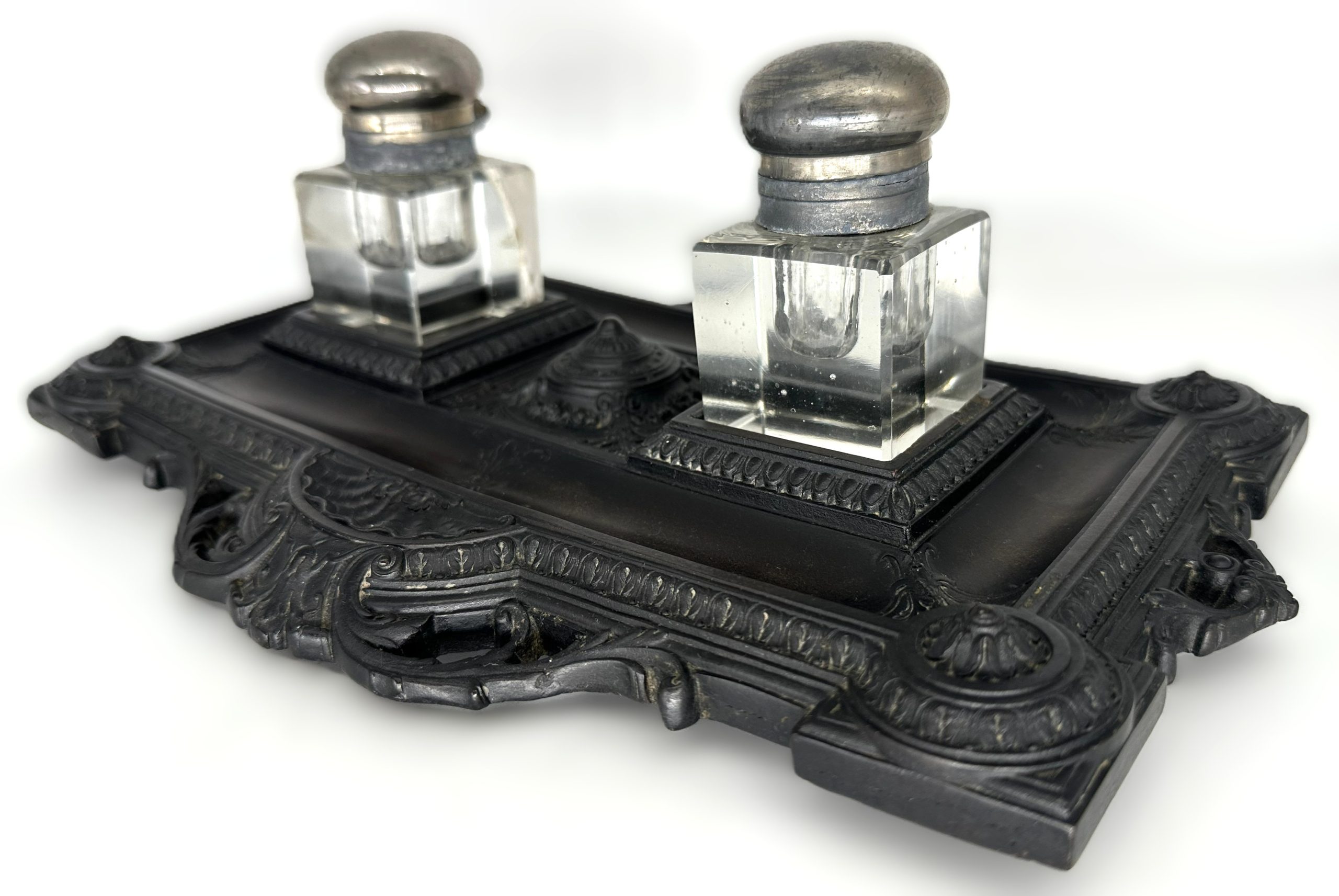
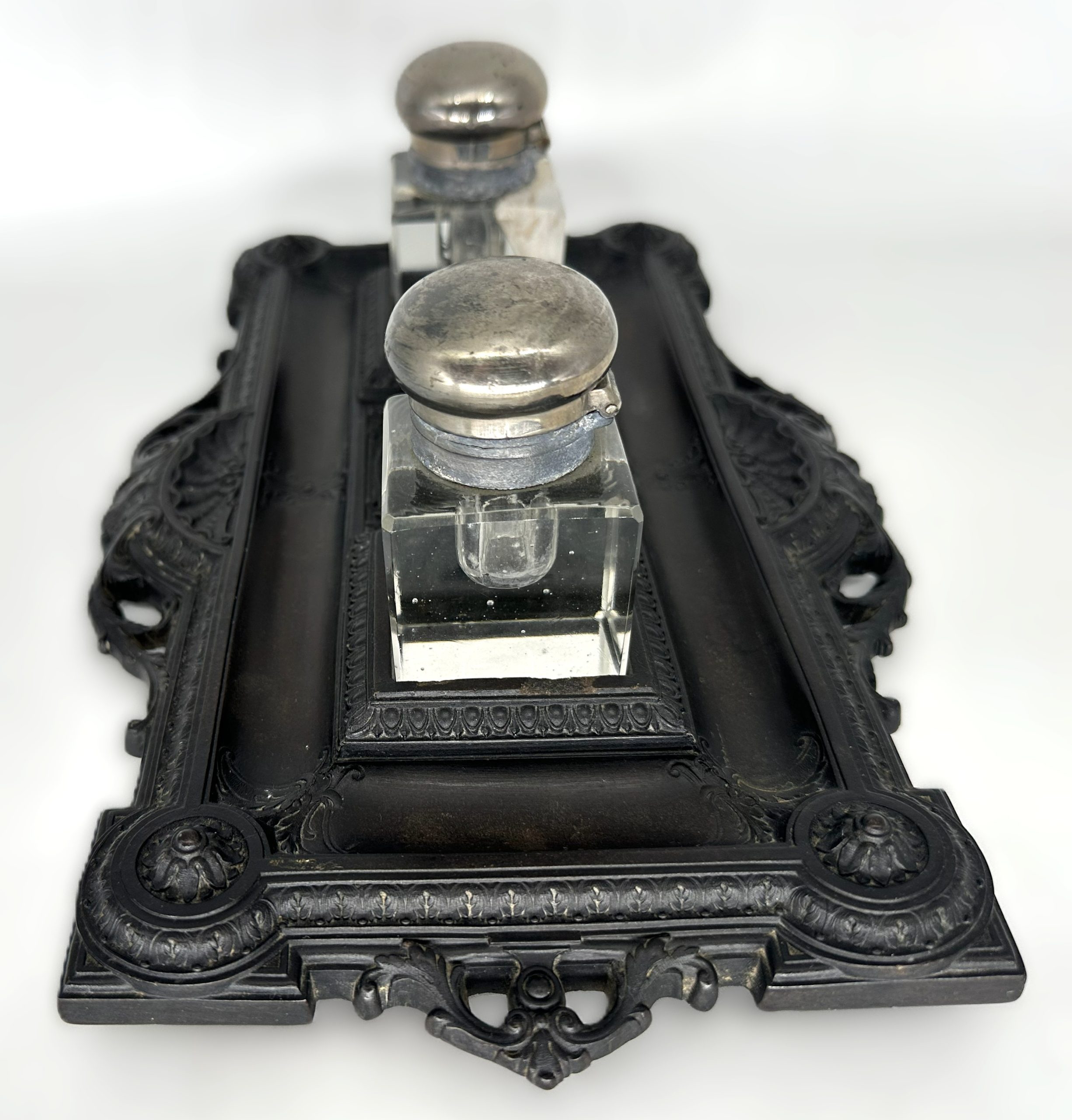
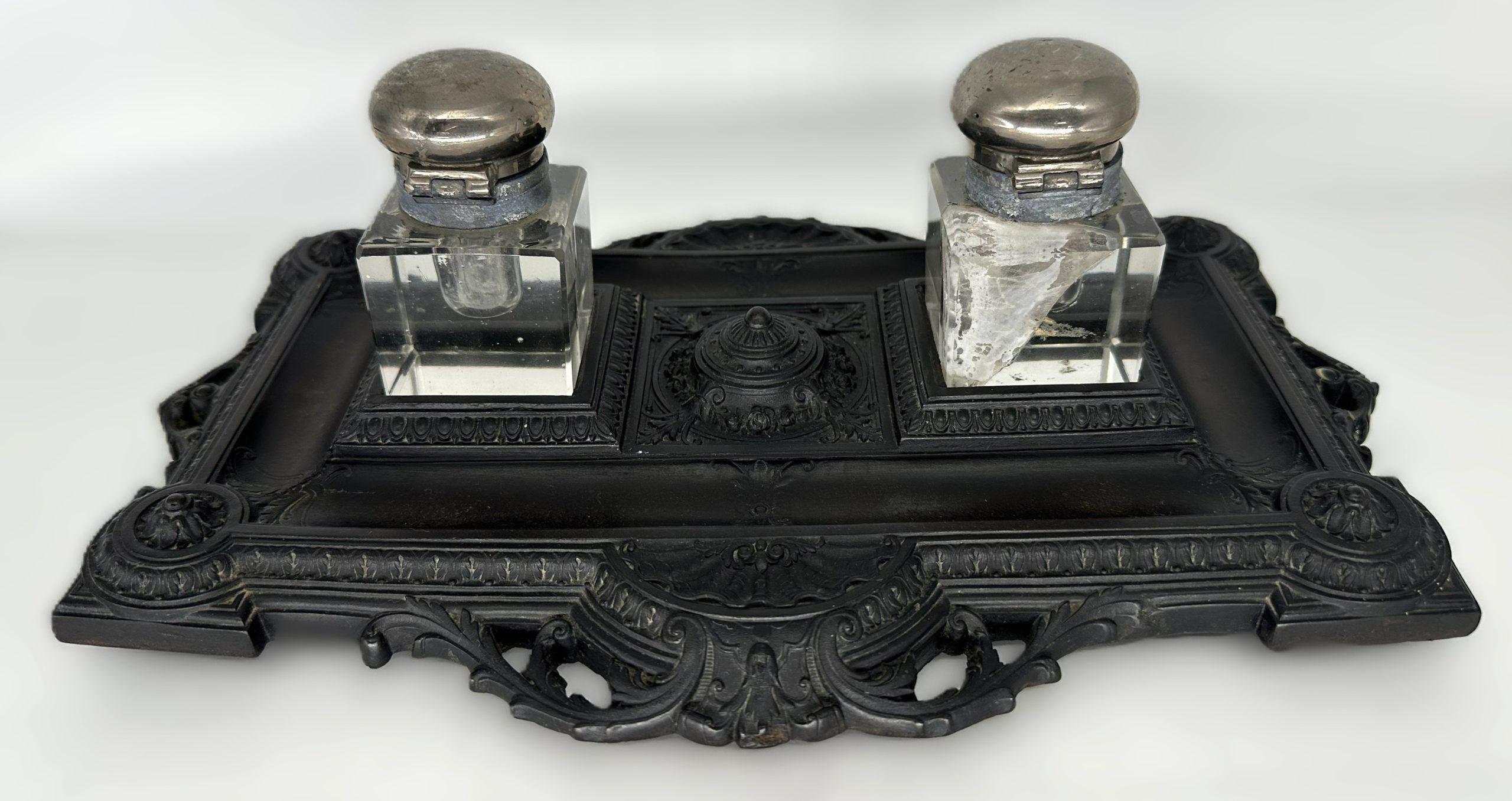
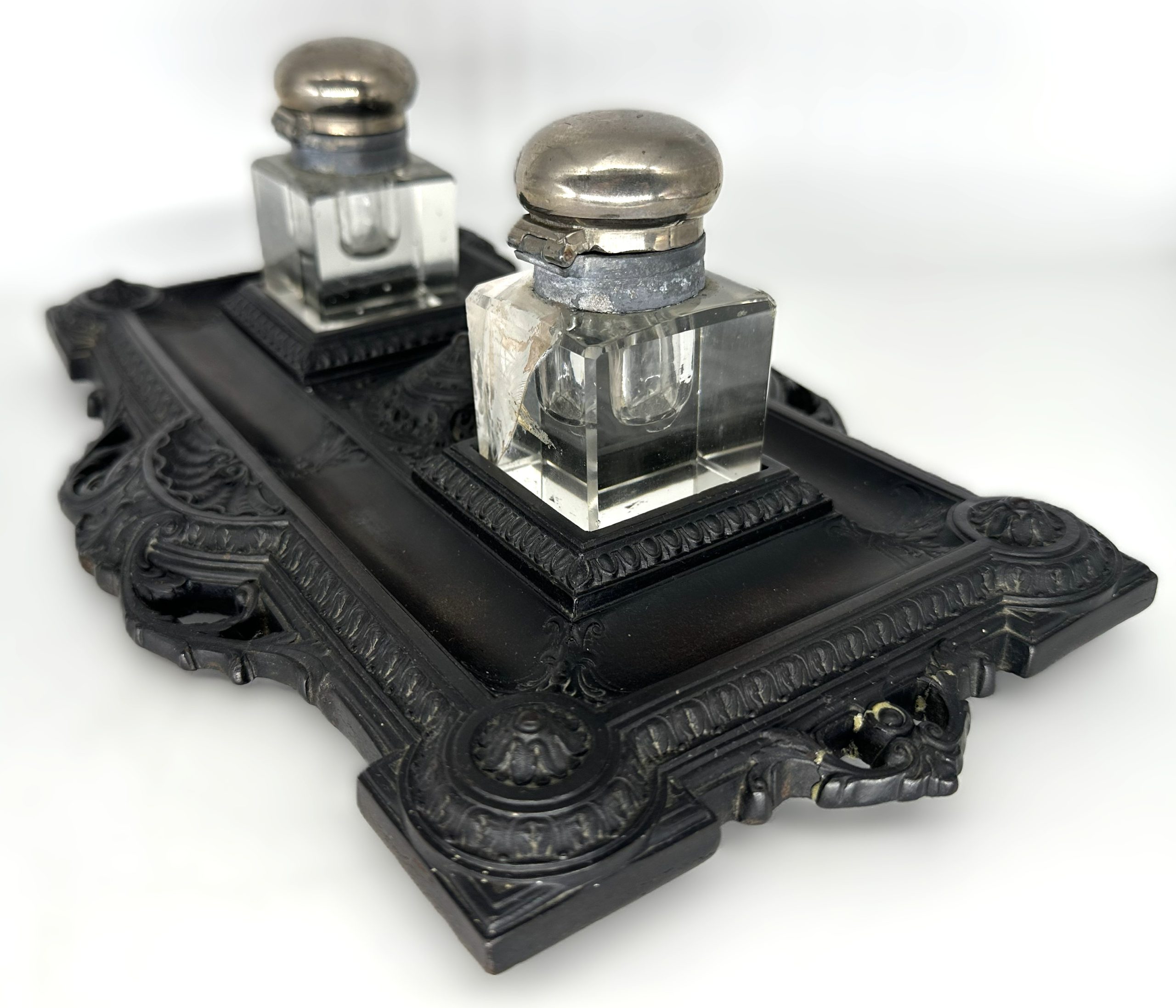
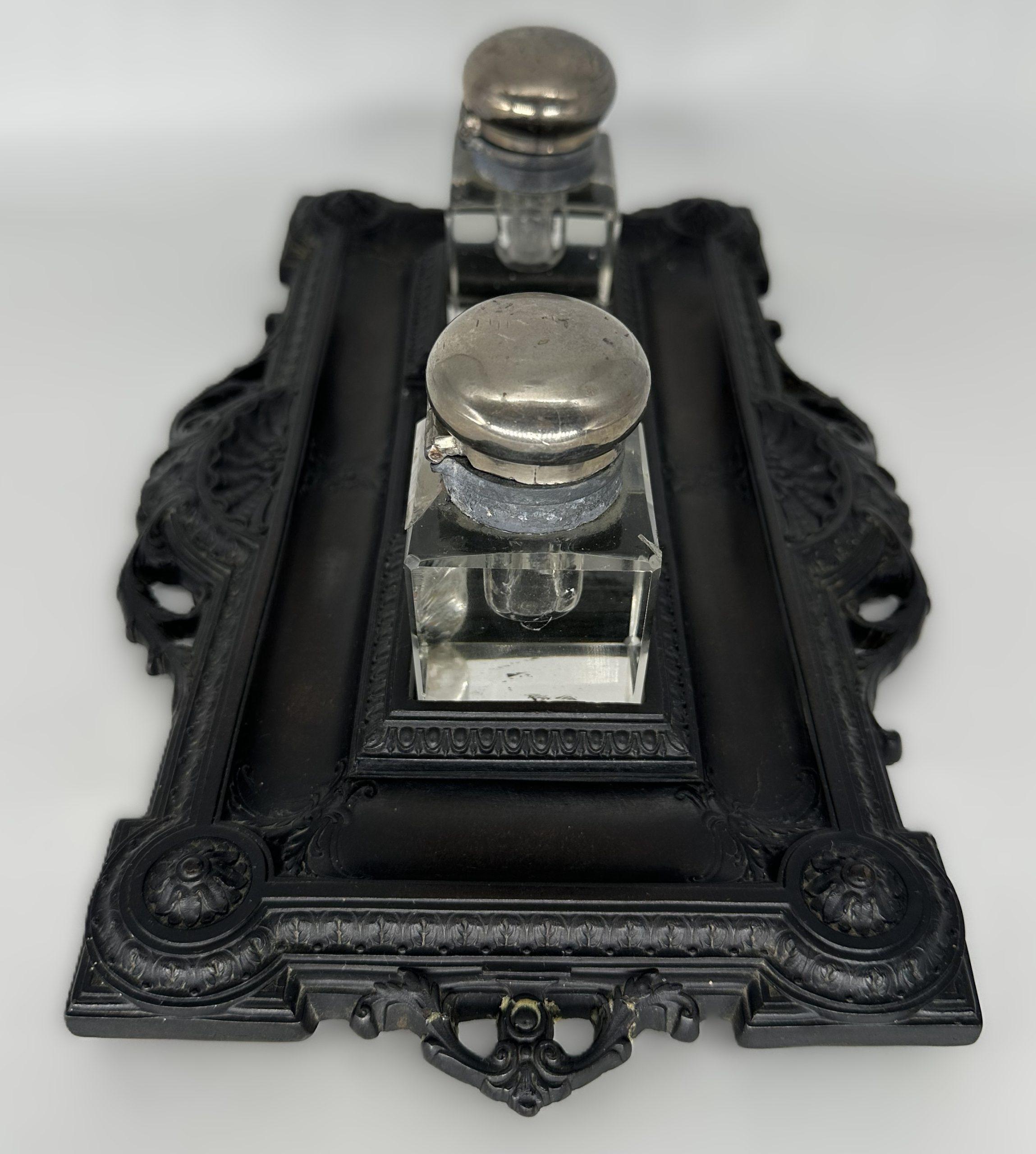
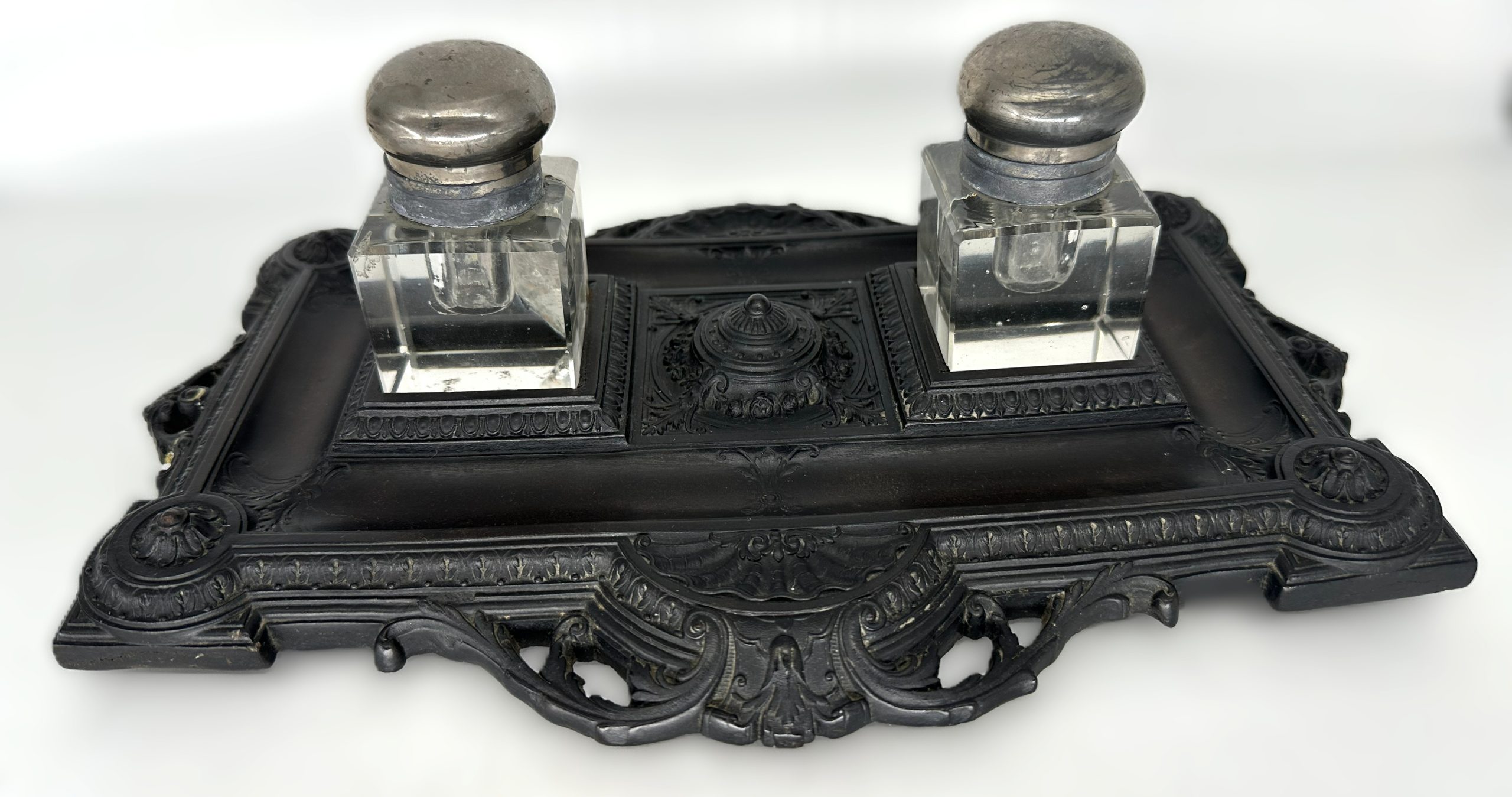
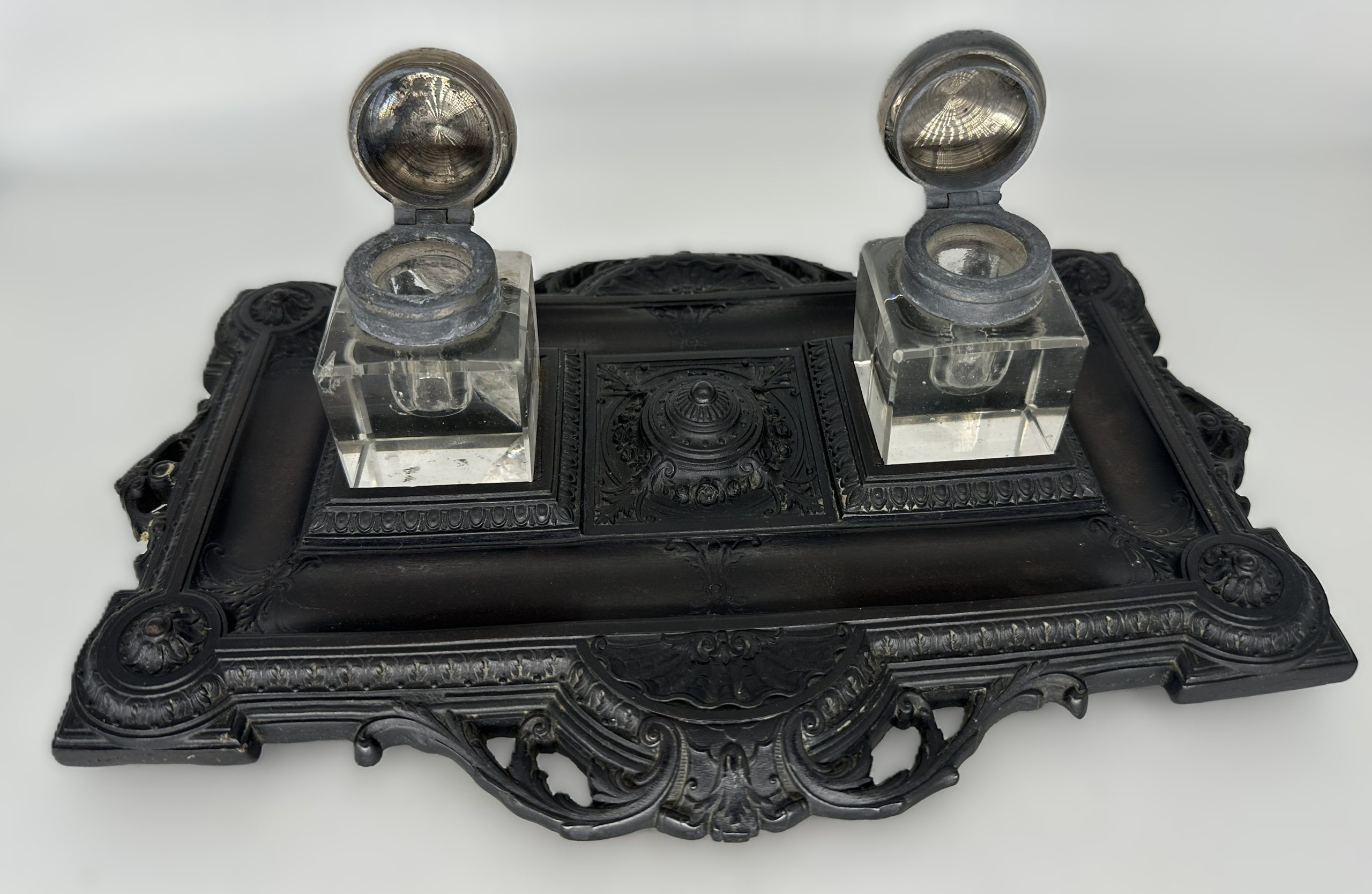
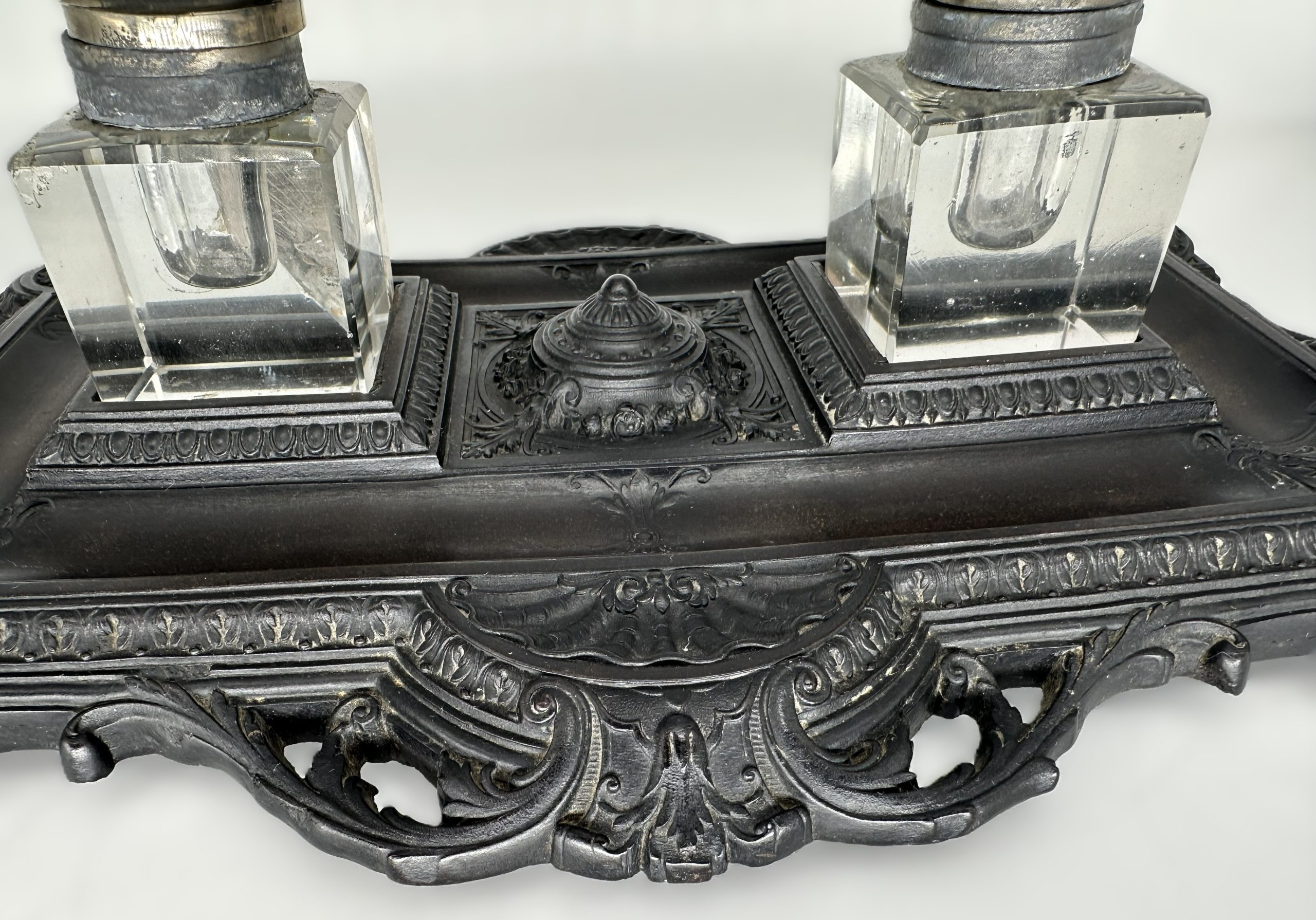
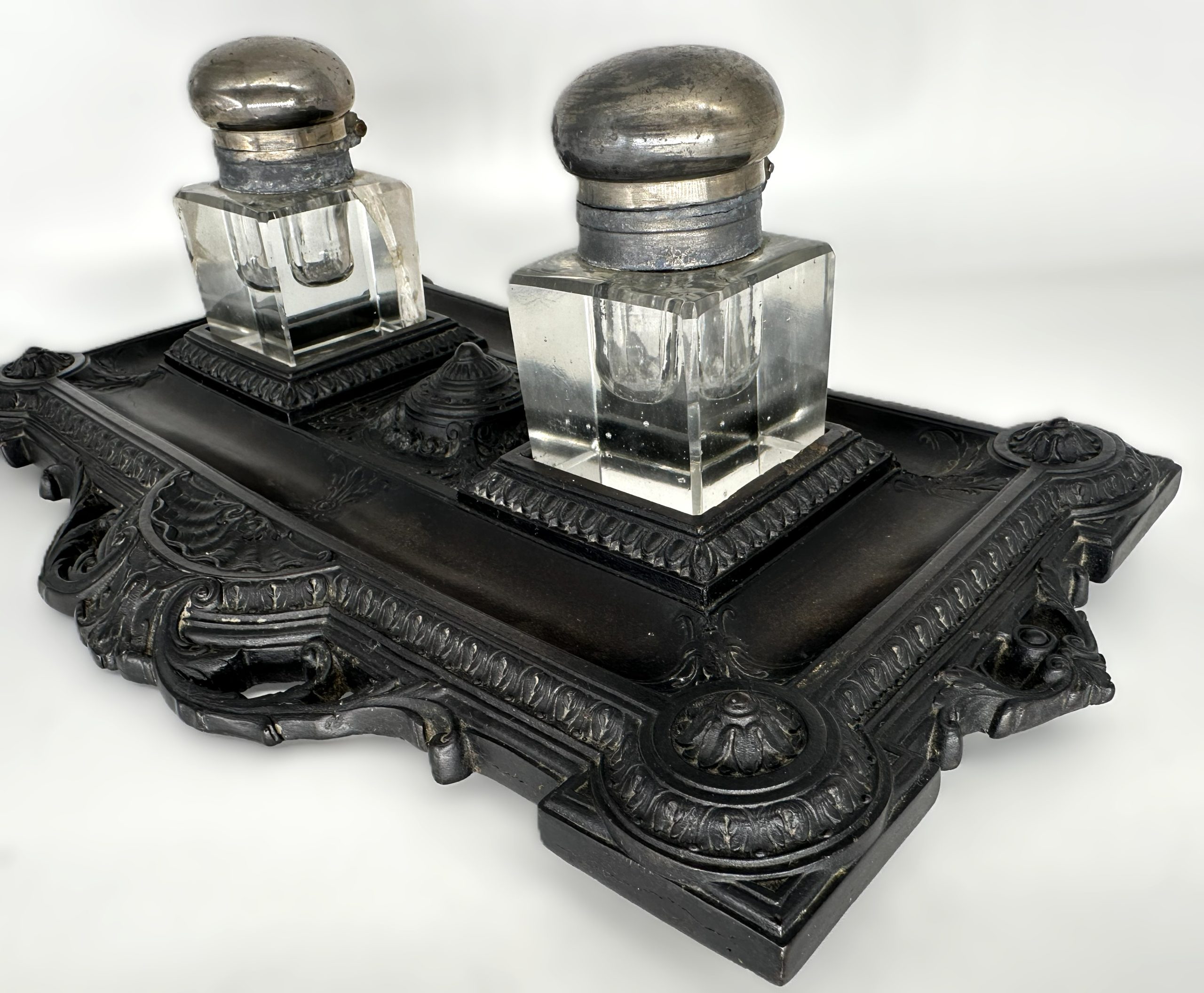
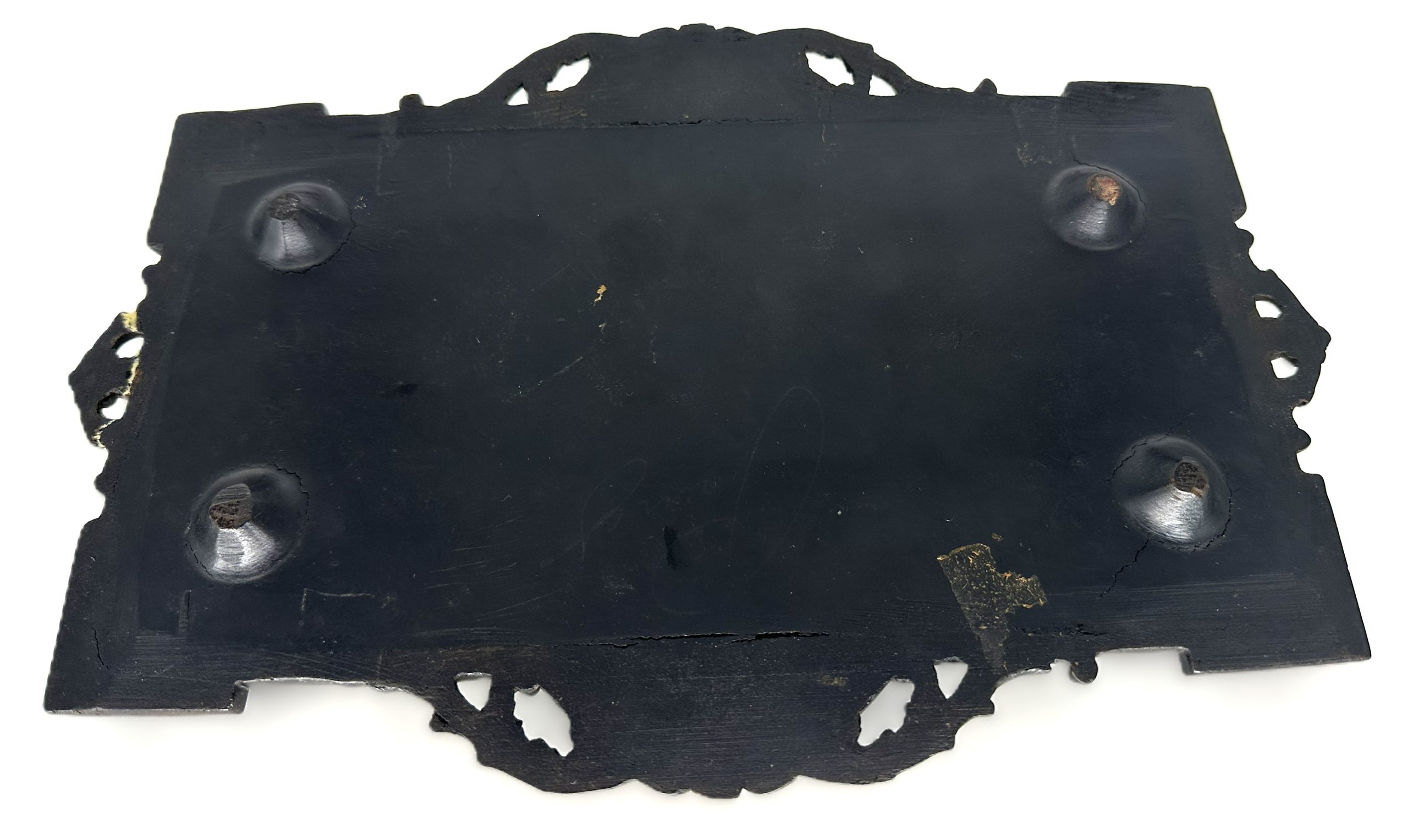
Gutta-Percha Double Inkstand (c. 1850–1860)
| Categories | Plastic - Bakelite - Gutta Percha |
| Material | Gutta Percha |
| Markings | Unmarked |
| Manufacturer | Undetermined |
| Origin | England |
| Date or Era | circa 1850 |
| Measuring | 12” x 8 ½” x 4 ½” |
This ornate Victorian double inkstand is molded from gutta-percha, a natural bio-thermoplastic derived from the evaporated latex of Palaquium trees native to the Malay Archipelago. Although chemically identical to natural rubber as an isomer (), its trans-polymer configuration creates a rigid, crystalline structure that remains firm and durable at room temperature.
First industrialized in Britain by Charles Hancock and Henry Bewley through The Gutta Percha Company of London (est. 1845), the material was softened in hot water or steam and compression-molded under high pressure into cold metal dies. This process achieved casting detail comparable to fine bronze or carved ebony.
- Design: Styled in the French Rococo / Classical Revival taste, featuring a central wafer or nib compartment flanked by dual pen recesses, stepped cut-glass inkwells with hinged pewter/white-metal caps, and borders of acanthus leaf, shell motifs, and egg-and-dart molding.
- Origin: England (likely London), circa 1850–1858.
- Historical Context: Highly celebrated during the 1851 Great Exhibition, decorative gutta-percha wares were produced in limited quantities for only a short window before the global supply was redirected almost exclusively to undersea telegraph cable insulation.
Historical & Technical Breakdown
- Origin & Botany: Gutta-percha is derived primarily from the sap of trees in the Sapotaceae family (most notably Palaquium gutta and Palaquium oblongifolium). While native to the Malay Peninsula (Malaysia), it is also indigenous across the wider Indo-Malayan Archipelago, including Sumatra, Borneo, and Java (Indonesia).
- Chemical Structure: Natural rubber (cis-1,4-polyisoprene) and gutta-percha (trans-1,4-polyisoprene) share the identical chemical formula . The trans stereoisomerism causes gutta-percha to form a rigid crystalline structure at room temperature, making it hard, tough, and inelastic until heated.
- Molding Process: Gutta-percha is a natural thermoplastic. Raw gum was cleaned, shredded, and boiled or steamed at roughly 55°C–65°C (130°F–150°F) until soft and putty-like. It was then placed into cold, engraved metal dies (or lead/plaster-backed steel molds) and subjected to hydraulic or screw-press pressure. As it cooled rapidly in the mold, it held sharp, micro-detailed impressions—including intricate Classical and Rococo Revival friezes, egg-and-dart borders, and acanthus scrollwork.
- Cost & Market Standing: In the late 1840s and 1850s, gutta-percha was an innovative, premium novelty material rather than a cheap substitute. While less expensive than carved jet, ebony, or solid cast bronze, it was marketed to middle- and upper-class Victorian households as a durable, impervious luxury desk accessory.
- Maker & Dating: Most decorative pieces of this exact type were produced in London, England by The Gutta Percha Company (Wharf Road, City Road, London), founded in 1845 by Henry Bewley, Samuel Gurney, and Charles Hancock. Production of ornate domestic wares flourished between circa 1848 and the late 1850s, especially following widespread acclaim at the Great Exhibition of 1851 in London.
- Decline of Domestic Wares:
- Telegraph Cables: Gutta-percha became the essential waterproofing and insulating material for global submarine telegraph cables, diverting nearly all raw supply to industrial contracts.
- Supply Depletion: Destructive harvesting methods (felling entire mature trees rather than tapping them) caused severe raw material shortages and soaring commodity costs.
- Competing Materials: Vulcanite/Ebonite (vulcanized hard rubber patented by Goodyear/Hancock) and later early semisynthetics like Celluloid (Parkesine) proved cheaper and less prone to brittleness when exposed to long-term light and oxygen.
Estimated value: $100
Content disclaimer. The information posted is the owner’s best knowledge and may not have been vetted by the SOIC. We welcome comments, corrections, and additions, working to make our website information comprehensive and accurate.
Join the Society of Inkwell Collectors (SOIC) – it’s free!
Founded in 1981 as a non-profit organization,
we are documenting inkwells (and accessories).
We’re here to help and inform!