


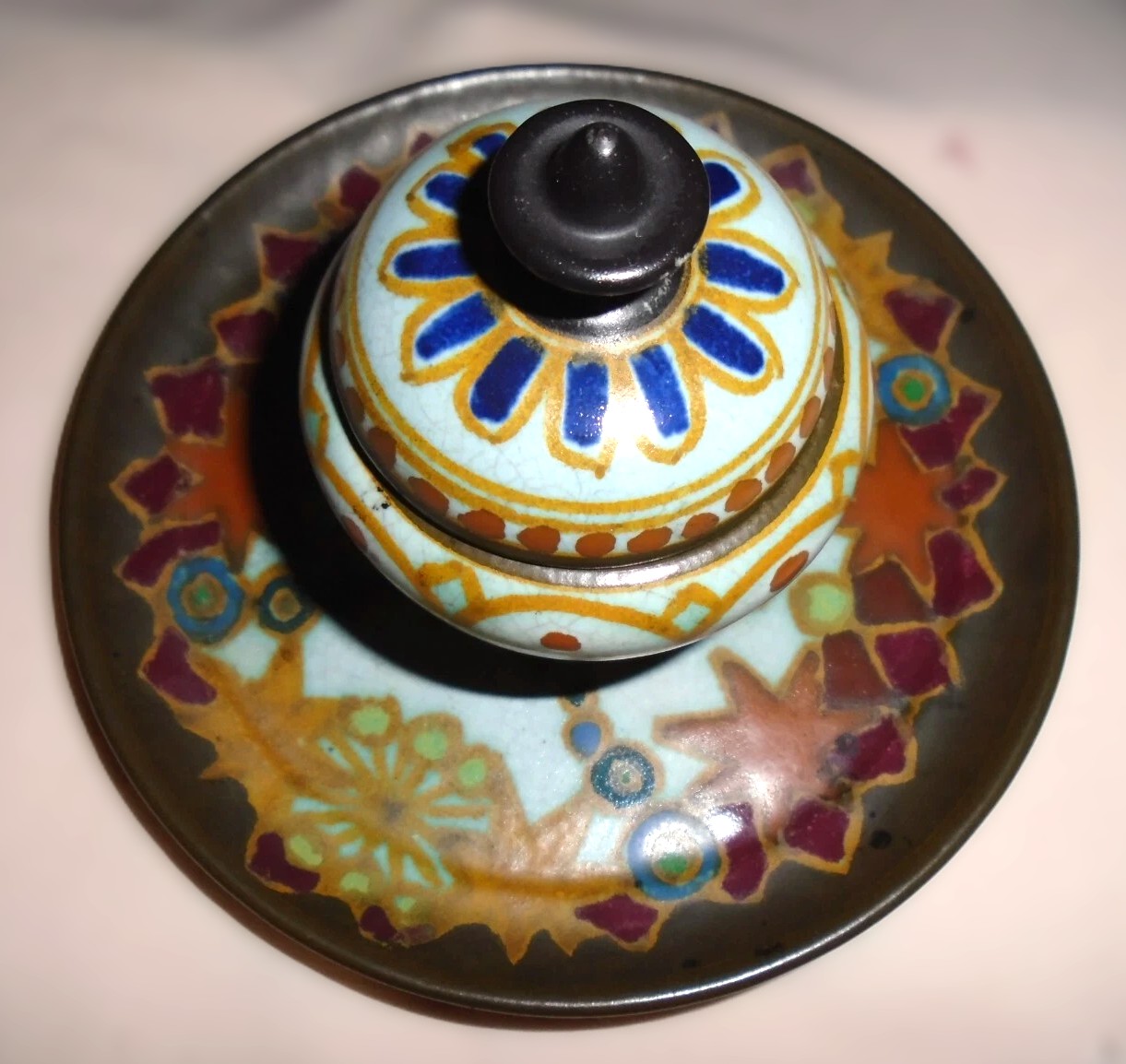
Gouda Pottery Inkwell
| Categories | Ceramics/Porcelain "Named" Makers |
| Material | Pottery |
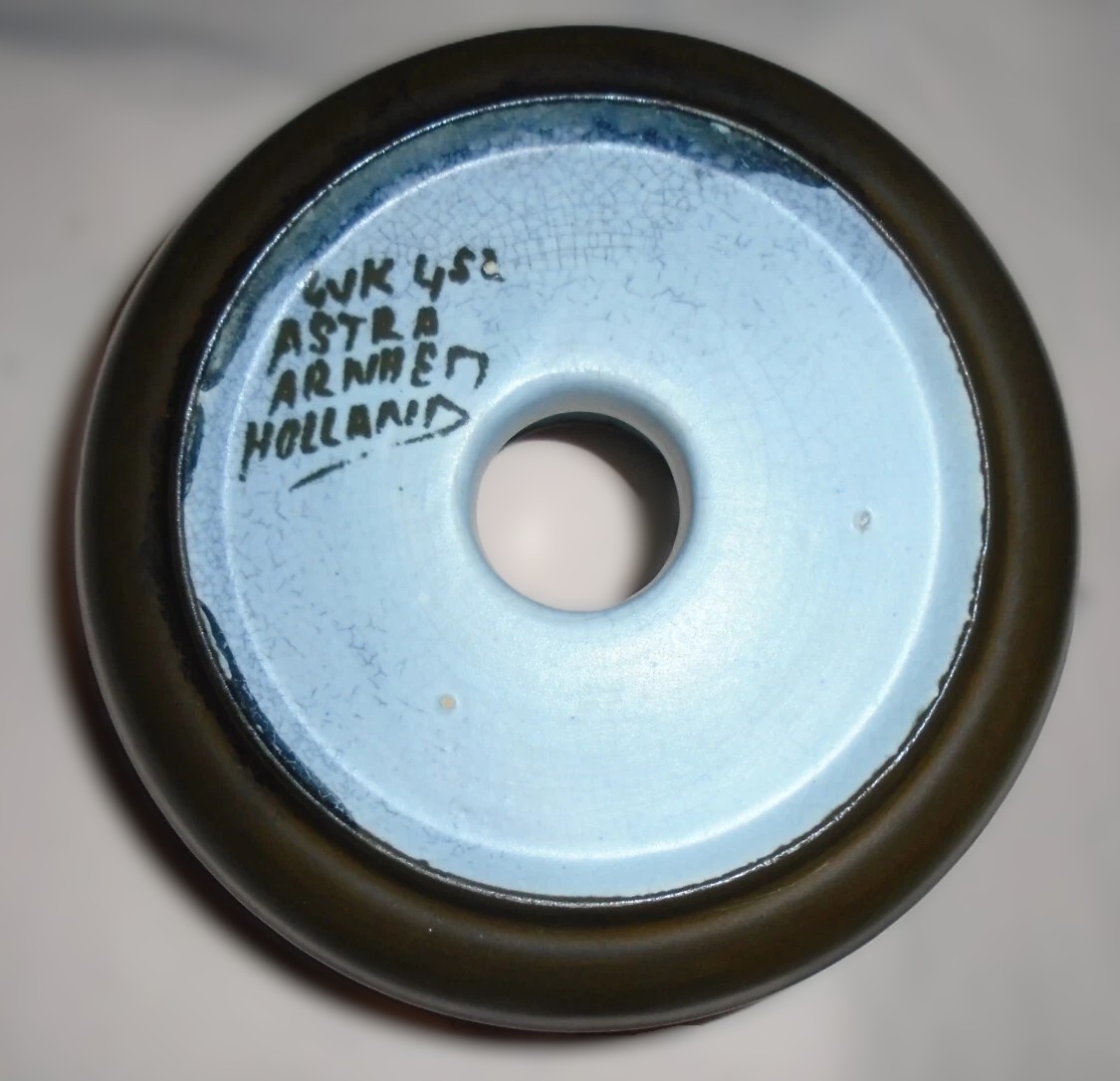
| Markings | See Narrative |
| Manufacturer | Gouda |
| Origin | Netherlands |
| Date or Era | circa 1920 |
| Measuring | 5 ¼” diameter; 4” high |
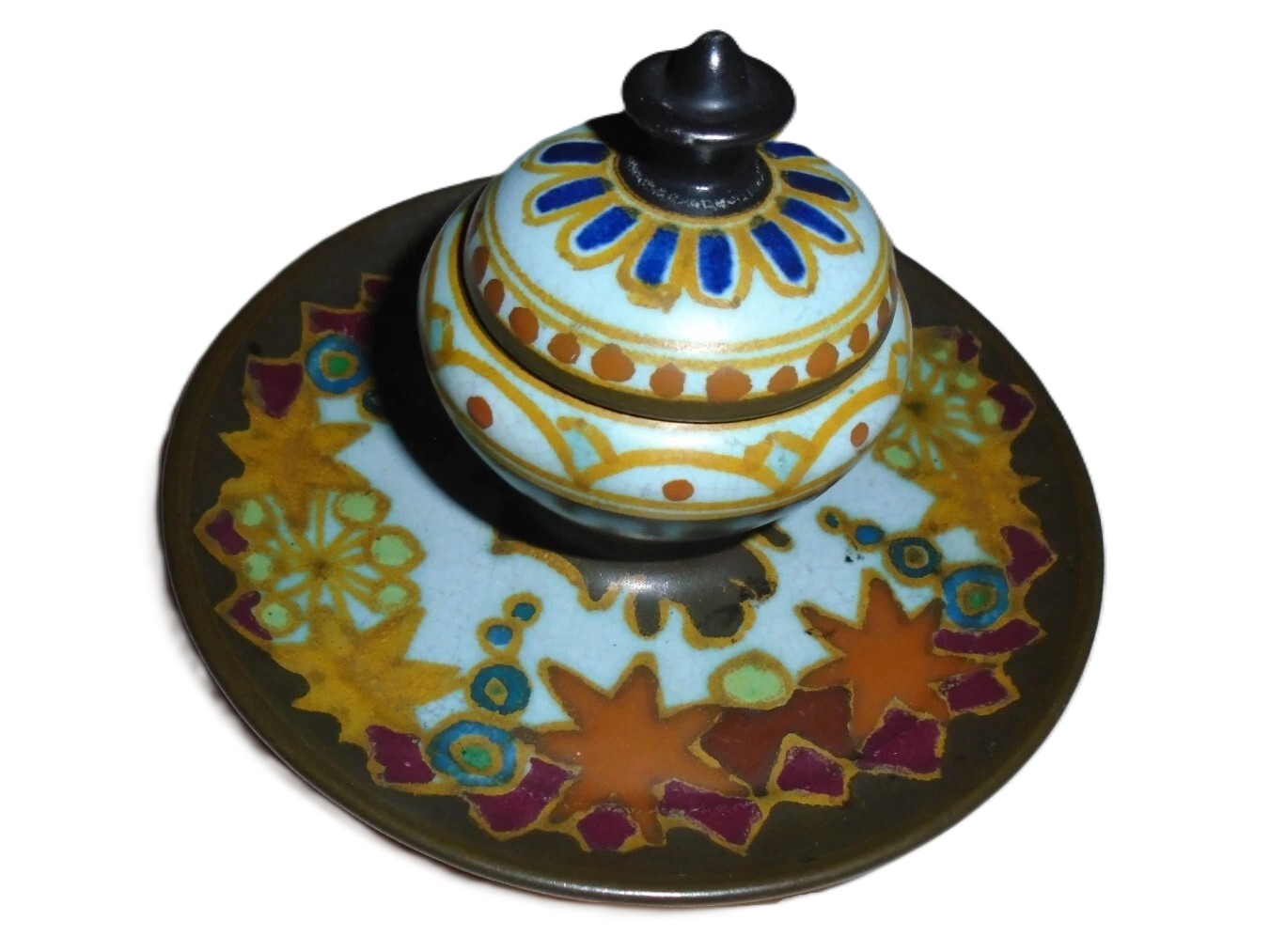
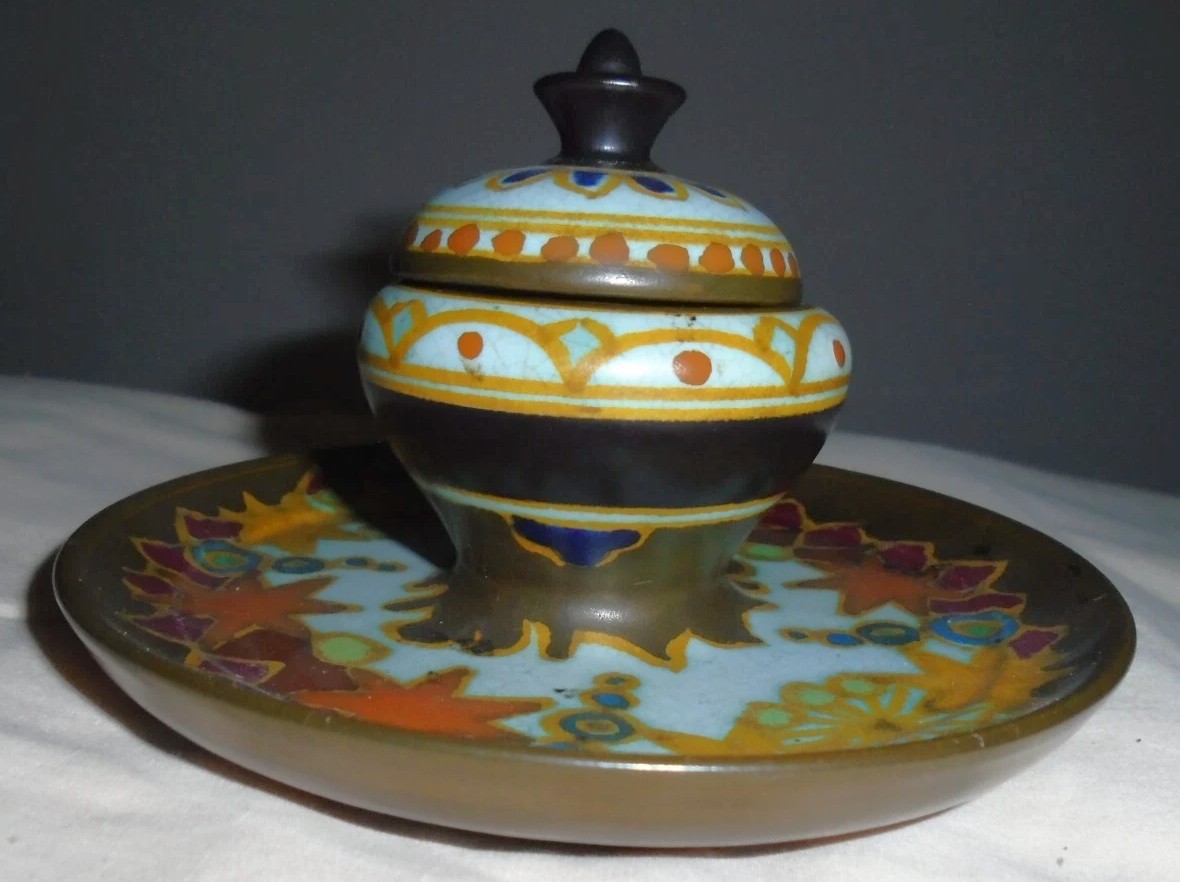
This Gouda pottery inkwell is a good example of the Arnhem factory’s work during the peak of the Dutch Art Nouveau and Art Deco periods. Featuring the “Astra” pattern, it beautifully demonstrates the factory’s signature “dark border” style, characterized by a semi-matte glaze and vibrant, stylized floral abstractions.
Construction & Form
The inkwell is designed as a single, cohesive unit with an integrated saucer-like base and a central, bulbous well.
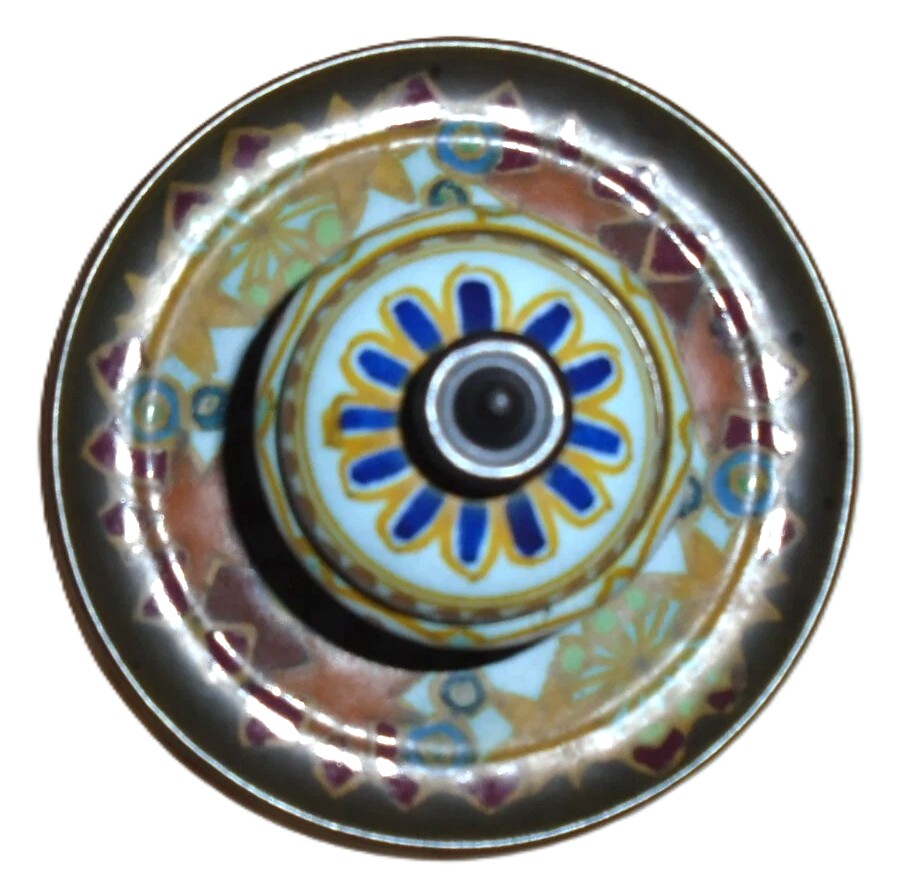
- The Base: A wide, shallow circular tray that serves as both a structural support and a decorative canvas.
- The Well: A rounded, vase-like body rises from the center of the base. It features a wide mouth designed to hold a separate, removable black ceramic ink pot.
- The Lid: A matching domed, lift-off cover. It is crowned with a distinct, matte black finial that provides a sharp, tactile contrast to the colorful pottery.
The “Astra” Decoration
The pattern lives up to its name (“Star”), featuring a cosmic array of abstract, sunburst-like floral motifs.
- Color Palette: The design utilizes a rich palette of burnt orange, deep burgundy, cobalt blue, and bright yellow, set against a pale, “duck-egg” blue ground. The edges are finished in a dark, bronzed-khaki border typical of the 1918–1928 Arnhem era.
- Motifs: The saucer is decorated with a ring of jagged, star-shaped flowers and circular “buds” in blue and green. The lid features a radiating sunflower-like motif in blue and yellow, framed by a delicate band of orange dots.
- Glaze & Texture: The finish is semi-matte with a fine, intentional “crackle” (craquelure) visible in the lighter blue areas, which is a hallmark of authentic Gouda ware from this period.
Markings & Provenance
As seen on the underside, the piece is hand-marked in dark slip:
- “GVK”: The initials of the artist or decorator.
- “452”: The specific mold or shape number.
- “Astra”: The pattern name.
- “Arnhem Holland”: Identifying the specific factory of origin.
Given that the Arnhem factory only produced these dark-bordered wares from 1918 until its closure in 1928, this piece is a well-preserved artifact from a very narrow and highly collectible window of Dutch ceramic history.
Sold for $85 in March 2026
Content disclaimer. The information posted is the owner’s best knowledge and may not have been vetted by the SOIC. We welcome comments, corrections, and additions, working to make our website information comprehensive and accurate.
Join the Society of Inkwell Collectors (SOIC) – it’s free!
Founded in 1981 as a non-profit organization,
we are documenting inkwells (and accessories).
We’re here to help and inform!