



Gouda Pottery – “Djaco” Pattern
| Categories | Ceramics/Porcelain "Named" Makers |
| Material | Pottery |
| Markings | See Narrative |
| Manufacturer | Gouda |
| Origin | Netherlands |
| Date or Era | circa 1930 |
| Measuring | Base: 2 ⅜”; Opening: 2 ¾”; Height: 3 ¼” |
This is a nice example of Art Deco era Dutch pottery. The “Djaco” pattern is appreciated by Gouda collectors for its bold geometric simplicity and vibrant, contrasting palette.
Antique Gouda Pottery Inkwell – “Djaco” Pattern (1930)
Manufacturer and Origin
Produced by the renowned Plateelbakkerij Zuid-Holland (PZH) factory in Gouda, Holland. This piece represents the pinnacle of the “Luxor” or semi-matte glaze period that defined the factory’s output during the late 1920s and early 1930s.
Form and Design
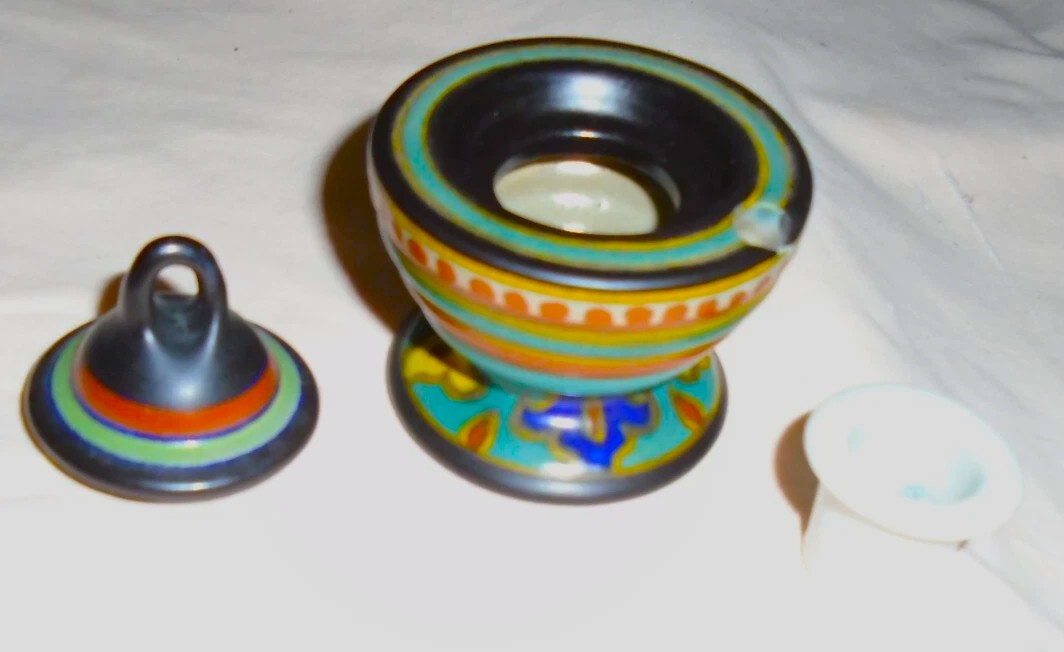
This three-piece assembly consists of the main vessel, a fitted lid, and a removable white ceramic insert.
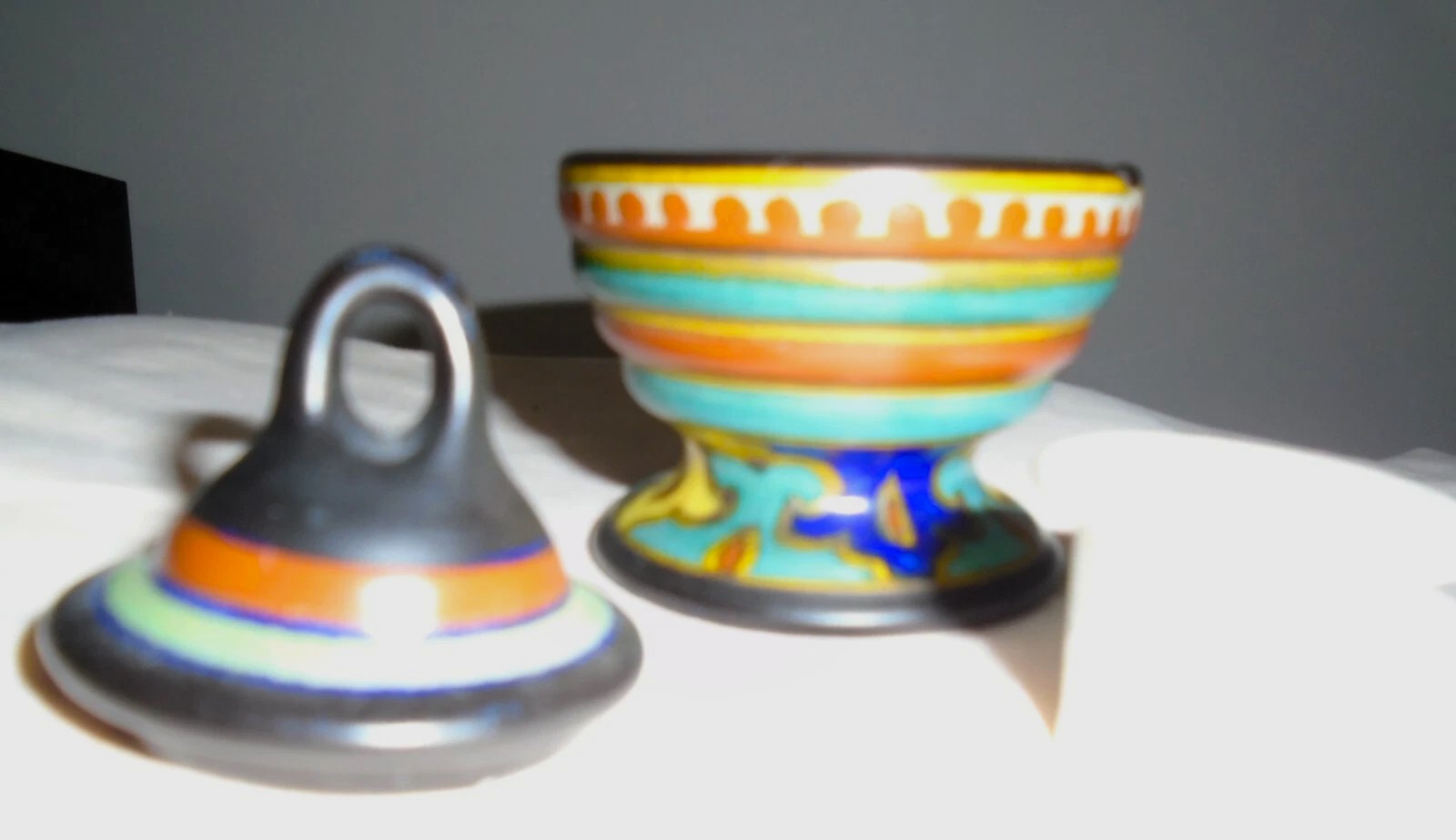
- Body: The inkwell features a classic, stepped bulbous form tapering down to a wide, flared pedestal base. A functional pen notch is integrated into the upper rim.
- Lid: The domed lid is finished with a distinctive circular ring finial.
- Insert: Includes a white ceramic liner that fits the interior cavity well (likely a contemporary or non-original replacement).
Decoration and Color Palette
The Djaco pattern is characterized by its sophisticated Art Deco aesthetic:
- Motif: The upper body is decorated with crisp, horizontal bands in shades of burnt orange, teal, forest green, and mustard yellow, separated by matte black outlines.
- Base Details: The flared base features a more intricate, stylized floral or “scroll” motif with teardrop accents in deep cobalt blue and orange against a turquoise ground.
- Glaze: Finished in the characteristic semi-matte (satin) glaze, which provides a smooth, non-reflective surface that enhances the depth of the hand-painted colors.
Markings and Authentication
The underside bears the comprehensive hand-painted markings typical of PZH production:
- Mold Number: 217 (appearing at the top).
- Pattern Name: “Djaco.”
- Factory Mark: “Plazuid” (the abbreviated trade name for Plateelbakkerij Zuid Holland).
- Date Symbol: A stylized house/gate symbol, the specific mark for the year 1930.
- Artist Mark: The initial “B”, identifying the specific painter responsible for the decoration.
Note
The “Djaco” pattern is a quintessential example of the transition from the flowing lines of Art Nouveau into the structured, rhythmic geometry of Art Deco.
Sold for $73 in March 2026
Content disclaimer. The information posted is the owner’s best knowledge and may not have been vetted by the SOIC. We welcome comments, corrections, and additions, working to make our website information comprehensive and accurate.
Join the Society of Inkwell Collectors (SOIC) – it’s free!
Founded in 1981 as a non-profit organization,
we are documenting inkwells (and accessories).
We’re here to help and inform!