

Inkipedia
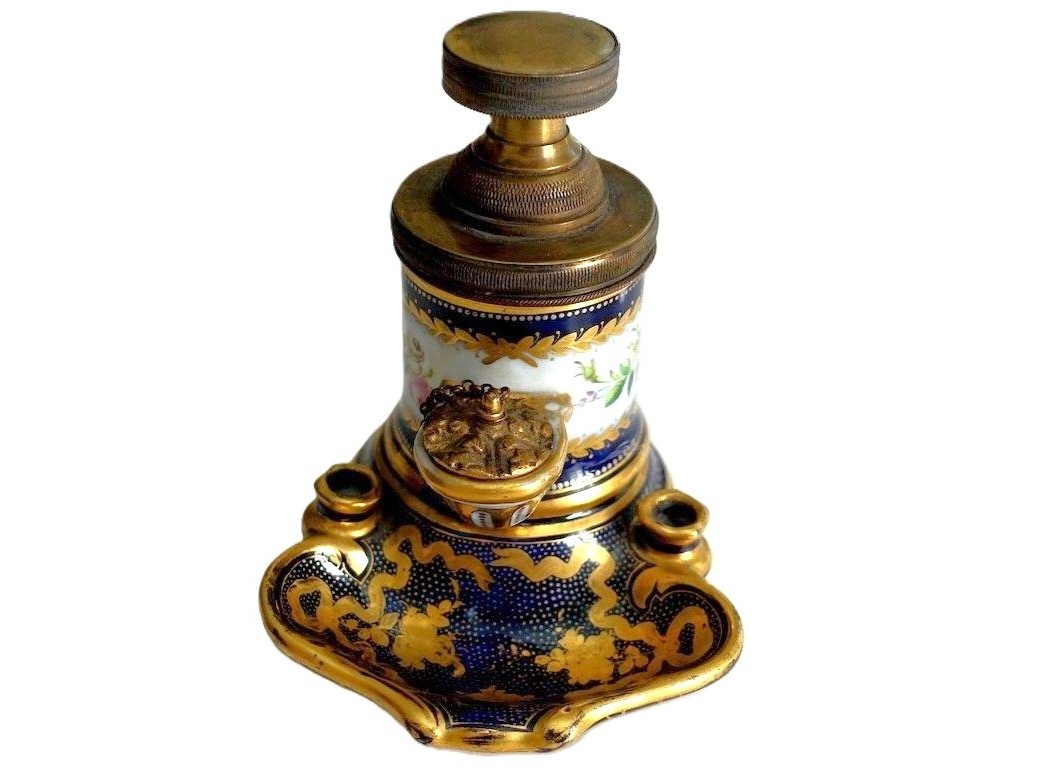

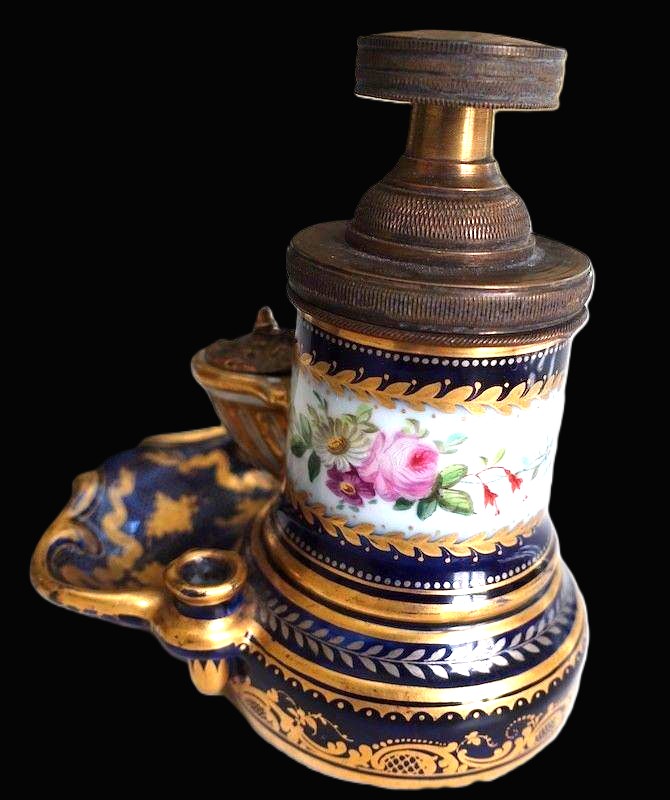

Gilded Cobalt French “Pump” Style Inkwell
| Categories | Mechanical - Pump / Siphon |
| Type | Pump |
| Material | Bronze, Porcelain |
| Markings | Unmarked |
| Manufacturer | Undetermined |
| Origin | France |
| Date or Era | circa 1865 |
Description
- Aesthetic: The piece is characterized by a deep cobalt blue porcelain body adorned with heavy gilded scrolling, floral patterns, and dotted details.
- Central Reservoir: The vertical cylinder features a white reserve in the center, decorated with hand-painted floral sprays of roses and other wildflowers, framed by a gilded laurel-leaf border.
- Base: The reservoir is integrated into a wide, scalloped porcelain tray which functions as a repository for small desk items like nibs or wafers.
- Hardware: The top is fitted with a bronze cap and a large, flat-topped turning knob. A small porcelain dipping font at the front is equipped with a matching decorative metal lid secured by a fine chain.
- Pen Holders: Two hollow porcelain cylinders are built into the tray on either side of the font to act as stable rests for quills or dip pens.
How the Displacement Mechanism Operates
While called a “pump,” this operates on a screw-driven displacement principle.
- Lowering the Piston: Turning the brass knob clockwise rotates a central threaded rod inside the reservoir. This action forces a solid porcelain cylinder (the plunger) downward into the ink supply.
- Raising the Ink: Because the ink has nowhere else to go, the physical presence of the descending porcelain plunger displaces the liquid, forcing it up through a hidden internal channel and into the small front dipping font.
- Preservation (Reverse): Turning the knob counter-clockwise lifts the plunger, creating a slight vacuum that draws the ink out of the font and back into the main airtight reservoir. This “clean” cycle prevented the ink from evaporating or turning into a thick sludge when not in use.
Origin and Attribution
- Maker: While this specific piece is not marked, the specific mechanical design and the quality of the porcelain are hallmarks of the Boquet or Morier workshops in Paris.
- Age: Circa 1860–1870. The elaborate use of cobalt blue glazes paired with hand-painted reserves was a signature style of the Second French Empire.
Estimated value: $200
Content disclaimer. The information posted is the owner’s best knowledge and may not have been vetted by the SOIC. We welcome comments, corrections, and additions, working to make our website information comprehensive and accurate.
Join the Society of Inkwell Collectors (SOIC) – it’s free!
Founded in 1981 as a non-profit organization,
we are documenting inkwells (and accessories).
We’re here to help and inform!