


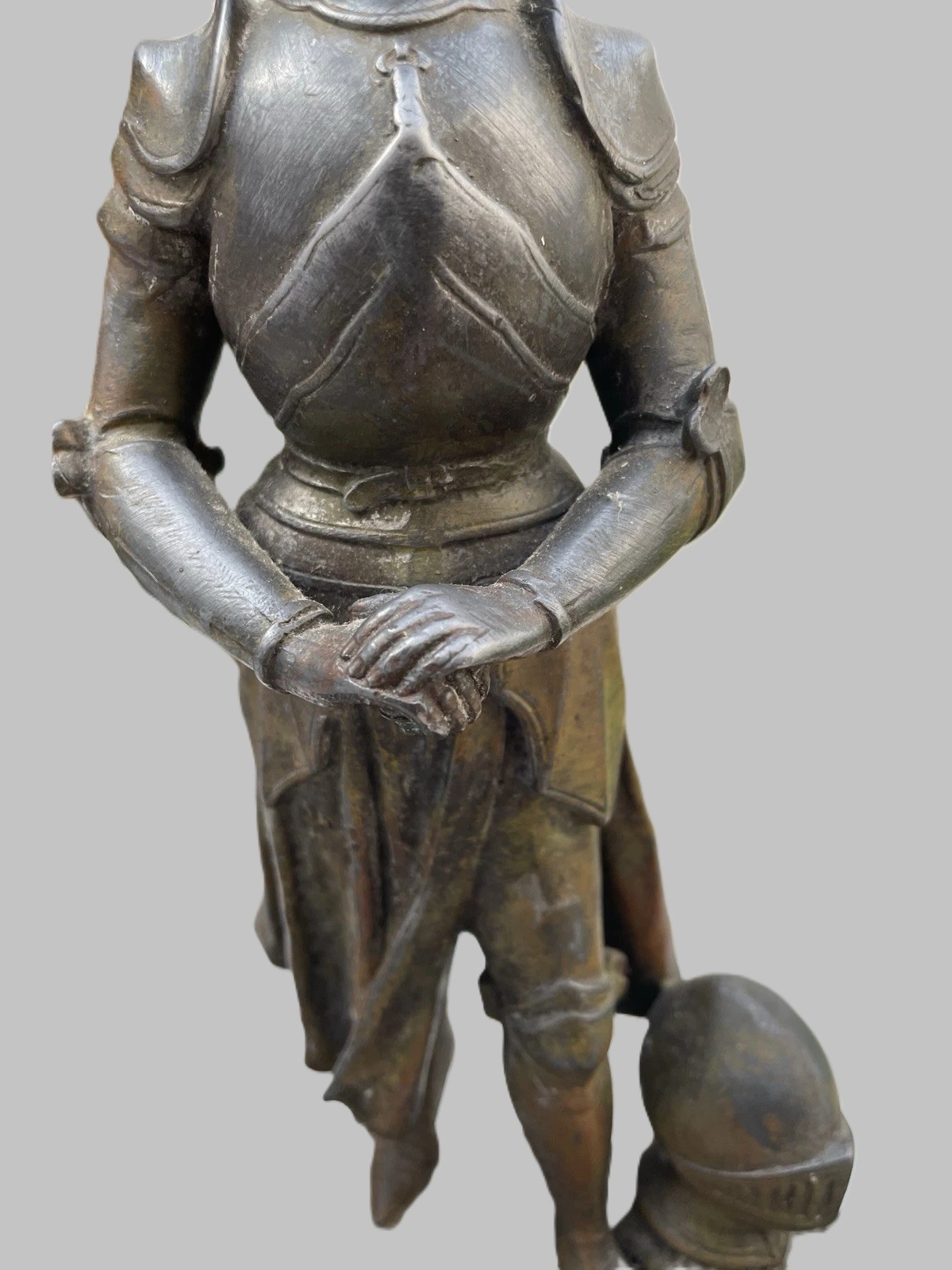


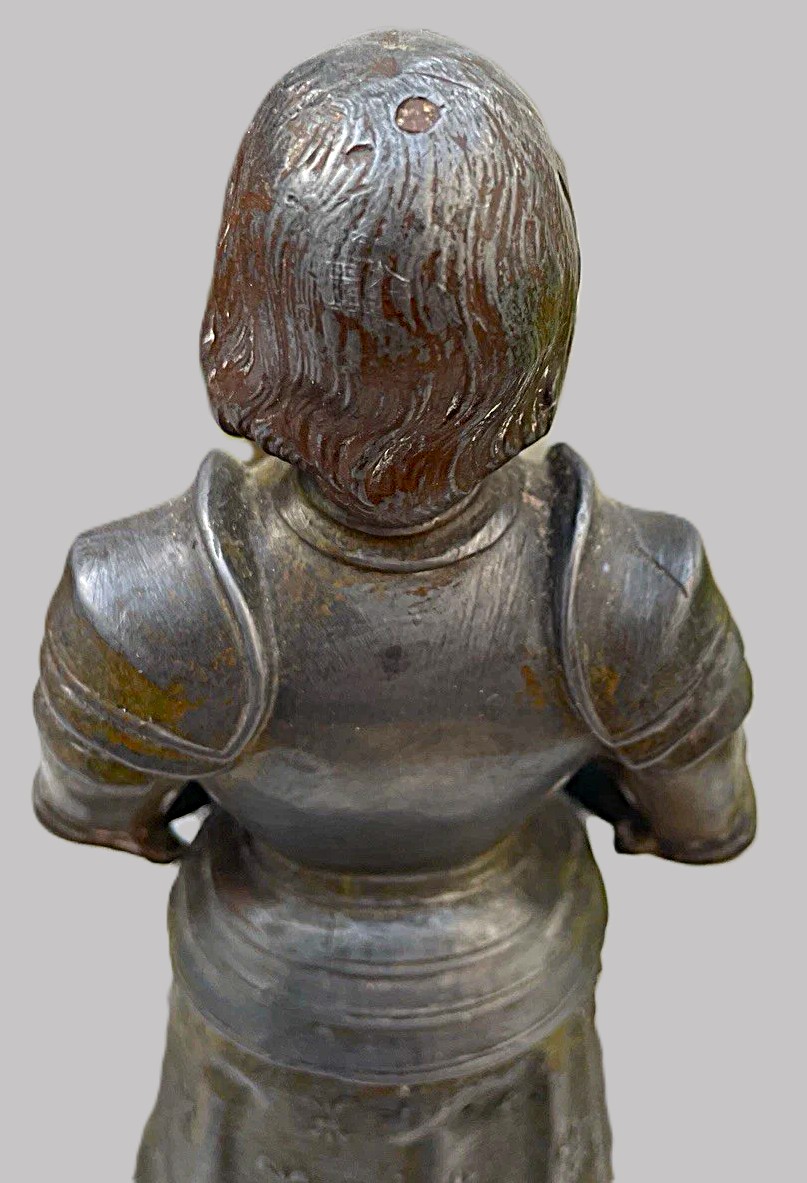


French Spelter Figural Inkstand – Joan of Arc (Jeanne d’Arc)
| Categories | Figural - Mythology; Literature; Religion; Fictional |
| Type | Historical |
| Material | Spelter |
| Markings | Unmarked |
| Manufacturer | Undetermined |
| Origin | France |
| Date or Era | circa 1890 |
| Measuring | 12 ¼” high |
- Description of the Inkstand
- Material: The piece is made of spelter (a zinc alloy known in France as Régule), which has been given a dark, bronze-like patina.
- The Figure: Joan is depicted in a moment of pious reflection, known as the “Maid of Orléans.”
- Armor: She wears full 15th-century plate armor, including a breastplate and jointed arm protection.
- The Tabard: Over her armor, she wears a skirt or tabard heavily decorated with a relief pattern of Fleur-de-lis, the symbol of the French monarchy she fought to restore.
- Accessories: Her helmet (a visored sallet or bascinet) rests on the ground by her left foot, symbolizing a pause in battle. She rests her hands on the hilt of her sword (the blade serving as a central pillar).
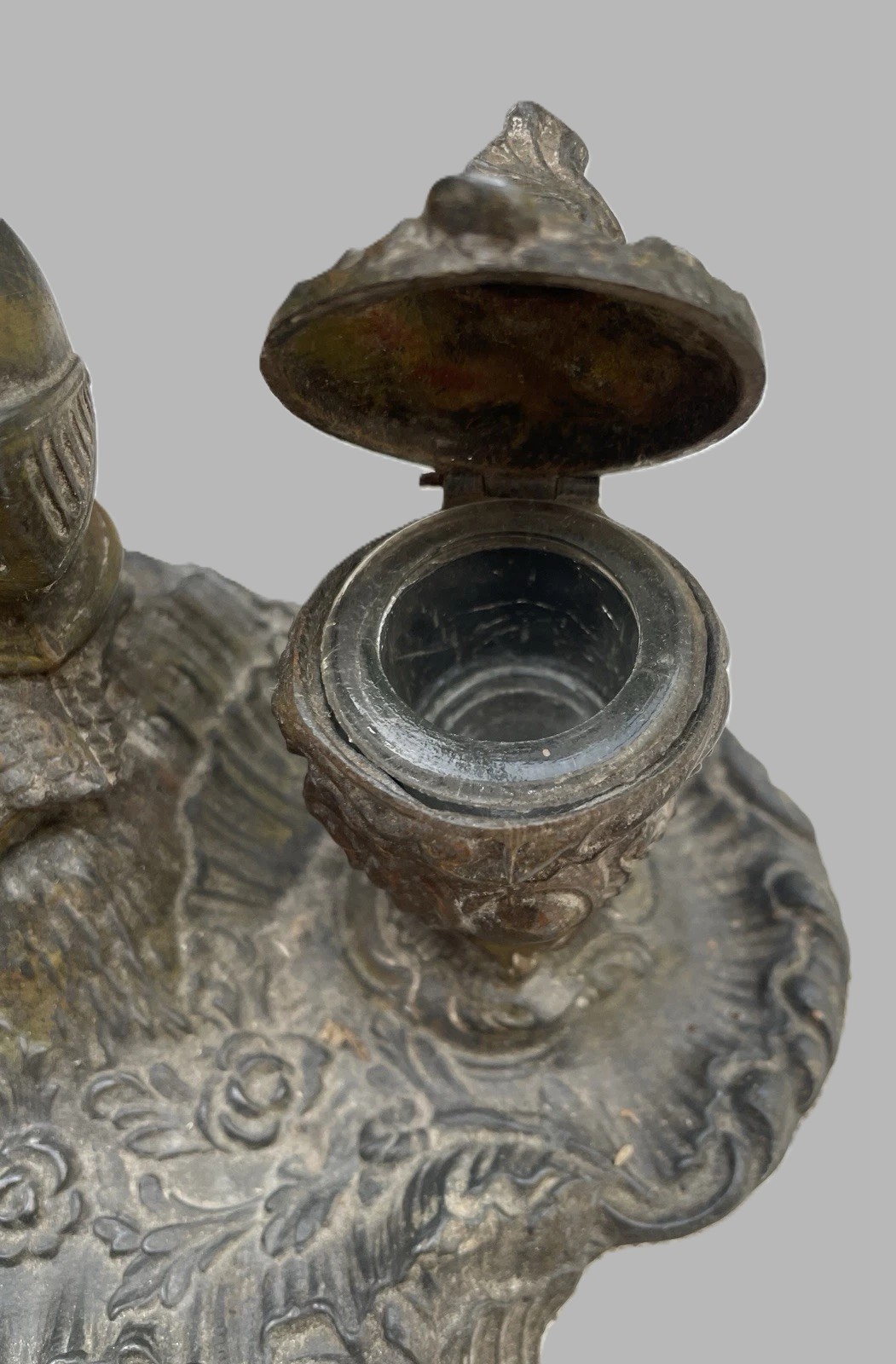
- The Base: The figure stands on a Rococo-style scrolling base that holds two urn-shaped inkwells. These feature hinged lids with finials and retain their original glass inserts.
Collector’s Note: This specific depiction of Joan (short hair, full armor, skirt) became incredibly popular in France between 1870 and 1920, surging in popularity leading up to her beatification in 1909 and canonization in 1920. This inkstand dates to the late 19th or early 20th century (c. 1890–1910).
- A Brief History of Joan of Arc (1412–1431)
Joan of Arc is one of history’s most fascinating figures—a teenage peasant girl who rose to command an army and saved France from English conquest.
- The Visionary: Born in Domrémy, France, during the height of the Hundred Years’ War, Joan was a peasant girl who, at age 13, began claiming she received visions from Archangel Michael, Saint Margaret, and Saint Catherine. They instructed her to support Charles VII and recover France from English domination.
- The Warrior: At age 17, she convinced the Dauphin (Charles VII) to let her travel to the Siege of Orléans (1429). Dressed in white armor and carrying a banner she designed herself, her arrival turned the tide of the war. She lifted the siege in just nine days, a miraculous victory that boosted French morale.
- The Martyr: In 1430, she was captured by the Burgundians (French allies of the English) and sold to the English government. She was put on trial in Rouen for heresy and cross-dressing (for wearing male military armor). Despite a brilliant defense, she was convicted and burned at the stake on May 30, 1431. She was roughly 19 years old.
- The Saint: Her conviction was overturned posthumously in 1456. She was eventually canonized as a Saint by the Catholic Church in 1920, solidifying her status as the patron saint of France and a symbol of national pride.
Sold for $117 in November 2025
Content disclaimer. The information posted is the owner’s best knowledge and may not have been vetted by the SOIC. We welcome comments, corrections, and additions, working to make our website information comprehensive and accurate.
Join the Society of Inkwell Collectors (SOIC) – it’s free!
Founded in 1981 as a non-profit organization,
we are documenting inkwells (and accessories).
We’re here to help and inform!