

Inkipedia
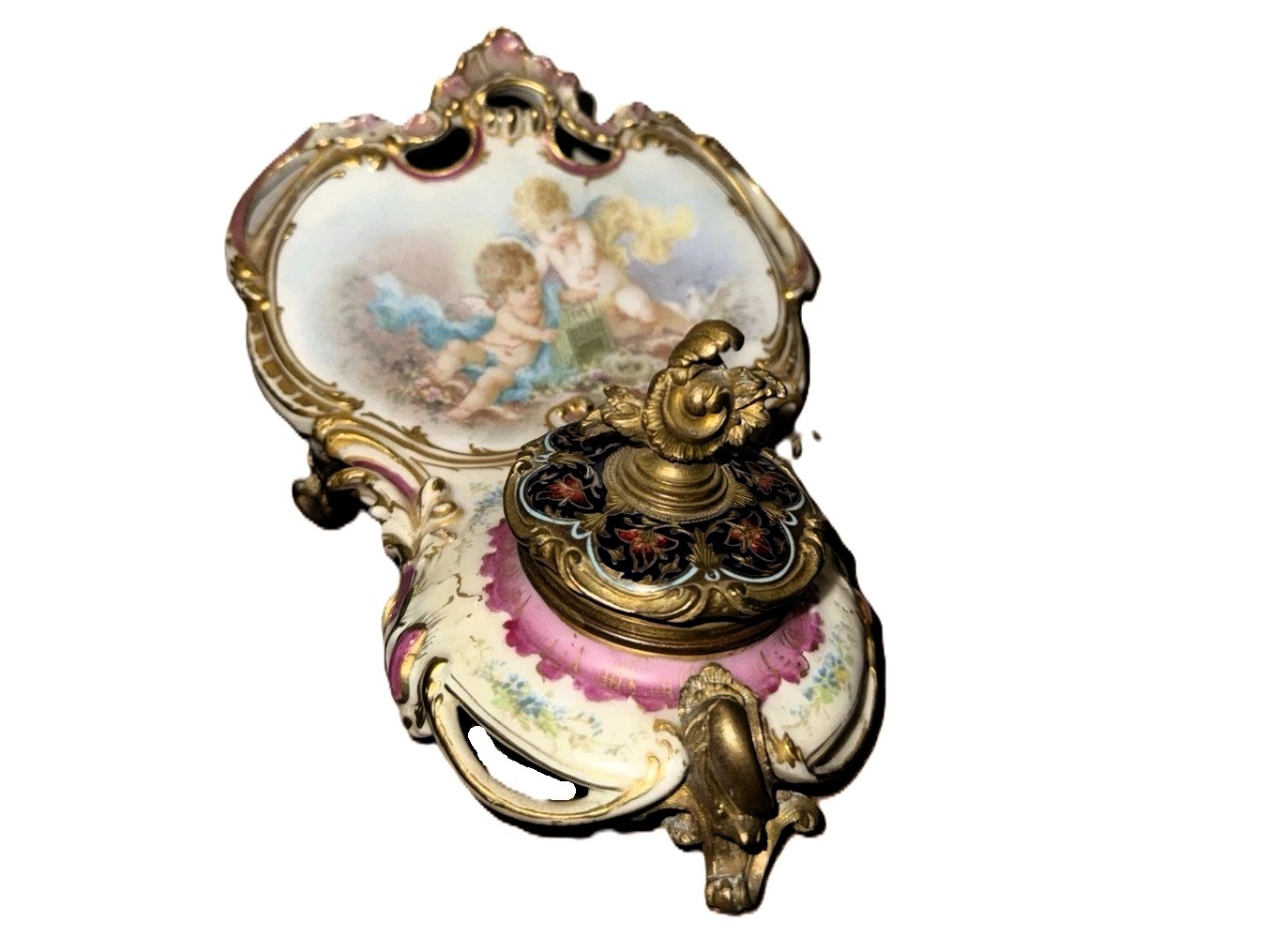
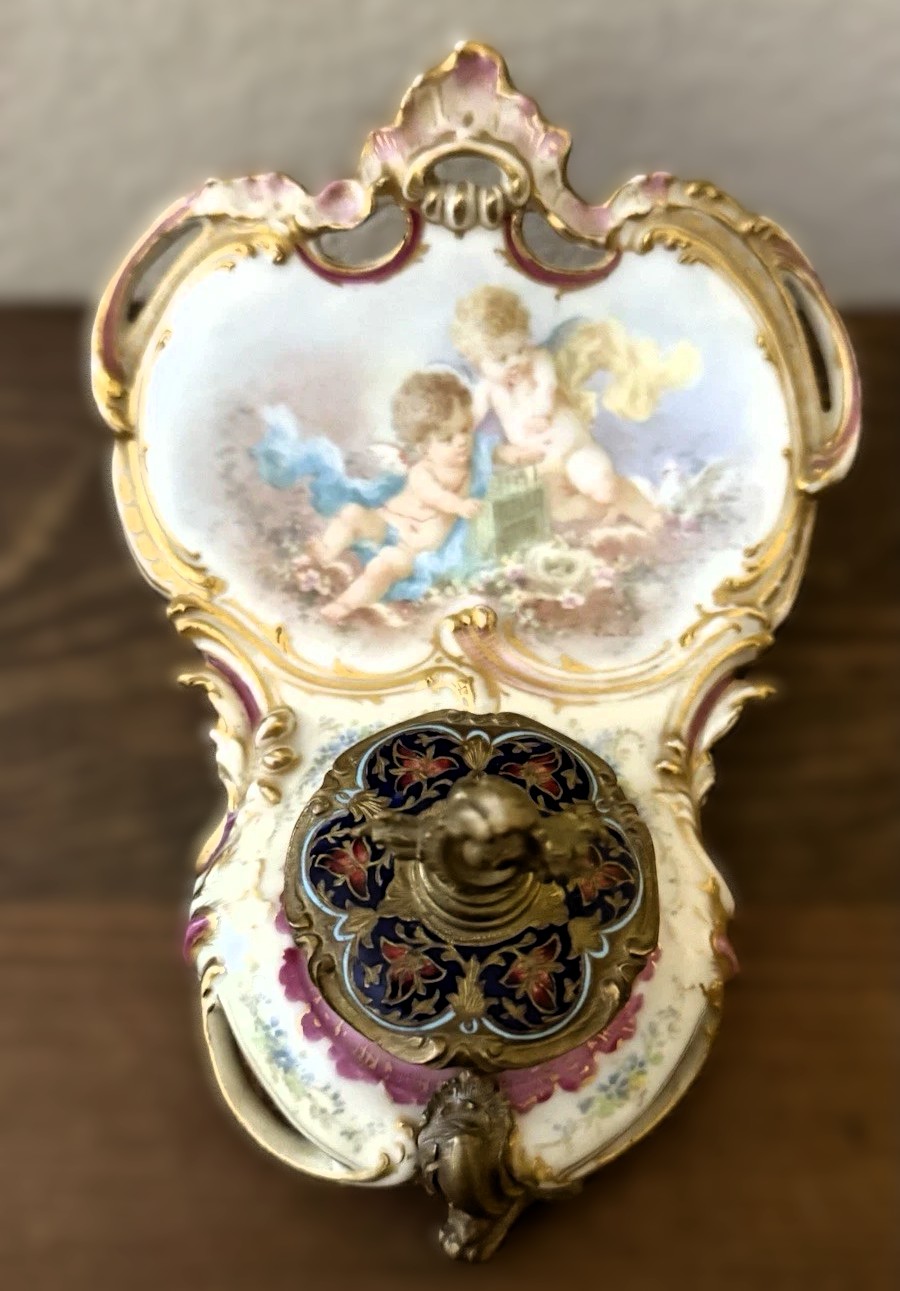
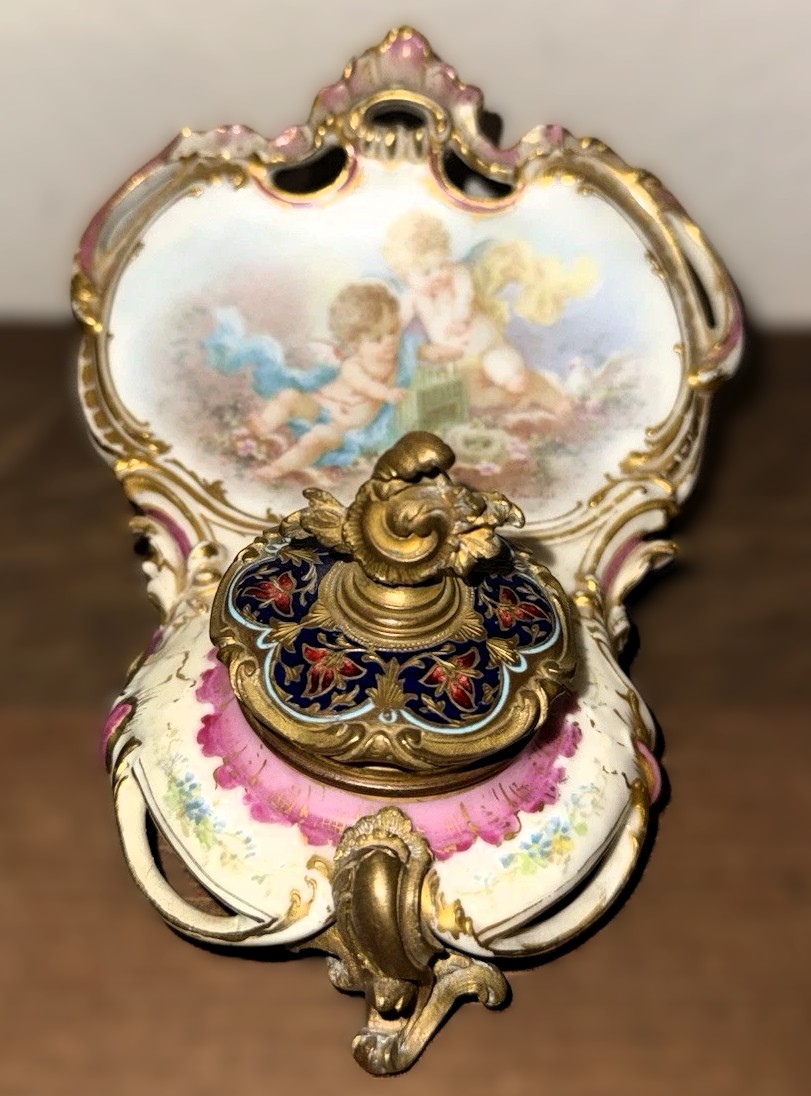


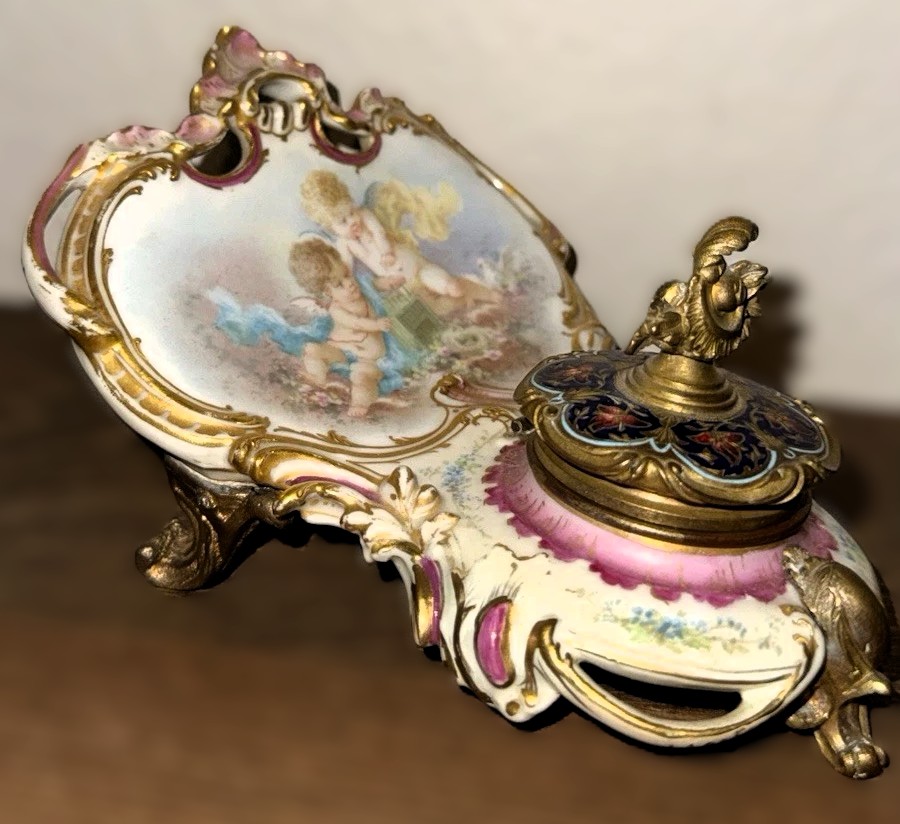


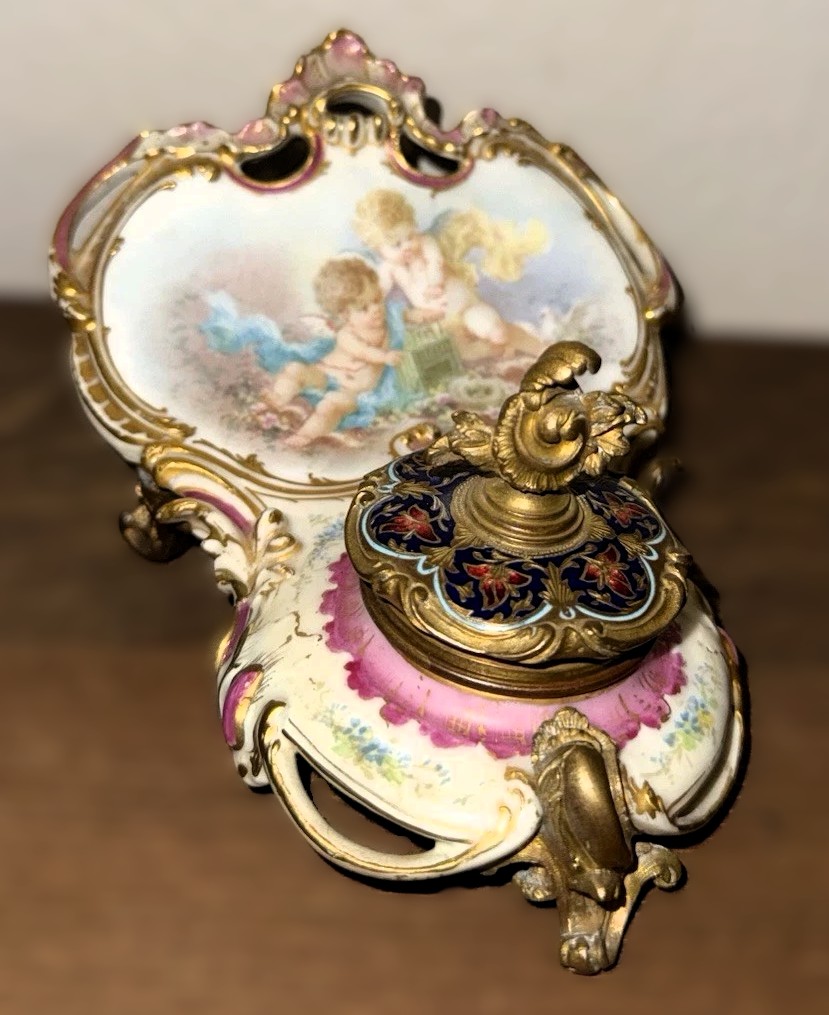
French Porcelain Inkstand
| Categories | Ceramics/Porcelain non-Figural, Enameled Metal |
| Material | Bronze, Enameled Brass/Bronze/Metal, Porcelain |
| Markings | Unmarked |
| Manufacturer | Undetermined |
| Origin | France |
| Date or Era | circa 1870 |
| Measuring | 6” x 4 ½” x 3 ¾” high |
This French porcelain inkstand is an opulent example of Neo-Rococo “Sèvres Style” desk ware, likely produced in Paris during the mid-to-late 19th century (circa 1860–1880).
Description
- The Stand: The piece features a scrolling, asymmetrical porcelain base with a high, shell-like backplate (reredos). It is decorated with a vibrant rose-pink (Rose Pompadour) background and extensive hand-applied gilding.
- The Scene: The central backplate features a romantic scene of two cherubs (putti) in a pastoral landscape. One cherub appears to be tending to a small birdcage while the other looks on.
- The Inkwell: A single, circular inkwell is mounted at the front, featuring a heavy brass rim and a hinged metal lid. The lid is elaborately decorated with Champlevé enamel in shades of navy blue, red, and turquoise, and is topped with a foliate brass finial.
- The Underside: The piece rests on three integrated, gilded scrolling feet. The bottom shows a recessed well for the inkpot and a circular, unglazed area typical of 19th-century French hard-paste porcelain.
Hand-Painted vs. Transfer
The cherub scene on this inkstand is hand-painted.
- Evidence of Handwork: Close-up images reveal the delicate, varied brushstrokes used to define the cherubs’ hair and the soft, atmospheric blending of the sky and foliage.
- Detailing: In a transfer, you would often see a fine “dot” pattern (ben-day dots) or perfectly uniform lines under magnification; here, the colors have a natural transparency and thickness that only comes from hand-applied pigments.
- Significance: High-quality French porcelain of this era was frequently hand-decorated by specialized “peintres-décorateurs” in Parisian studios to add value for luxury retailers.
Origin and Estimated Age
- Origin: France. The form and the specific combination of the rose-pink and Champlevé enamel are characteristics of “Vieux Paris” (Old Paris) porcelain.
- Age: Circa 1860–1880. This style flourished during the Second Empire under Napoleon III, when there was a massive revival of 18th-century Rococo tastes.
Additional Information
- The “Sèvres” Influence: While not made at the Royal Sèvres factory, this piece was intended to emulate their famous 18th-century designs. It was likely made by one of the premier private Parisian factories such as Edmé Samson or Jacob Petit, who were masters of the Neo-Rococo style.
- Dual-Metal Construction: The use of Champlevé enamel on the lid is a high-end touch. This technique involved carving cells into the metal and filling them with powdered glass, which was then fired at high temperatures.
- Missing Liner: The inkwell is missing its insert.
Sold for $188 in December 2025
Content disclaimer. The information posted is the owner’s best knowledge and may not have been vetted by the SOIC. We welcome comments, corrections, and additions, working to make our website information comprehensive and accurate.
Join the Society of Inkwell Collectors (SOIC) – it’s free!
Founded in 1981 as a non-profit organization,
we are documenting inkwells (and accessories).
We’re here to help and inform!