

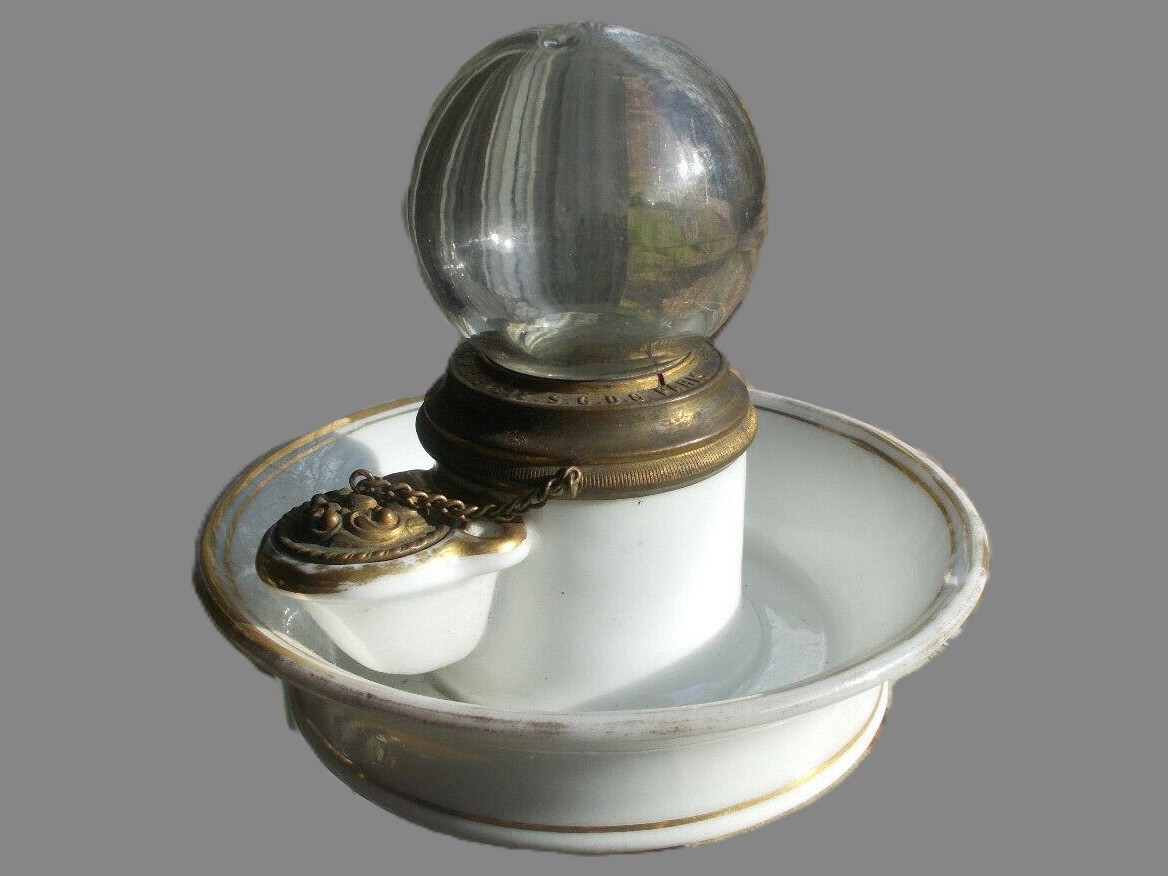
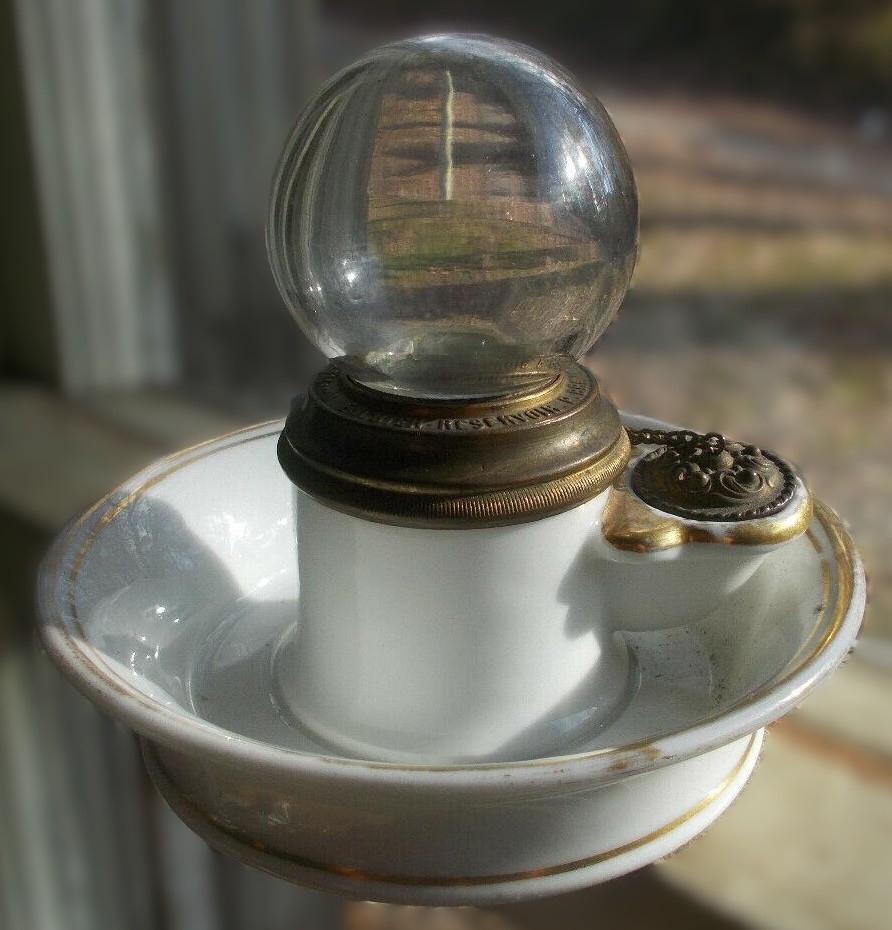
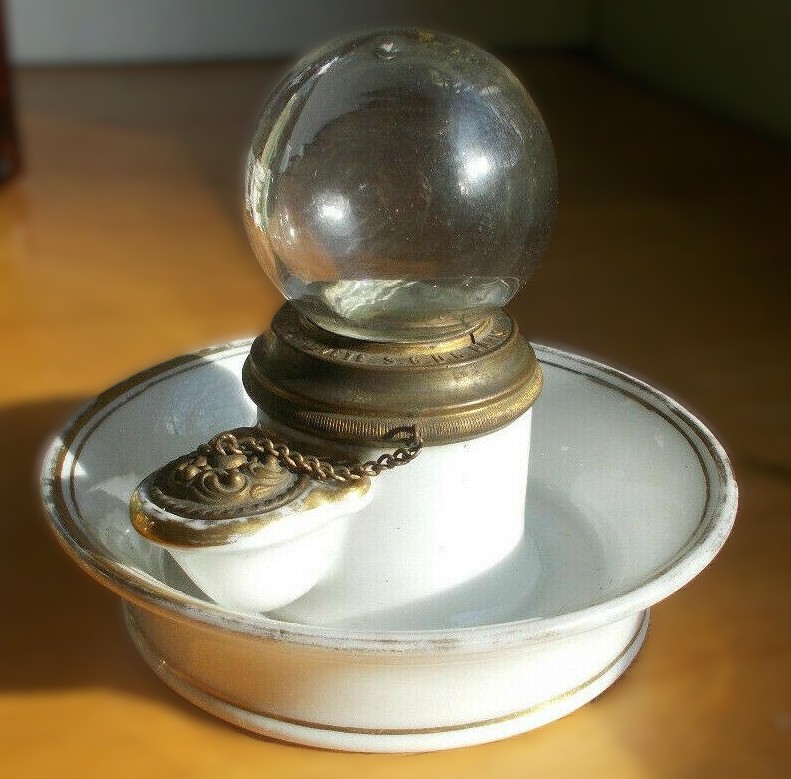
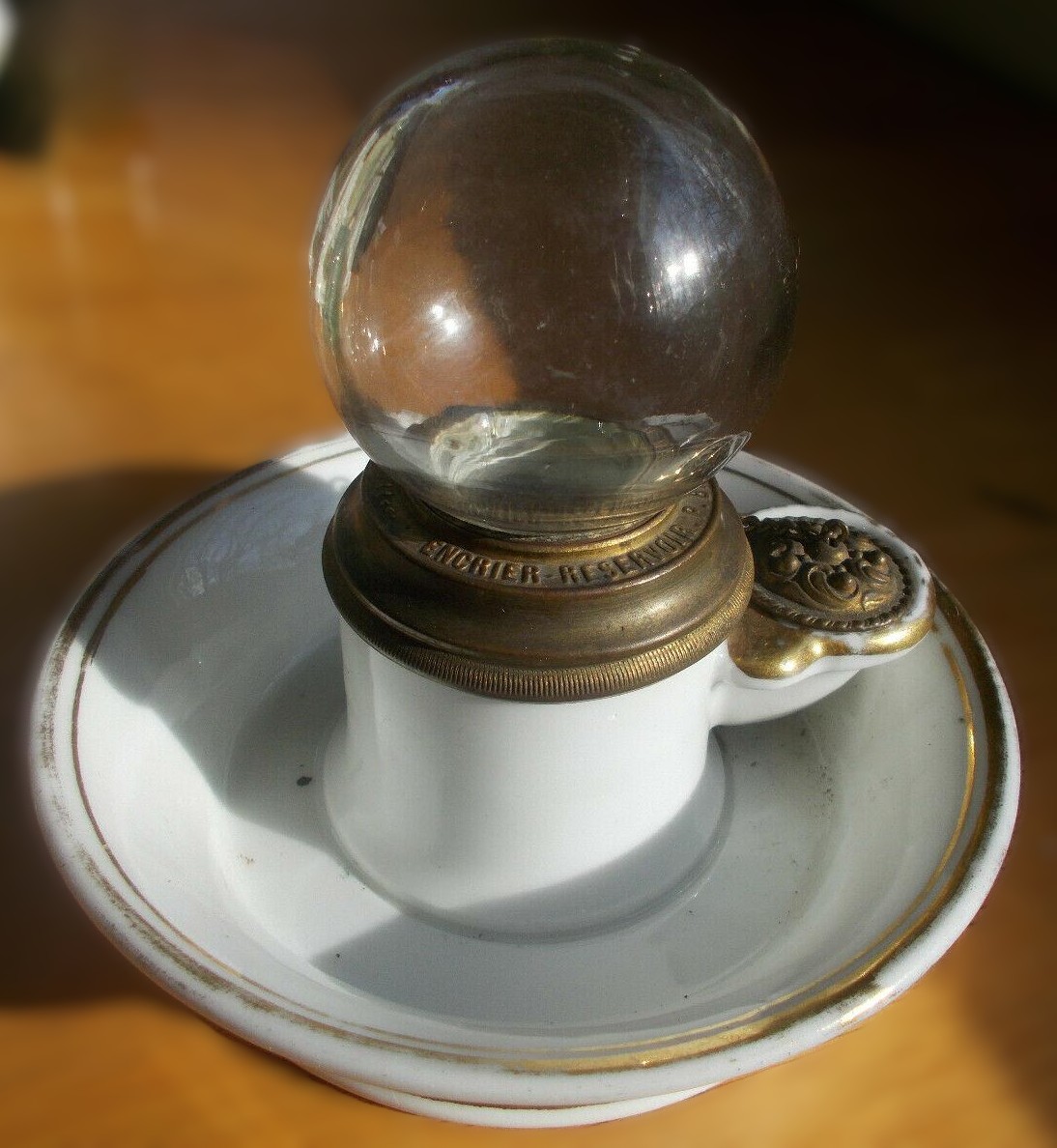

French Pneumatic Reservoir Inkwell
| Categories | Mechanical - Pump / Siphon |
| Type | Siphon |
| Material | Brass, Porcelain |
| Markings | See Narrative |
| Manufacturer | Undetermined |
| Origin | France |
| Date or Era | circa 1845 |
| Measuring | 5” diameter; 4 ¼” high |
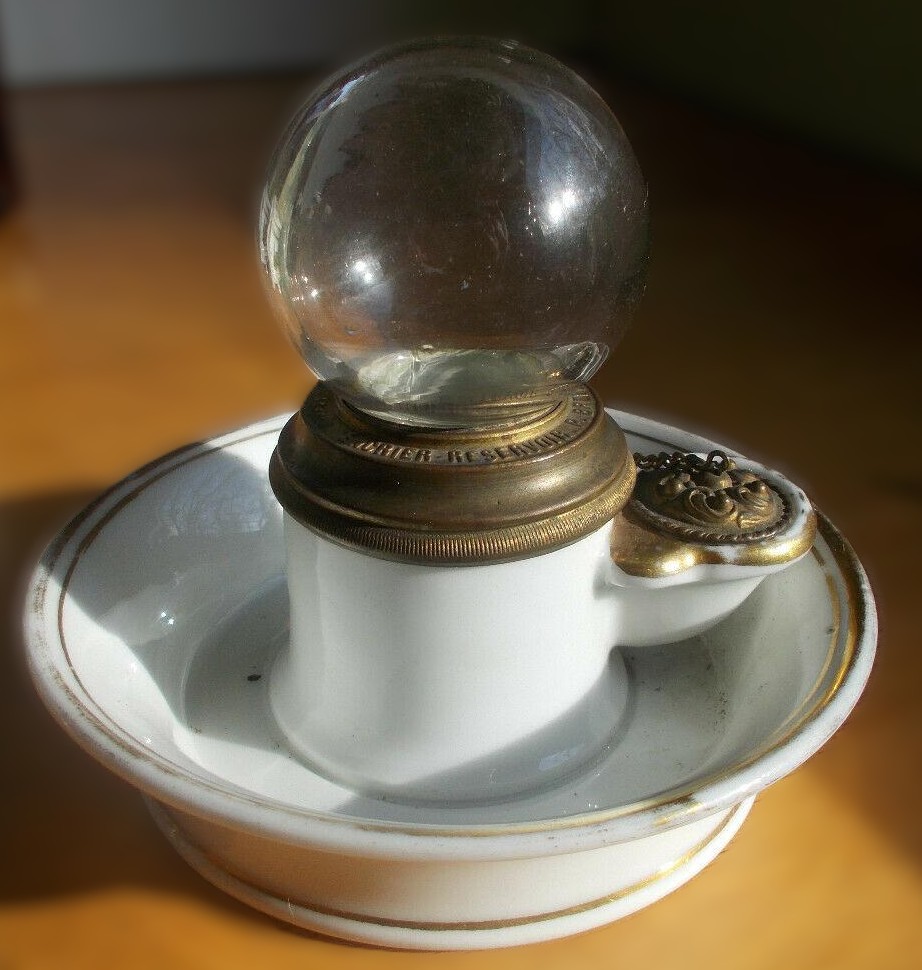
This French pneumatic reservoir inkwell dates from the 1840s to the 1850s.
How It Works: The Pneumatic Principle
This inkwell operates on the Barometric (or Pneumatic) Fountain Principle, utilizing atmospheric pressure to maintain a perfectly steady ink level without spilling or drying out.
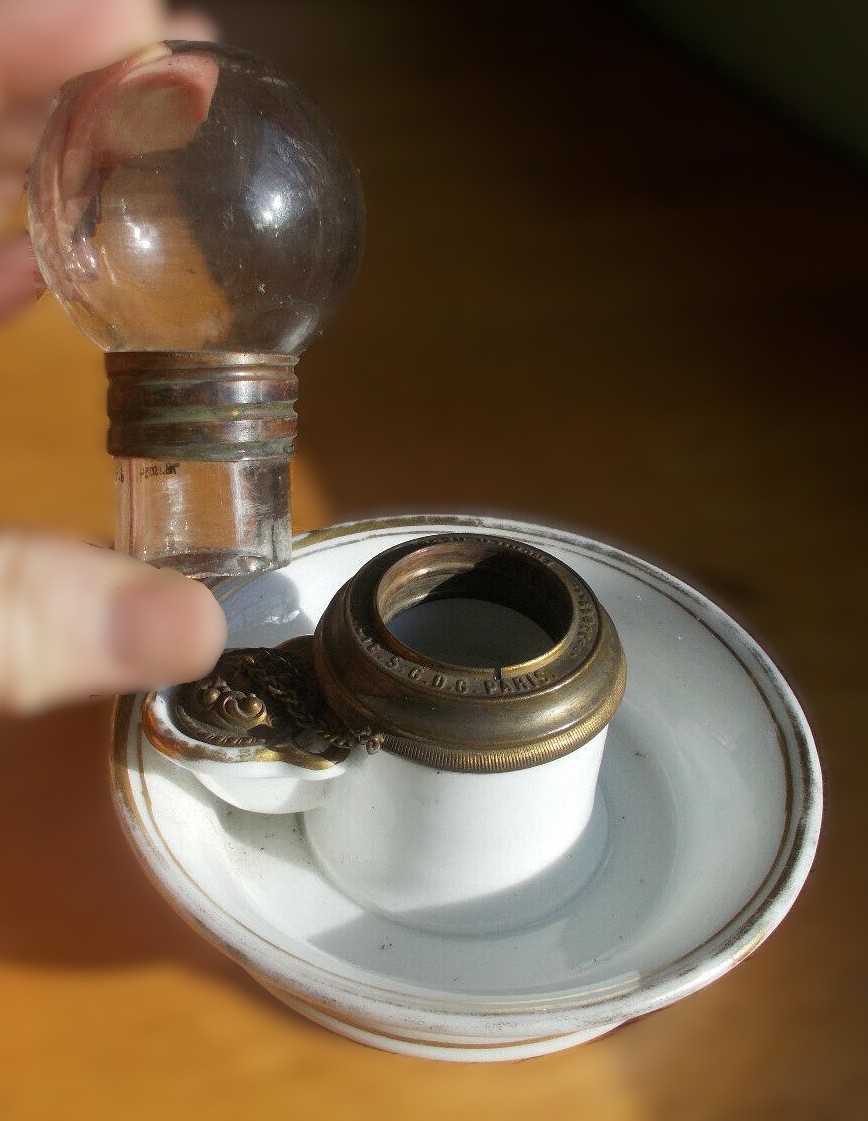
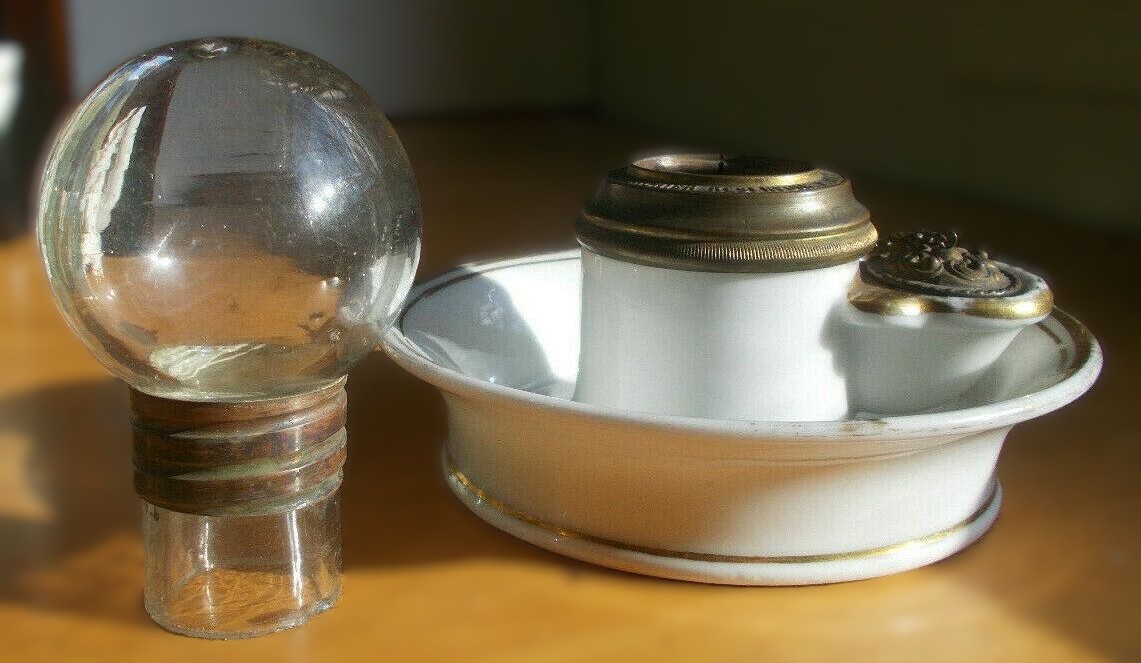
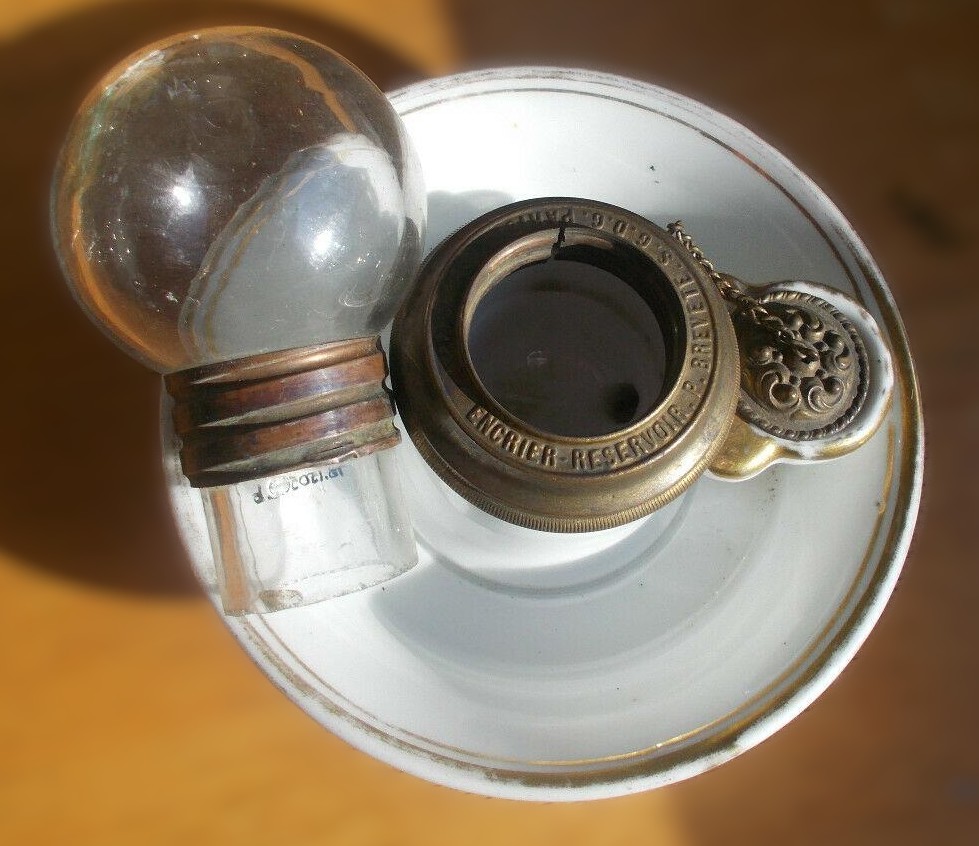
- Filling the Reservoir: To fill it, the hand-blown glass globe reservoir top is unscrewed from the porcelain base. The globe is inverted, filled completely with ink through the bottom opening, and then carefully screwed back down into the porcelain base collar.
- The Airtight Seal: The bold embossing around the brass collar reading “ENCRIER RESERVOIR. P. BREVETE. S.G.D.G. PARIS” highlights that the design is patented. The letters G.D.G. stand for “Sans Garantie du Gouvernement” (Patented Without Government Guarantee), a standard French legal marking introduced by the patent law of 1844. The threads create a tight seal, and the hollow glass tube section sits deep inside the central column of the porcelain base.
- Equilibrium and Gravity: When the inkwell is set upright, gravity causes ink to flow from the airtight glass globe down into the porcelain central column and emerge into the small, exposed dipping font at the front.
- Atmospheric Balance: As ink rises in the small dipping cup, it covers the tiny passage hole leading from the central column. Once this opening is covered by ink, outside air can no longer enter the upper glass globe. A partial vacuum forms in the sealed space at the top of the glass ball, holding the rest of the ink suspended inside the globe.
- Self-Regulating Flow: As you write and dip your pen, the ink level in the small cup drops slightly, exposing the internal hole. A tiny bubble of air escapes up into the glass globe, displacing a corresponding amount of ink, which flows down to replenish the dipping cup. It automatically stops flowing the moment the dipping cup is full again.
A cast brass lid on a chain covers the font when not in use to protect the ink from dust and minimize surface evaporation.
Identification & The French Patent
In France, these were broadly categorized as Encriers à Siphon (siphon inkwells) or Encriers Pneumatiques (pneumatic inkwells).
During the late 1830s and 1840s, a sudden wave of French patents was granted for this precise layout—combining a ceramic base tray, a central screw-in glass fountain sphere, and a low dipping cup. Prominent French inventors and stationers of the era who secured patents (Brevets) for these specific improvements include M. Lortet (1840), M. Maquet (1844), and M. de la Rue (1846). They designed these variations specifically to standardize the brass collar threading so the glass wouldn’t leak air, resolving the exact mechanism this piece expertly showcases.
Museum Provenance: The Strong Museum
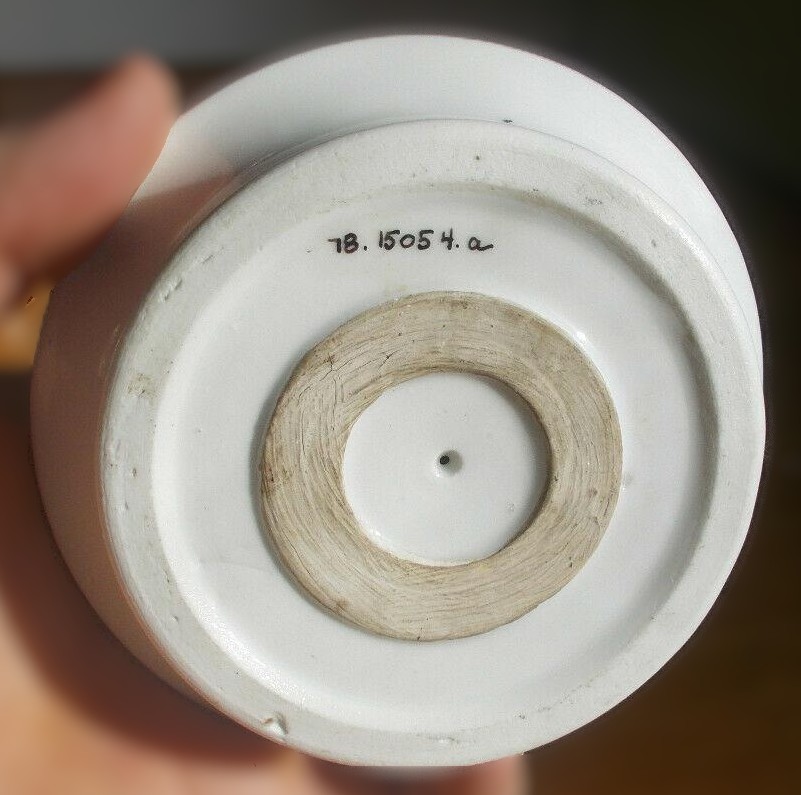
On the unglazed bottom ring of the porcelain base, there is a hand-inked artifact catalog number:
78.15054.a
This format confirms its exact origin. The “78” denotes that this item was officially cataloged or accessioned into the museum’s collection in 1978.
The Strong National Museum of Play (historically The Margaret Woodbury Strong Museum in Rochester, NY) was founded on the massive private collections of Margaret Woodbury Strong (1897–1969). While the museum is widely celebrated today for toys and video games, Margaret Strong’s original mid-century collections were incredibly vast and scholarly, encompassing thousands of Victorian-era domestic objects, ceramics, lighting, and a phenomenal selection of 19th-century writing equipment and novelty inkwells.
During the late 1980s and 1990s, as the Strong Museum narrowed its institutional mission specifically toward the history of “Play,” they responsibly deaccessioned and auctioned off large portions of their non-toy Victorian decorative arts and historical housewares. This inkwell was once a part of this elite, meticulously documented museum collection before making its way into the antique marketplace.
Summary
Rare French Pneumatic “Encrier Réservoir” Inkwell, c. 1845 An exceptional mid-19th-century French barometric fountain inkwell. Features a hand-blown clear glass spherical reservoir top with an integrated glass tube insert, terminating in a heavy brass threaded collar. The brass is boldly stamped: “ENCRIER RESERVOIR – P. BREVETE – S.G.D.G. PARIS”, denoting its protected status under the French patent law of 1844. The globe screws tightly into a fine white porcelain base featuring an integrated pen-rest tray, gilt accents, and a forward-facing dipping well secured by an ornate, chain-linked cast brass cover.
Functions on a self-regulating pneumatic vacuum principle, maintaining a constant ink level in the dipping well as the pen draws from the reservoir.
Provenance: Formally held in the permanent collection of the renowned Strong Museum (Rochester, NY); retains its original museum accession number (78.15054.a) hand-inked on the base.
Sold for $300 in November 2020
Content disclaimer. The information posted is the owner’s best knowledge and may not have been vetted by the SOIC. We welcome comments, corrections, and additions, working to make our website information comprehensive and accurate.
Join the Society of Inkwell Collectors (SOIC) – it’s free!
Founded in 1981 as a non-profit organization,
we are documenting inkwells (and accessories).
We’re here to help and inform!