

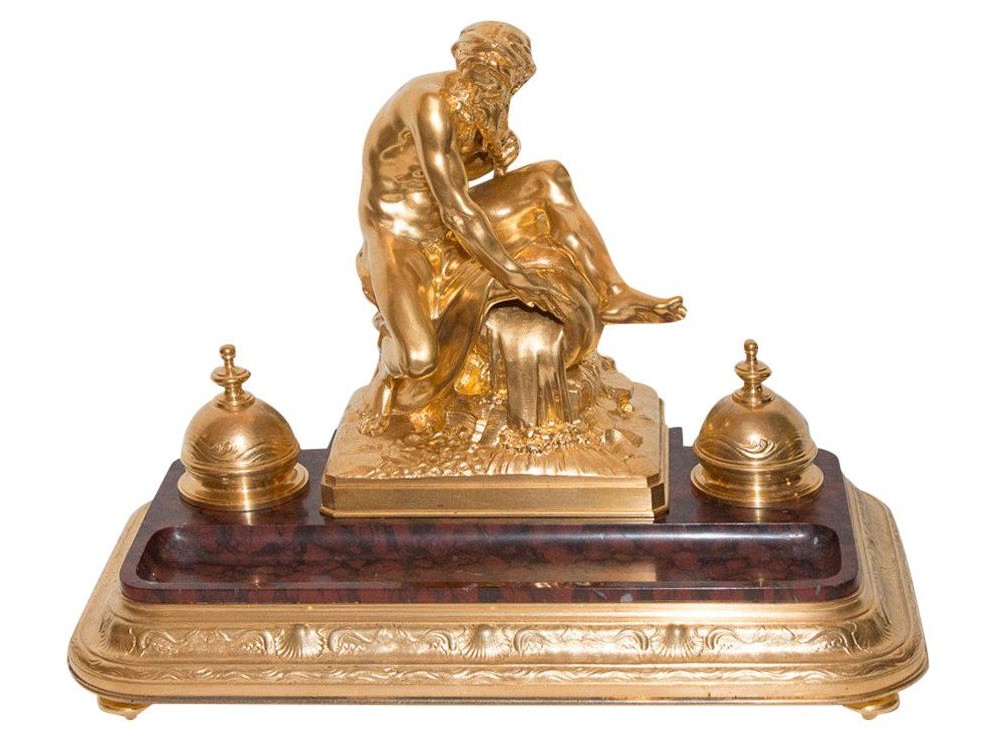
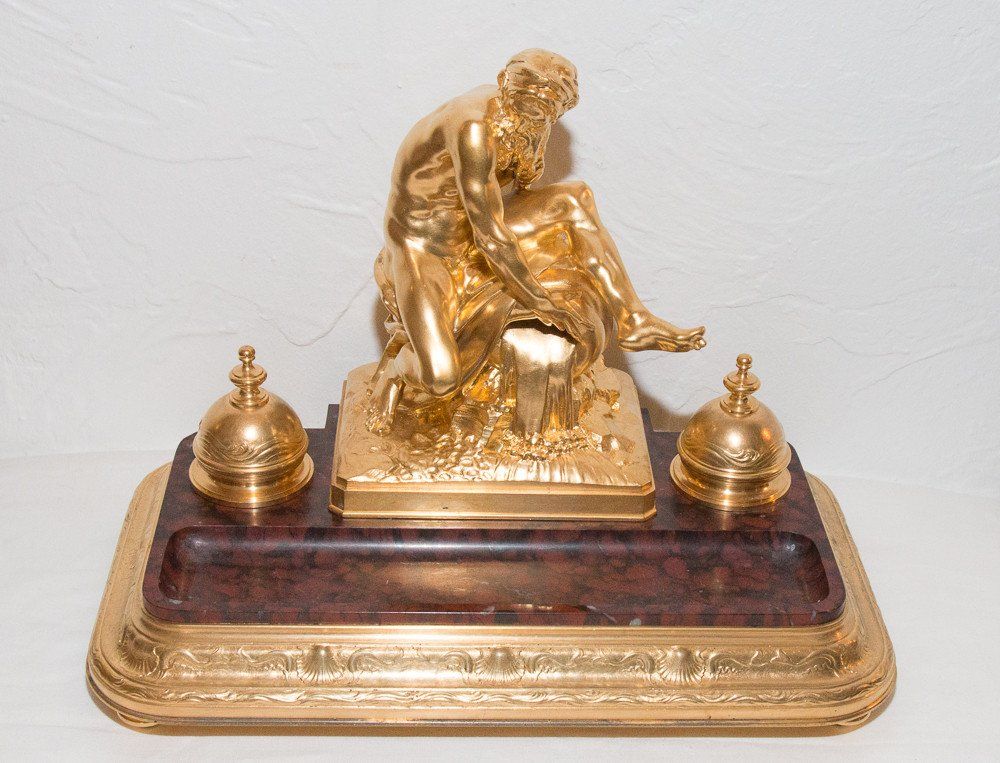





French Gilt Bronze and Rouge Griotte Marble Inkstand
| Categories | Figural - Mythology; Literature; Religion; Fictional |
| Type | Mythology |
| Material | Gilt Bronze, Marble |
| Markings | See Narrative |
| Manufacturer | Barbedienne Foundry |
| Origin | France |
| Date or Era | circa 1880 |
This inkstand was produced by the world-renowned foundry F. Barbedienne (Ferdinand Barbedienne) in the late 19th century (c. 1870–1890).
- The Maker: Ferdinand Barbedienne (1810–1892)
The signature “F. BARBEDIENNE” engraved on the bronze edge identifies this as a product of the Maison Barbedienne, the most important and prestigious art foundry in France during the second half of the 19th century.
- The “Collas” Method: Barbedienne was famous for using the Collas machine (a pantograph), which allowed him to take famous large-scale museum sculptures (like those by Caffieri or Michelangelo) and mathematically reduce them to smaller sizes for use as clock toppers, bronzes, or inkstands like this one.
- Quality: Pieces signed by Barbedienne are considered the gold standard of 19th-century bronze casting, known for their crisp chasing (hand-finishing) and high-quality gilding.
- The Allegory: “The River” (Le Fleuve)
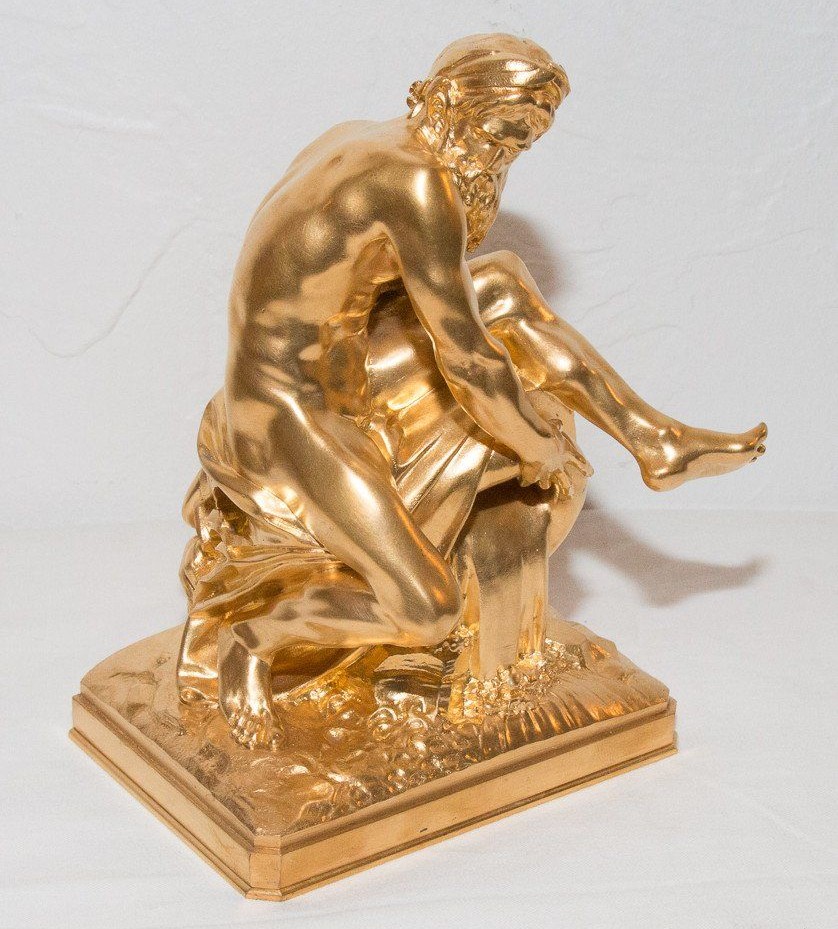
The central figure is a reduction of a famous 18th-century sculpture, “Le Fleuve” (The River) by Jean-Jacques Caffieri (1725–1792).
- What it Represents: In classical and Neoclassical art, rivers were not depicted as water but personified as River Gods.
- The Old Man: Rivers are depicted as older, bearded men to symbolize ancient wisdom and the passage of time.
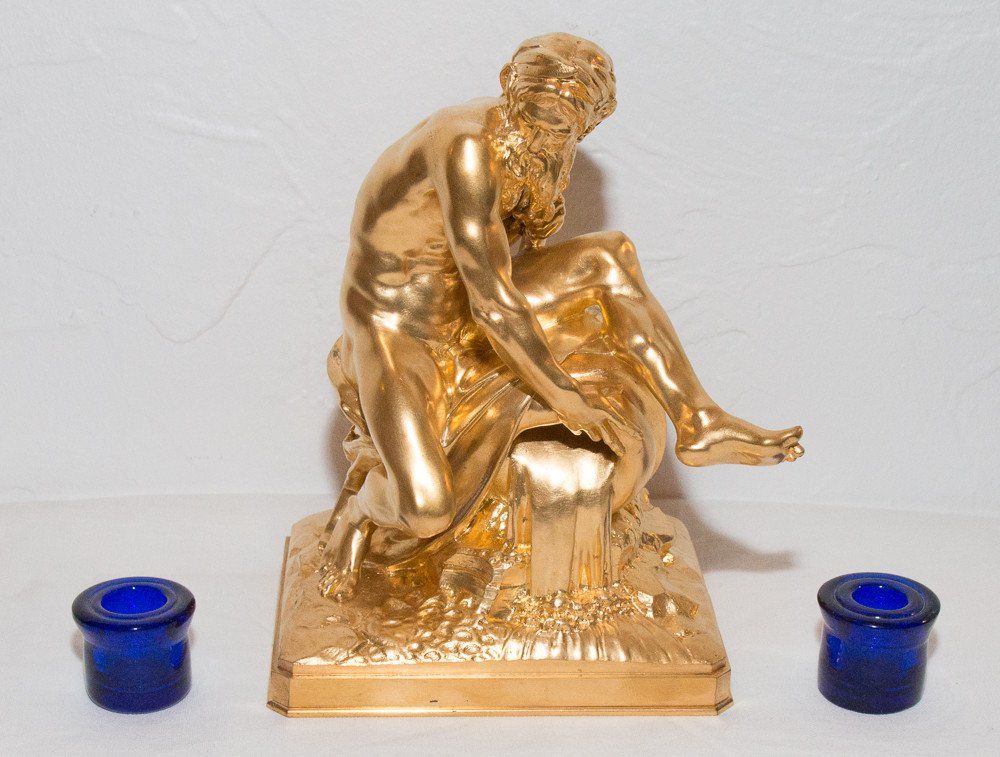
- The Urn: The figure is seated on an overturned urn from which water flows eternally. This represents the “Source” or headwaters of the river.
- The Oar: The paddle or oar under his left arm represents Navigation, signifying that the river is deep and calm enough to support trade and travel.
- The Reeds: The crown of reeds in his hair connects him to the riverbank flora.
- The Story: This is not necessarily a story of a specific mythological event, but rather a personification of the power and bounty of nature. In the 18th century (when the original was sculpted), these figures were often commissioned to represent specific French rivers (like the Seine or the Rhône) for Royal gardens or fountains.
- Physical Description & Materials
- The Marble: The base is made of Rouge Griotte marble (sometimes called Griotte Rouge or Rouge Royal). This marble is characterized by its deep cherry-red color with dark mottling and white calcite veins. It was a luxury material favored by French cabinetmakers.
- The Bronze: The metal is Gilt Bronze (often called Ormolu).
- The Inkwells: The stand features two matching inkwells with domed, fluted lids topped with finials.
- Glass Inserts: It retains the original Cobalt Blue glass liners.
- The Base: The marble plaque is carved with a pen tray (depression) in the front and is mounted in a heavy bronze frame decorated with Acanthus leaves and shells, resting on four turned “toupie” (spinning top) feet.
Summary of Attribution
- Item: Figural Inkstand (“Encrier”)
- Maker: F. Barbedienne (Paris)
- Artist (Model): After Jean-Jacques Caffieri
- Date: Circa 1880 (Napoleon III / Belle Époque period)
- Style: Louis XV Revival (Rococo)
Sold for $2782 in March 2024
Content disclaimer. The information posted is the owner’s best knowledge and may not have been vetted by the SOIC. We welcome comments, corrections, and additions, working to make our website information comprehensive and accurate.
Join the Society of Inkwell Collectors (SOIC) – it’s free!
Founded in 1981 as a non-profit organization,
we are documenting inkwells (and accessories).
We’re here to help and inform!