






French Faience Inkstand
| Categories | Ceramics/Porcelain non-Figural |
| Material | Faience Pottery |
| Markings | See Narrative |
| Manufacturer | Mousset & Delannoy |
| Origin | France |
| Date or Era | circa 1890 |
| Measuring | 8 ⅜” x 5 ¾” x 3 ⅛” high |
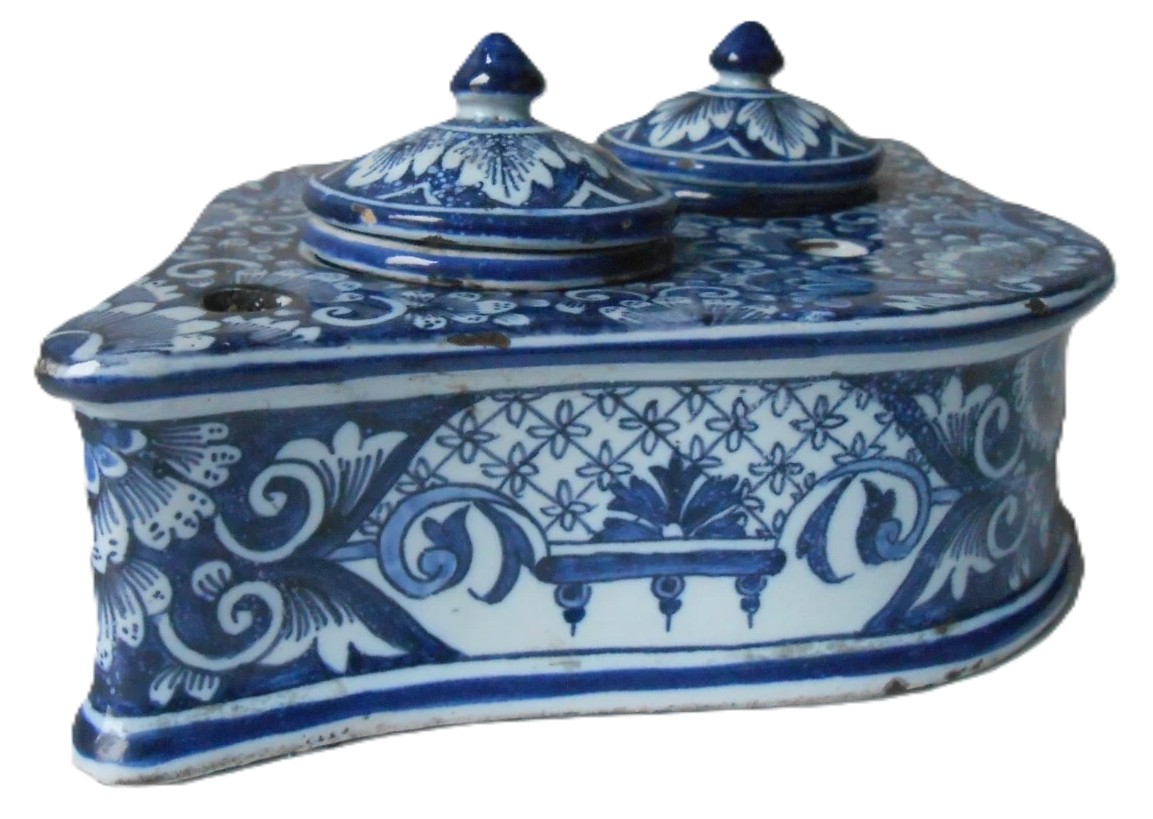
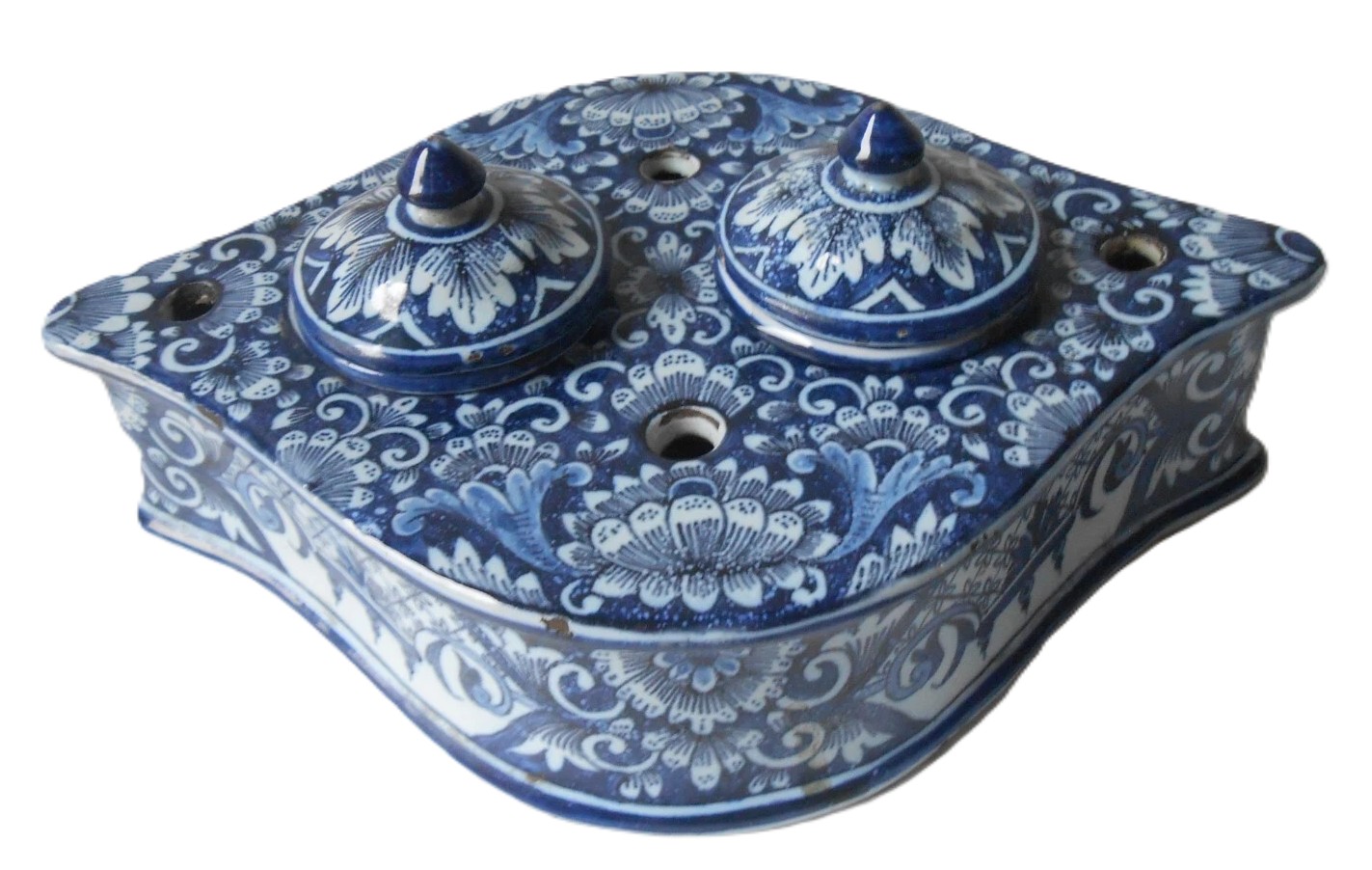
This ceramic faience inkstand is a beautiful example of heart-shaped (“en forme de cœur”) writing desk accessories, a popular form for gift-giving and decorative desk sets in the 18th and 19th centuries.
Description & Components
The piece is made of faience (tin-glazed earthenware).
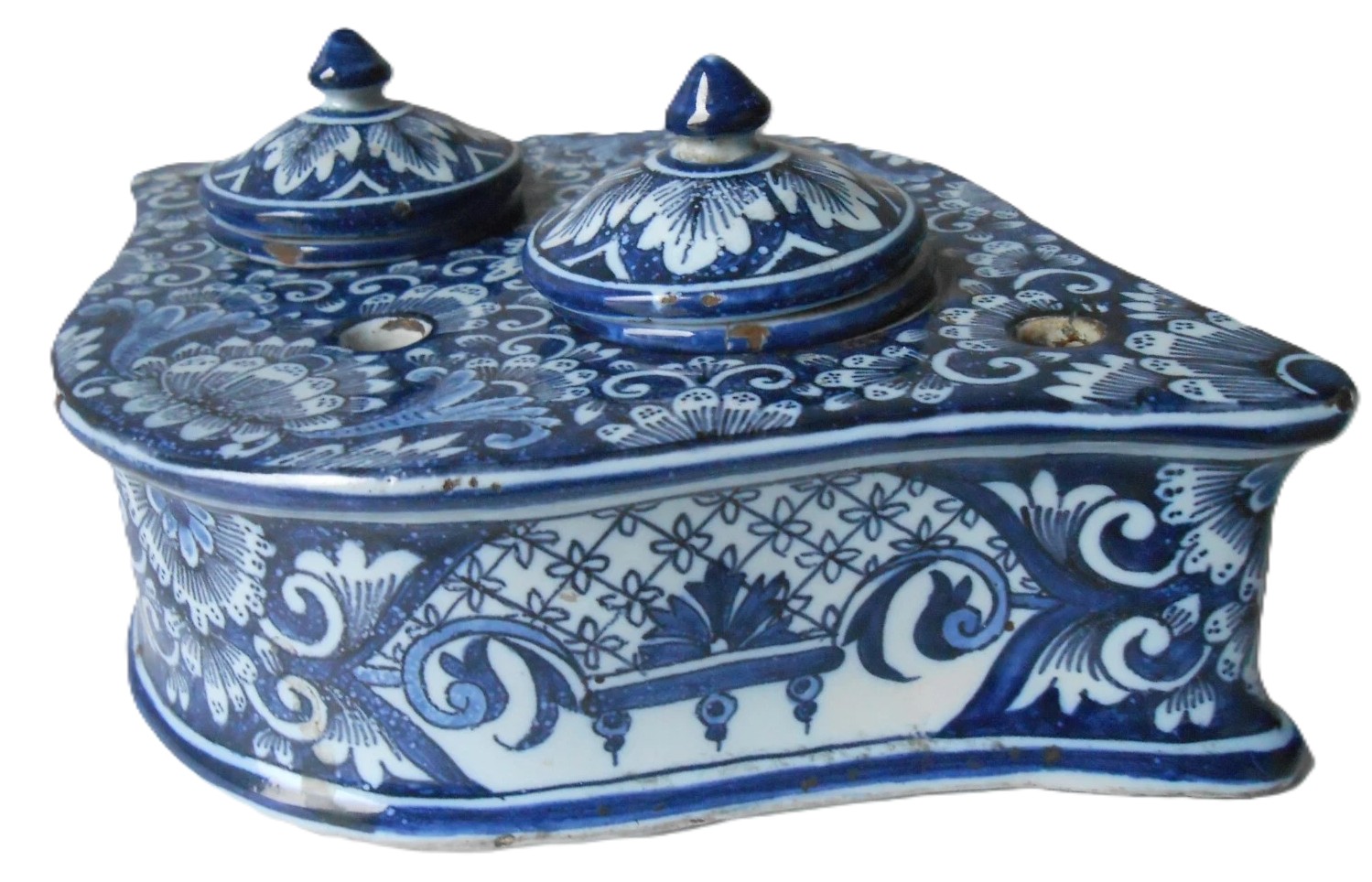
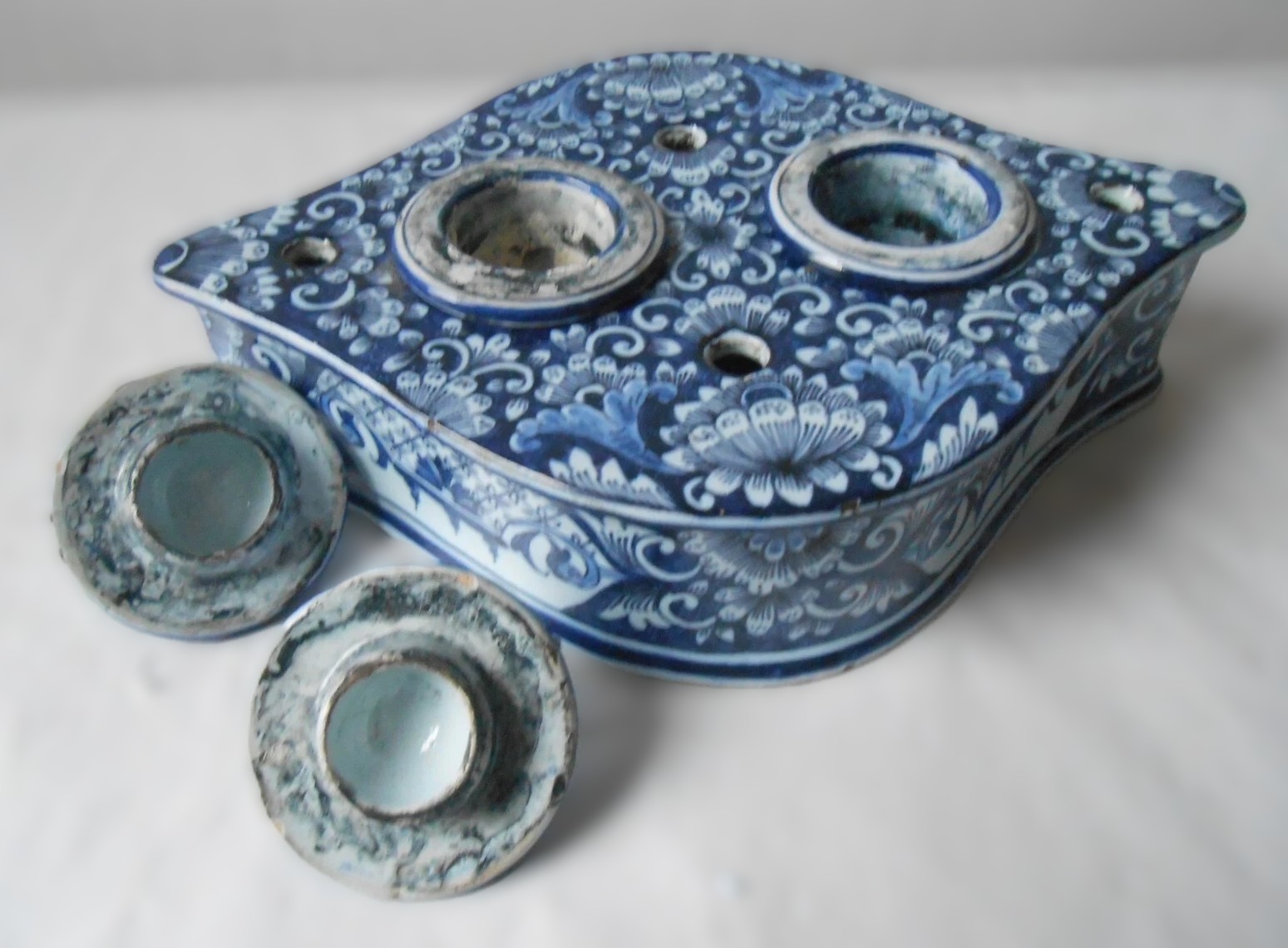
- Shape: It is a large heart-shaped container with four holes near the “point” for quills and two large central openings for inkwells.
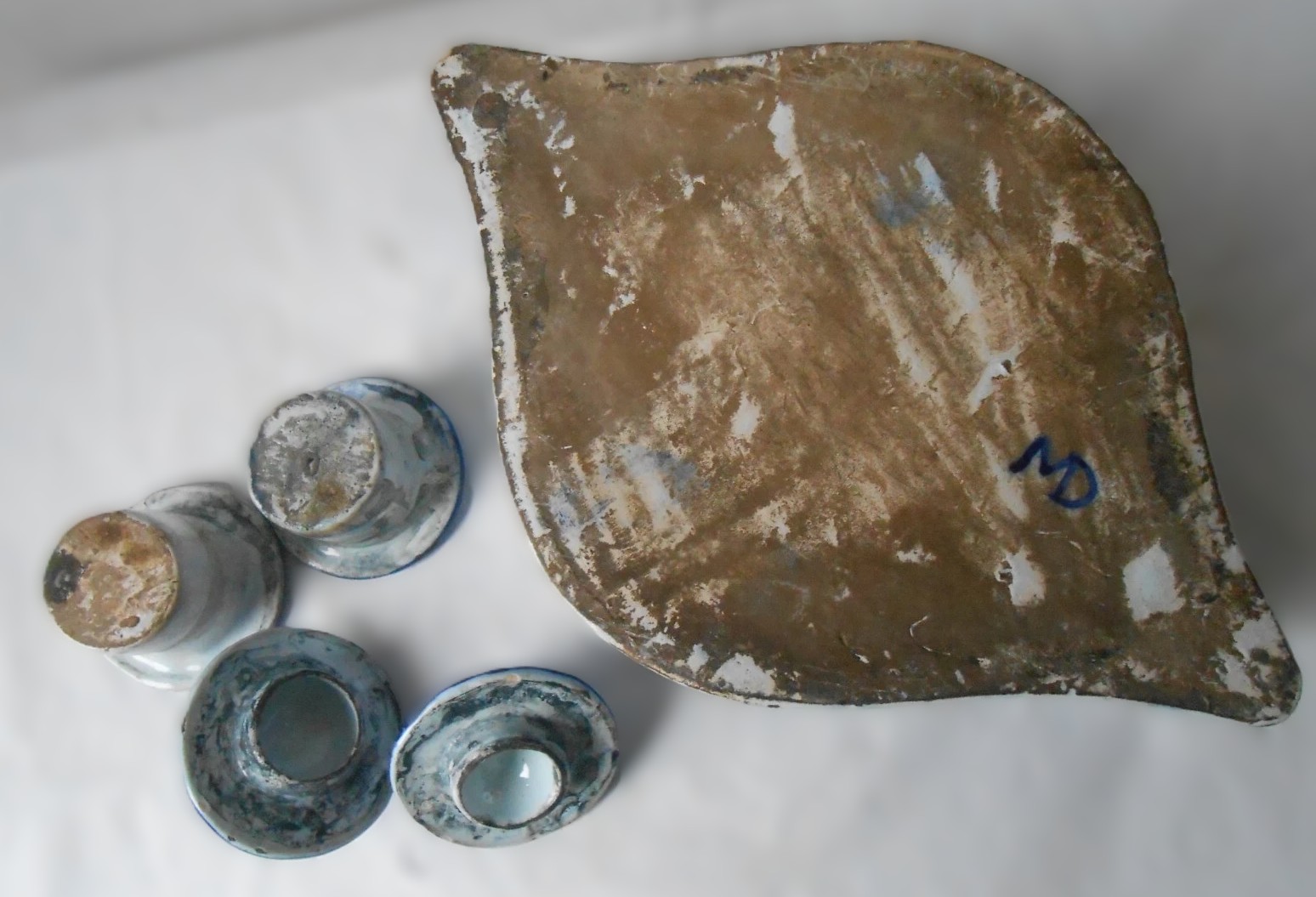
- Inserts: It retains its original removable ceramic godets (internal cups), which is a sign of a complete, well-preserved set.
- Decoration: It is decorated in a traditional blue and white palette. The central motif is a “corbeille de fleurs” (flower basket), surrounded by dense floral scrolls and a lambrequin border (the pointed, lace-like pattern along the edges). This specific style of decoration is known as the “Style de Rouen” (Rouen style).
Origin and Manufacturer
- Where it was made: This piece is from Desvres, a major pottery center in Northern France. Desvres became world-famous in the late 19th century for producing high-quality reproductions of “Vieux Rouen” (Old Rouen) and “Vieux Delft” (Old Delft) styles.
- The “MD” Mark: The blue initials “MD” on the unglazed base likely refer to the Mousset & Delannoy factory (or a similar partnership like Masse-Delannoy) in Desvres. While many factories used monograms, this simple blue signature on a rustic, unglazed base is a hallmark of Desvres production.
- Delft vs. France: While the “lambrequin” style originated in the French city of Rouen, Delft potters also copied it. However, the rustic, sandy texture of the unglazed bottom and the “MD” initials strongly favor a French origin over a Dutch one.
Approximate Age
- Stylistic Era: The design is based on French models from the late 18th century (c. 1760–1780).
- Actual Production: The execution, the specific appearance of the “MD” mark, and the condition suggest this is a late 19th-century (c. 1880–1900) production. At that time, French potters like Fourmaintraux and Martel in Desvres revitalized these classic 18th-century forms for a new market of collectors.
Summary: This is a French Faience Inkstand in the Rouen style, manufactured in Desvres, Northern France, likely by Mousset & Delannoy, circa 1880–1900. It is a high-quality “reproduction” of an 18th-century design.
Sold for $170 in February 2026
Content disclaimer. The information posted is the owner’s best knowledge and may not have been vetted by the SOIC. We welcome comments, corrections, and additions, working to make our website information comprehensive and accurate.
Join the Society of Inkwell Collectors (SOIC) – it’s free!
Founded in 1981 as a non-profit organization,
we are documenting inkwells (and accessories).
We’re here to help and inform!