




French Faience Inkstand
| Categories | Ceramics/Porcelain "Named" Makers |
| Material | Faience Pottery |
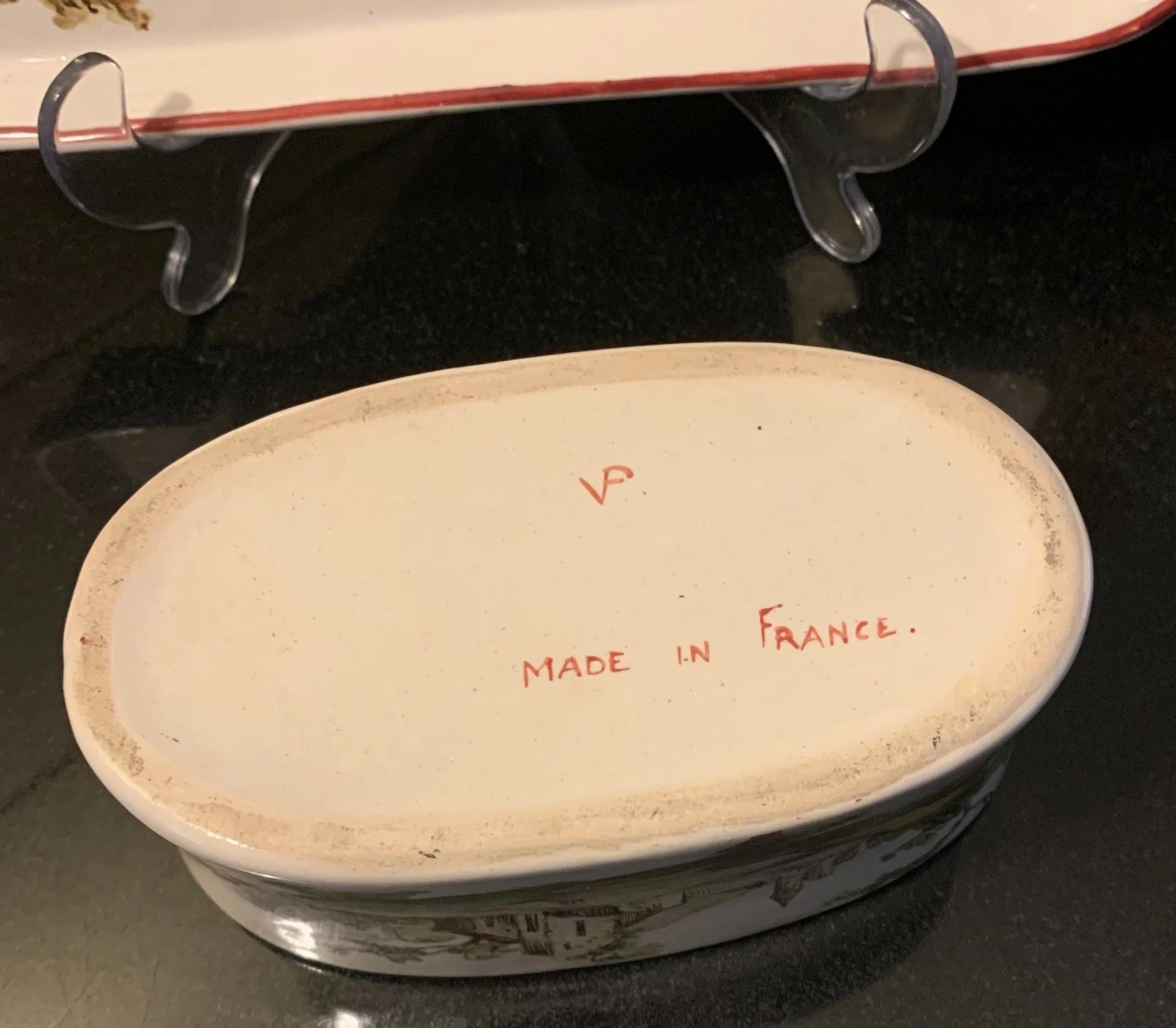
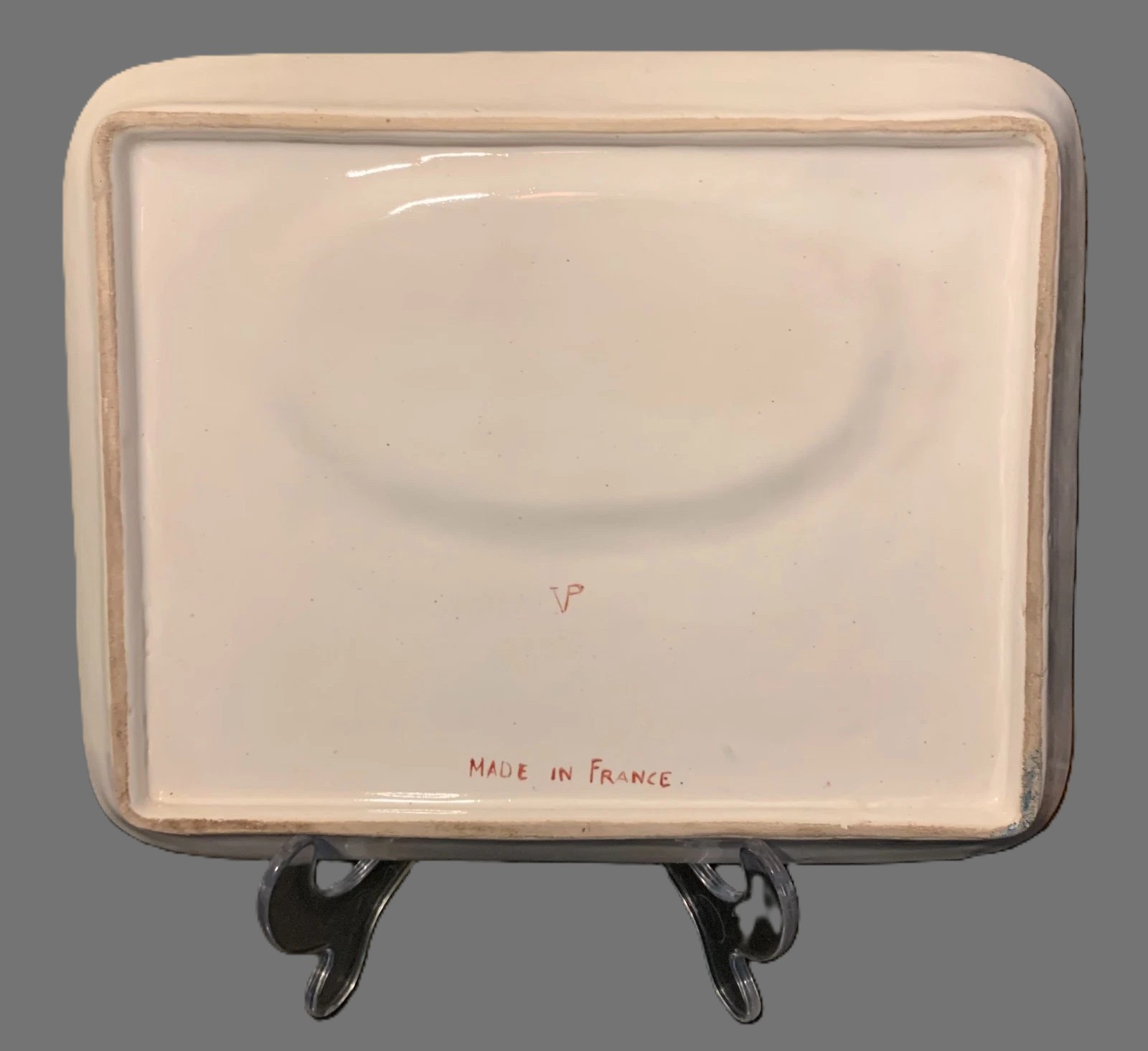
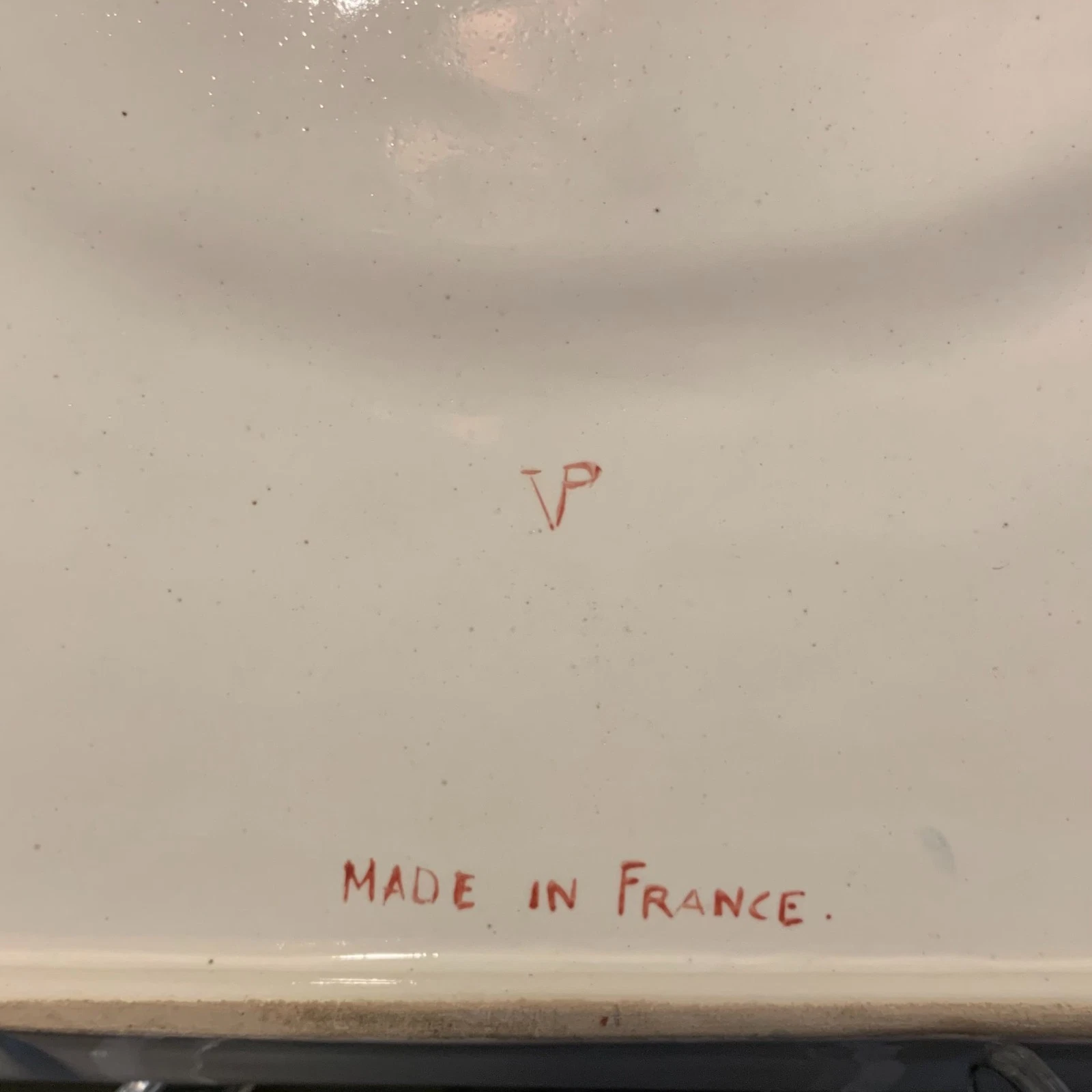
| Markings | See Narrative |
| Manufacturer | Veuve Perrin |
| Origin | France |
| Date or Era | circa 1900 |
| Measuring | Tray: 9 ⅞” x 7 ⅞”; inkwell 5 ⅜” across / 2 ¾” high |
This French faience inkstand is an example of petit feu (little fire) tin-glazed earthenware. Based on the “VP” mark and the presence of “Made in France,” this piece is a late 19th-century or early 20th-century revival of 18th-century Marseille pottery.
The “VP” Maker’s Mark
The stylistic red “VP” mark stands for the Veuve Perrin (Widow Perrin) factory.
- Historical Origin: The original Veuve Perrin factory in Marseille was founded by Pierrette Candelot (the widow of Claude Perrin) and operated from 1748 until 1803. It was world-renowned for its delicate polychrome landscapes and floral sprays.
- The Identification: While the mark mimics the original 18th-century “VP” cipher, the addition of the printed “MADE IN FRANCE” is the key dating indicator.
Age and Dating
This inkstand was likely manufactured between 1890 and 1920.
- The McKinley Tariff Act (1890): This US law required imported goods to be marked with their country of origin. The phrase “Made in France” (rather than just “France”) became standard on French export ceramics shortly after 1890.
- Revival Period: During the late 19th century, factories in centers like Desvres (such as Fourmaintraux) and Quimper specialized in high-quality revivals of earlier “Old Marseille” styles, complete with the famous Veuve Perrin mark to indicate the pattern’s lineage.
Description of the Set
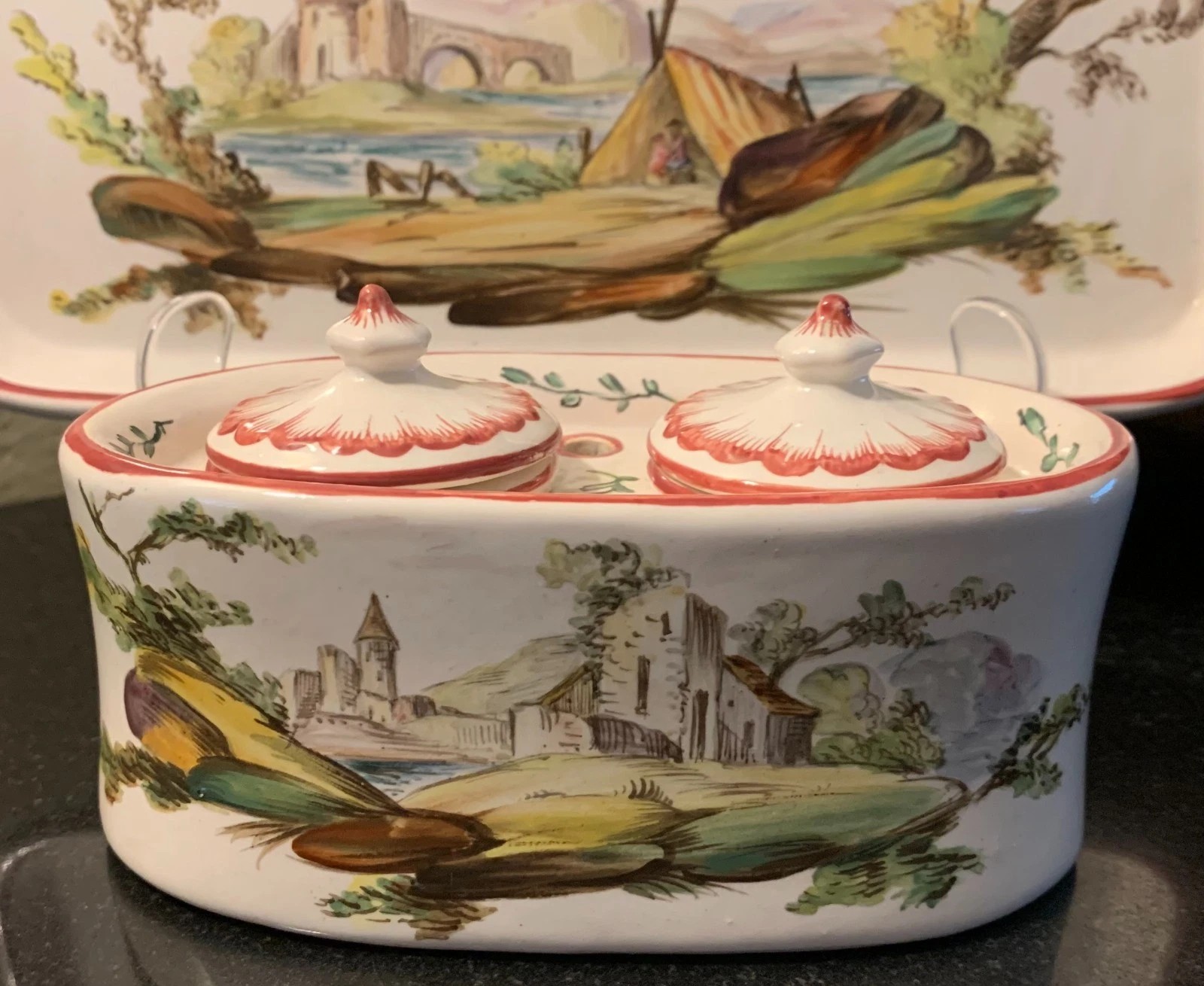
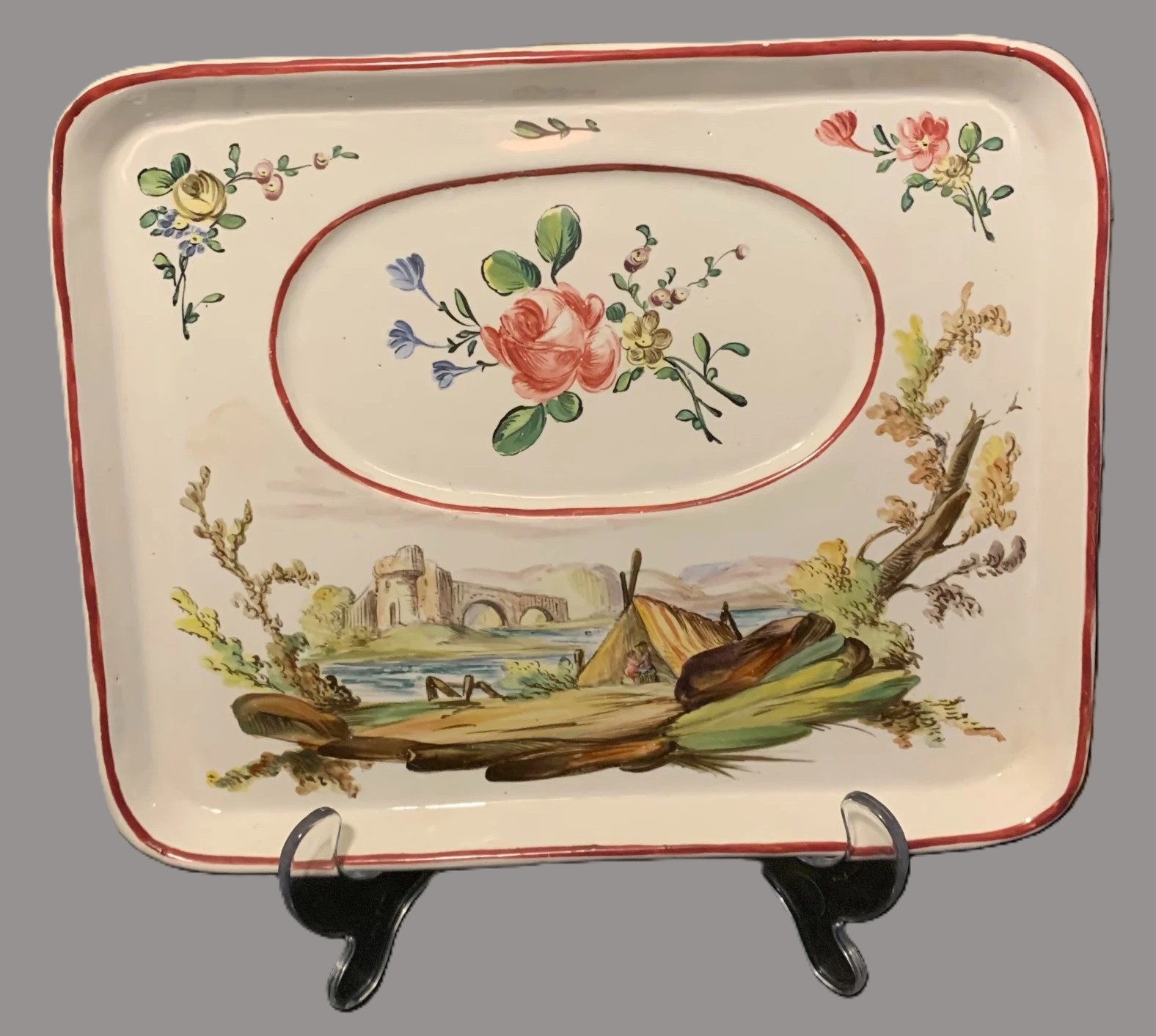
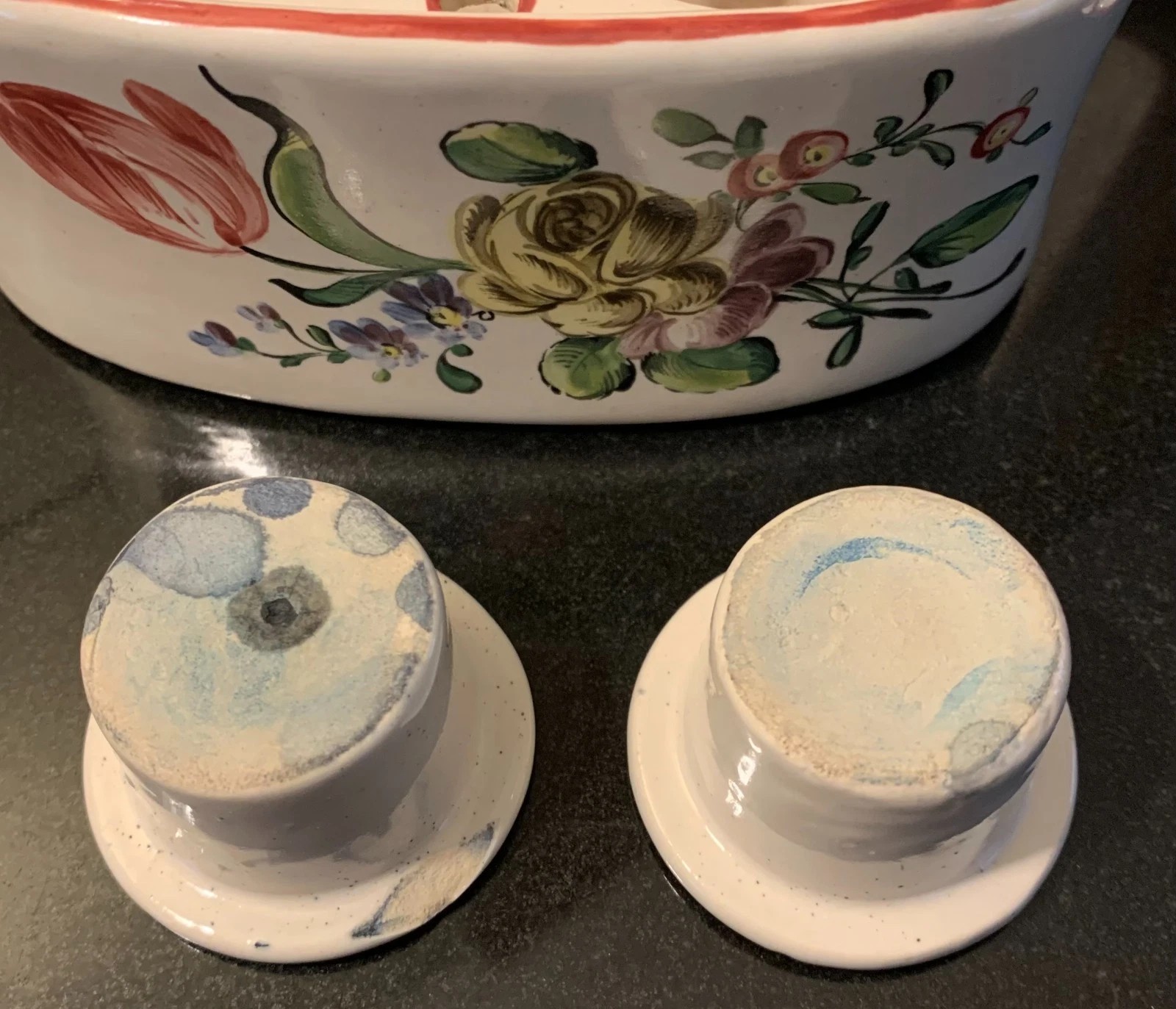
- The Tray: A rectangular stand with rounded corners and a raised red-rimmed border. It features a central médallion designed to hold the inkwell base, flanked by hand-painted floral bouquets. The lower section depicts a pastoral scene with a thatched tent/hut by a river, an arched stone bridge, and a fortified tower in the distance.
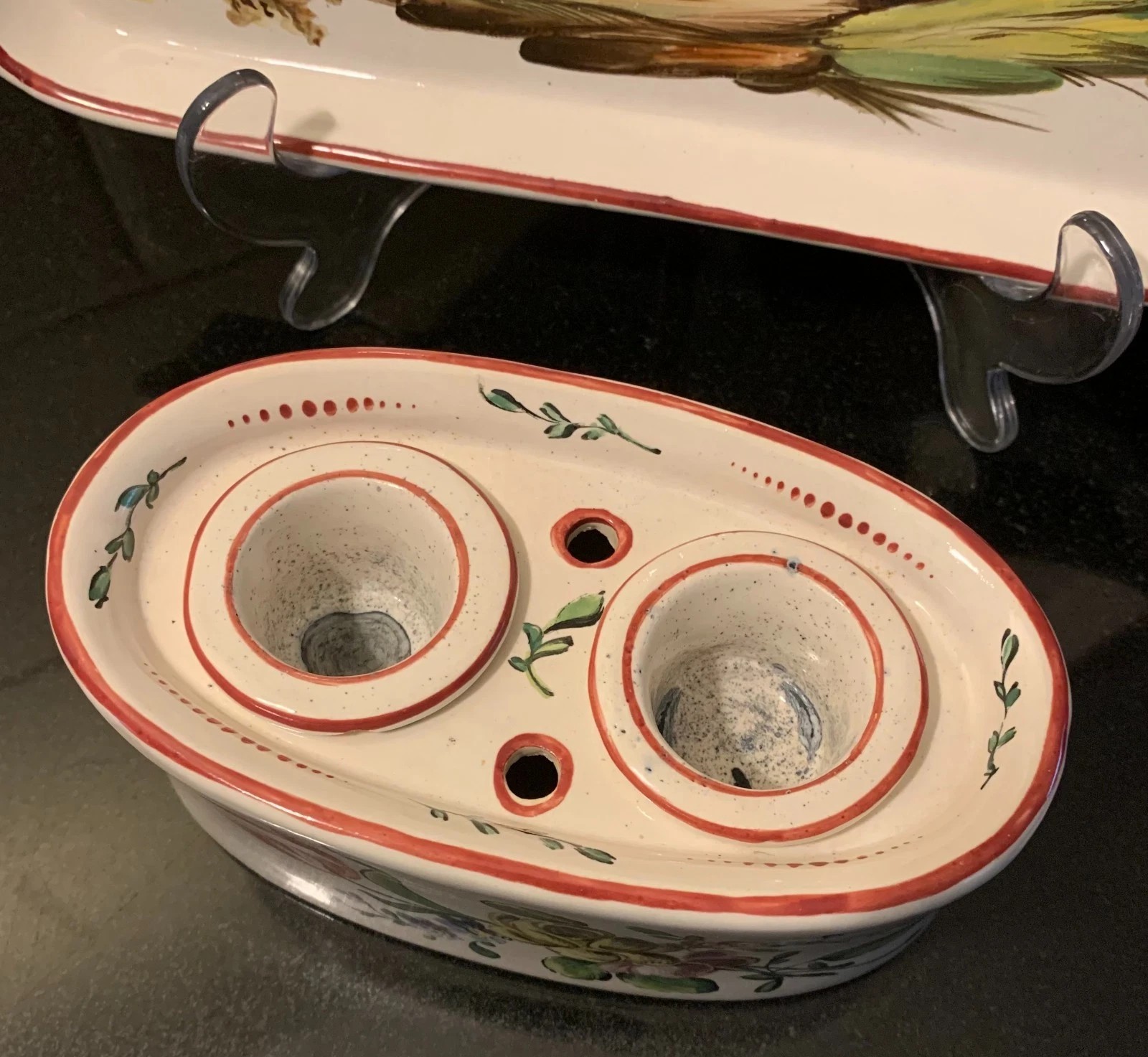
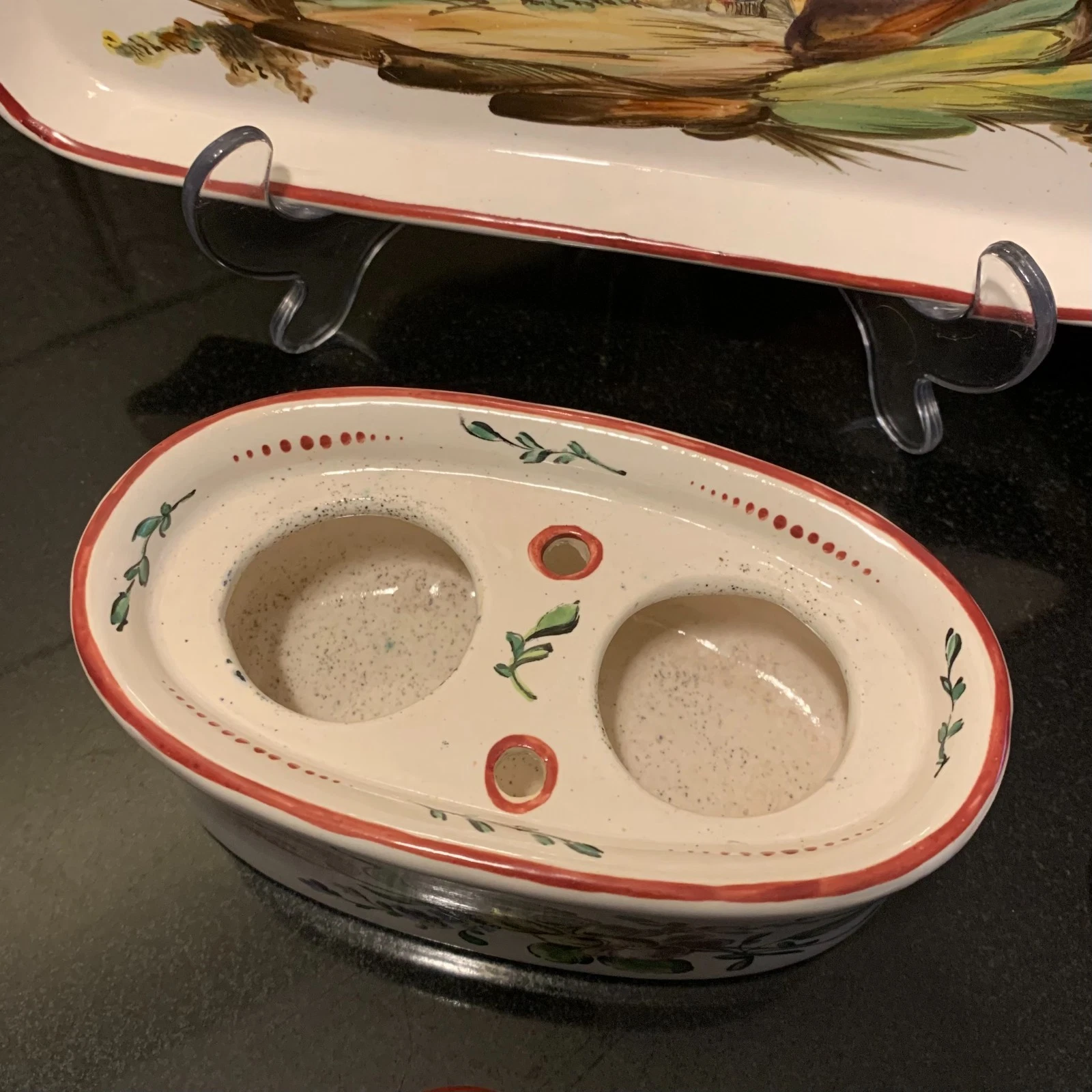
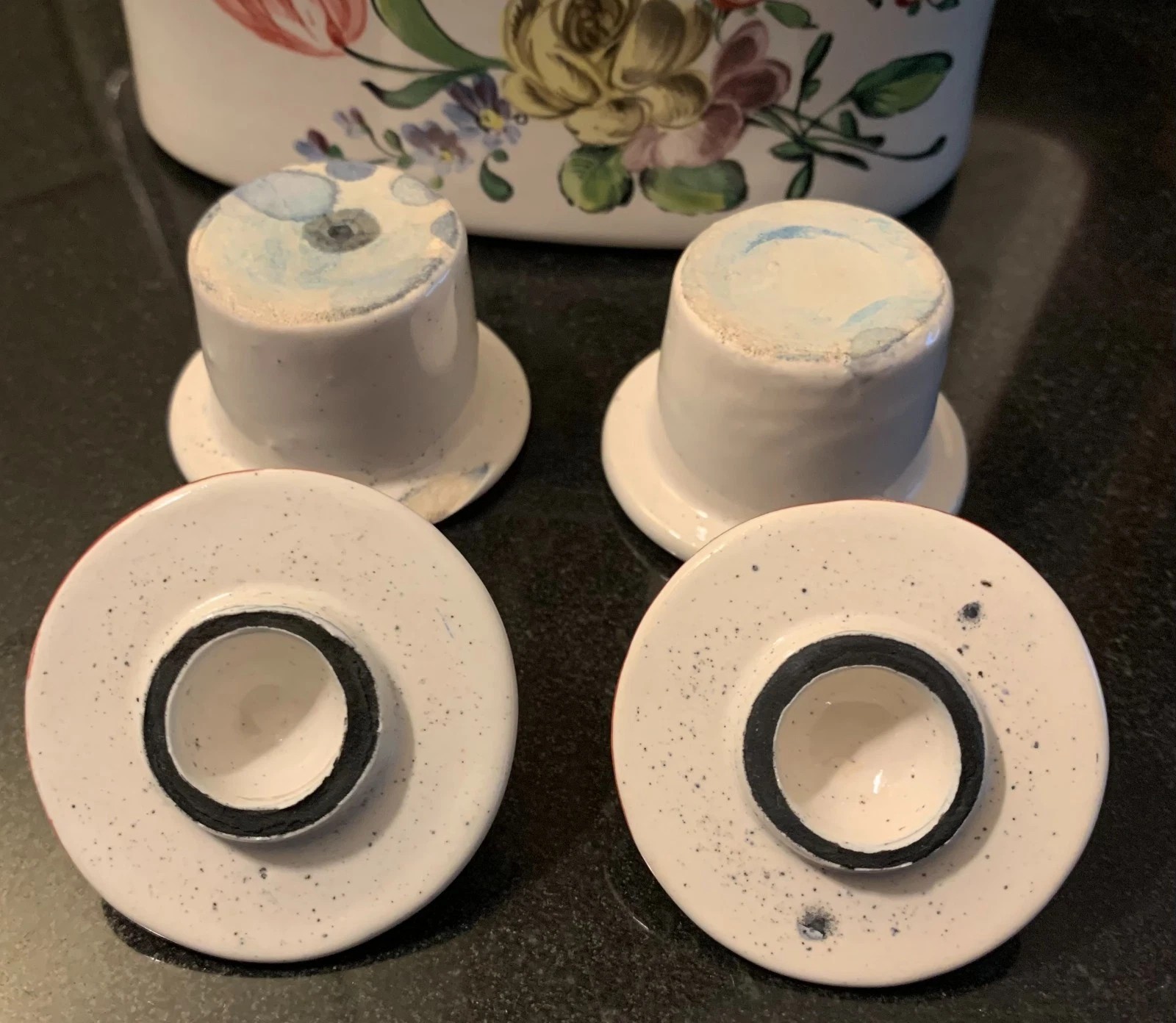
- The Inkwell Base: An oval-shaped container decorated with a wrap-around landscape. The top surface has two large circular openings for the wells and two smaller holes (for quills or pens).
- The Wells and Lids: Two original cylindrical ceramic inserts with matching lids. The lids have a distinctive scalloped red-border design and “onion” style finials.
- Style: The “shabby chic” or rustic painting style, characterized by soft greens, ochres, and pinks, is quintessential Provençal faience.
The presence of the “VP” mark alongside a printed “MADE IN FRANCE” confirms that this is a high-quality Desvres revival of 18th-century Marseille faience. In the late 19th century, the town of Desvres in northern France became the premier center for reproducing historical French pottery styles, particularly those of Marseille, Rouen, and Moustiers.
The Specific Factory: Fourmaintraux
The most likely manufacturer of your inkstand is the Fourmaintraux family, specifically the factory of Fourmaintraux-Frères or Fourmaintraux-Courquin.
- The Fourmaintraux Dynasty: This family dominated Desvres production for over a century. By the 1890s, they had a massive catalog of “Museum Styles.” They were famous for their “Old Marseille” pattern, which utilized the signature “VP” mark of Veuve Perrin as a decorative homage to the original 18th-century designs.
- The “VP” Mark in Desvres: Unlike modern “fakes,” these were sold as high-end artistic revivals. The “VP” mark was used to tell the customer: “This piece is decorated in the style of the Widow Perrin’s famous Marseille workshops.”
- Export Indicators: The “Made in France” stamp was explicitly added for the international market (primarily the US and UK) following the McKinley Tariff Act of 1890, which required the country of origin to be clearly marked in English.
Can we identify the painter?
Identifying a specific individual painter is unfortunately very difficult. During this period (roughly 1890–1915), the Fourmaintraux factories employed hundreds of skilled decorators.
- The Studio System: Most of these artists worked in a “studio” setting where they specialized in specific motifs—one painter might handle the landscapes while another did the floral sprays.
- Signatures: Unless there is a secondary tiny monogram or number hidden near the VP mark, the piece is considered a product of the collective factory “hand.” However, the quality of the brushwork on this set—particularly the atmospheric detail in the bridge and tower scene—suggests it was executed by one of their more senior decorators.
Summary of Attributes
| Feature | Details |
| Origin | Desvres, France (Northern France) |
| Factory | Most likely Fourmaintraux-Courquin |
| Style | Vieux Marseille (Old Marseille) Revival |
| Period | Circa 1895–1910 |
| Technique | Petit Feu (overglaze hand-painting) |
This set is a wonderful example of “Historicism” in French ceramics—a time when French makers looked back to their golden age of pottery to create luxury items for the burgeoning middle-class market.
Sold for $134 in January 2026
Content disclaimer. The information posted is the owner’s best knowledge and may not have been vetted by the SOIC. We welcome comments, corrections, and additions, working to make our website information comprehensive and accurate.
Join the Society of Inkwell Collectors (SOIC) – it’s free!
Founded in 1981 as a non-profit organization,
we are documenting inkwells (and accessories).
We’re here to help and inform!