

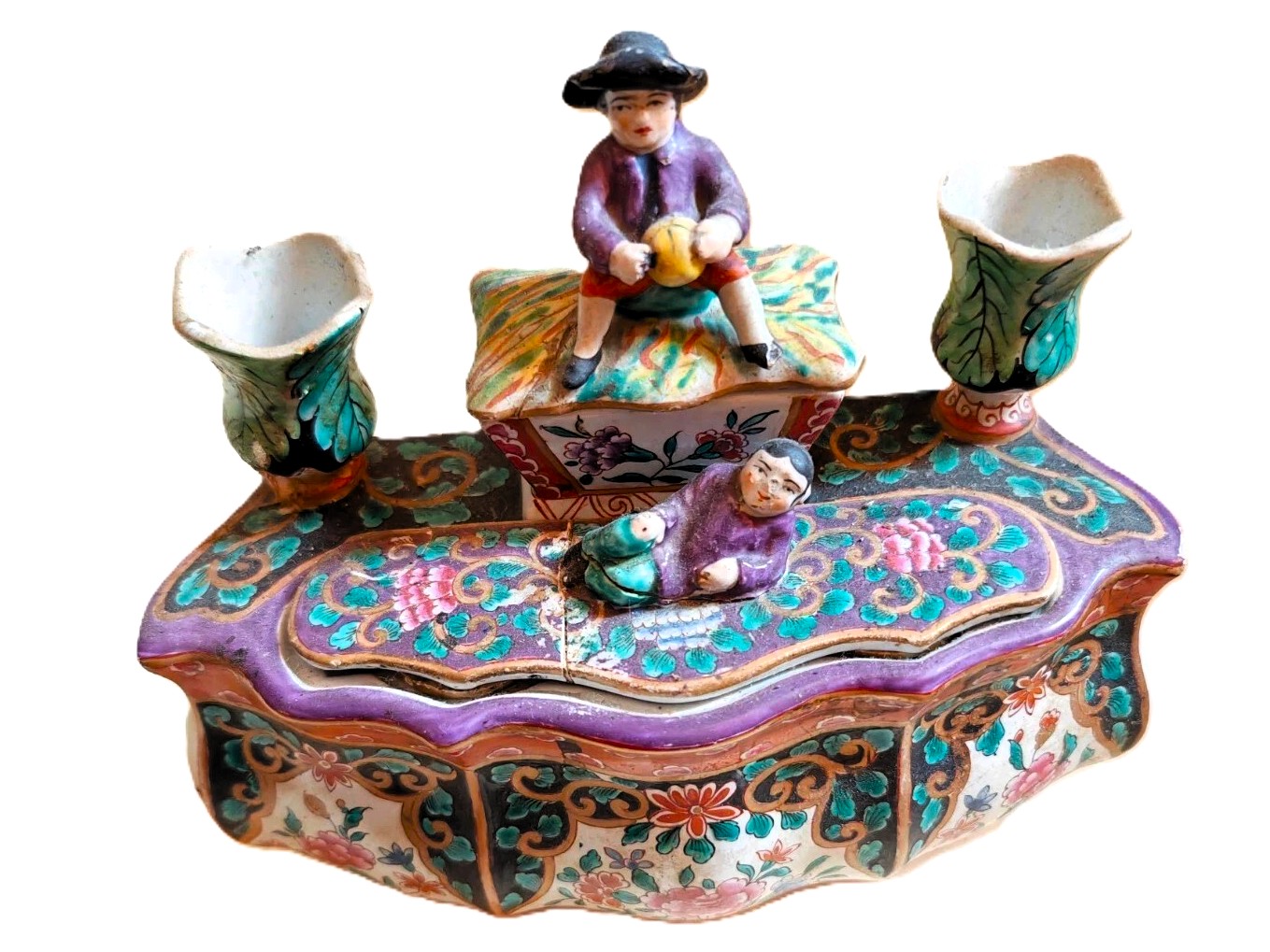
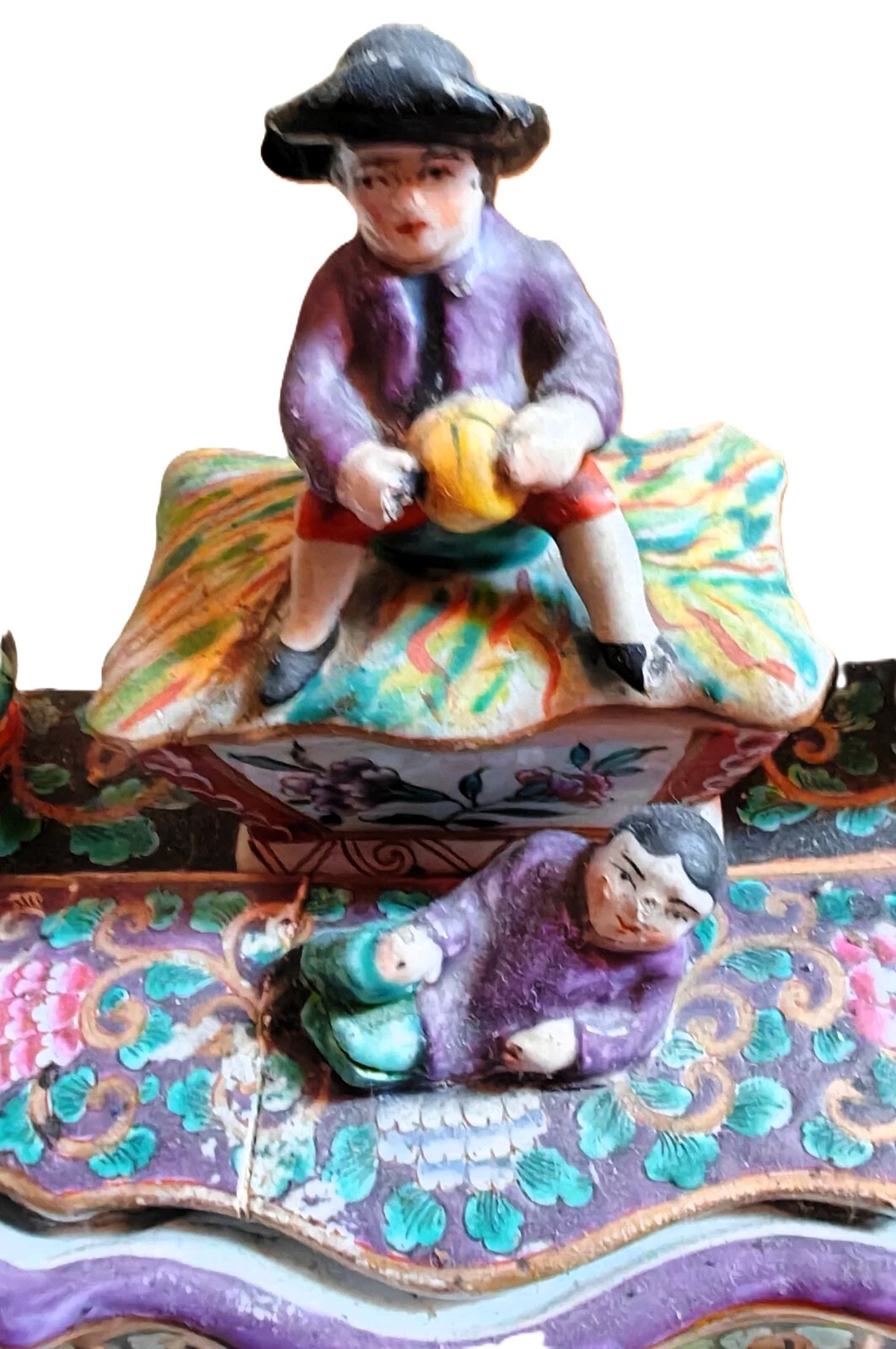
French Faience “Chinoiserie” Figural Inkstand
| Categories | Ceramics/Porcelain "Named" Makers |
| Material | Earthenware |
| Markings | See narrative |
| Manufacturer | Alfred Renoleau |
| Origin | France |
| Date or Era | circa 1895 |
| Measuring | 9 ½” long; 6 ¼” high |
Identification: Alfred Renoleau (Angoulême)
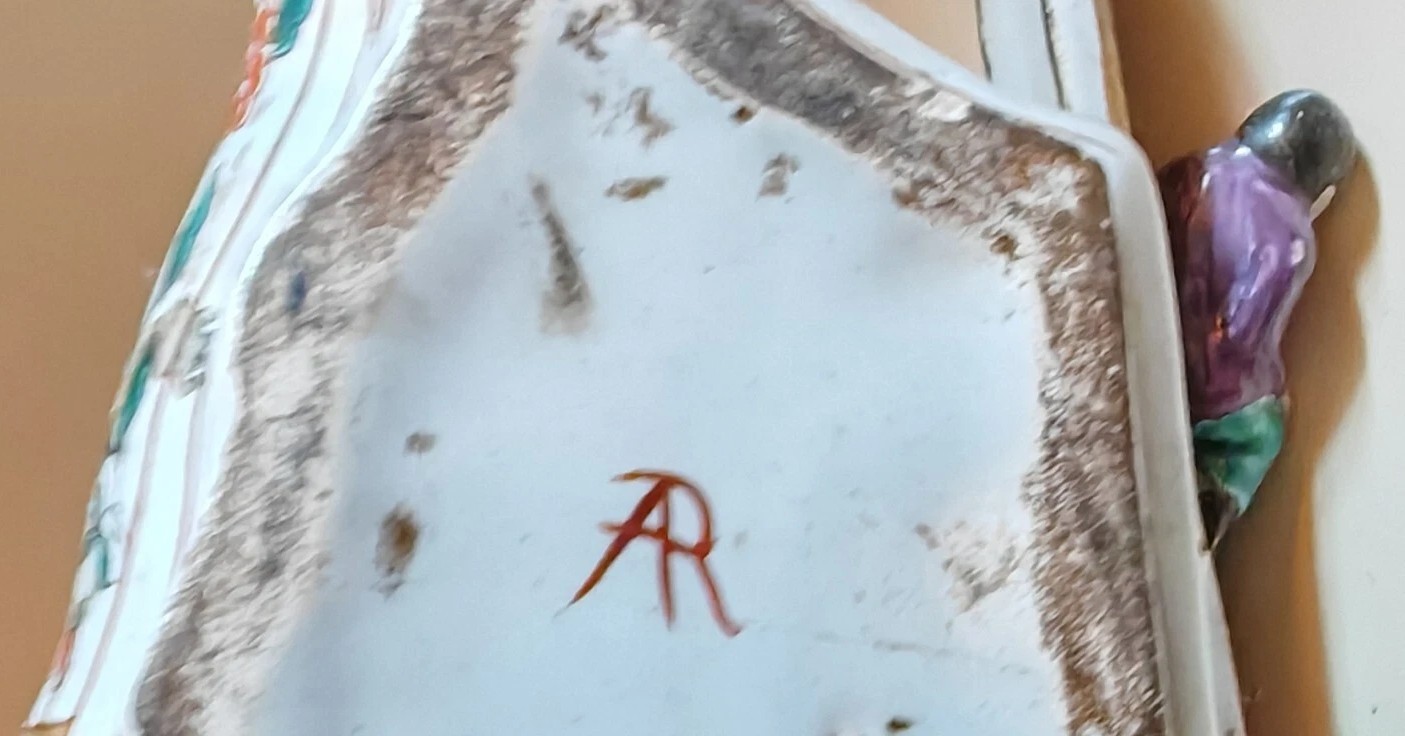
The Mark: The reddish-brown mark on the underside—a stylized ligature where the letter “A” shares a leg with the letter “R”—is the signature of Alfred Renoleau (1854–1930).
“Angoulême Faience”:
- What it is: “Faience” is the French term for tin-glazed earthenware (a porous pottery dipped in a white glaze and then painted).
- The Connection: Alfred Renoleau was the most famous ceramist working in the city of Angoulême (Southwest France) during the late 19th and early 20th centuries. He revived the local pottery tradition, often copying earlier 18th-century styles like Nevers or Rouen. This piece is a classic example of Angoulême Faience from the Renoleau workshop.
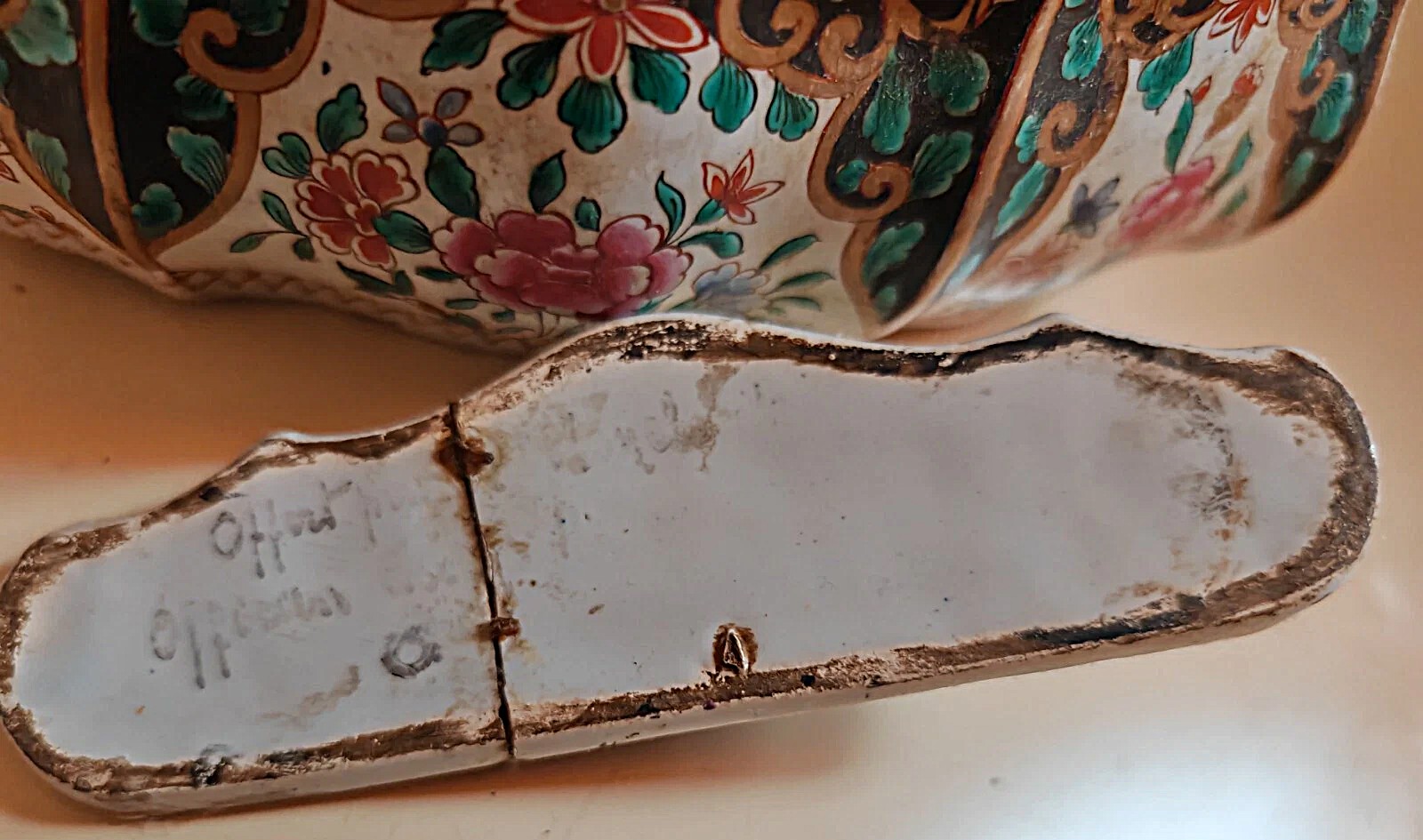
The Inscription: A Presentation Piece?
On the underside of the lid, the handwritten inscription reads: “Offert / Officiers”
- “Offert”: This is the French word for “Offered” (or “Given” / “Presented”).
- The Second Word: While faint, the second word appears to be “Officiers” (Officers).
- Meaning: This suggests the inkstand was a presentation gift, likely given by a group of military officers to a colleague, or to the officers’ mess hall. It was very common in the late 19th century to commission local faience pieces as commemorative gifts.
Visual Description:
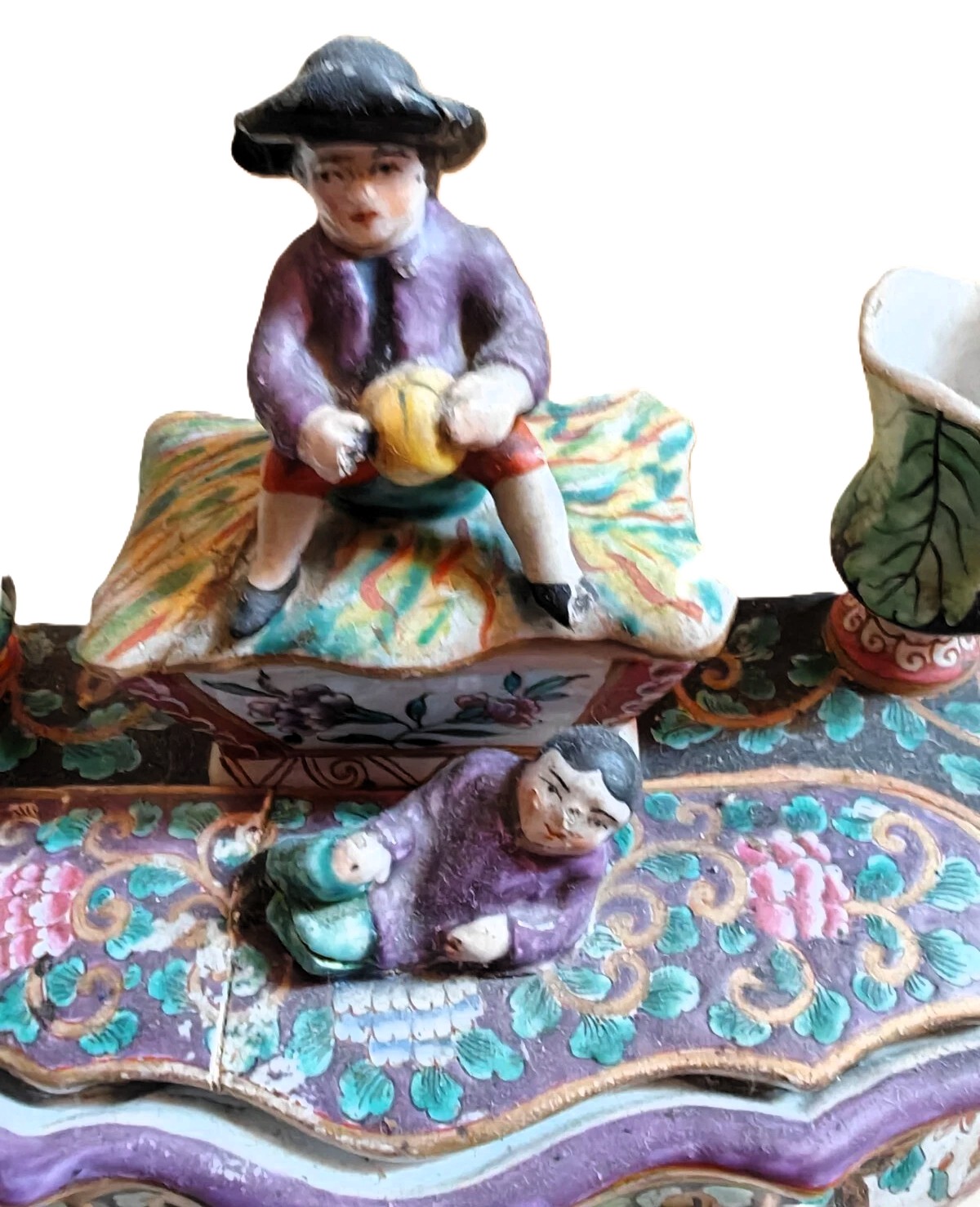
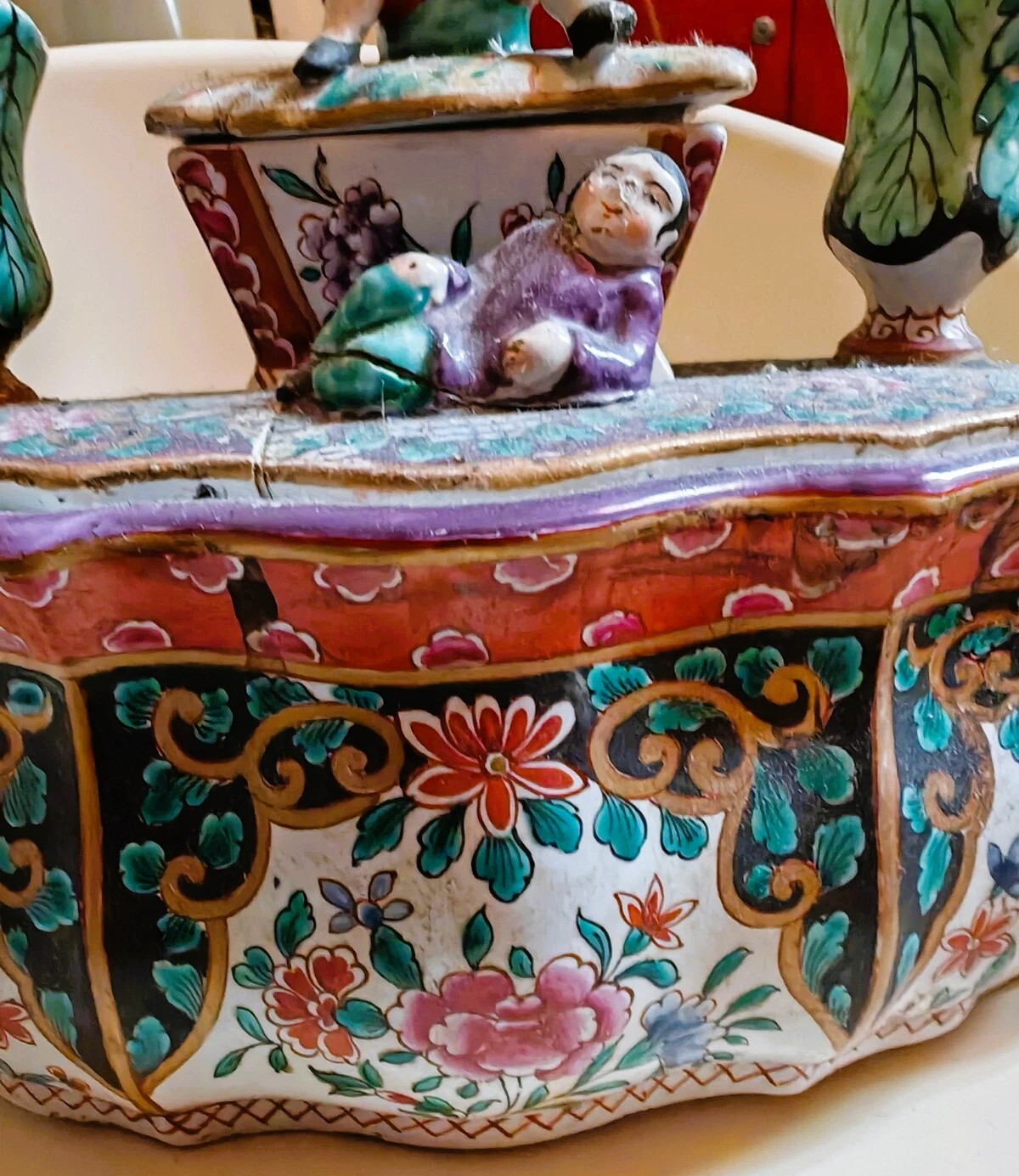
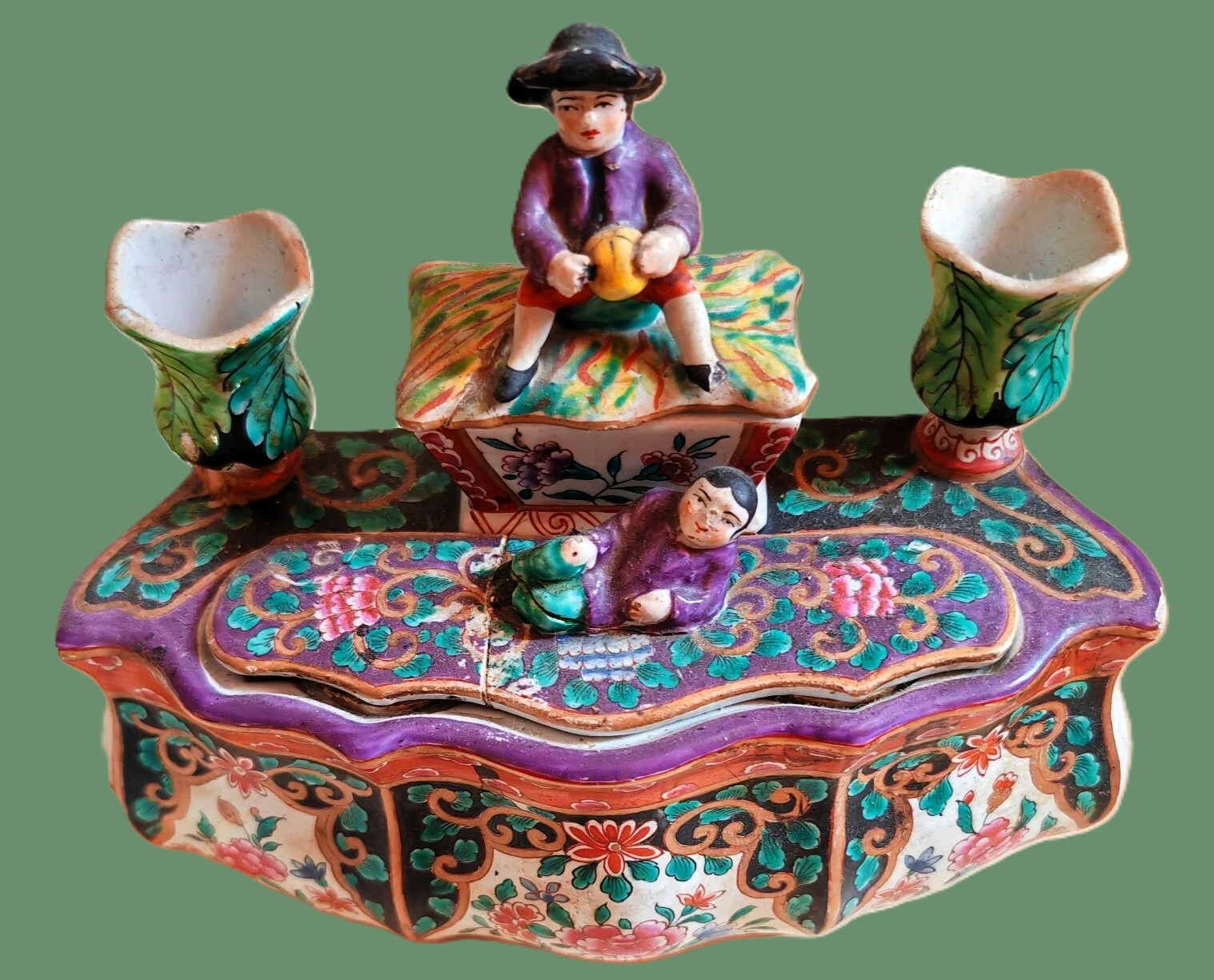
A polychrome tin-glazed earthenware (faience) inkstand in the Rococo Revival style. The body features a “bombé” (swelling) form with molded scrollwork painted in manganese purple and teal green. The flat surfaces are decorated with hand-painted floral sprays in pink, red, and green.
The Figures: The stand is surmounted by two figures in the “Magot” style (a French term for stylized, often caricature-like figures of Asian descent, popular in 18th-century Chinoiserie).
- One figure reclines playfully on the front platform.
- The second figure sits atop the central lid, wearing a black hat and holding a large yellow sphere (possibly fruit or a ball).
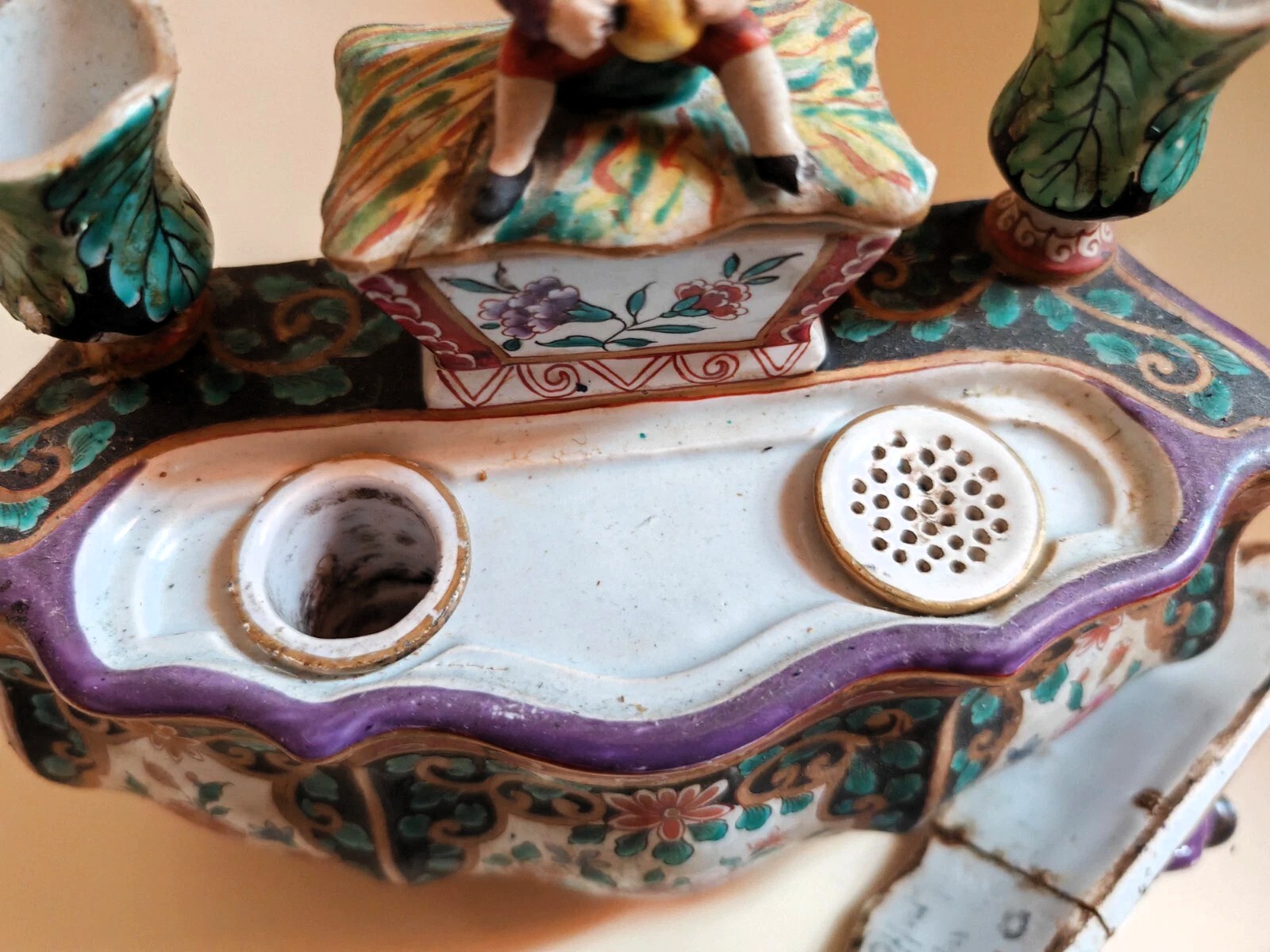
Compartments: The stand holds two removable inserts:
- Inkwell: An open cup for holding ink.
- Sander (Pounce Pot): A cup with a perforated top. Before blotting paper was invented, one would shake “pounce” (fine powder or sand) from this shaker onto wet ink to dry it.
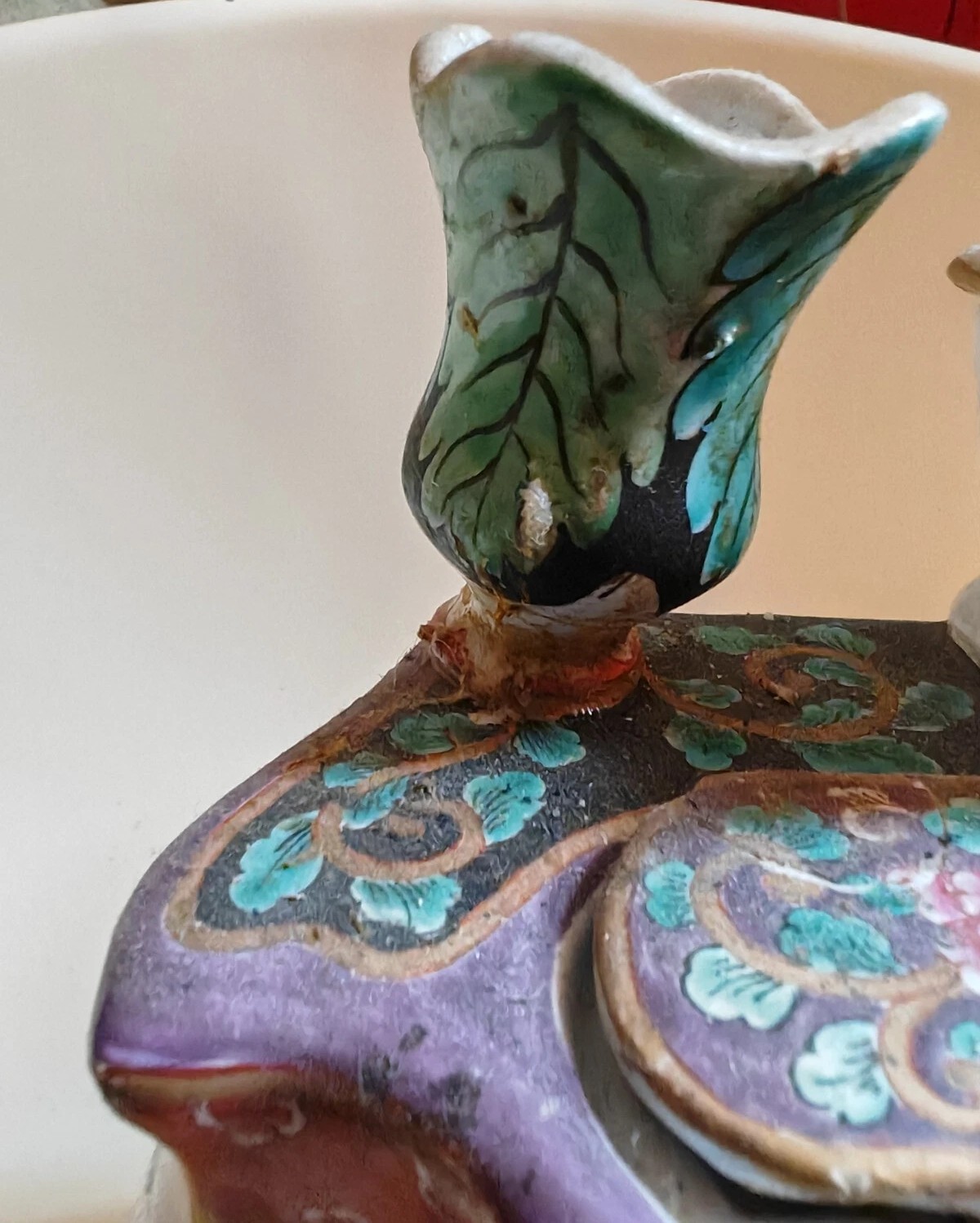
- The two tulip-shaped vessels standing upright on the back corners are most likely quill holders (vases to hold your pens upright) rather than candleholders.
Why the “Antique” Features? (The Revival Style)
The sander is an 18th-century technology. However, Alfred Renoleau (the maker) was famous for being a “Revivalist.”
- Intentional Nostalgia: In the 1890s, there was a massive craze in France for “Rococo Revival”—copying the styles of the 1700s.
- Decorative Function: Makers like Renoleau included archaic features like pounce pots on their inkstands deliberately to make them look like 18th-century antiques. They were selling the “romance” of the past to Victorian buyers. Even though the user in 1900 would likely use blotting paper, the sander was included for historical accuracy to the style, not the era.
- The Definitive Proof: The “AR” Mark
The most critical clue is the history of the man who signed it.
- Alfred Renoleau (1854–1930): He did not open his workshop in Angoulême and start using that specific “AR” ligature mark until 1891.
- Therefore, it is physically impossible for this piece to be older than 1891, regardless of the “old fashioned” features he sculpted into it.
Conclusion: This is a high-quality “Revival” piece from roughly 1895–1905. It was designed to look 150 years old the day it was made!
Sold for $150 in November 2025
Content disclaimer. The information posted is the owner’s best knowledge and may not have been vetted by the SOIC. We welcome comments, corrections, and additions, working to make our website information comprehensive and accurate.
Join the Society of Inkwell Collectors (SOIC) – it’s free!
Founded in 1981 as a non-profit organization,
we are documenting inkwells (and accessories).
We’re here to help and inform!