



French Enamel Cloisonné Inkstand
| Categories | Enameled Metal |
| Type | Cloisonné |
| Material | Enameled Brass/Bronze/Metal |
| Markings | Unmarked |
| Manufacturer | Undetermined |
| Origin | France |
| Date or Era | circa 1880 |
| Measuring | 8 ½” x 5 ¼” x 2” high |
Description of the Inkstand
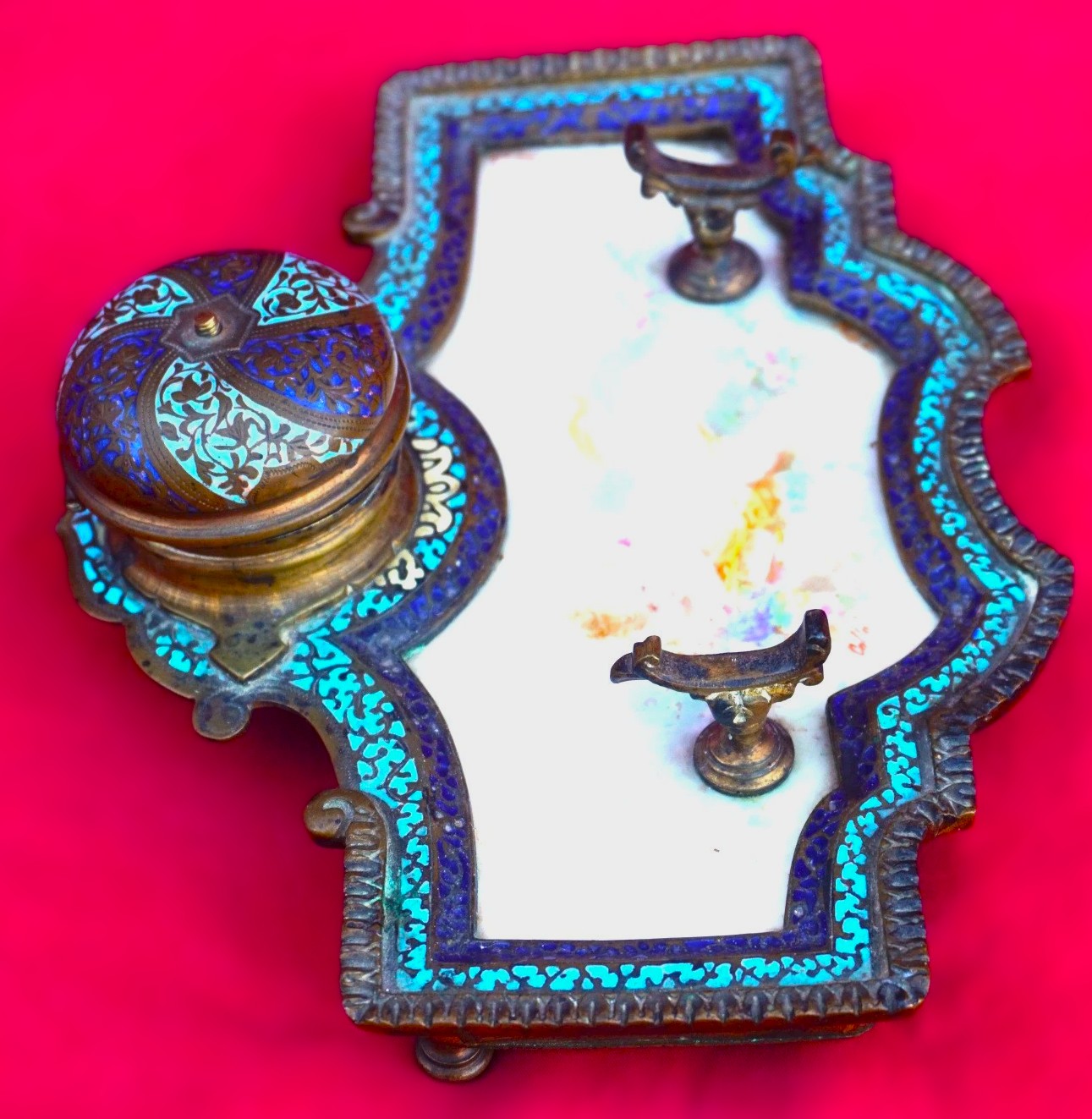
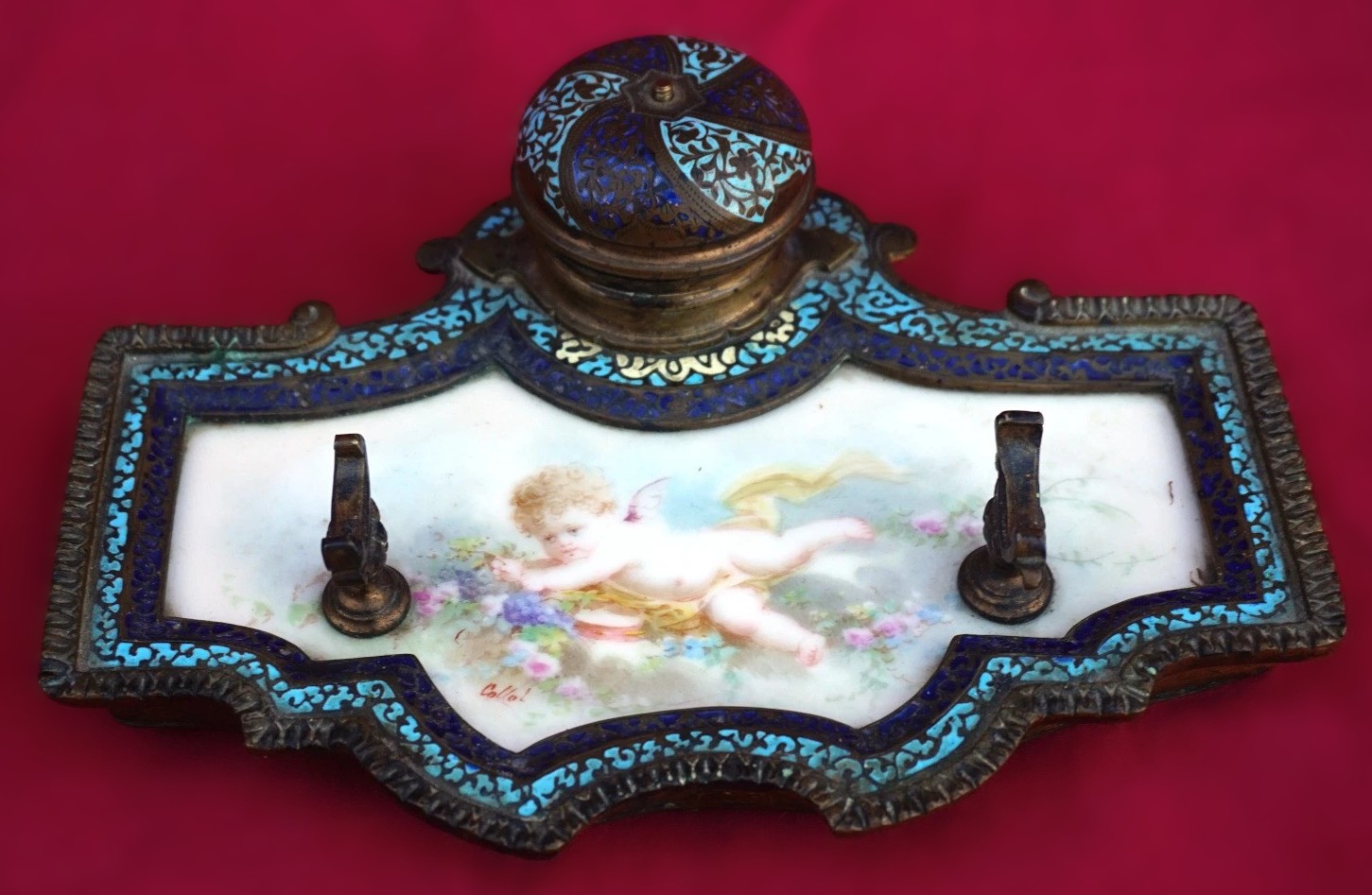
The piece consists of a cast brass or bronze frame decorated with French enamel cloisonné and a central hand-painted porcelain tray.
- The Porcelain Tray: The tray features a central scene of a winged cherub (putto) reclining among a garden of colorful flowers. In the lower-left corner of the porcelain, there is a visible artist signature: “Collet”. Painters like Collet were often commissioned to decorate porcelain inserts for high-end bronze retailers in Paris.
- Enamel Work: The cloisonné decoration uses a vibrant palette of turquoise, cobalt blue, and white enamel. The pattern on the base is a repeating foliate scroll, while the lid features a swirling “petal” or “turbine” design that separates different colored sections.
- Metal Components: The base is scalloped and ornate. Two scrolled supports on the porcelain tray serve as pen rests.
- Underside: The bottom of the piece shows the construction typical of the late 1800s, with a heavy metal plate secured by large flat-head screws.
Age and Origin
This inkstand likely dates to approximately 1870–1890.
During this period, French manufacturers like F. Barbedienne or L’Escalier de Cristal popularized the combination of “cloisonné à la française” on bronze with Sèvres-style porcelain. The use of vibrant blue enamels and the romantic cherub theme are quintessential to the French Third Republic’s taste for neo-classical and Rococo revival aesthetics.
The Cloisonné Process
Cloisonné is a sophisticated enameling technique that requires multiple stages of craftsmanship:
- Creating the Cells: Thin strips of metal wire (usually brass or copper) are bent into patterns and soldered onto the metal surface. These wires form the “cloisons” (French for “partitions” or “cells”).
- Filling with Enamel: Finely ground glass powder (frit) mixed with water or oil is applied into the individual cells using a small brush or needle. Each color is placed in its designated compartment.
- Firing: The piece is fired in a kiln. The heat melts the glass powder into a hard, smooth enamel. Because enamel shrinks when it melts, this process of filling and firing is often repeated several times to ensure the cells are full.
- Grinding and Polishing: After firing, the surface is uneven. The artisan grinds the enamel down with abrasive stones until it is flush with the metal wires. It is then polished to a high luster, revealing the crisp patterns.
Additional Observations
- Condition: Three feet are missing from the underside, leaving the screw holes visible. The lid finial and glass inkwell insert are missing.
- Material: Given the weight and the way the metal has aged, the base is gilt bronze (ormolu).
Sold for $150 in April 2026
Content disclaimer. The information posted is the owner’s best knowledge and may not have been vetted by the SOIC. We welcome comments, corrections, and additions, working to make our website information comprehensive and accurate.
Join the Society of Inkwell Collectors (SOIC) – it’s free!
Founded in 1981 as a non-profit organization,
we are documenting inkwells (and accessories).
We’re here to help and inform!