

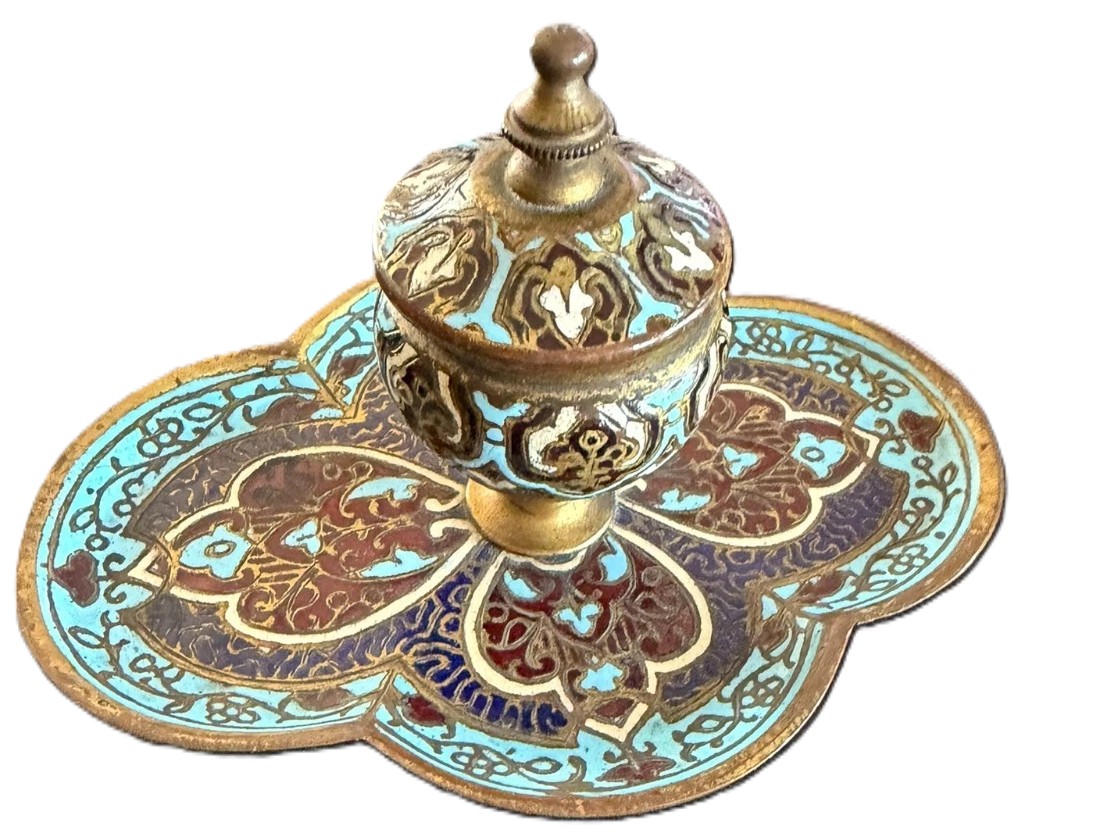
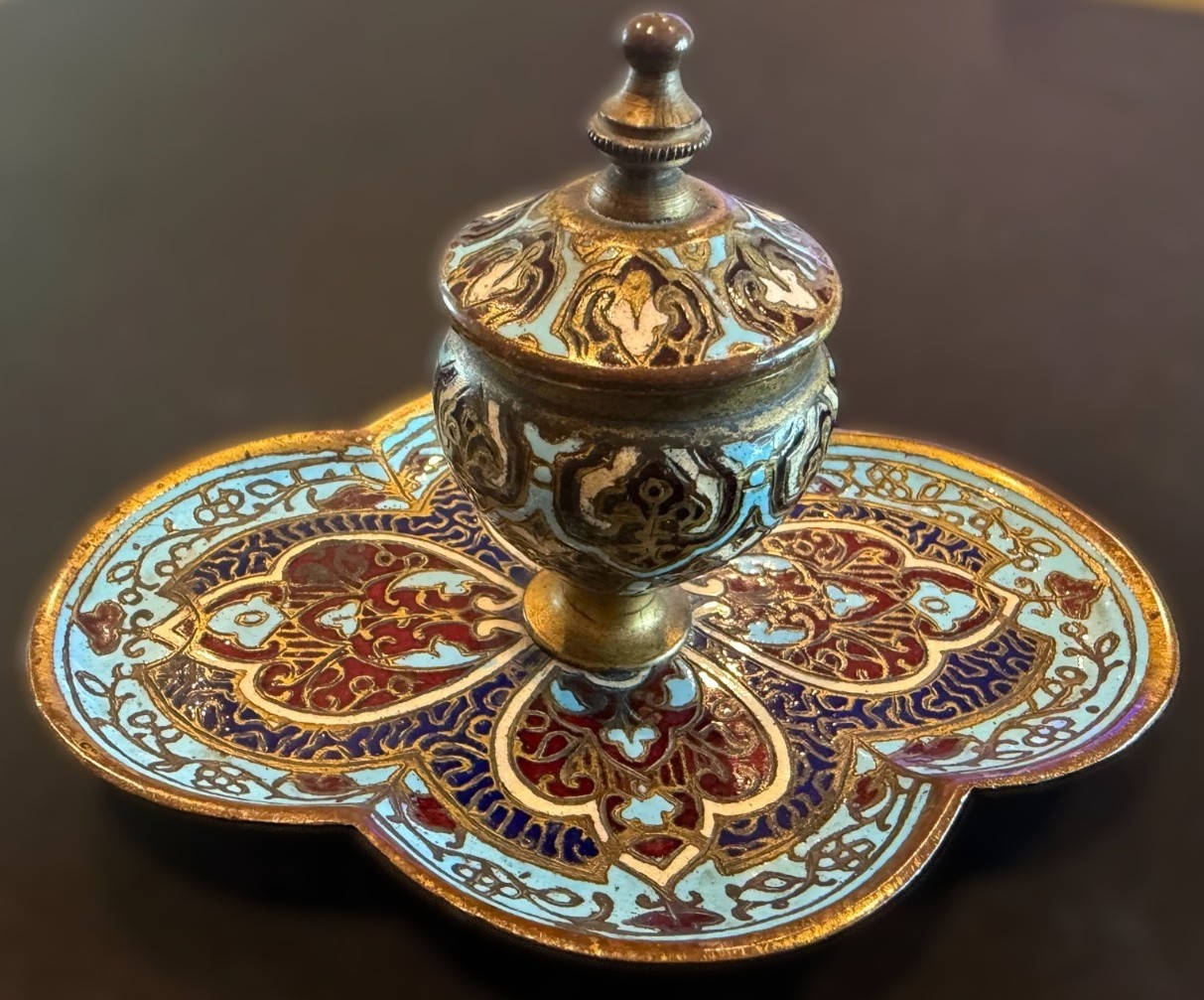
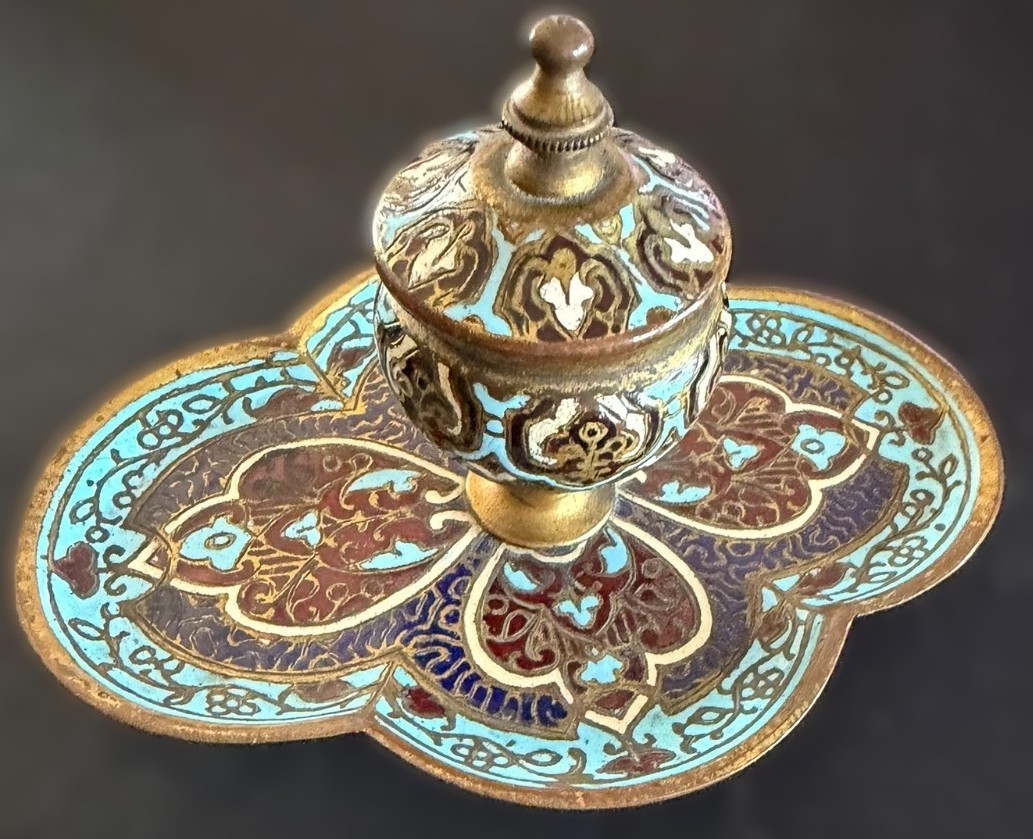
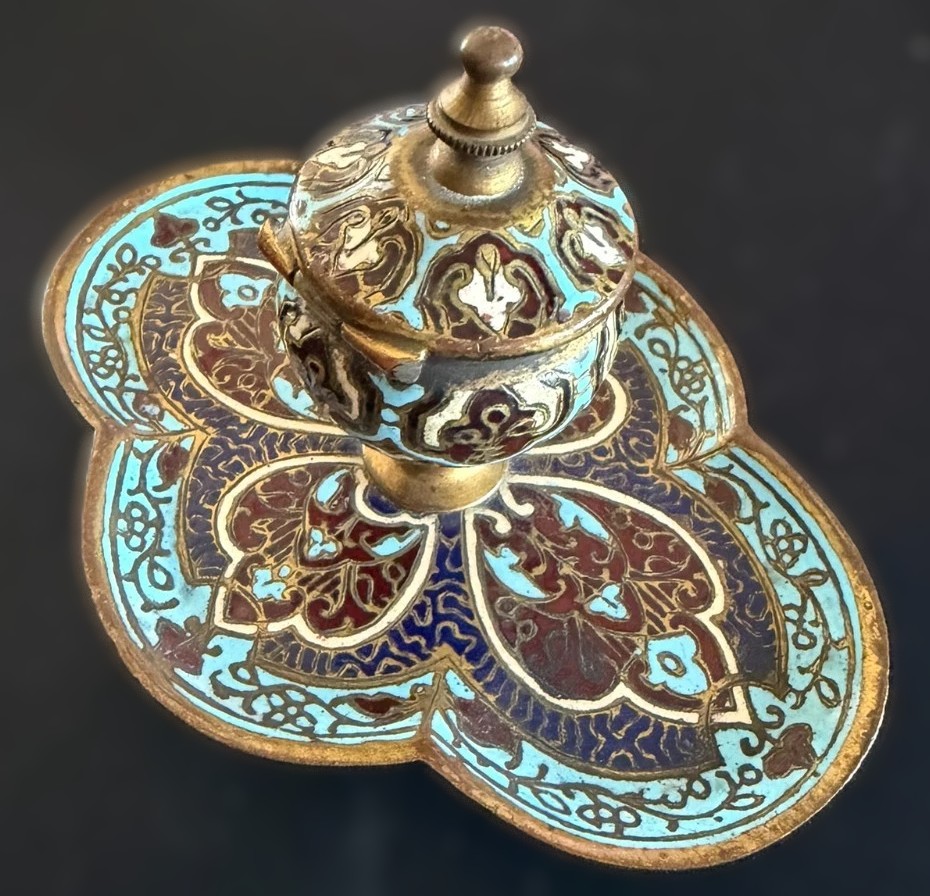
French Champlevé Enamel Inkstand
| Categories | Enameled Metal |
| Type | Champlevé |
| Material | Enameled Brass/Bronze/Metal |
| Markings | Unmarked |
| Manufacturer | Undetermined |
| Origin | France |
| Date or Era | circa 1880 |
Description
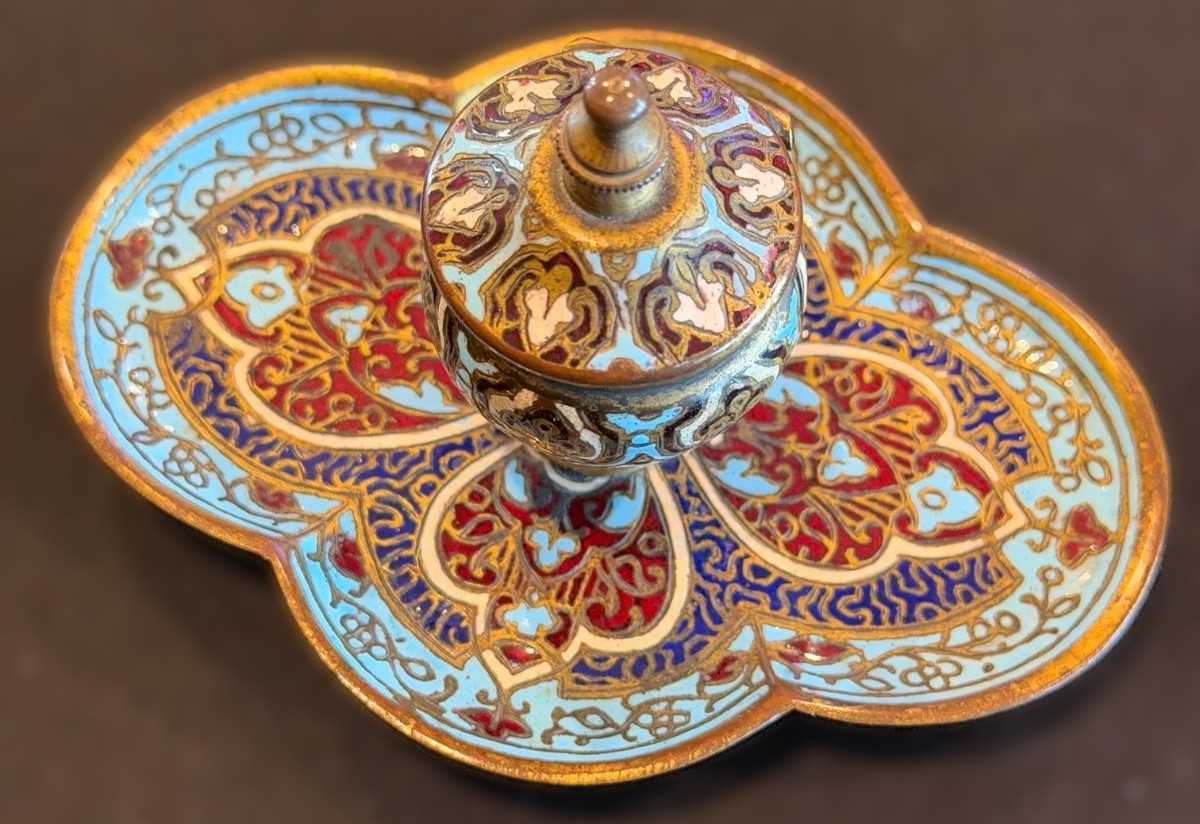
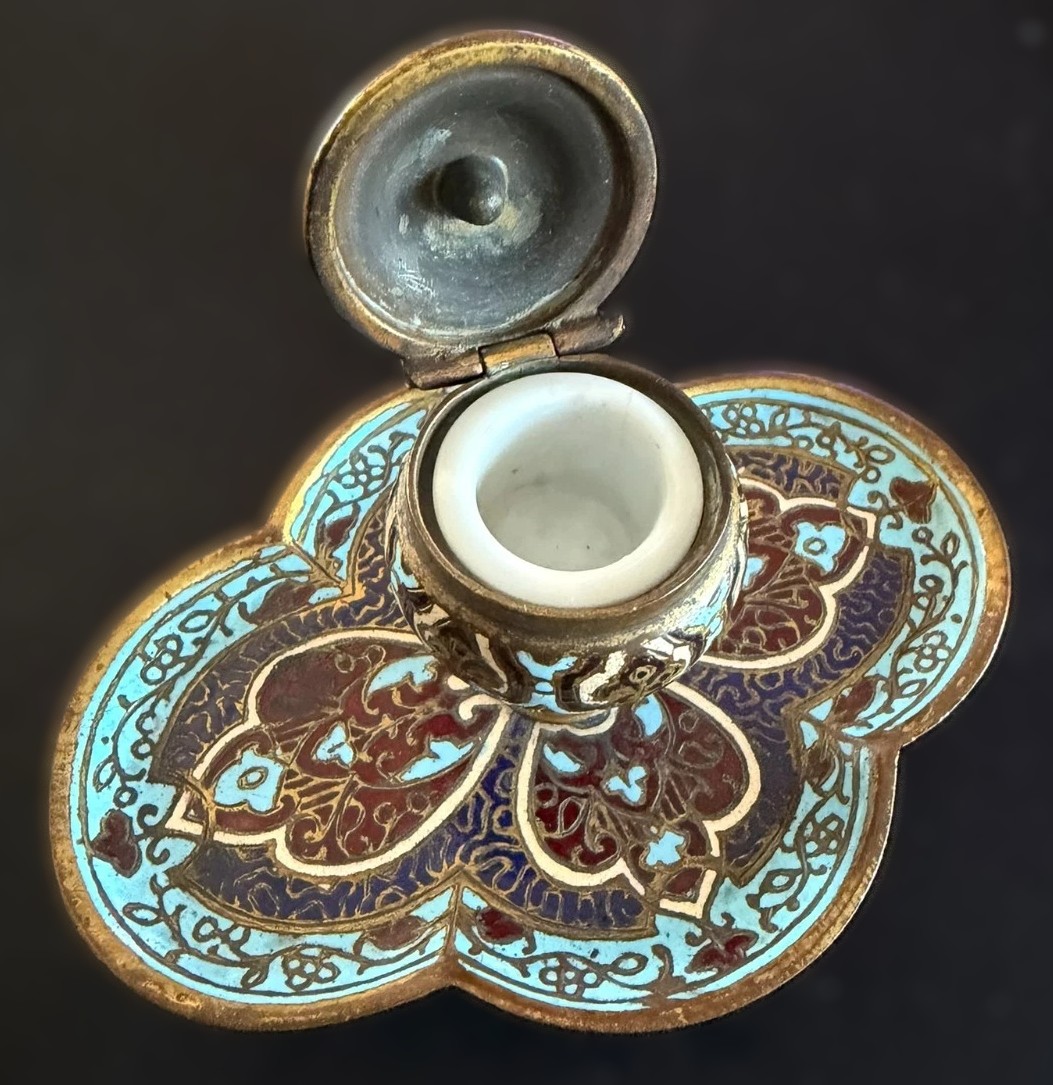
This inkwell features a single, pedestal-mounted pot set upon a wide, trilobe (three-lobed) base. The piece is made from gilt bronze (also known as ormolu), which serves as the framework for the intricate enamel work.
- Enamel Palette: The polychrome decoration utilizes a classic French palette of the era: a vibrant turquoise (sky blue) ground, accented by oxblood red (carmine), cobalt blue, and white.
- Design Motifs: The patterns are a blend of arabesque and floral motifs, typical of the “Orientalist” and “Japonisme” trends popular in France at the time. The base features stylized leaf designs within the lobes, while the ink pot itself is adorned with repeating geometric and foliate bands.
- Structure:
- The Pot: A globular or urn-shaped well sits on a short, flared pedestal.
- The Lid: A hinged, domed lid topped with a turned ball finial.
- Internal Well: Inside sits a white porcelain insert.
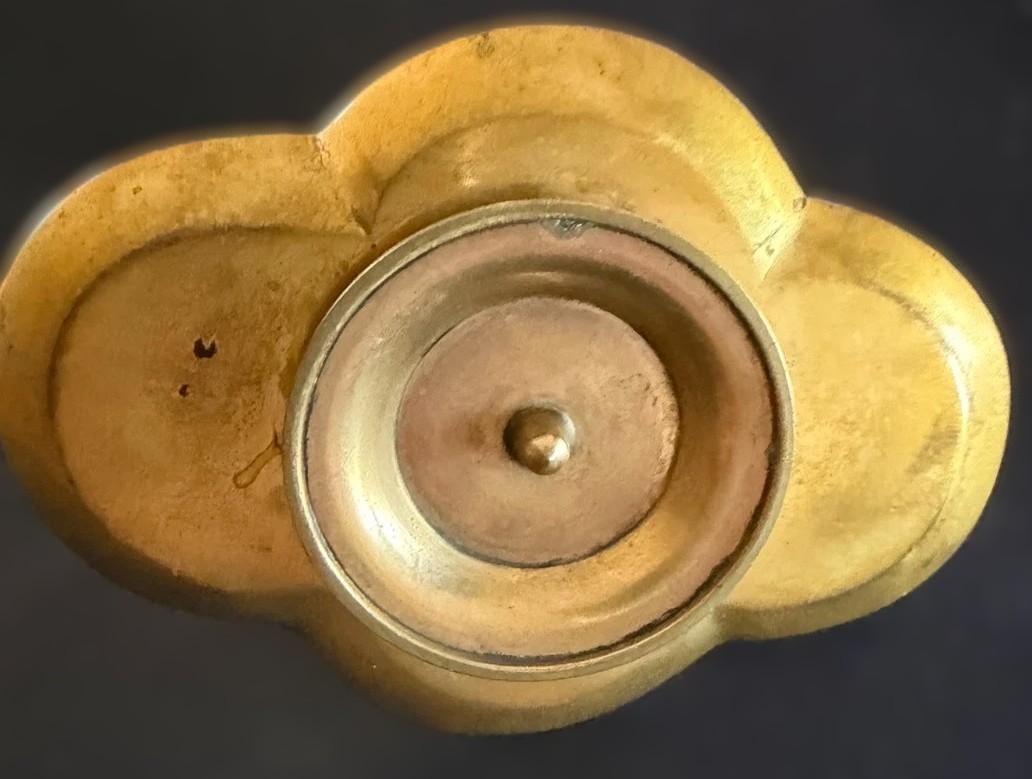
- The Base: The underside shows a simple, functional construction with a central nut and bolt holding the pedestal to the tray—a hallmark of late 19th-century assembly.
Estimated Age
This piece was most likely made during the late 19th century, specifically between 1870 and 1900.
This period covers the Napoleon III and early Belle Époque eras, when French foundries like Ferdinand Barbedienne and Maison Alphonse Giroux popularized this style. While many of these pieces were produced for the luxury export market and remain unsigned, the quality of the casting and the specific shades of enamel strongly support a French origin from this “Golden Age” of desk sets.
The Champlevé Process
The term Champlevé is French for “raised field,” referring to the way the metal remains flush with the enamel. The process is labor-intensive and requires several steps:
- Preparation of the Metal: A craftsman carves, etches, or casts “cells” (depressions) into the surface of the bronze or brass. Unlike Cloisonné, where wires are soldered on top of the metal to create barriers, Champlevé involves removing the metal to create the design.
- Filling the Cells: Each depression is filled with a paste made of powdered glass (frit) mixed with metallic oxides for color.
- Firing: The piece is placed in a high-temperature kiln. The glass powder melts, fuses to the metal, and becomes a smooth, hard enamel. Because different colors melt at different temperatures, the piece often undergoes multiple firings.
- Grinding & Polishing: Once the cells are filled, the surface is rough. The artisan grinds the enamel down until it is perfectly flush with the metal borders. It is then polished to a high luster.
- Gilding: Finally, the exposed metal ridges are often plated with a thin layer of gold (mercury gilding or electroplating) to prevent tarnish and provide the “gilt bronze” finish seen on this inkwell.
Sold for $300 in March 2026
Content disclaimer. The information posted is the owner’s best knowledge and may not have been vetted by the SOIC. We welcome comments, corrections, and additions, working to make our website information comprehensive and accurate.
Join the Society of Inkwell Collectors (SOIC) – it’s free!
Founded in 1981 as a non-profit organization,
we are documenting inkwells (and accessories).
We’re here to help and inform!