


Fatimid Calligraphic Inkwell
| Categories | Early - Primitive, Middle East / Africa |
| Material | Bronze |
| Markings | See Narrative |
| Manufacturer | Undetermined |
| Origin | Egypt |
| Date or Era | Late 10th – 12th Century CE |
| Measuring | 4 ⅜” diameter |
This is a remarkable example of Fatimid metalwork, produced in the cultural centers of Fustat (Old Cairo) or perhaps Greater Syria. The craftsmanship reflects the sophisticated aesthetic of the 10th to 12th centuries, where utilitarian objects for the literate elite were treated as miniature works of architecture.
Fatimid Calligraphic Inkwell
Overview
- Origin: Egypt or Syria (Fatimid Caliphate).
- Date: Late 10th – 12th Century CE.
- Material: Cast copper alloy (bronze) with traces of red pigment (possibly cinnabar-based).
- Dimensions: Compact, cylindrical form designed for portability and desktop use.
Construction and Technique
The inkwell is composed of two primary parts: a heavy, cylindrical body and a deep-flanged lid that fits securely over the neck. The piece was created using the lost-wax casting method, followed by meticulous hand-finishing. The decorative program is executed through incising and engraving, with the recessed areas filled with a vibrant red pigment to provide high contrast against the dark patina of the bronze.
The Lid
The lid is a masterclass in concentric design, divided into three distinct zones:
- The Finial: A prominent, multi-tiered baluster-shaped finial serves as the handle. It features a flared top and a central bulbous section, reminiscent of the domes and minarets of Fatimid architecture.
- The Calligraphic Band: A wide register of floriated Kufic script circles the finial. The calligraphy likely repeats traditional Arabic “Good Wishes” (du’a), such as al-yumn (good fortune) or al-baraka (blessing). The vertical strokes of the letters often terminate in stylized leaf-like motifs.
- The Outer Rim: A decorative border consisting of circular medallions containing six-petaled rosettes or foliate scrolls, interspersed with geometric knots.
The Body
The body features a continuous horizontal register organized into a series of blind arcades or niches.
- Architectural Motif: Each “niche” is framed by a pointed arch, a common motif in Islamic art that mirrors the mihrab (prayer niche).
- Infill: Inside these arches are further Kufic inscriptions set against a dense background of the surviving red pigment. This red inlay was a signature technique used to ensure the “word” remained the focal point even as the metal aged.
- Patination: The surface exhibits a rich, variegated patina ranging from deep chocolate brown to areas of malachite-green verdigris, indicating a significant age and stable oxidation.
The Base
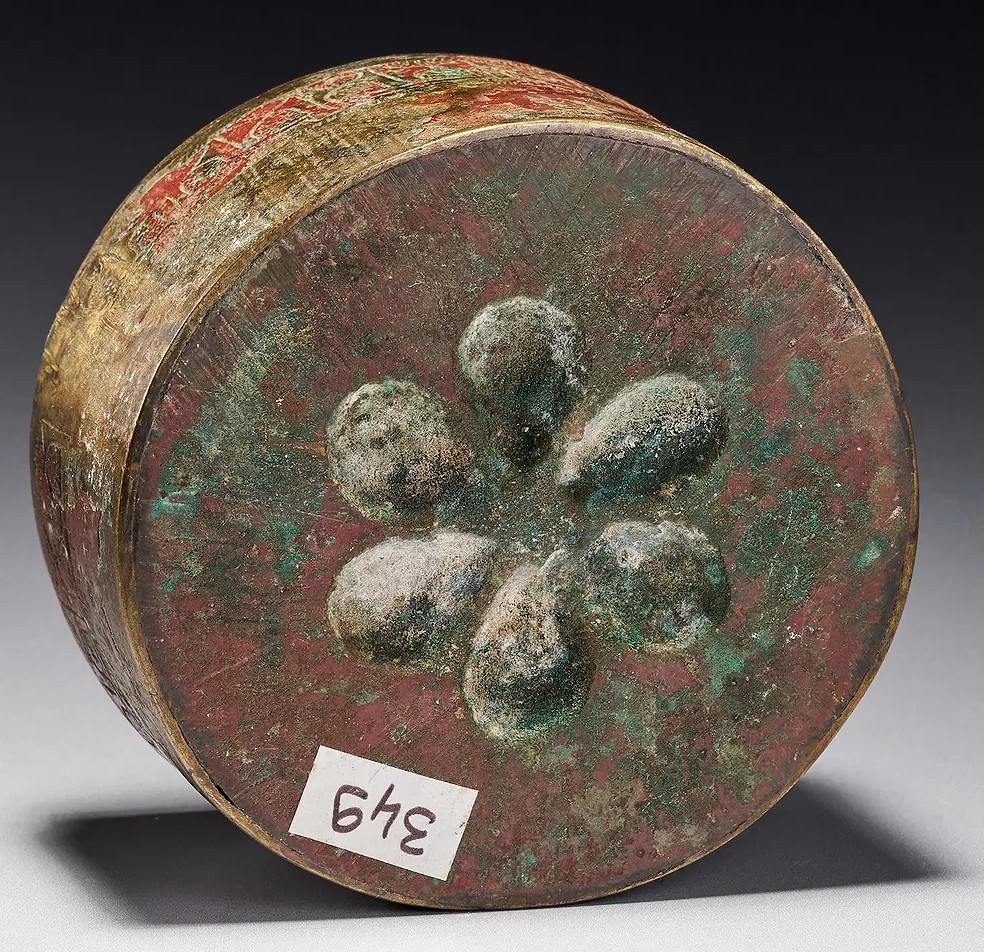
The underside reveals a raised six-petaled rosette cast in high relief. In Islamic symbolism, the hexagram or six-petaled flower often represented the “Seal of Solomon,” a protective emblem.
Clarifications
- The Script: The script seen here is strictly Kufic. The angularity and “blocked” nature of these letters are quintessentially Fatimid.
- Red Pigment: This is likely not “degraded inlay” (like silver or gold) but rather a deliberate pigment paste. This was a more affordable but highly effective alternative to the niello or precious metal inlays found on royal commissions.
- The Arches: The “cartouches” on the body are specifically architectural niches, intended to give the inkwell the appearance of a monumental building in miniature—a common theme for 11th-century “treasures of the table.”
Sold for $3,325 in April 2026
Content disclaimer. The information posted is the owner’s best knowledge and may not have been vetted by the SOIC. We welcome comments, corrections, and additions, working to make our website information comprehensive and accurate.
Join the Society of Inkwell Collectors (SOIC) – it’s free!
Founded in 1981 as a non-profit organization,
we are documenting inkwells (and accessories).
We’re here to help and inform!