

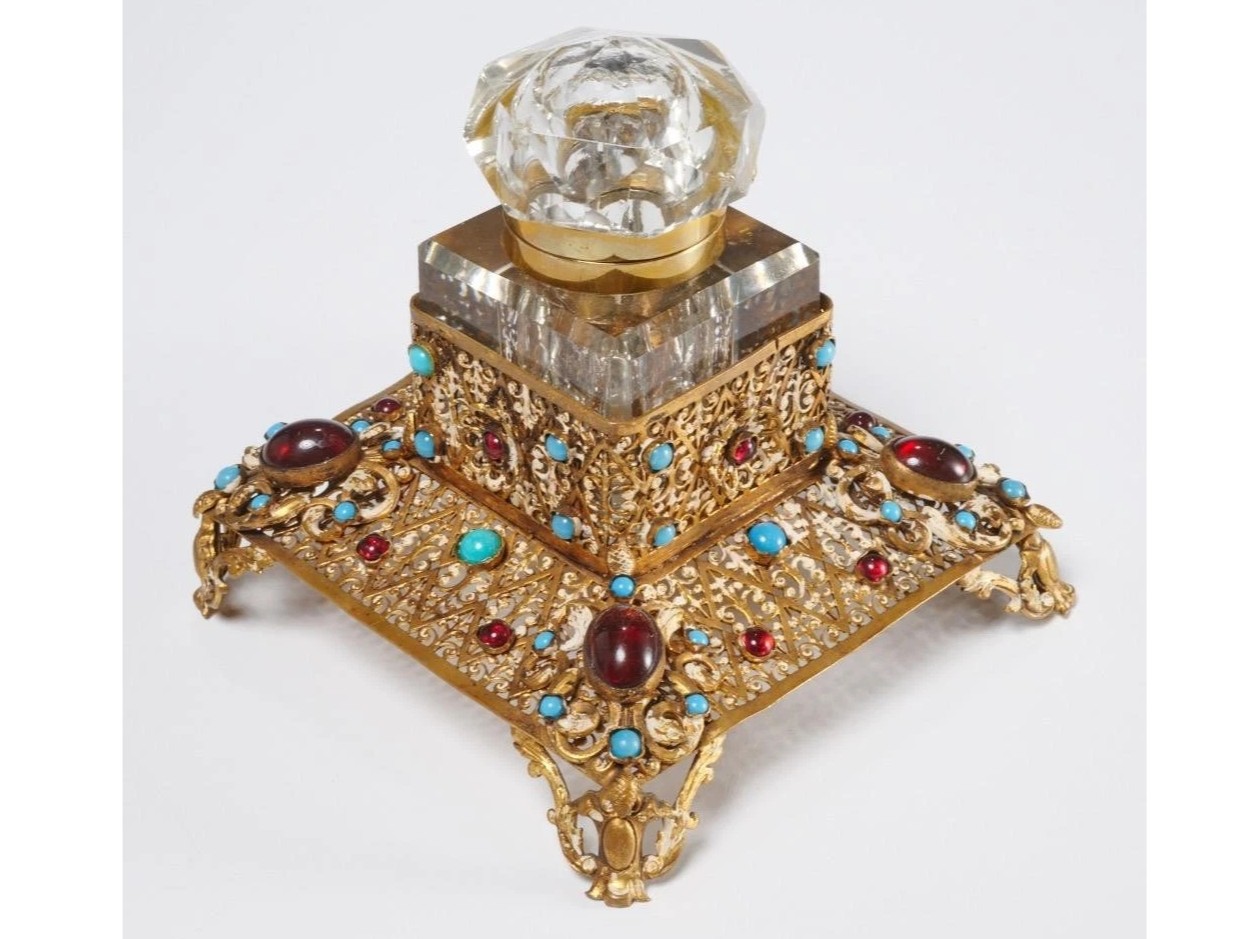
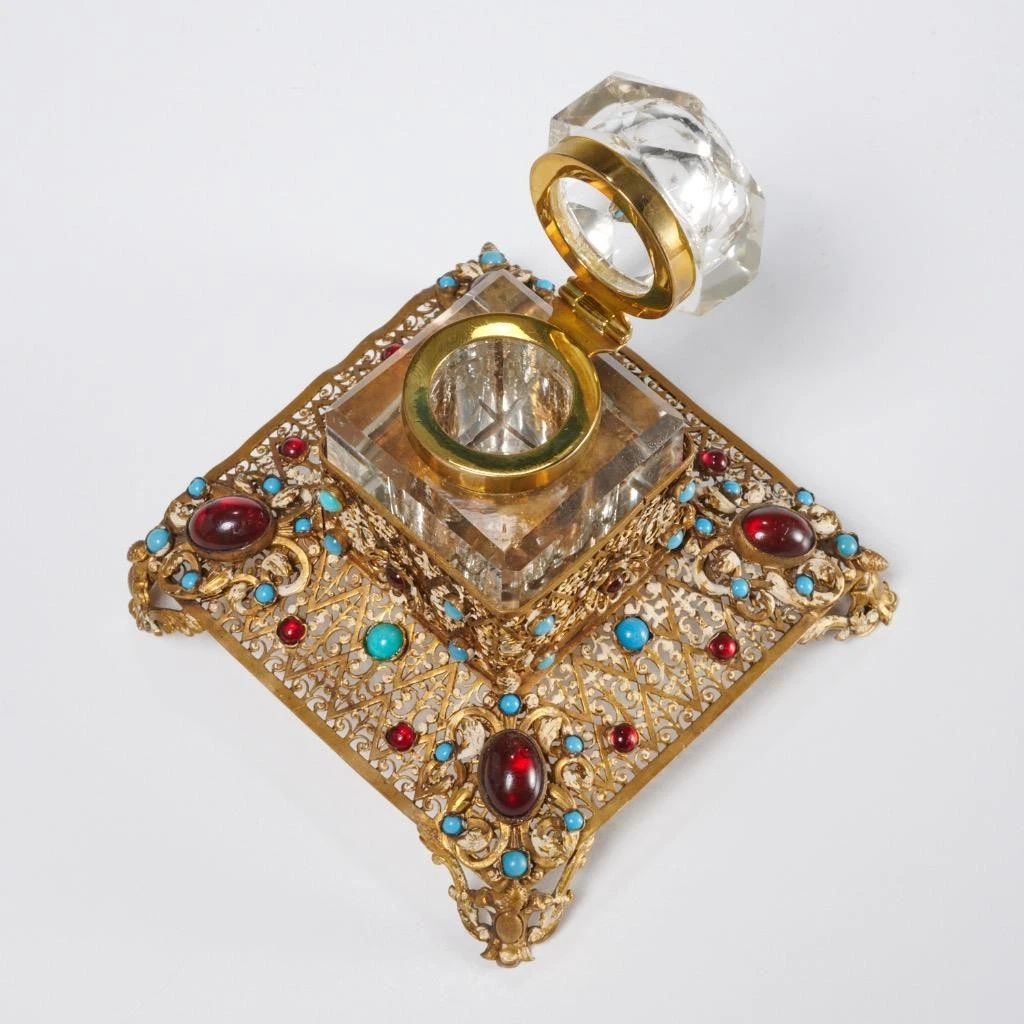
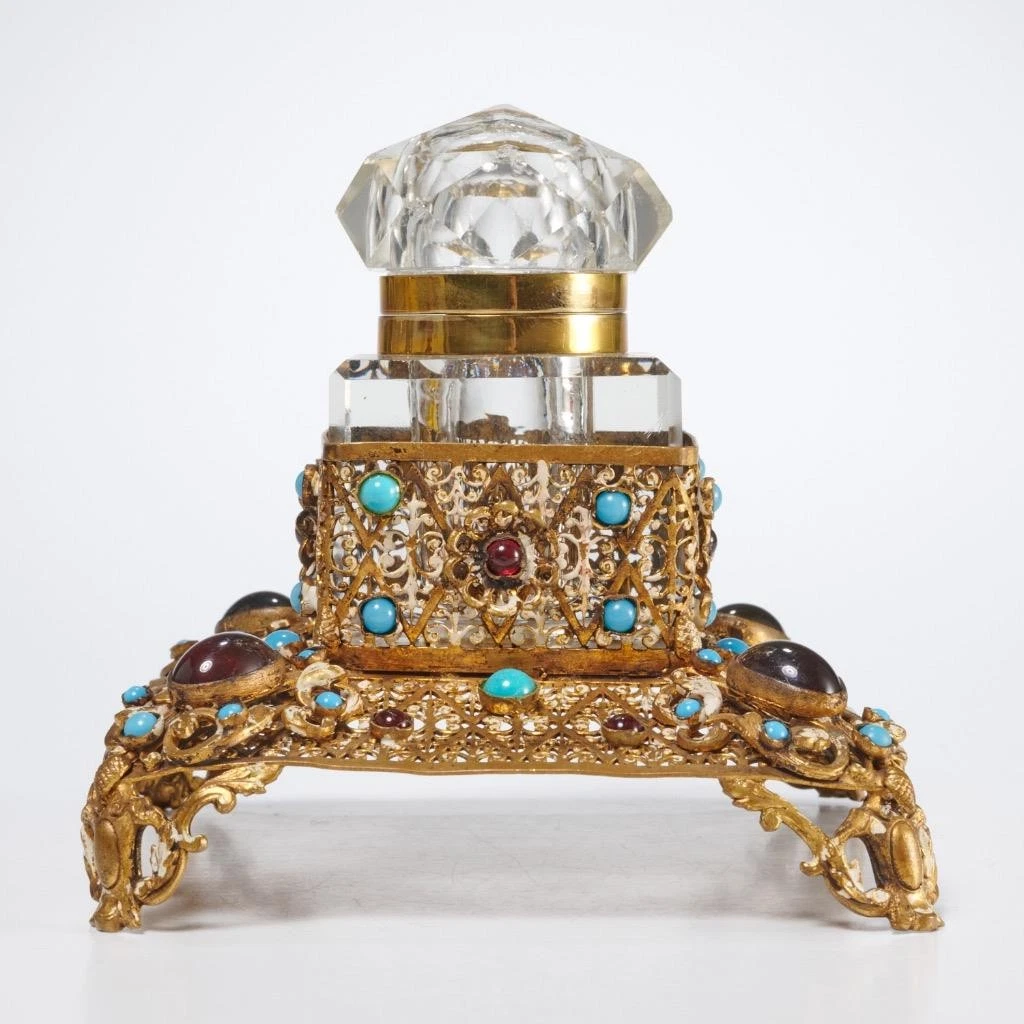
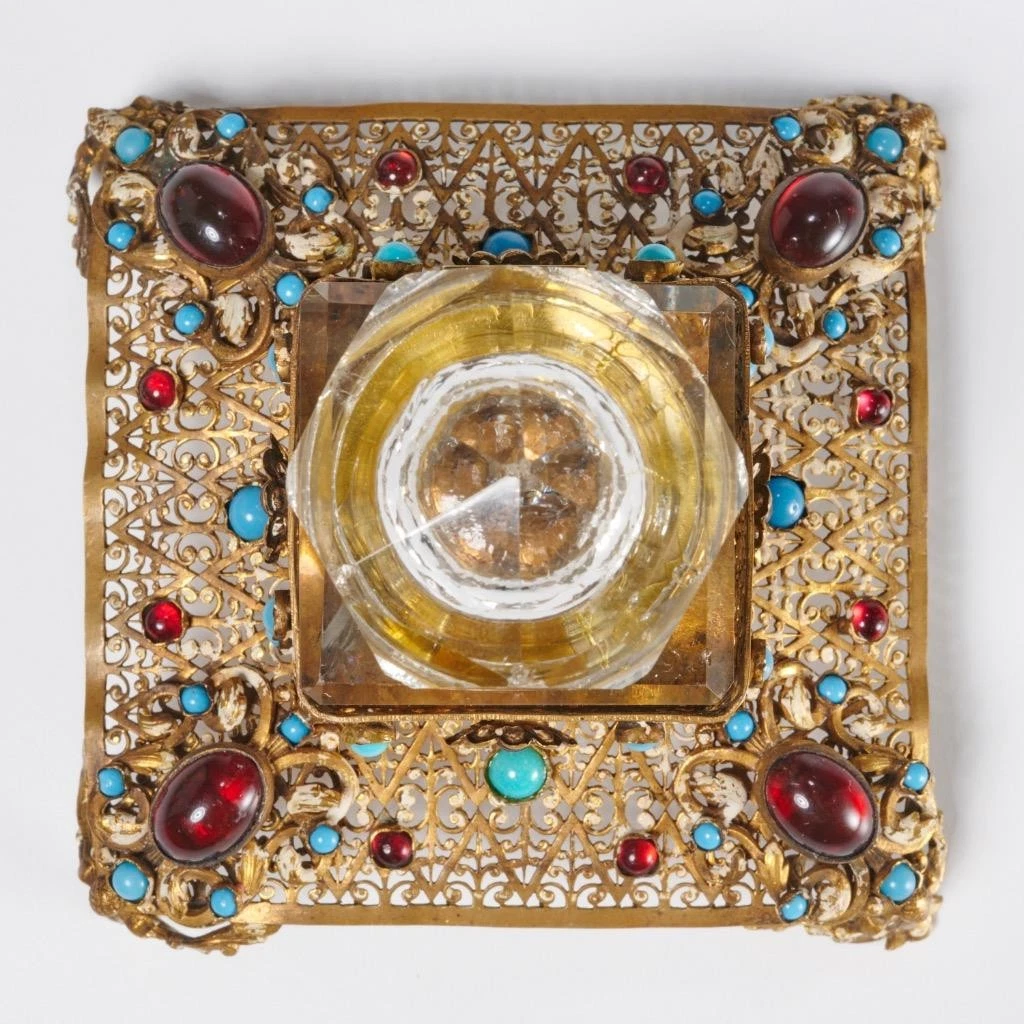
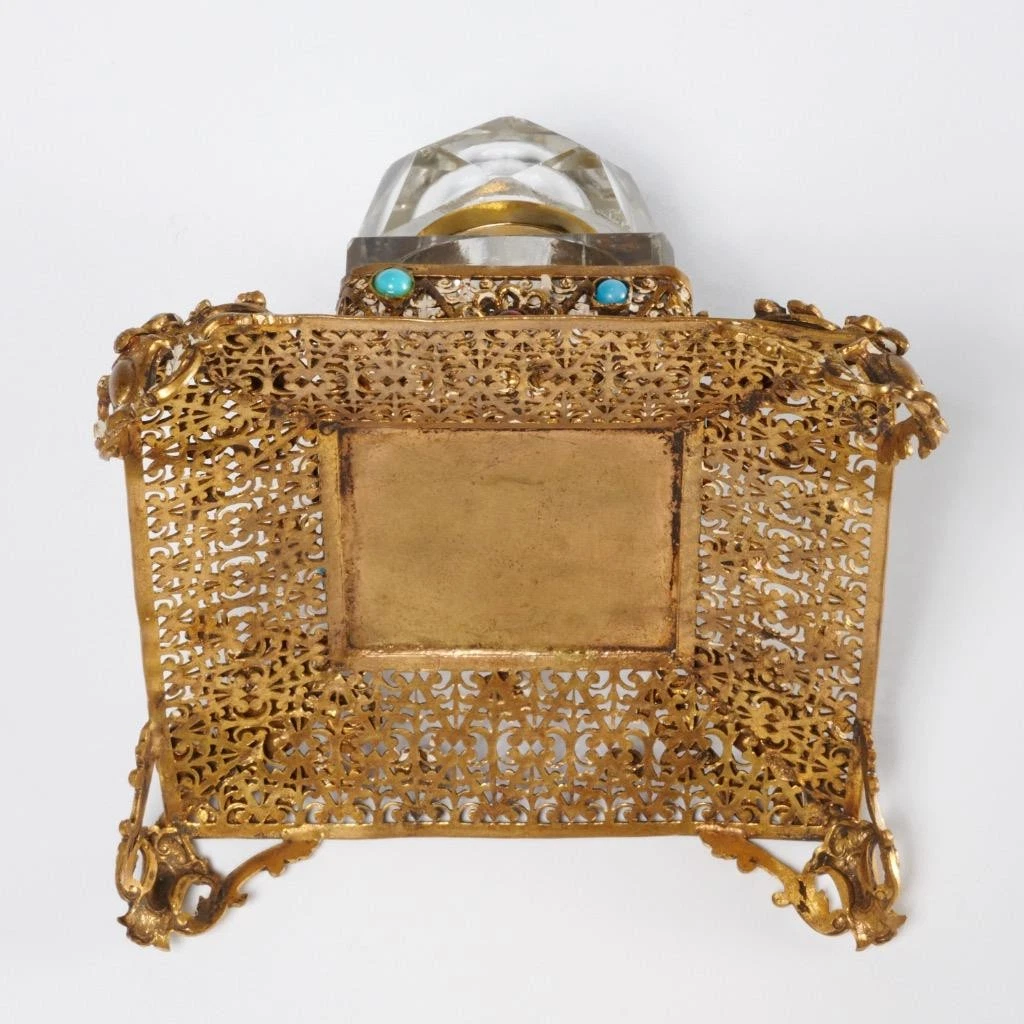
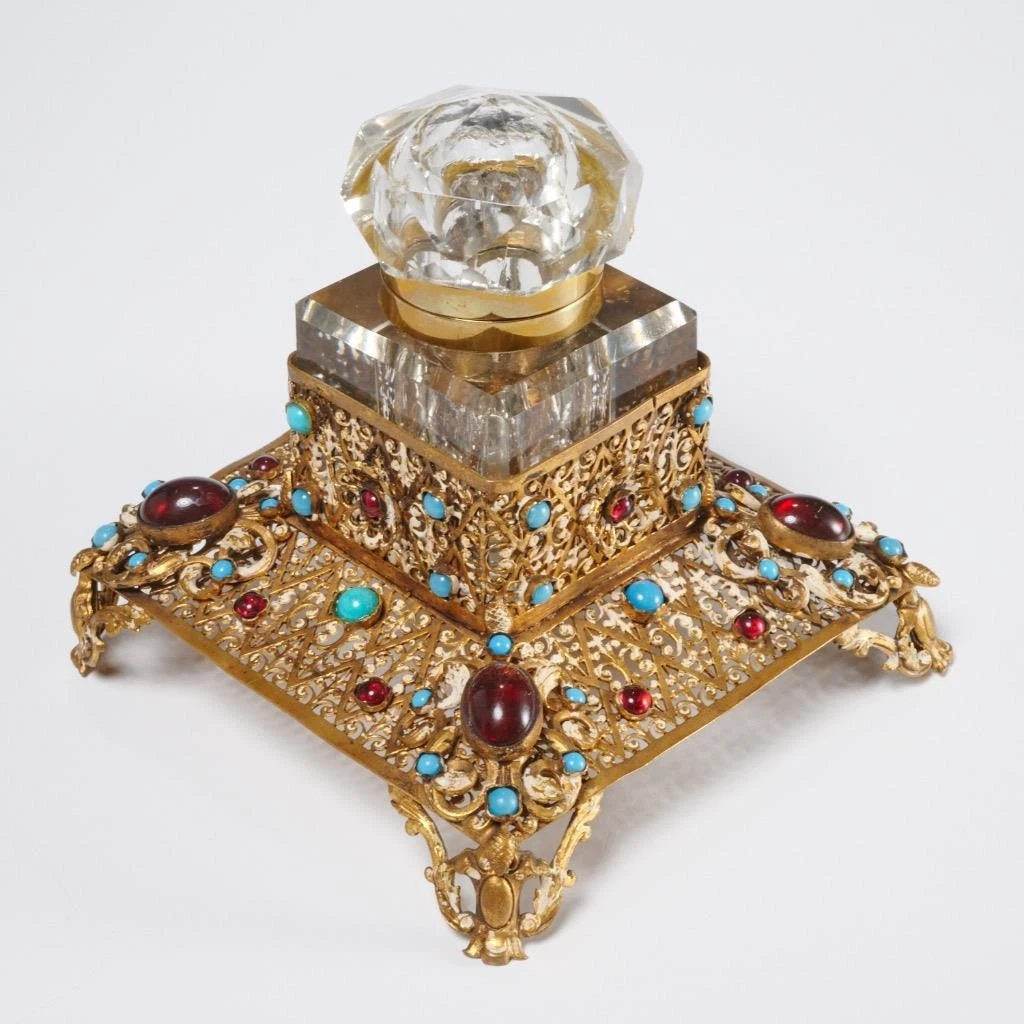
Faceted Crystal Inkwell in Jeweled Brass Stand
| Categories | Glass - Non-figural |
| Material | Brass |
| Markings | Unmarked |
| Manufacturer | Undetermined |
| Origin | Undetermined |
| Date or Era | circa 1900 |
| Measuring | 3 ¾” x 3 ¾” x 4” high |
Detailed Description
- Overall Form: An inkstand consisting of a highly decorative metal stand encasing a precision-cut crystal inkwell. This style is often referred to as Bohemian, Russian, or Continental in origin, reflecting the high standards of European crystal and metal factories.
- The Inkwell (Crystal):
- Material: Heavy, high-quality lead crystal.
- Cut: The crystal is faceted with deep geometric cuts (sharp beveled edges).
- Lid: The crystal lid is also faceted and fitted with a brass coupling.
- The Stand (Jeweled Brass):
- Material: Fine cast brass finished with a bright, polished gold color.
- Decoration (Jeweling): The stand is highly ornate, featuring intricate Rococo Revival or Neo-Baroque scrollwork, punctuated extensively with “jewels”—these are colored glass stones, pastes, or rhinestones, set into the metalwork. The colors are ruby red, emerald green, sapphire blue, turquoise, or faux pearls.
- Base: The stand usually sits on small feet and has a cut-out area that allows the upper facets of the crystal inkwell to be visible.
The entire aesthetic is one of opulence and maximalism, characteristic of luxury items produced in workshops specializing in high-end desk and vanity accessories.
Age and Origin Assessment
The style of intense faceting, the use of bright, jeweled metal mounts, and the revival of historic Rococo patterns points to specific centers of production in Europe.
| Feature | Implication |
| Heavy Faceting | Indicates a center for high-quality crystal glass production, such as Bohemia (Czech Republic/Austria), or high-end Russian workshops. |
| Jeweled Metalwork | The use of numerous glass “jewels” is a hallmark of decorative accessories made for the European and American markets, popular from the Late Victorian era through the Art Nouveau period. |
| Rococo Revival Scrolls | Places the design firmly in the 1880s to 1910s, a period when European manufacturers revived elaborate 18th-century court styles. |
- Likely Origin: The most probable origins are:
- Bohemia (Austro-Hungarian Empire): Known worldwide for its superb cut crystal and glassware, often pairing it with elaborate metal mounts.
- France (Parisian Workshops): Known for producing articles de Paris in this high-end, jeweled style.
- Russia: Workshops produced similar opulent items, especially those influenced by French and Bohemian styles.
- Estimated Age: circa 1885 – 1910
Sold for $73 in October 2025
Content disclaimer. The information posted is the owner’s best knowledge and may not have been vetted by the SOIC. We welcome comments, corrections, and additions, working to make our website information comprehensive and accurate.
Join the Society of Inkwell Collectors (SOIC) – it’s free!
Founded in 1981 as a non-profit organization,
we are documenting inkwells (and accessories).
We’re here to help and inform!