







English Boulle Inlay Inkstand
| Categories | Wood Inkstands |
| Type | Boulle |
| Material | Brass, Tortoiseshell, Wood |
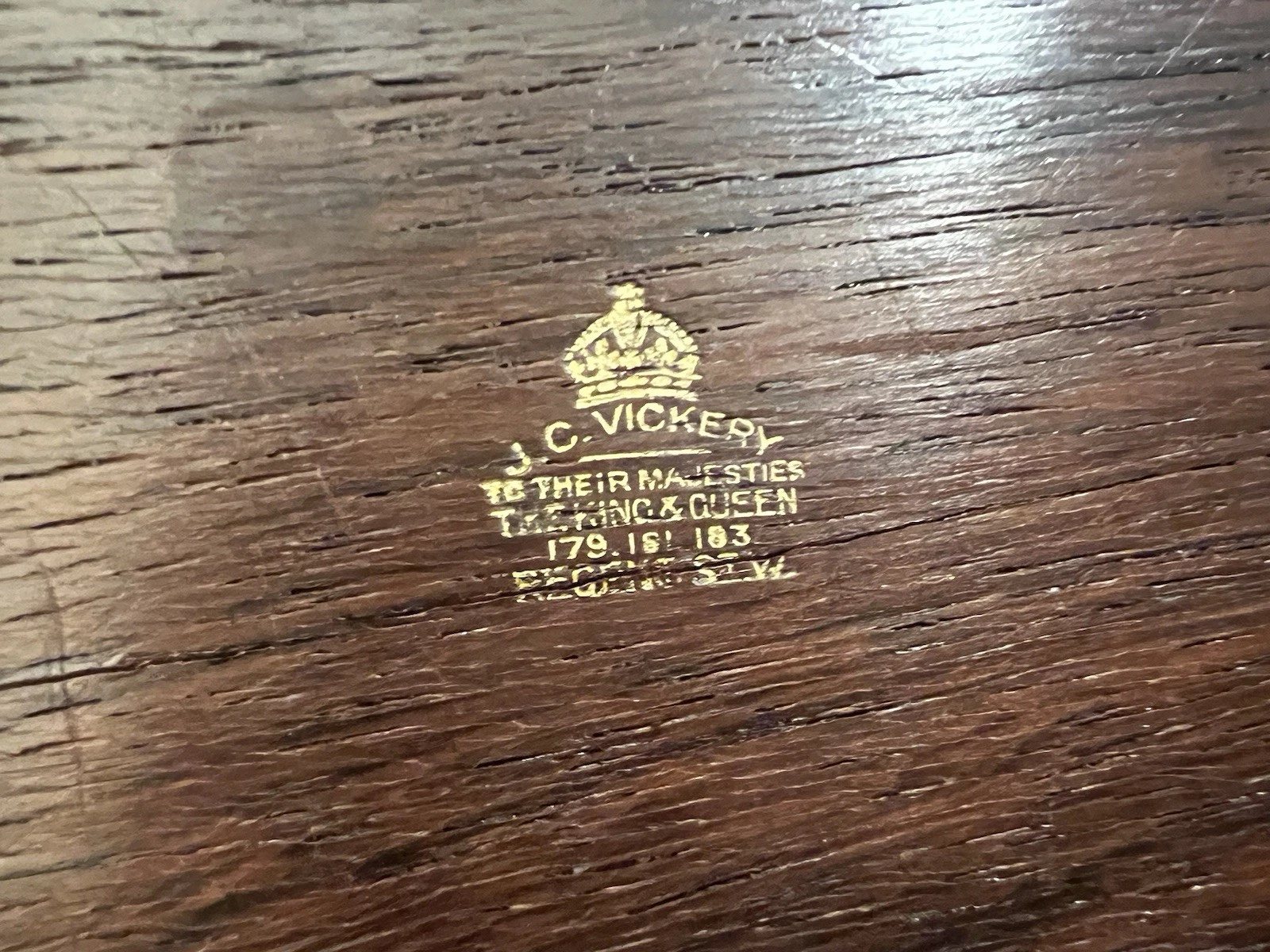
| Markings | See Narrative |
| Manufacturer | Undetermined |
| Origin | England |
| Date or Era | circa 1900 |
| Measuring | 6 ⅞” x 6 ⅞” x 4 ½” high |
Description
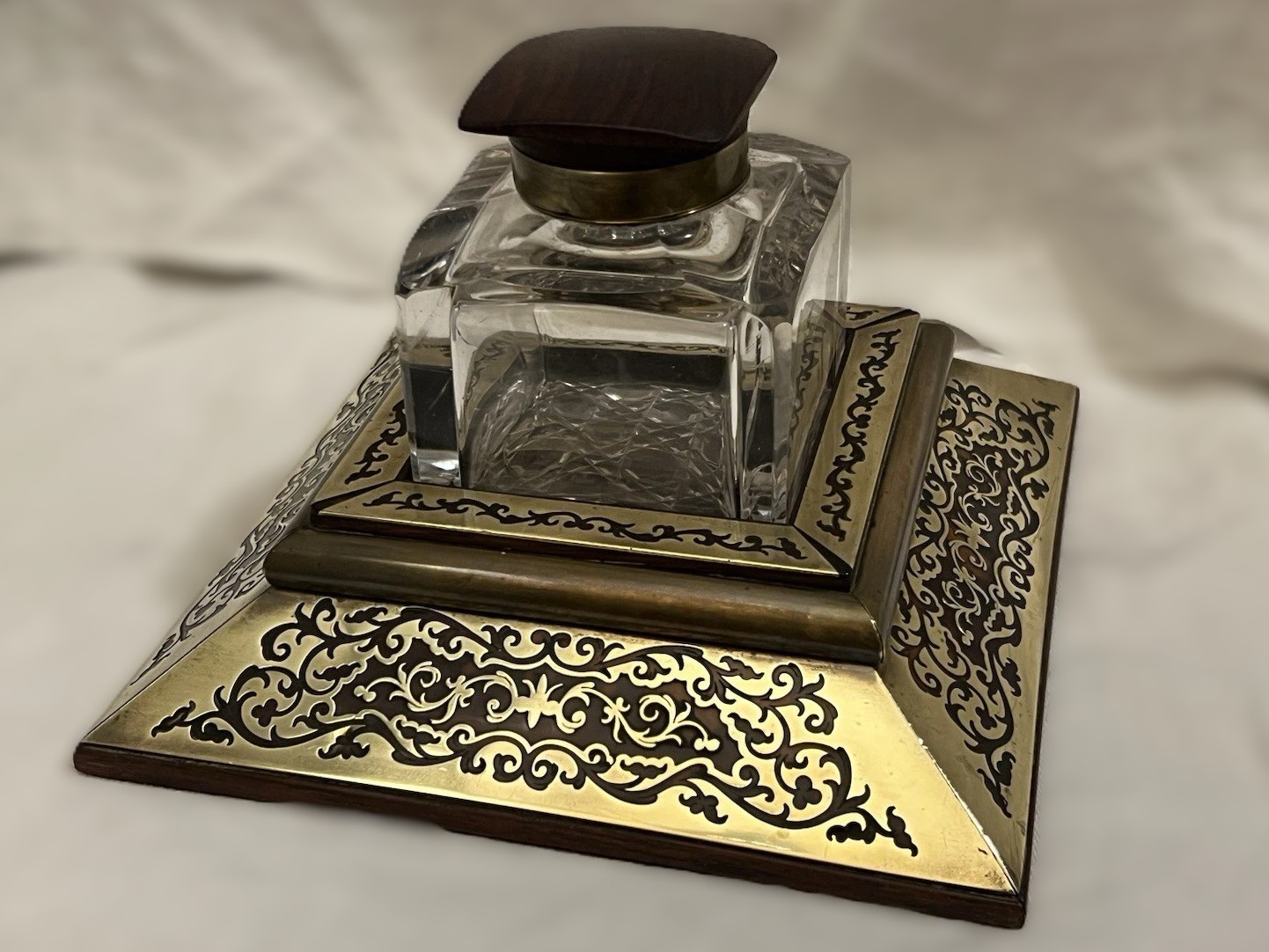
The Boulle Stand
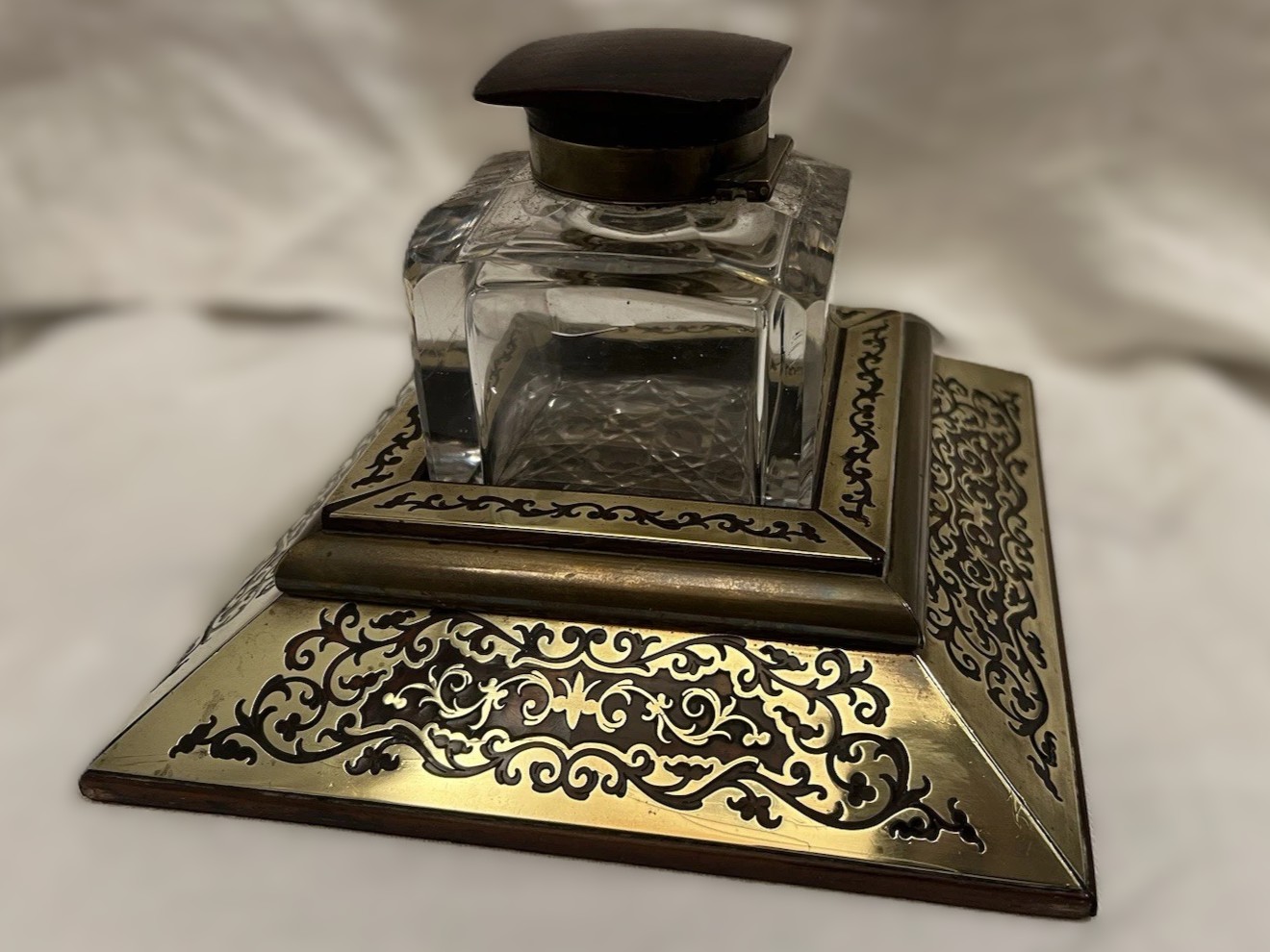
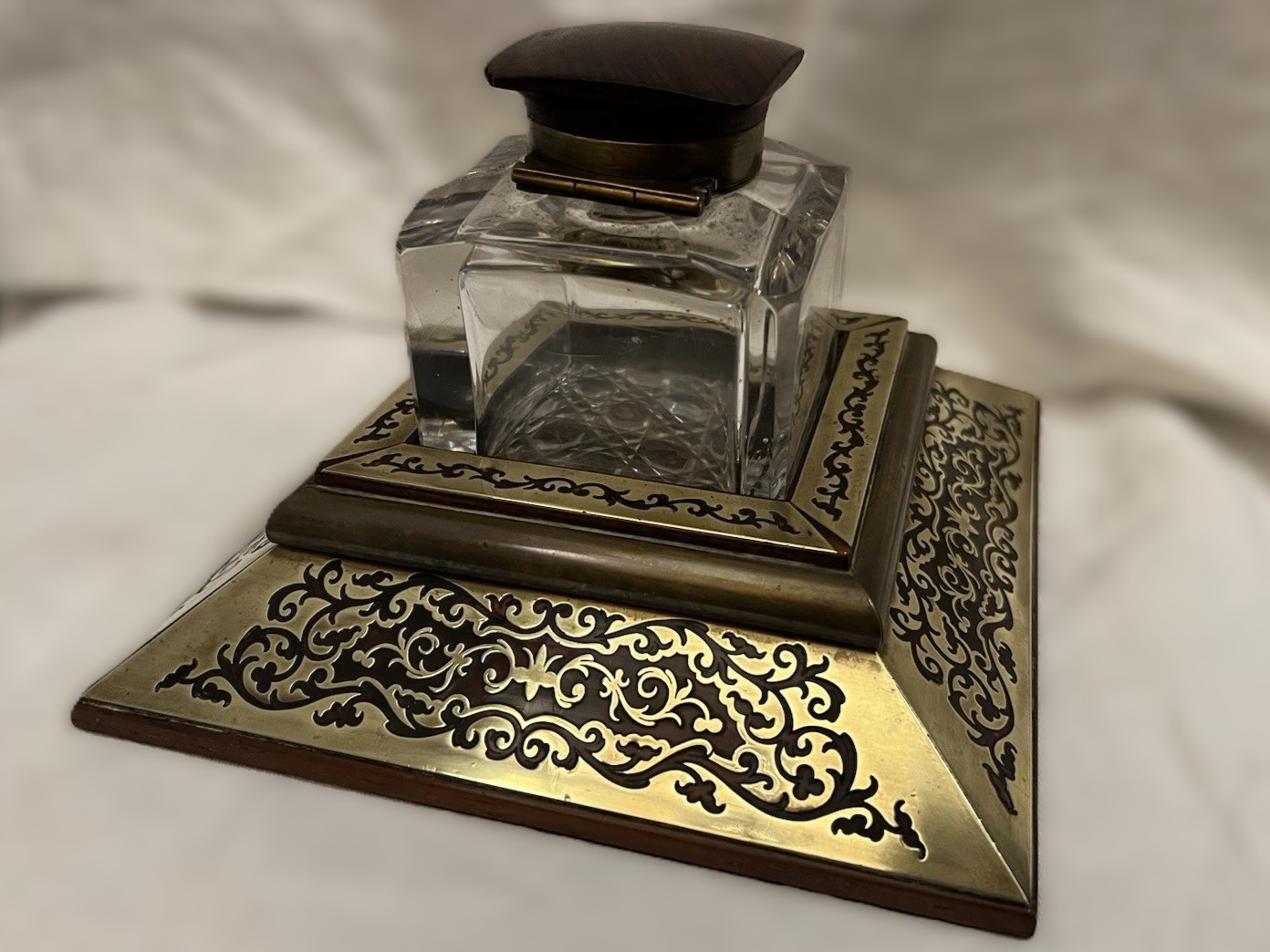
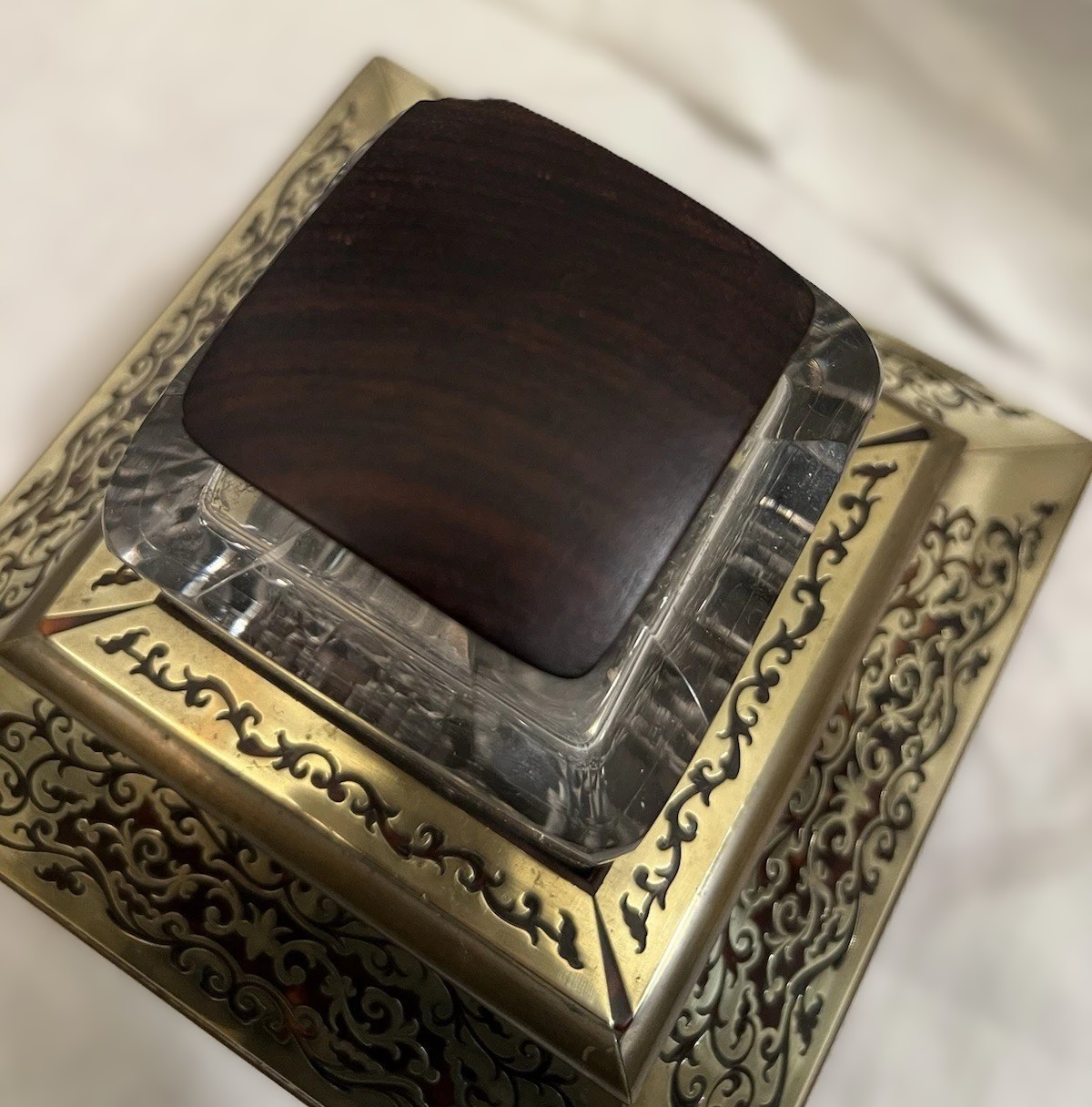
- Form & Structure: The stand features a flared, pyramidal design with sloping sides that draw the eye up toward the central inkwell receptacle. The central cavity is a square recess lined with rich wood, perfectly sized to hold the crystal inkwell.
- Inlay Work: The primary decorative feature is a continuous band of scrolling foliate and arabesque Boulle marquetry surrounding all four sides of the base. A secondary, tighter band of scrolling inlay borders the upper rim directly framing the inkwell.
The Cut Crystal Inkwell
- The Body: The heavy, thick-walled crystal well is cut in a classic cubical form with beveled corners.
- The Base: The underside of the crystal bottle features an intricately geometric, brilliant cane pattern cut directly into the bottom to add texture.
- The Collar & Lid: The well is fitted with a fitted brass collar and a matching hinged mechanism. The lid is topped with a low, domed square of finished rosewood that mirrors the shape of the inkstand’s footprint.
Retailer Markings
- The underside of the smooth rosewood base contains a crisp, gold-stamped royal warrant mark.
- The stamp reads:
J.C. VICKERY To Their Majesties the King & Queen 179, 181, 183 Regent St. W.
Understanding “Boulle” Marquetry
The term “Boulle” refers to a distinctive style of luxury marquetry involving the inlay of patterned materials—most famously brass and tortoiseshell—into a wood veneer or directly onto furniture and small decorative objects.
- The Origin: The technique is named after André-Charles Boulle (1642–1732), a master cabinetmaker to King Louis XIV of France. While he did not invent the process, his exquisite craftsmanship and elaborate designs for the Palace of Versailles popularized it to the point where the style permanently bore his name.
- The Craftsmanship: To create this effect, a craftsman layers a sheet of brass and a sheet of tortoiseshell together and cuts the desired pattern through both layers simultaneously using a fine saw. This yields two perfectly matching sets of pieces:
- Première Partie (First Part): A background of tortoiseshell inlaid with brass patterns (as showcased on the sloping panels of this stand).
- Contre-Partie (Counterpart): A background of brass inlaid with tortoiseshell patterns (the visual inverse).
Sold for $359 in May 2026
Content disclaimer. The information posted is the owner’s best knowledge and may not have been vetted by the SOIC. We welcome comments, corrections, and additions, working to make our website information comprehensive and accurate.
Join the Society of Inkwell Collectors (SOIC) – it’s free!
Founded in 1981 as a non-profit organization,
we are documenting inkwells (and accessories).
We’re here to help and inform!