

Inkipedia
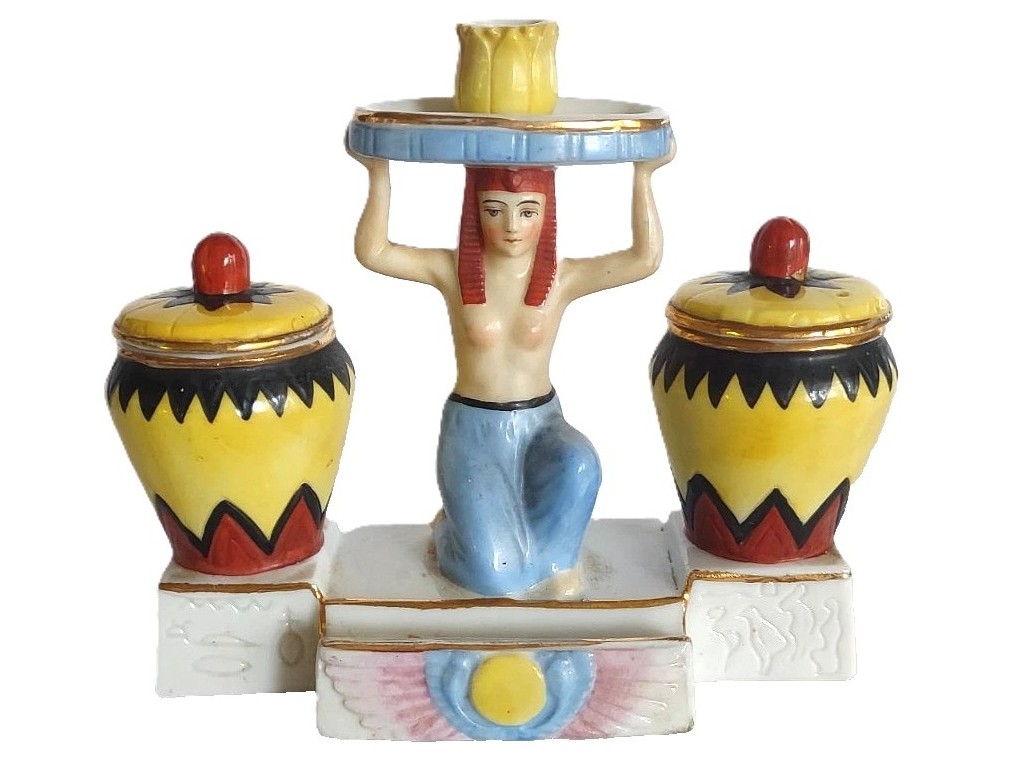
Egyptian Revival Porcelain Inkstand
| Categories | Art Deco, Middle East / Africa |
| Type | Egyptian Revival |
| Material | Porcelain |
| Markings | See Narrative |
| Manufacturer | Undetermined |
| Origin | Undetermined |
| Date or Era | circa 1930 |
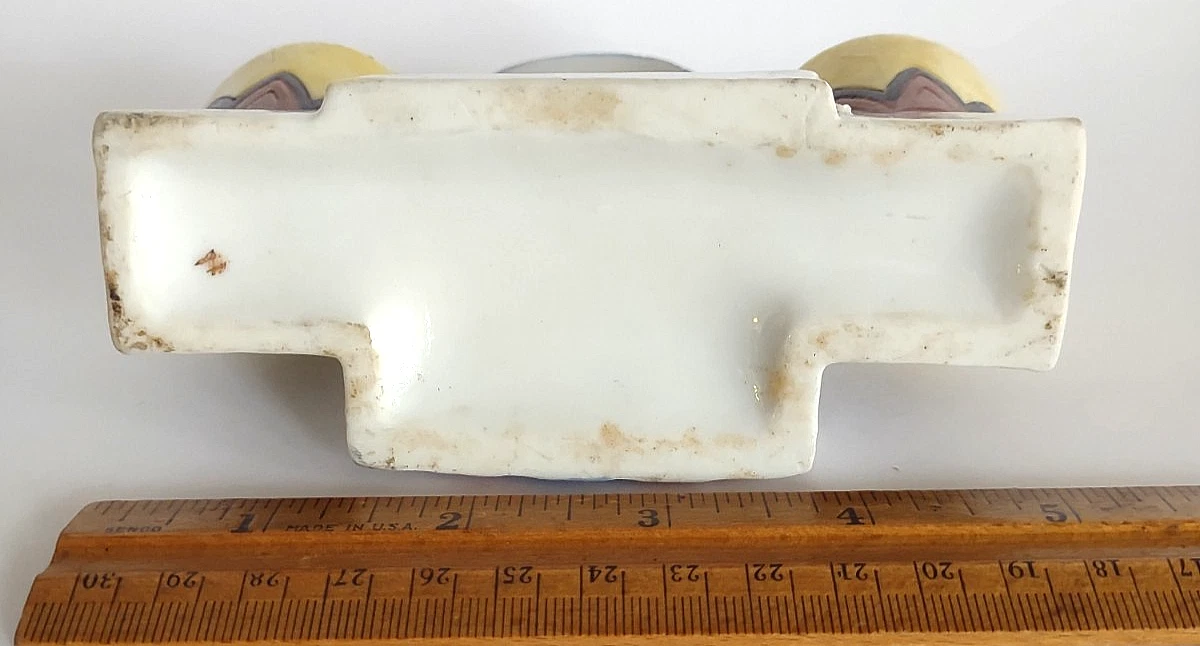
| Measuring | 5” x 2” x 4 ½” high |
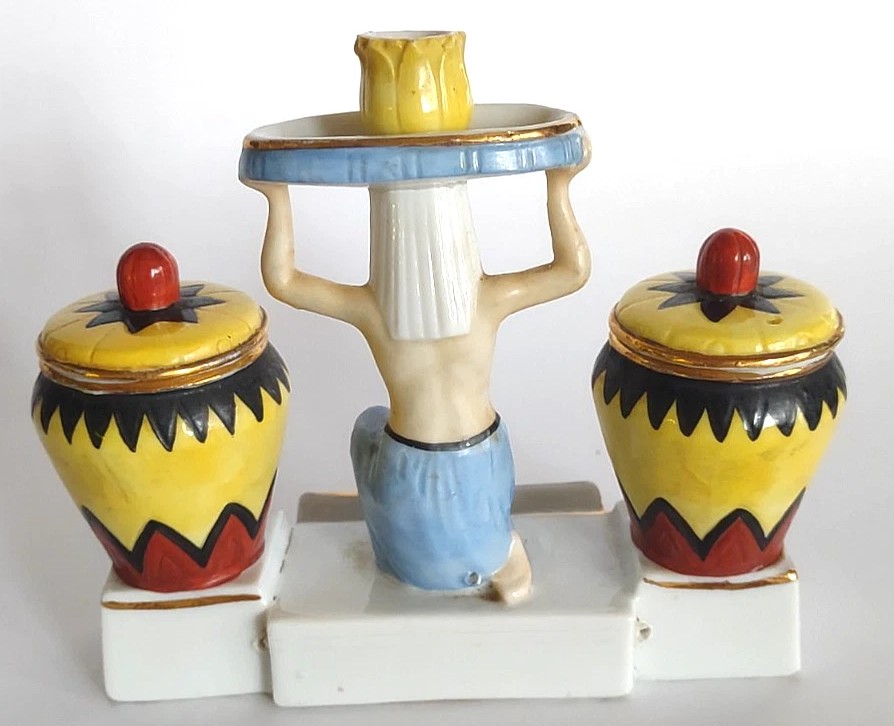
This Art Deco Egyptian Revival porcelain double inkstand likely dates to the 1920s to early 1930s during the height of the “Egyptomania” craze that swept Europe and America following Howard Carter’s discovery of King Tutankhamun’s tomb in November 1922.
Key Features & Design Elements
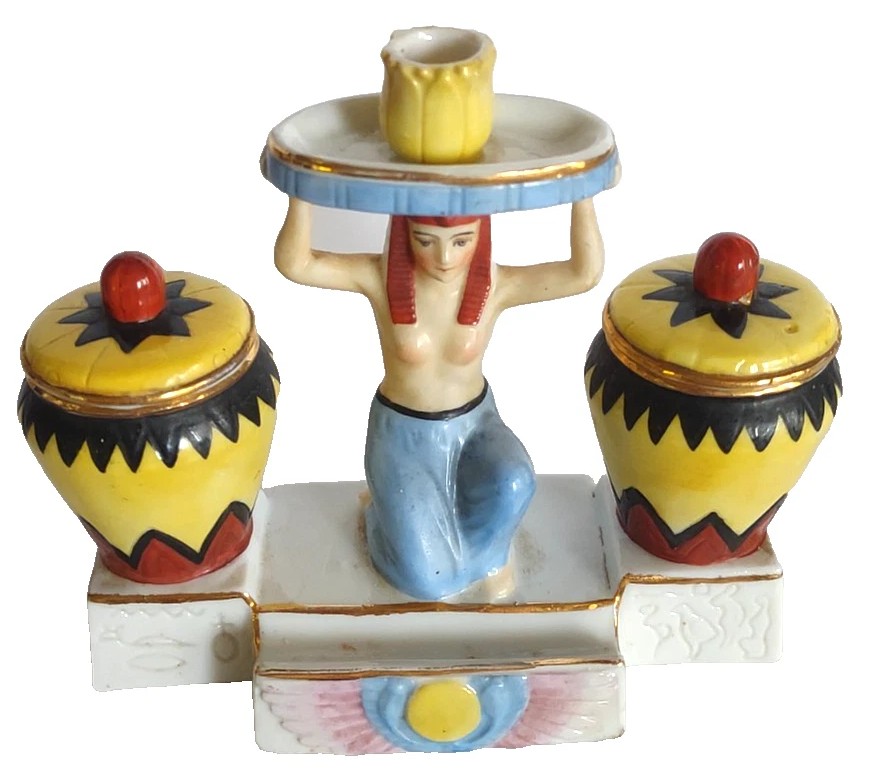
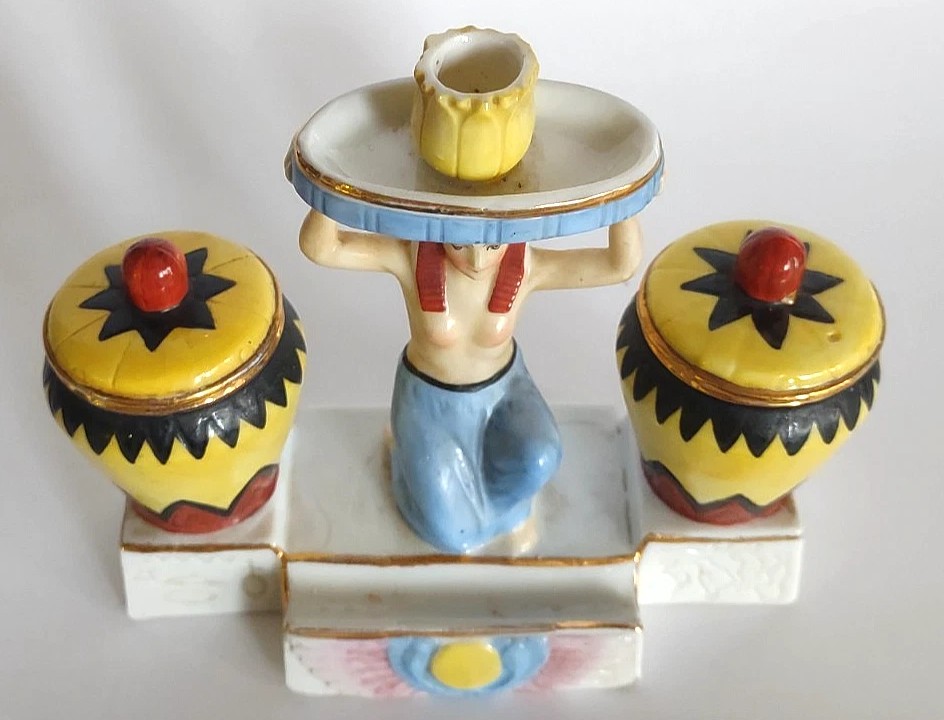
- Central Figure & Lotus Candle Socket: The central sculpture depicts a kneeling Egyptian maiden/dancer in a stylized headdress (Nemes style) and blue skirt, bare-chested in true Art Deco exoticism. She balances a flat platter overhead supporting a molded lotus flower candle socket, meant to hold a small taper candle (historically used for melting sealing wax as well as lighting a desktop).
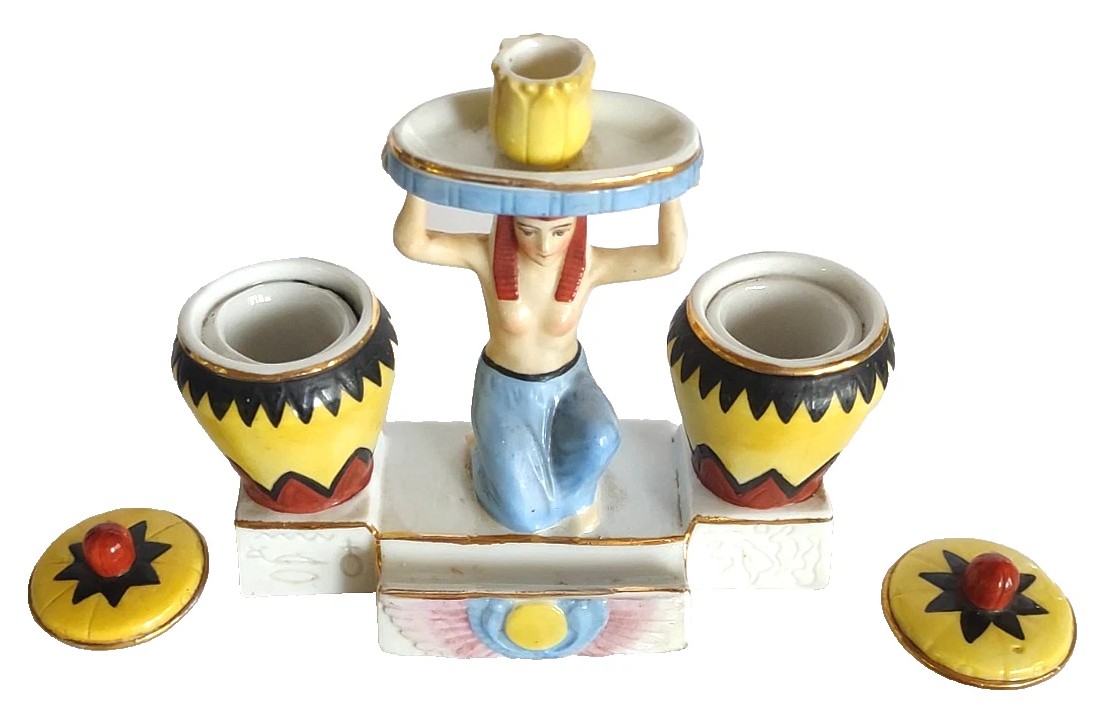
- Twin Inkwells: Flanking the maiden are two integrated, bulbous urns painted with bold geometric Art Deco/Egyptian chevron-and-sawtooth borders in bright yellow, black, and rust red, accented with gold luster trim. Each features an unattached lift-off porcelain lid topped with a rounded red finial. Inside are removeable ceramic inserts.
- Pen Trough & Hieroglyphic Reliefs: The front lower tier functions as a horizontal pen tray. The face of the tray is decorated in raised relief with a colorful winged solar disk (a prominent ancient Egyptian symbol of protection). Flanking the pen rest, the front facets of the corner plinths feature molded pseudo-hieroglyphic motifs beneath the glaze.
Origin, Maker & Marks
- Probable Origin: Continental Europe (likely Germany, Bohemia/Czechoslovakia, or Austria) or Japan (Noritake/Nippon export era).
- The bright enameling, high-gloss luster, and distinct Art Deco color palette are very characteristic of 1920s German porcelain factories (such as Schaubach-Kunst, Hertwig & Co., or Sitzendorf) as well as Bohemian novelty porcelain producers from the interwar period.
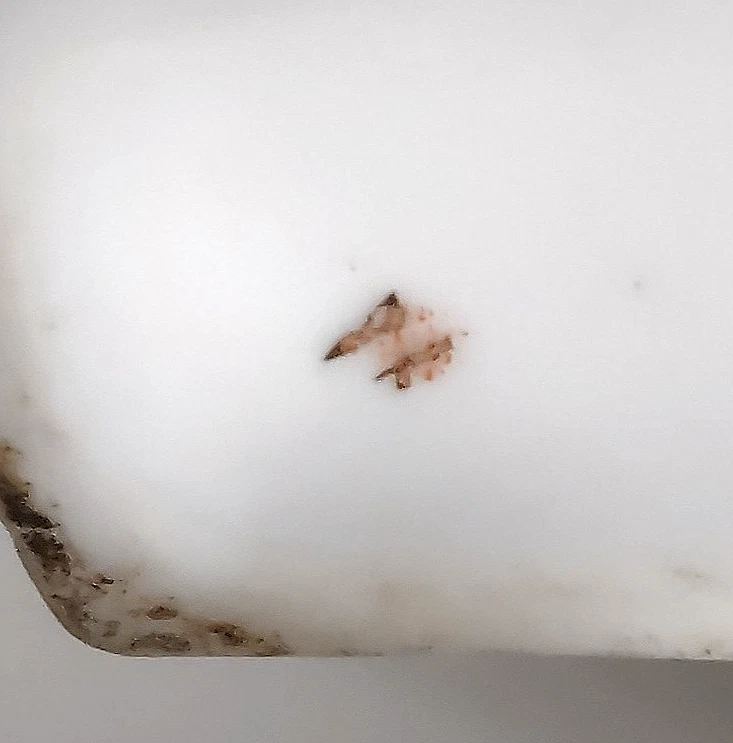
- The Underside Mark: The faint reddish/brown stamped mark appears to be a fragmented manufacturer’s backstamp (often an initial letter, crown, shield, or intertwined monogram) applied over the glaze that has worn away or smudged during firing/handling. Because the red overglaze stamp is partially rubbed off, attributing a definitive single factory is difficult without a matching catalog mold number, but the material is fine hard-paste porcelain with hand-applied and stenciled enamels.
- Date Range: Circa 1923–1932.
Sold for $240 in July 2026
Content disclaimer. The information posted is the owner’s best knowledge and may not have been vetted by the SOIC. We welcome comments, corrections, and additions, working to make our website information comprehensive and accurate.
Join the Society of Inkwell Collectors (SOIC) – it’s free!
Founded in 1981 as a non-profit organization,
we are documenting inkwells (and accessories).
We’re here to help and inform!