

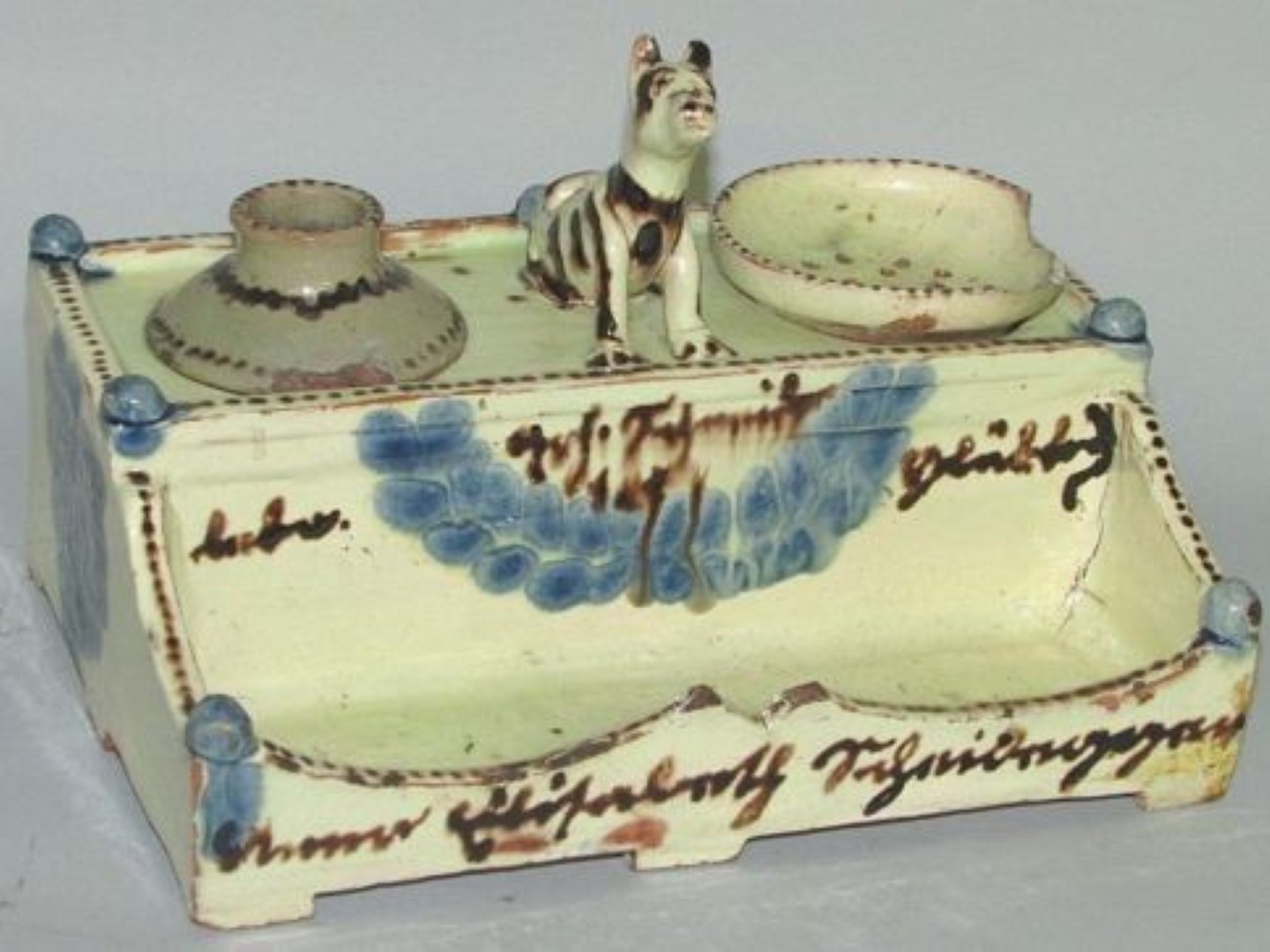
Early German Folk Pottery Presentation Inkstand
| Categories | Early - Primitive, Presentation Piece |
| Material | Earthenware |
| Markings | See Narrative |
| Manufacturer | Undetermined |
| Origin | Undetermined |
| Date or Era | circa 1800 |
| Measuring | 8 ⅛” x 5” x 5” high |
Early German Folk Pottery Presentation Inkstand
Circa 1780–1820
Description
This personal piece of European lead-glazed folk earthenware—most likely originating from the central or southern regions of Germany, or produced by an early immigrant potter in the Southeastern Pennsylvania German tradition—dates to the late 18th or very early 19th century.
The inkstand is constructed with a dual-tier design resting on short slab feet. It features a warm, overall cream-colored slip glaze accented with vibrant cobalt blue washes and rich manganese brown detailing. The upper tier serves as the functional writing station, containing an inset turned inkwell on the left and a matching sander/pounce dish on the right. Guarding the two wells is a charming, naively hand-modeled figure of a seated brindle dog. The lower tier consists of a deep, open trough designed specifically for resting quill pens horizontally.
Inscription & Decipherment
The inkstand is ornately decorated with personalized family details and well-wishes written in traditional Kurrent (old German cursive script). The fluid, sharp-angled manganese writing is divided into distinct sections:
- The Front Lip (Lower Tier Name): Universally identifies the original owner or recipient as “Anna Elisabeth Schneiderin”. The suffix on the surname is a classic regional Germanic naming convention used to denote a female family member.
- The Middle Face (Upper Tier Dedication): Flanking a central cobalt blue garland motif, the script reads “liebe… gesun[d]heit… glück[liche]” (“dear/beloved… health/good health… happiness”).
Historical Context
This presentation inkstand is a classic example of historic Sgraffito or slip-painted folk pottery. Pieces of this caliber were custom-ordered from local village potters to commemorate significant life milestones such as weddings, confirmations, or milestone birthdays. The inclusion of the sander (used for blotting wet ink with pounce sand before the invention of blotting paper) and the meticulously preserved Kurrent script make this a rare and vibrant survival of early utilitarian folk art.
Condition Note
The piece exhibits a natural, stable web of fine age-crazing throughout the glaze, with minor historic chipping to the rim of the sander dish and the edges of the pen trough, all consistent with over two centuries of appreciation and use.
Sold for $700 in October 2014
Content disclaimer. The information posted is the owner’s best knowledge and may not have been vetted by the SOIC. We welcome comments, corrections, and additions, working to make our website information comprehensive and accurate.
Join the Society of Inkwell Collectors (SOIC) – it’s free!
Founded in 1981 as a non-profit organization,
we are documenting inkwells (and accessories).
We’re here to help and inform!