

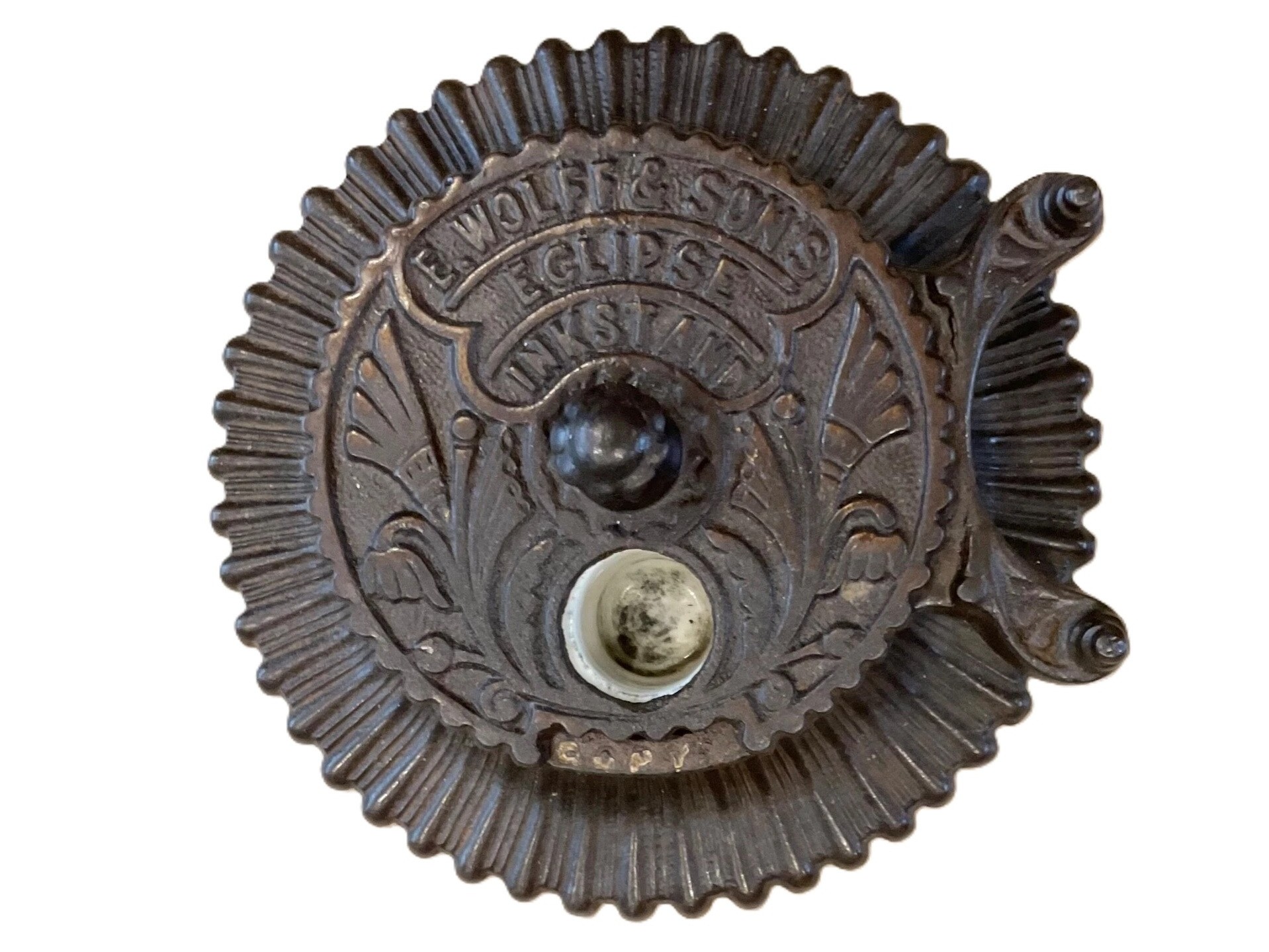
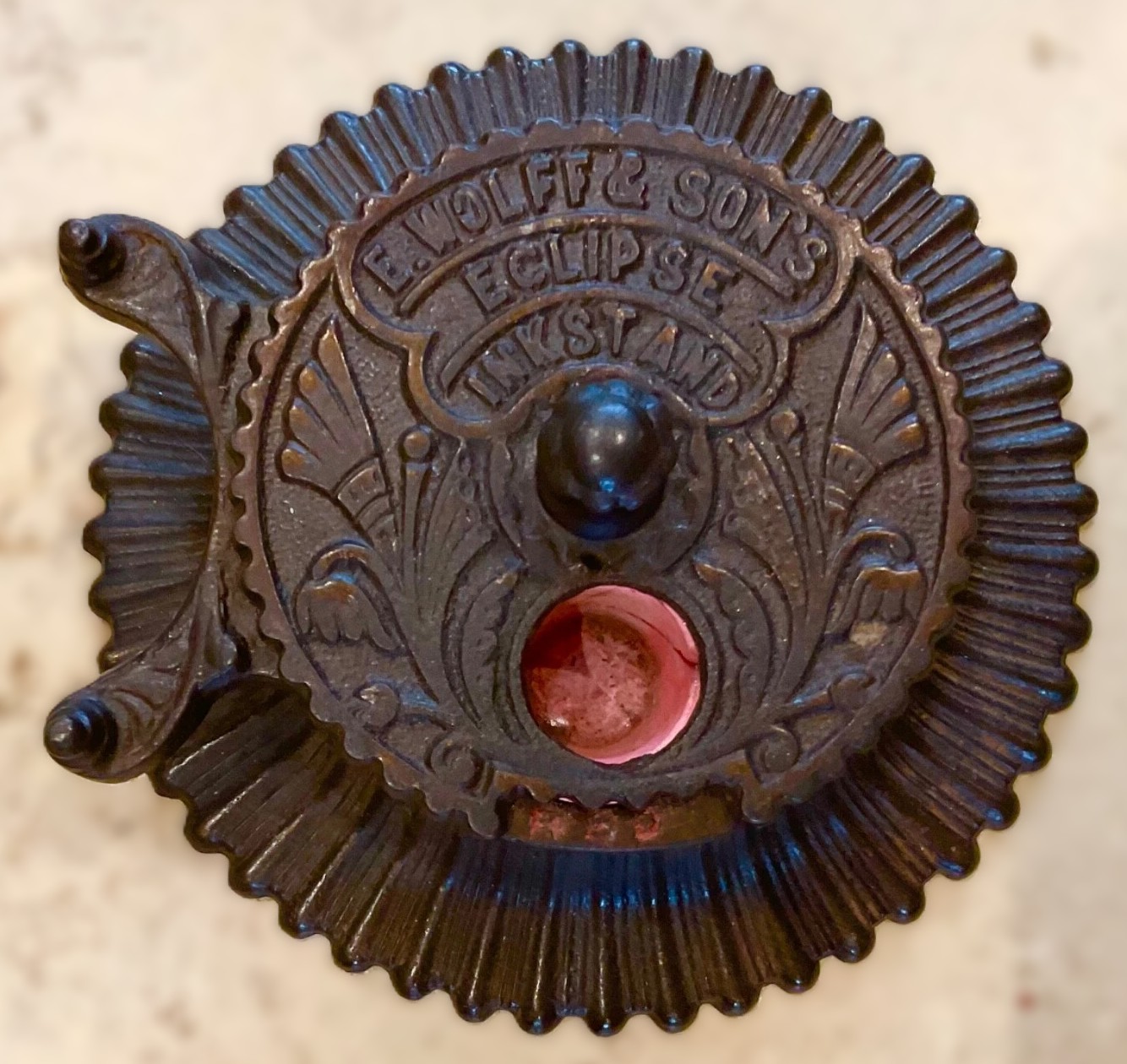
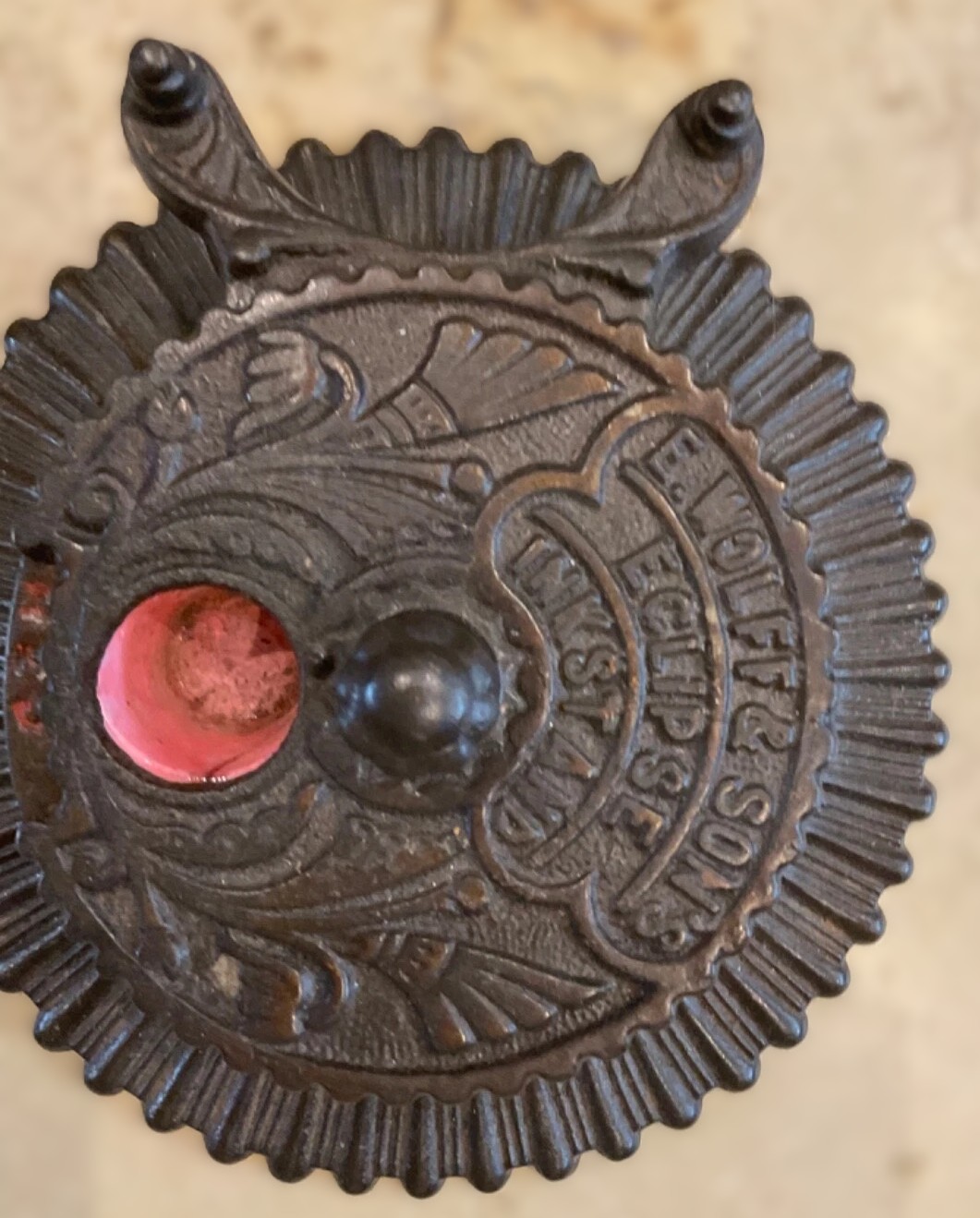


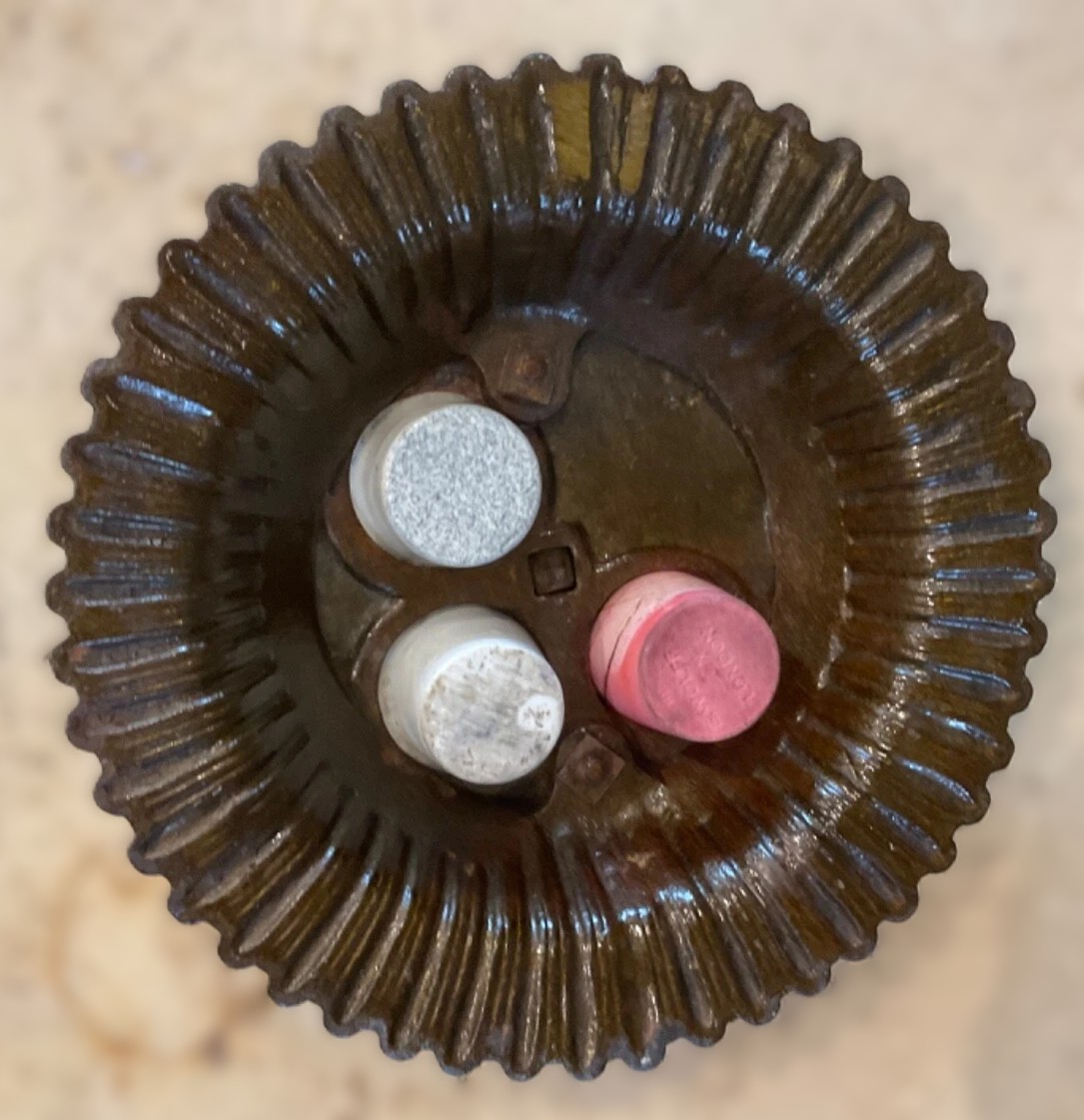
E. Wolff & Sons “Eclipse” Inkstand
| Categories | Cast Iron, Mechanical - Levered or Rotating Lids |
| Material | Cast iron |
| Markings | See Narrative |
| Manufacturer | E. Wolff & Sons |
| Origin | England |
| Date or Era | circa 1884 |
- Description: E. Wolff & Sons “Eclipse” Inkstand
This is a Victorian mechanical inkstand made of cast iron with original ceramic (porcelain) inserts. It was designed as a “systems” inkstand for a busy clerk or business desk.
- The “Eclipse” Mechanism: The name “Eclipse” refers to the revolving lid’s function. The heavy cast iron cover features a single aperture (hole). By rotating the lid, the user could “eclipse” (cover) the inkwells they weren’t using and expose only the one needed. This served two purposes:
- Preservation: It minimized evaporation and kept dust out of the inks.
- Error Prevention: It physically prevented a clerk from accidentally dipping a pen meant for red ink into the black ink—a common and messy mistake in the era of dip pens.
- The Three Wells: The ceramic liners are color-coded and labeled for the standard business necessities of the 1880s: RED (for accounting/ corrections), BLACK (for standard correspondence), and COPY (see below).
- Design: The casting features stylized Victorian floral/foliate relief work on the lid and a fluted “pie crust” edge on the base.
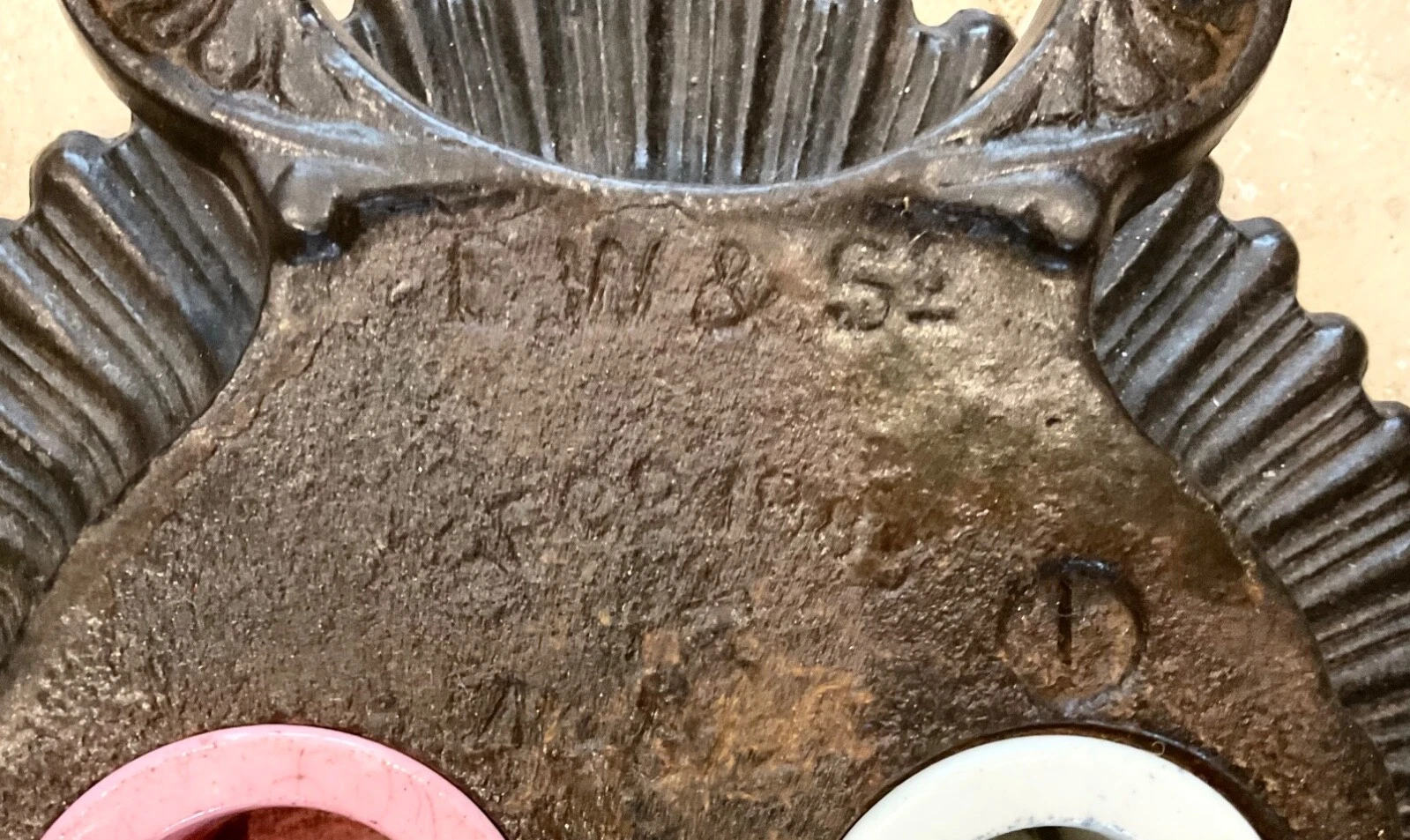
- The Registration: “Reg. 1883 No. 6722”
This is an English registration.
- The Number (6722): In 1884, the British patent office overhauled their system, moving from the “Diamond Mark” to a simple sequential numbering system starting at 1.
- Rd. No. 6722 falls into the very first batch of registrations under this new system. It dates specifically to early 1884 (Registrations 1 through 19,753 were all issued in 1884).
- The “1883” Date: The inscription “1883” on the casting almost certainly refers to the “Patents, Designs, and Trade Marks Act of 1883.” This was the piece of legislation that created the new numbering system. Manufacturers often stamped “Reg under Act 1883” or similar during the transition period to show they were protected under the new law.
Summary of Registration:
- Date: 1884
- Class: Class I (Metal goods)
- Registrant: E. Wolff & Sons
- What is “COPY” Ink?
“Copy” (or Copying) ink was a specialized, thick, and sticky ink essential to the 19th-century office before the invention of the photocopier or carbon paper.
- Ingredients: It was typically a high-quality iron-gall ink with added sugar, gum arabic, or glycerin. This kept the ink from drying completely hard; it remained slightly soluble and “tacky” on the paper for a long time.
- How it worked:
- The clerk would write a letter using Copy ink.
- They would place the letter into a book of thin, translucent tissue paper.
- The page would be dampened with water and the book squeezed tightly in a heavy iron “Copying Press” (screw press).
- The pressure would transfer some of the wet ink onto the back of the tissue paper. Because the paper was thin, the text could be read from the front side.
- Why separate wells? You could not use Copy ink for regular mail because it was sticky and could smudge easily if it got damp (e.g., in the rain). Therefore, a desk needed separate wells for “Black” (permanent/non-copying) and “Copy” (for internal records).
- About E. Wolff & Sons
- Wolff & Sons was a prominent London stationer and pencil manufacturer, best known for their “Royal Sovereign” pencils.
- History: The firm was founded around 1796 by Elias Wolff. They operated the Falcon Pencil Works in Battersea, London.
- Innovations: They were major innovators in the pencil industry, inventing “Creta Laevis” (a type of colored crayon/pencil) and methods for compressing graphite dust to make pencil leads without using whole cut stones.
- Stationery: While famous for pencils, they produced a wide range of “Stationers’ Sundries,” including erasers, crayons, and specialized desk accessories like this inkstand. The cast iron “Eclipse” stand was likely manufactured for them by a Birmingham foundry but branded with their name for sale in their London catalog.
Sold for $160 in November 2025
Content disclaimer. The information posted is the owner’s best knowledge and may not have been vetted by the SOIC. We welcome comments, corrections, and additions, working to make our website information comprehensive and accurate.
Join the Society of Inkwell Collectors (SOIC) – it’s free!
Founded in 1981 as a non-profit organization,
we are documenting inkwells (and accessories).
We’re here to help and inform!