

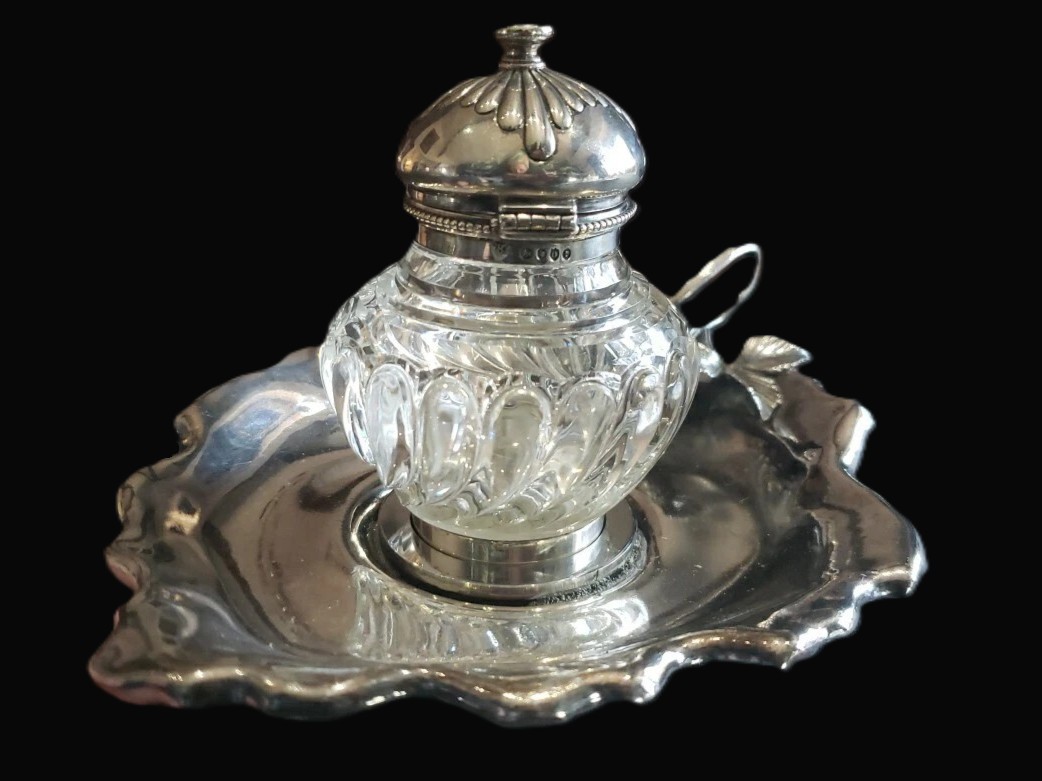
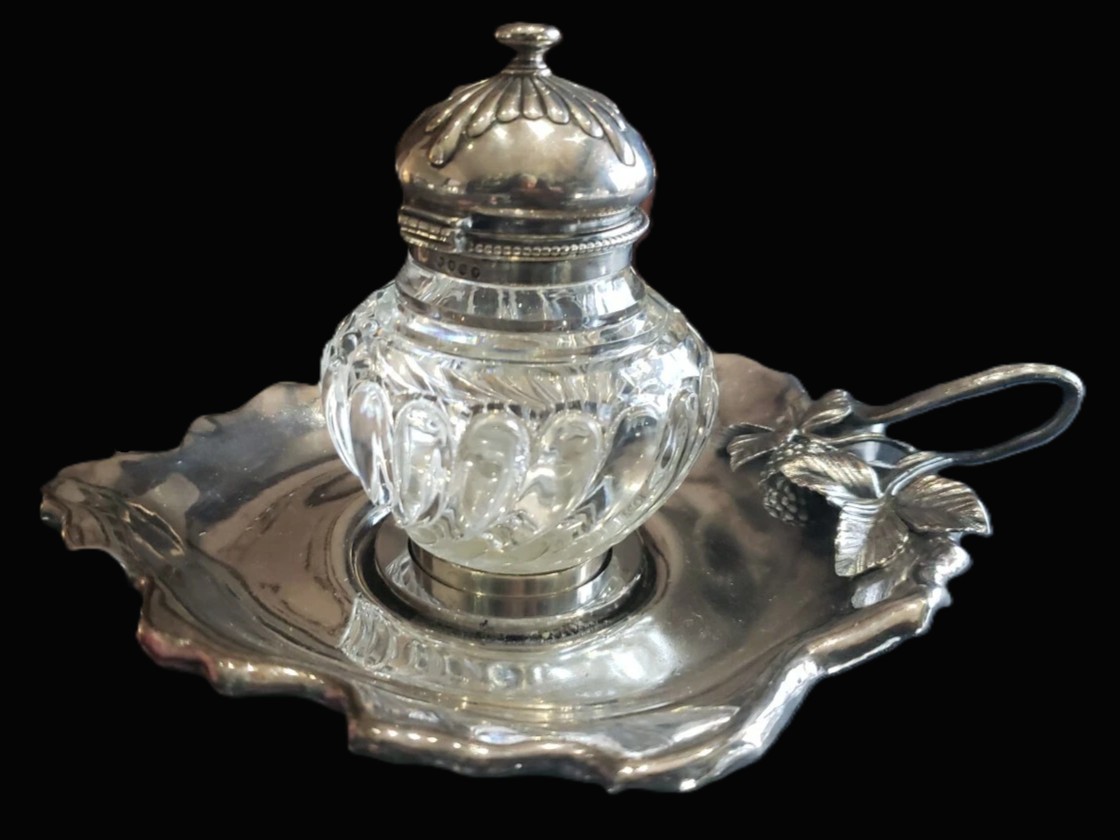
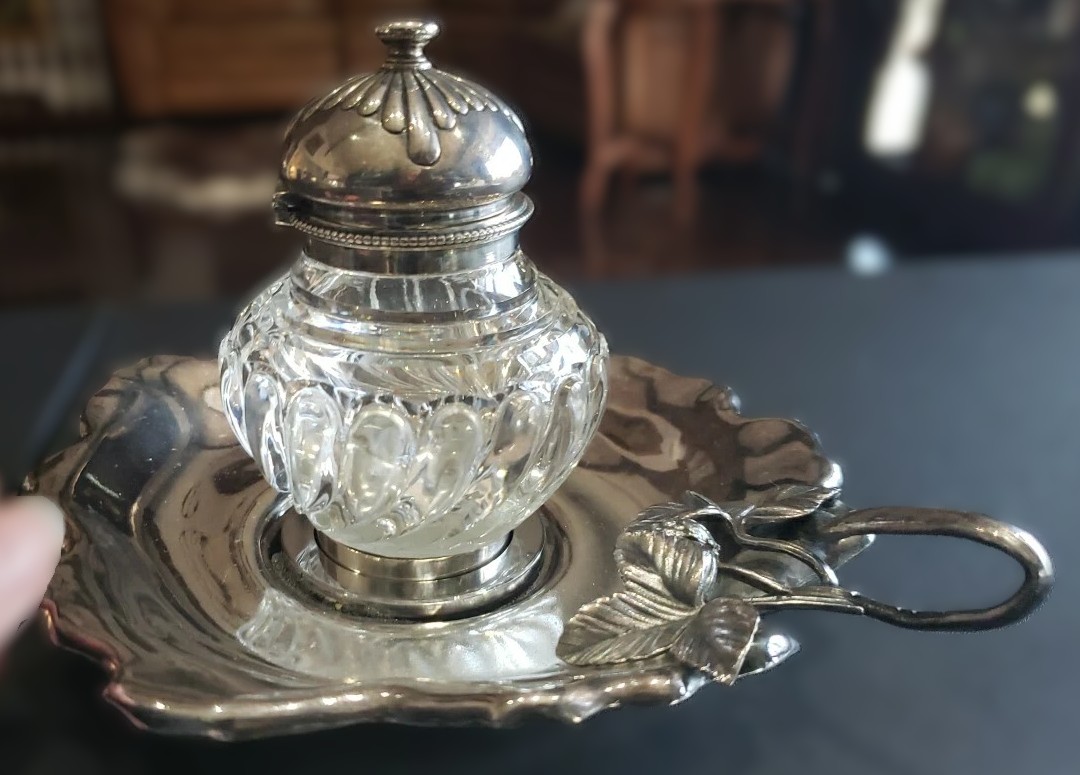
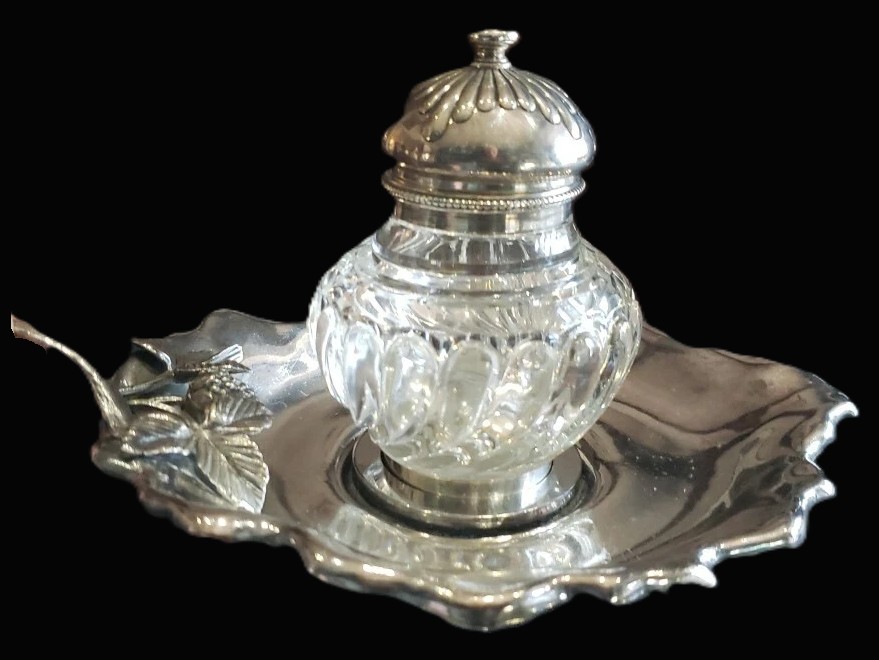
Cut-Crystal and Silver Inkstand, London & New York
| Categories | Silver |
| Material | Glass, Silver |
| Markings | See narrative |
| Manufacturer | Barnard & Sons |
| Origin | England |
| Date or Era | circa 1889 |
| Measuring | 7 ½” x 6”x 3 ¾” high |
Overview
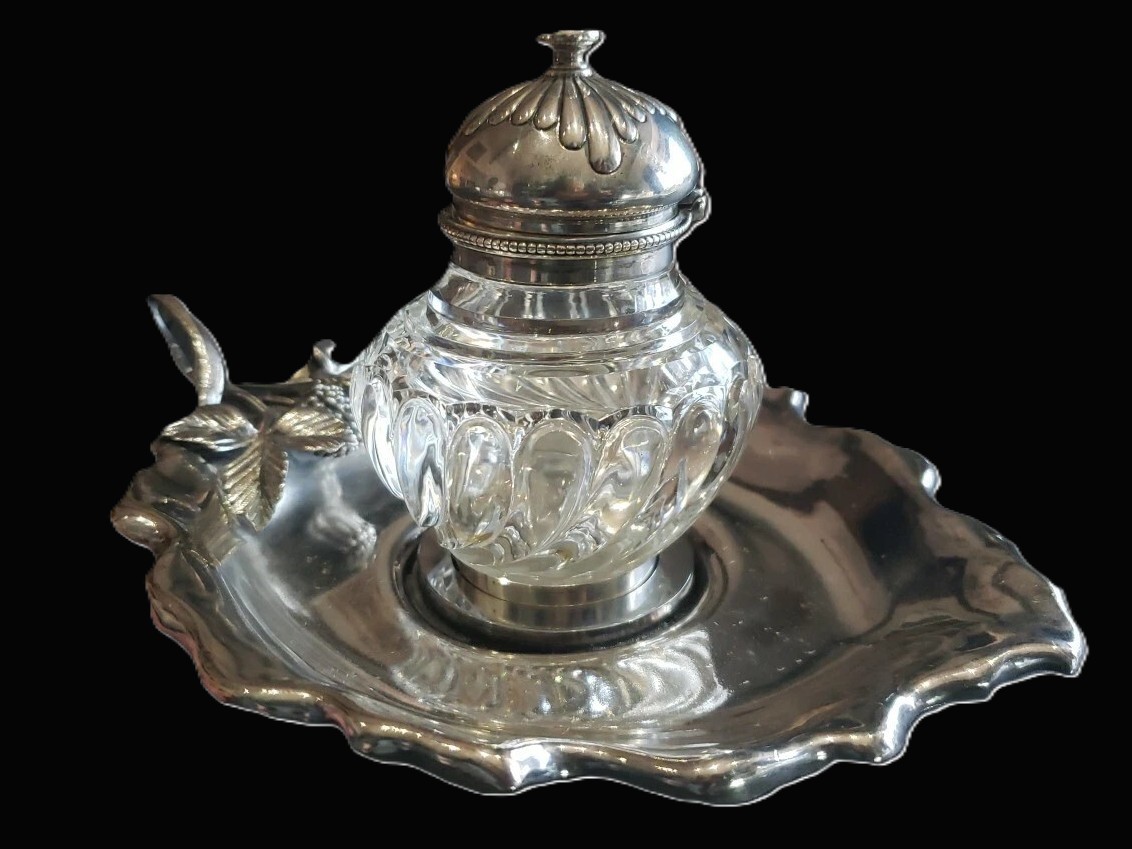
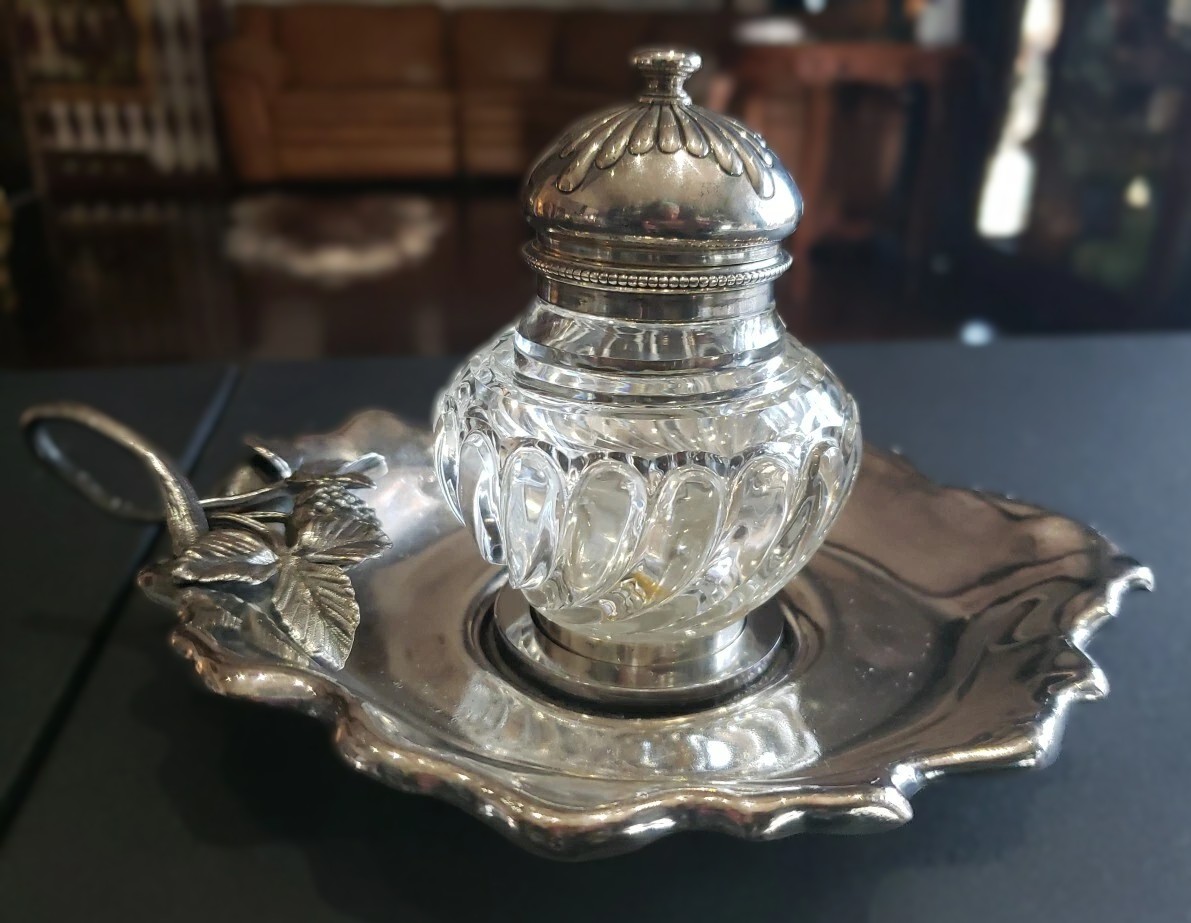
This inkstand is a cross-Atlantic “marriage” of high-quality English sterling silver craftsmanship and American Gilded Age quadruple silverplate design. The two components fit together with remarkable precision, forming a cohesive and elegant functional art piece.
Components
- The Inkwell Bottle
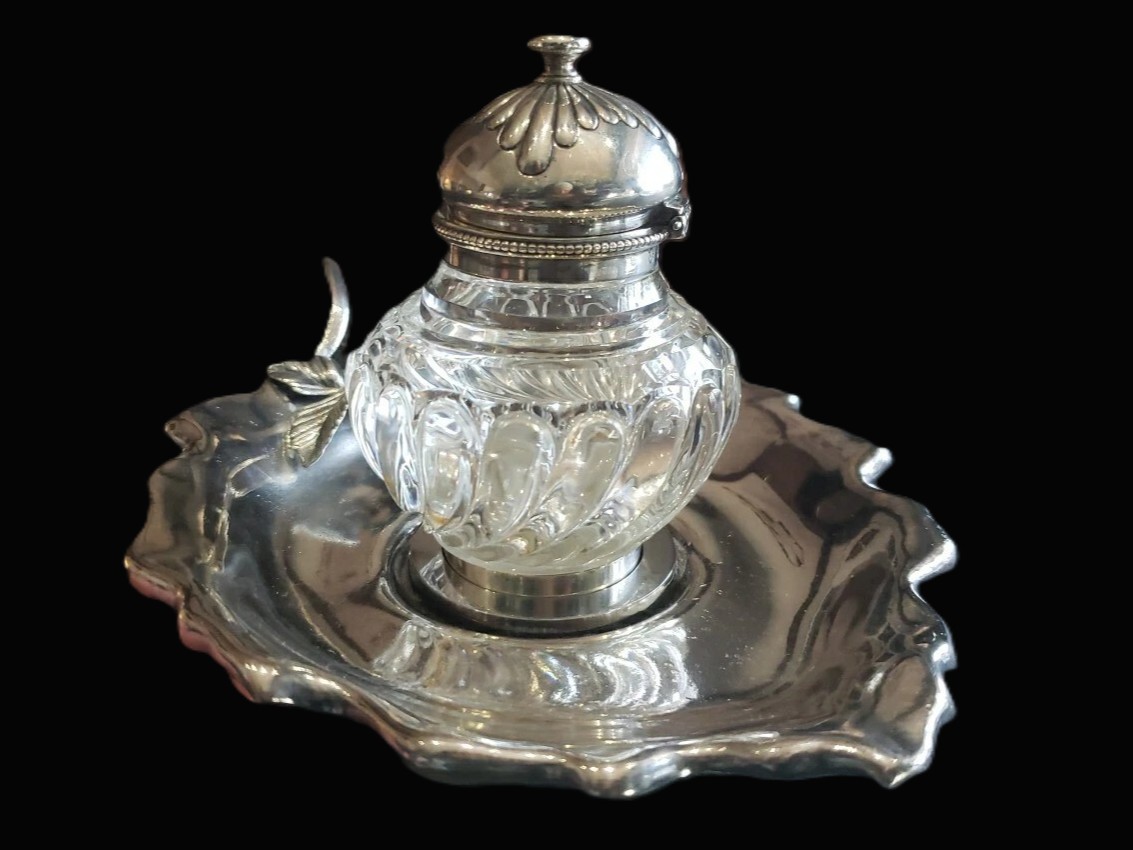
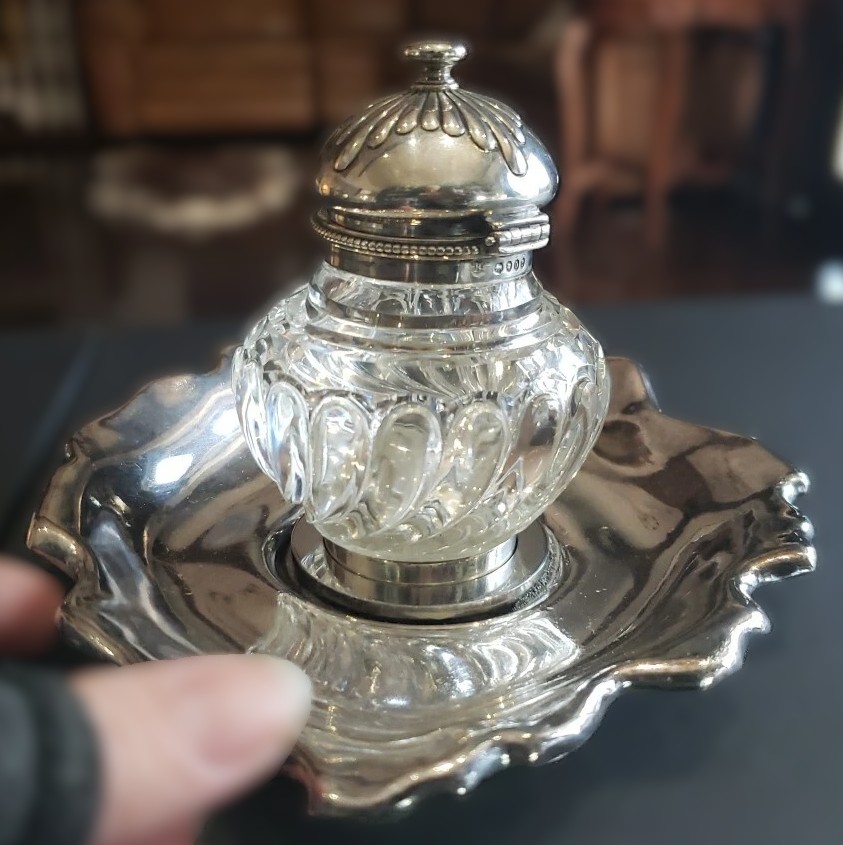
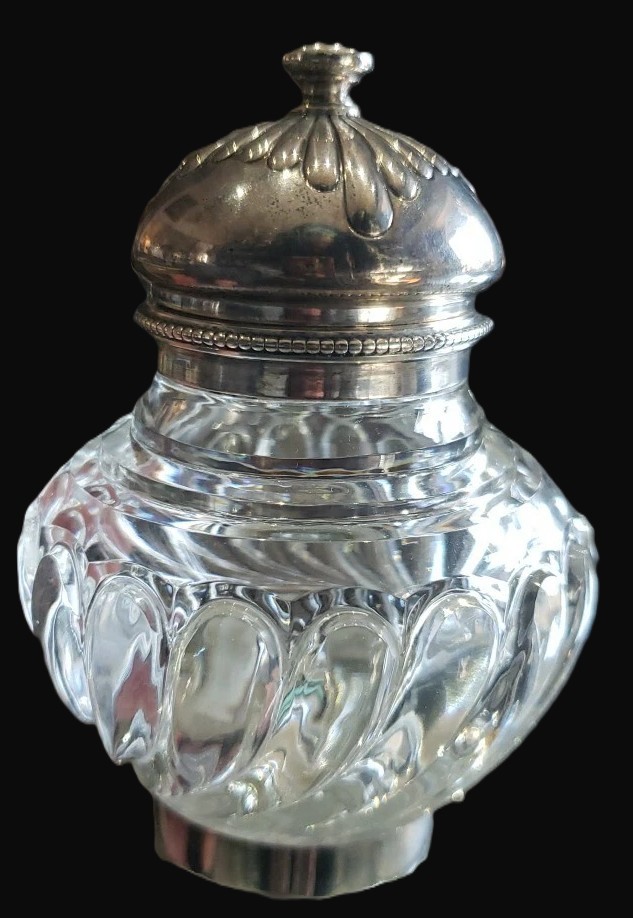
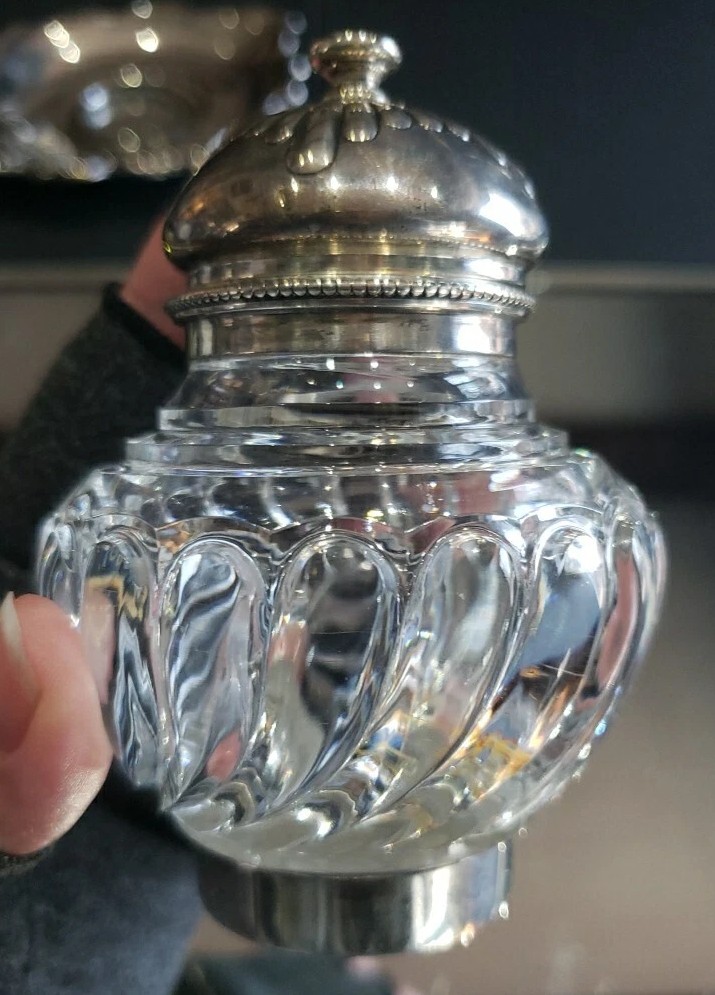
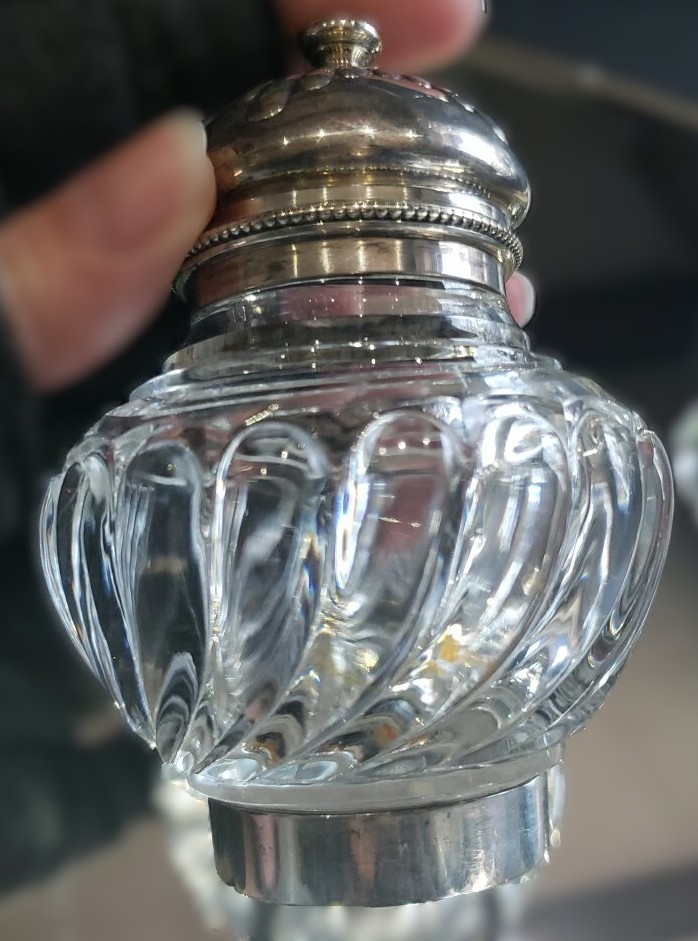
- Body: A heavy, clear crystal/glass inkwell cut with an elegant, deeply sculpted swirled pillar tusk/fluted pattern.
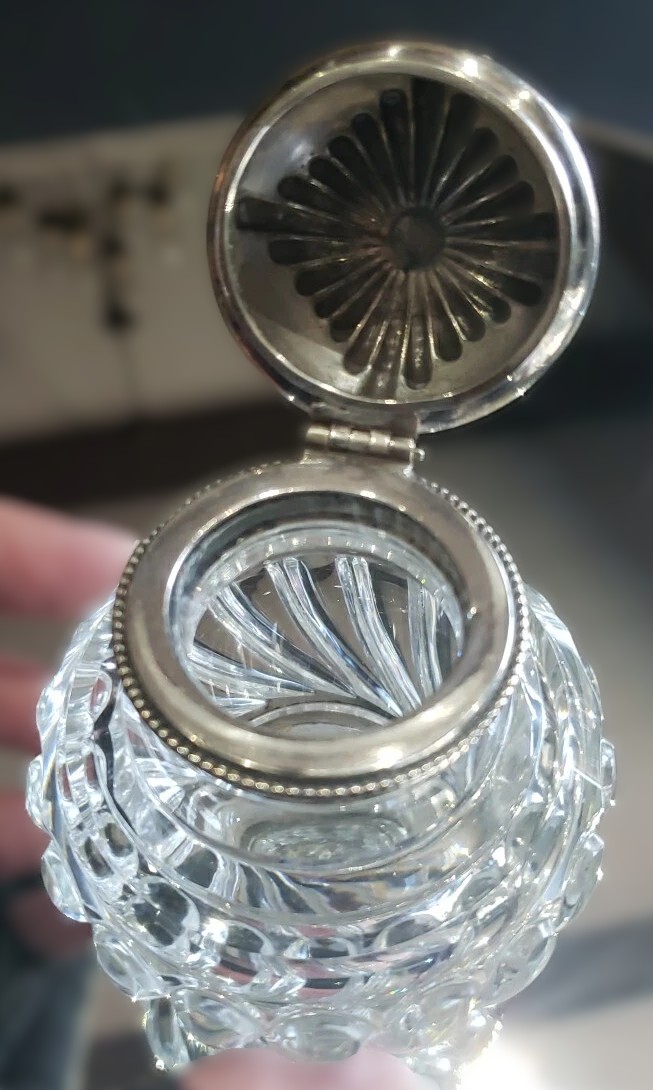
- Lid & Collar: The inkwell has a solid sterling silver domed, hinged lid featuring a central finial and a detailed radiating lobed/gadrooned design. A delicate beaded pattern trims the lower edge of the lid.
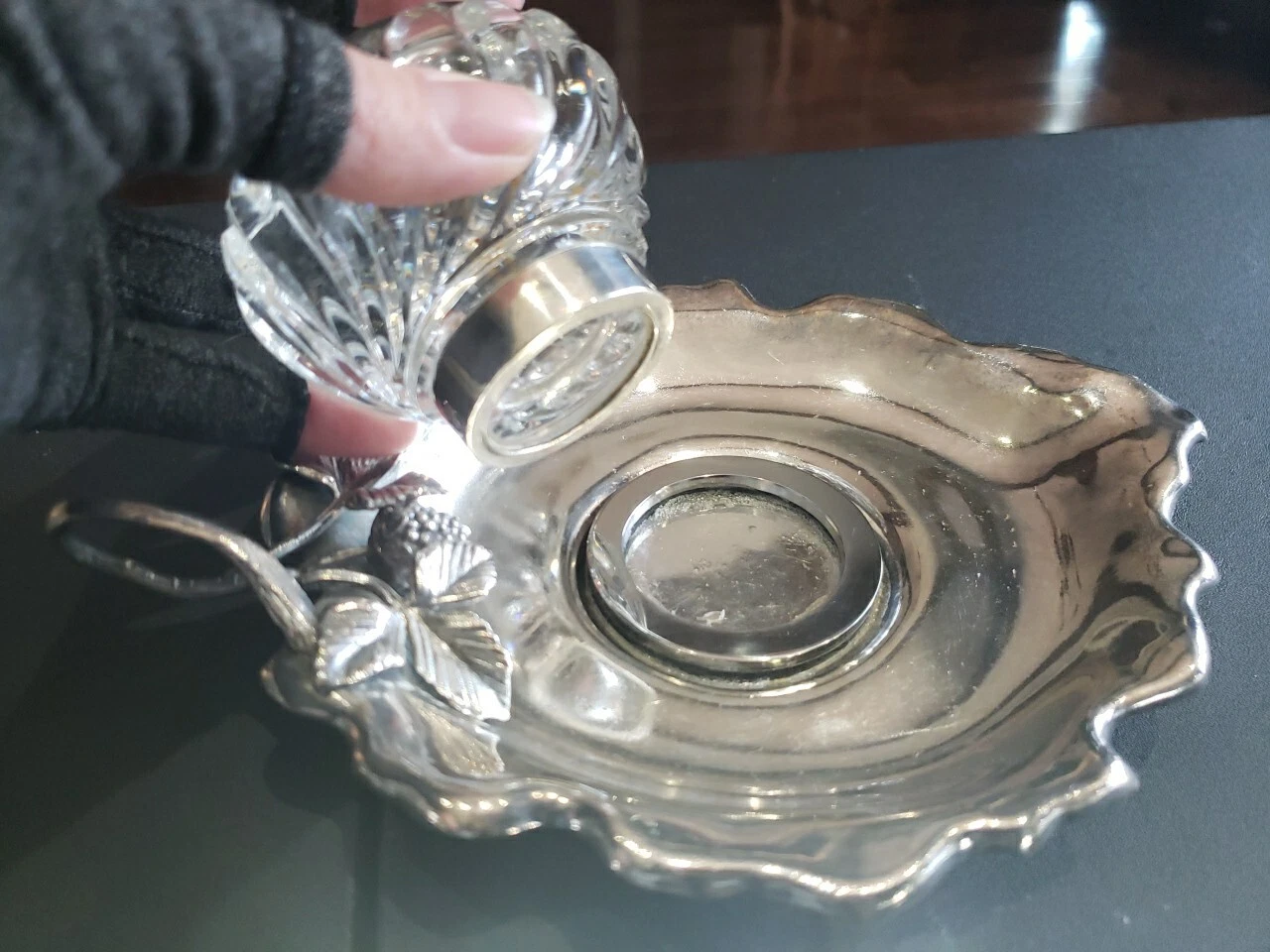
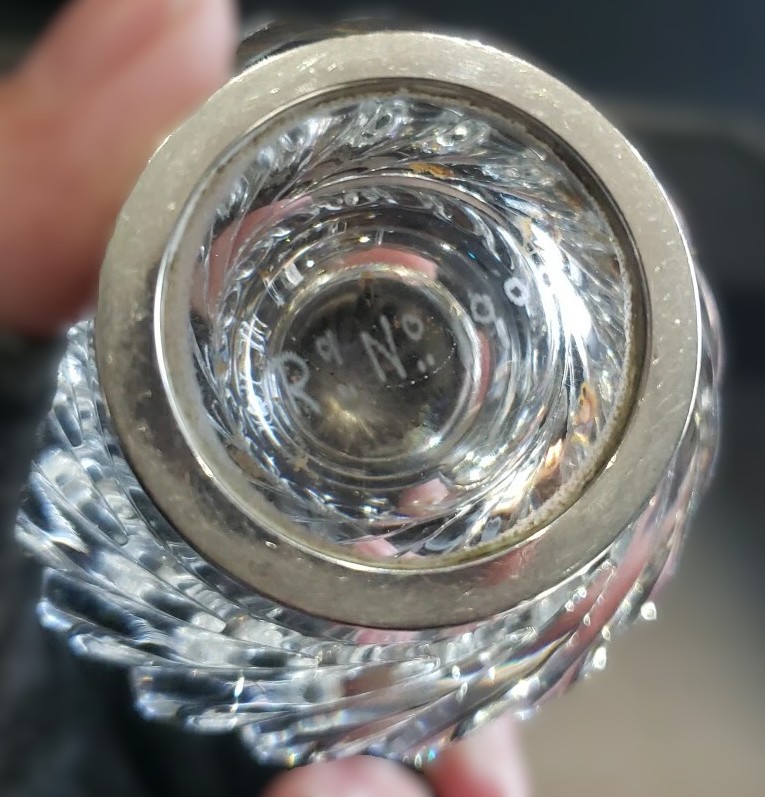
- Base Fitment: The bottom of the glass features a glass stem with a polished metal collar ring designed to sit flush into the tray’s integrated receiver. The underside of the crystal bottle is marked with a British design registration mark (Rᵈ Nᵒ).
- Dimensions: 3 ¾” high by 3″ wide.
- The Presentation Tray
- Style: Crafted in the late 19th-century Aesthetic/Rococo Revival style, the heavy quadruple-plated tray features an asymmetrical, organic scalloped border mimicking stylized foliage or a leaf.
- Handle: The handle is cast as a rustic branch accented by leaves and clusters of berries (resembling blackberries or raspberries).
- Receiver: Fixed permanently to the center of the tray is an elevated, engineered metal ring designed to hold the inkwell.
- Dimensions: 7 ½” long (including the handle) by 6″ wide.
Hallmarks & Precise Dating
The Inkwell Lid (London, 1889)
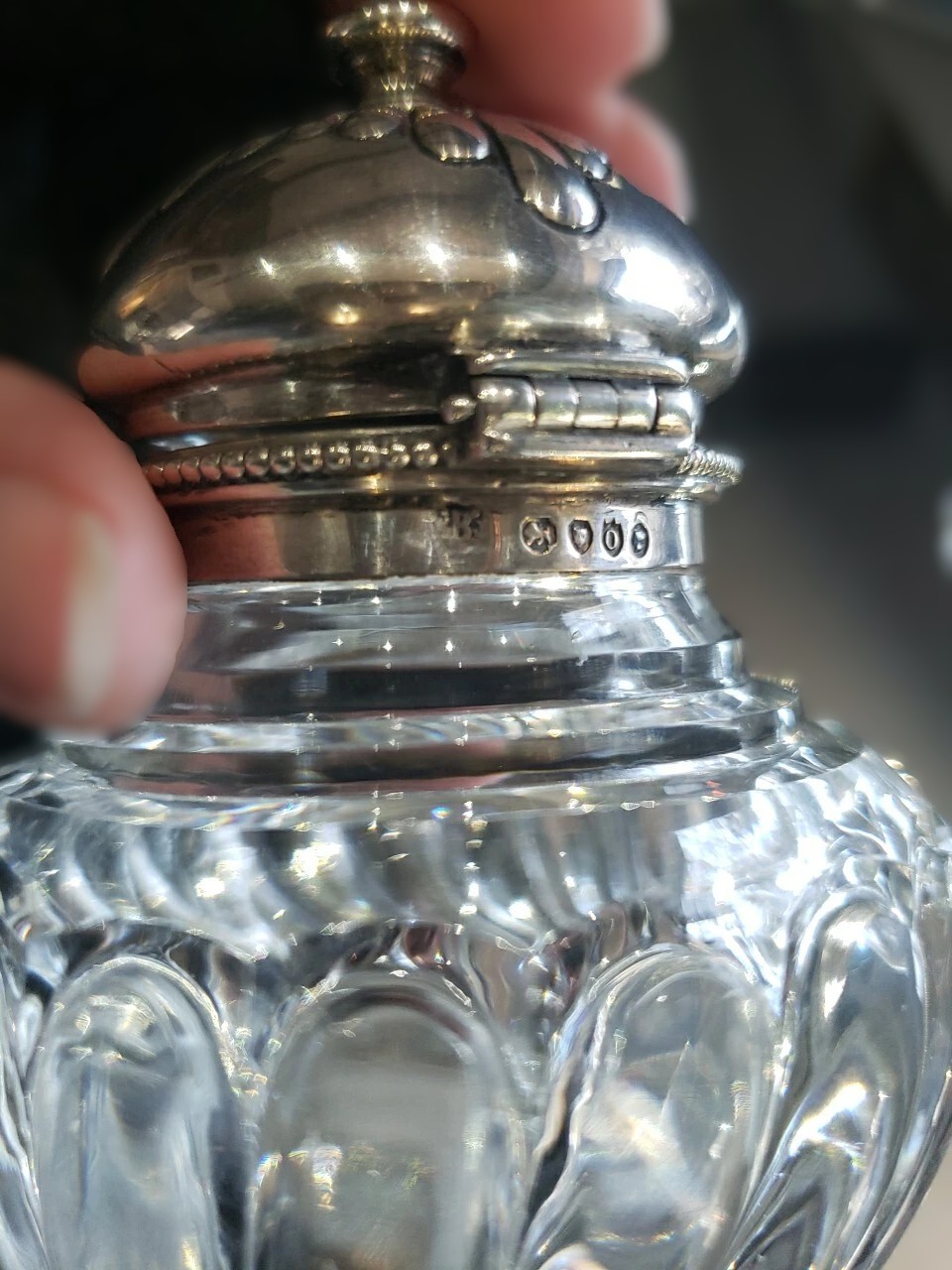
The collar of the hinged lid bears a full set of British hallmarks stamped into the silver:
- Sponsor’s/Maker’s Mark: JWB indicating the renowned workshop of John Walter Barnard.
- Standard Mark: The Lion Passant, certifying the lid is solid .925 sterling silver.
- Assay Office Mark: The Leopard’s Head, denoting that the silver was tested and marked in London.
- Date Letter: A lowercase “o” inside a shield with a pointed base. In the London alphabetical assay cycles, this specific font and shield style precisely dates the piece to the year 1889.
The Tray Base (New York, c. 1886–1895)
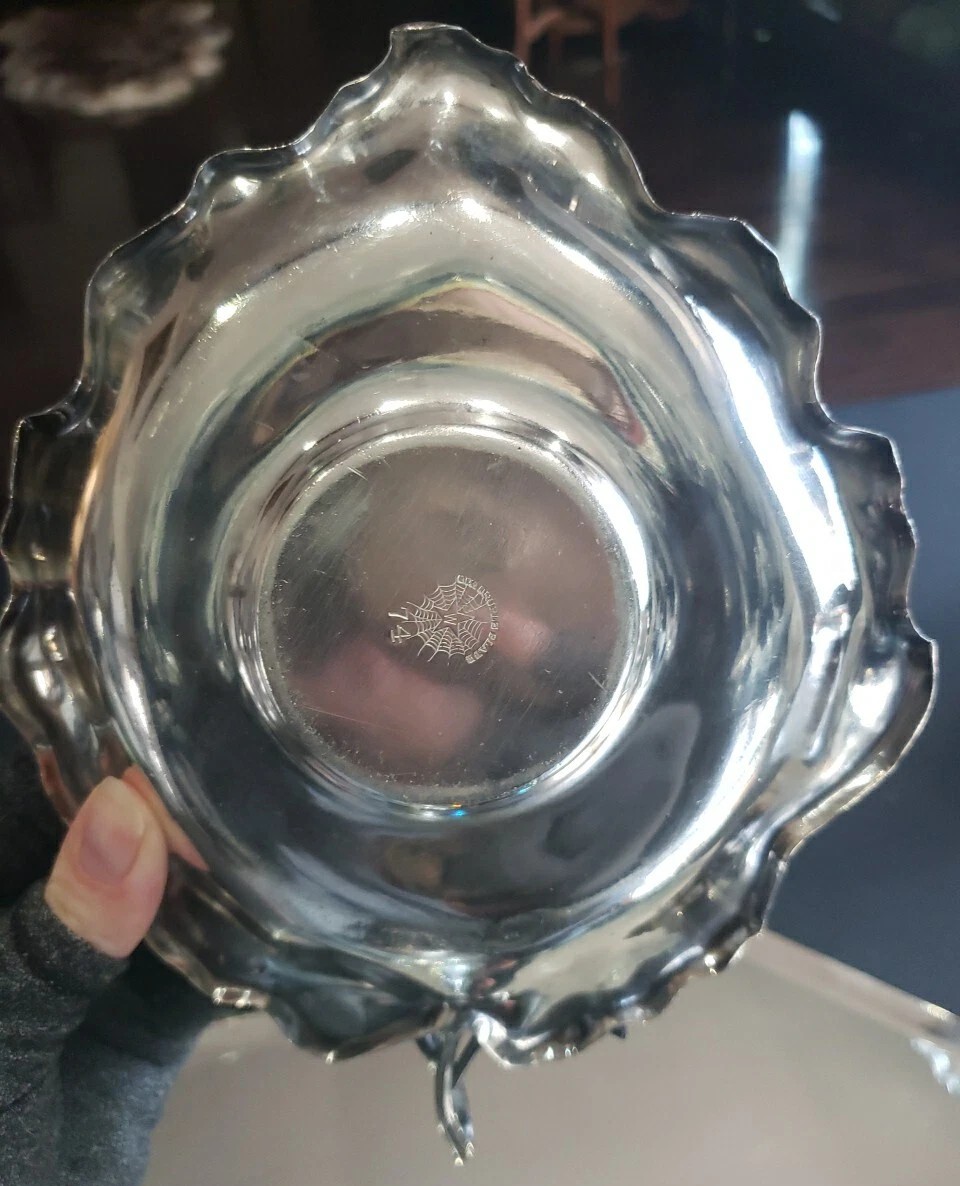
The underside of the tray features the historic American maker’s mark consisting of a capital letter “W” nestled inside a detailed spider web (cobweb) design.
- It is stamped with the designation “QUADRUPPLE PLATE” along with the unique factory design/pattern number “74”.
Historical Manufacturer Backgrounds
John Walter Barnard (London)
The Barnard family represents what is widely considered the oldest continuously operating manufacturing silversmith lineage in the world, tracing its origins directly back to the prestigious master smith Anthony Nelme around 1680. Through centuries of successive apprenticeships and successions, the firm evolved into Edward Barnard & Sons. In the late 19th century, Walter Barnard and John Barnard (II) steered the workshop, famous for producing exceptionally fine domestic presentation plate, church silver, and high-end desk accoutrements for elite clientele.
E.G. Webster & Son (New York)
Founded by Elizur G. Webster in 1859 in Brooklyn, New York, the firm initially operated under names like the Webster Manufacturing Co. before transitioning to E.G. Webster & Son in 1886 when Elizur partnered with his son, Fred H. Webster. The firm was highly respected for producing premium, heavily plated white-metal and nickel hollowware during the height of the American silverplate boom. Their superior plating standards meant their pieces endured daily usage beautifully. The company’s success eventually caught the eye of the International Silver Company, which absorbed the firm in 1928.
Analyzing the “Marriage” of the Two Pieces
In the world of antiques, a “marriage” refers to two separate items combined to make a complete set. Because both components date precisely to the same late-1880s/early-1890s timeframe and the structural fit between the tray’s ring and the bottle’s collar is completely seamless, there are two primary historical explanations for how this occurred:
- Theory A: Coordinated Luxury Sourcing (Period Original): High-end Gilded Age American jewelers and silversmiths frequently cross-sourced exceptional components from Europe to complement their own fabrications. E.G. Webster (or a premium retailer matching them) may have imported the high-grade English cut-glass bottle with its certified London sterling silver top directly from Barnard to dress up their own premium quadruple-plated tray bases, selling the completed unit as a luxury hybrid import.
- Theory B: Contemporary Period Replacement: If an affluent original owner purchased a full E.G. Webster inkstand and subsequently cracked the original glass well, they would not throw away the heavy silver tray. Instead, they would take it to a high-end jeweler who would source a perfectly fitting, premium British sterling-mounted replacement well from an upscale silversmith like Barnard. Because the dimensions align flawlessly, this replacement would have occurred right around the turn of the century.
This cross-continental combination tells a story of late-Victorian trade, luxury retail customs, and the shared design ethos between London and New York silversmiths during the era.
Sold for $220 in June 2026
Content disclaimer. The information posted is the owner’s best knowledge and may not have been vetted by the SOIC. We welcome comments, corrections, and additions, working to make our website information comprehensive and accurate.
Join the Society of Inkwell Collectors (SOIC) – it’s free!
Founded in 1981 as a non-profit organization,
we are documenting inkwells (and accessories).
We’re here to help and inform!