

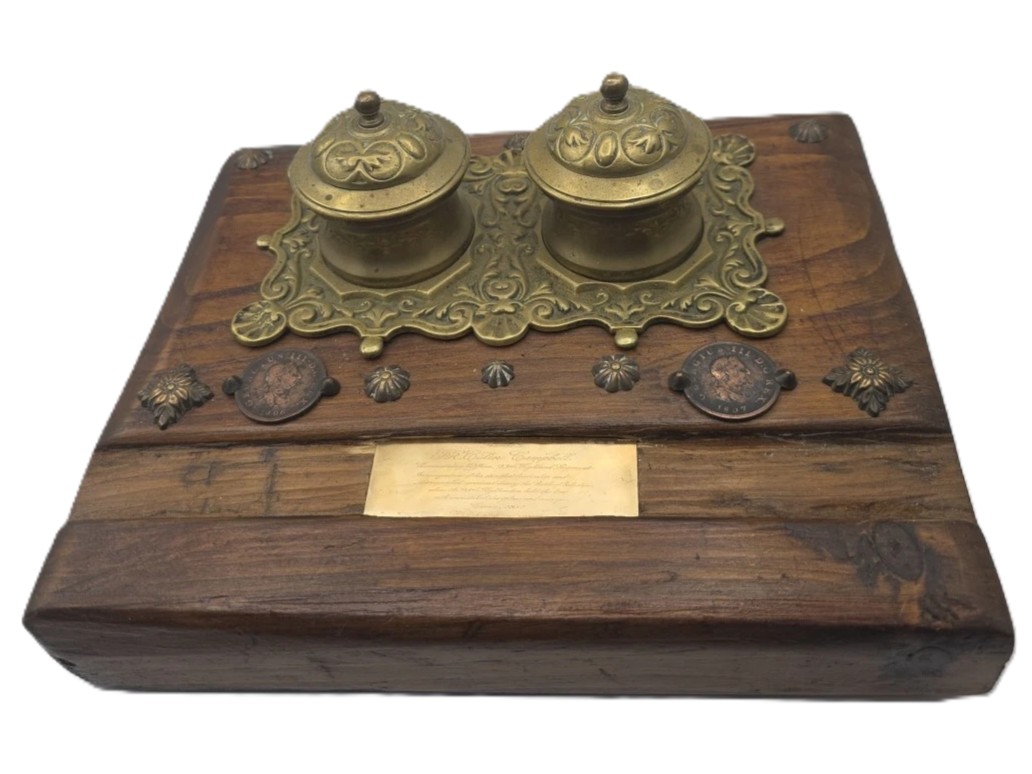
Crimean War Presentation Inkstand
| Categories | Presentation Piece |
| Type | Military |
| Material | Brass, Wood |
| Markings | See Narrative |
| Manufacturer | Undetermined |
| Origin | England |
| Date or Era | circa 1856 |
| Measuring | 10” x 8” |
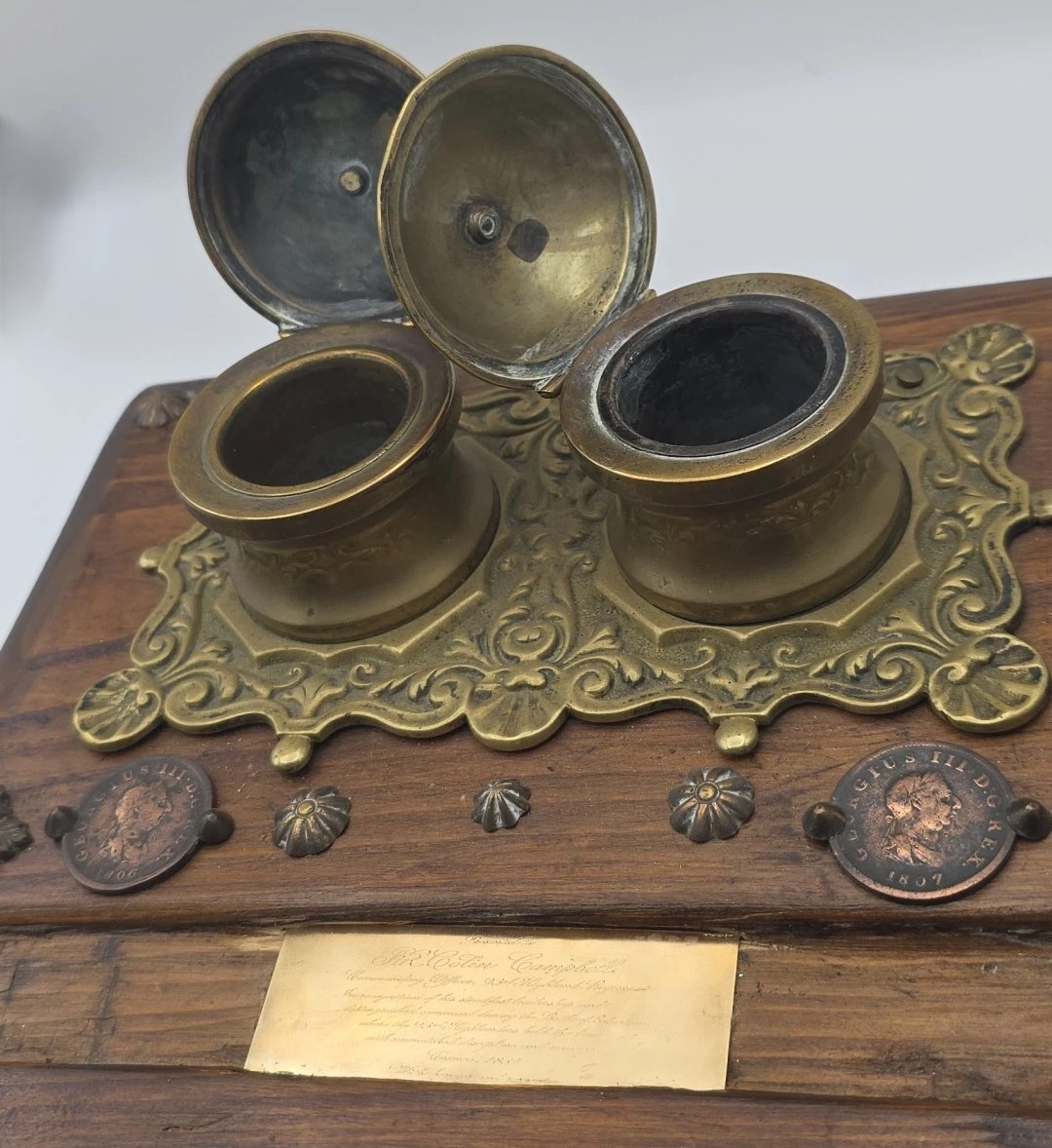
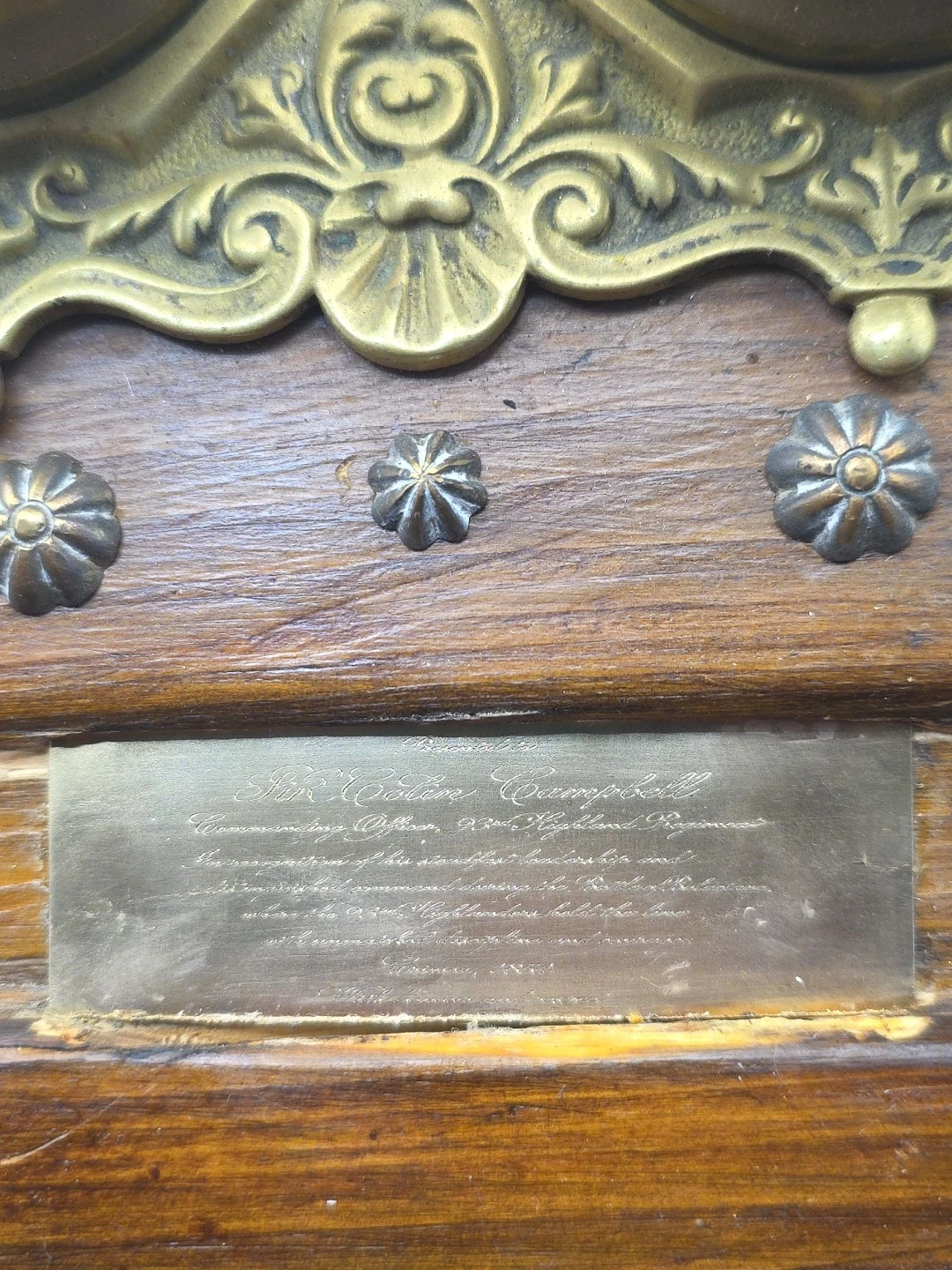
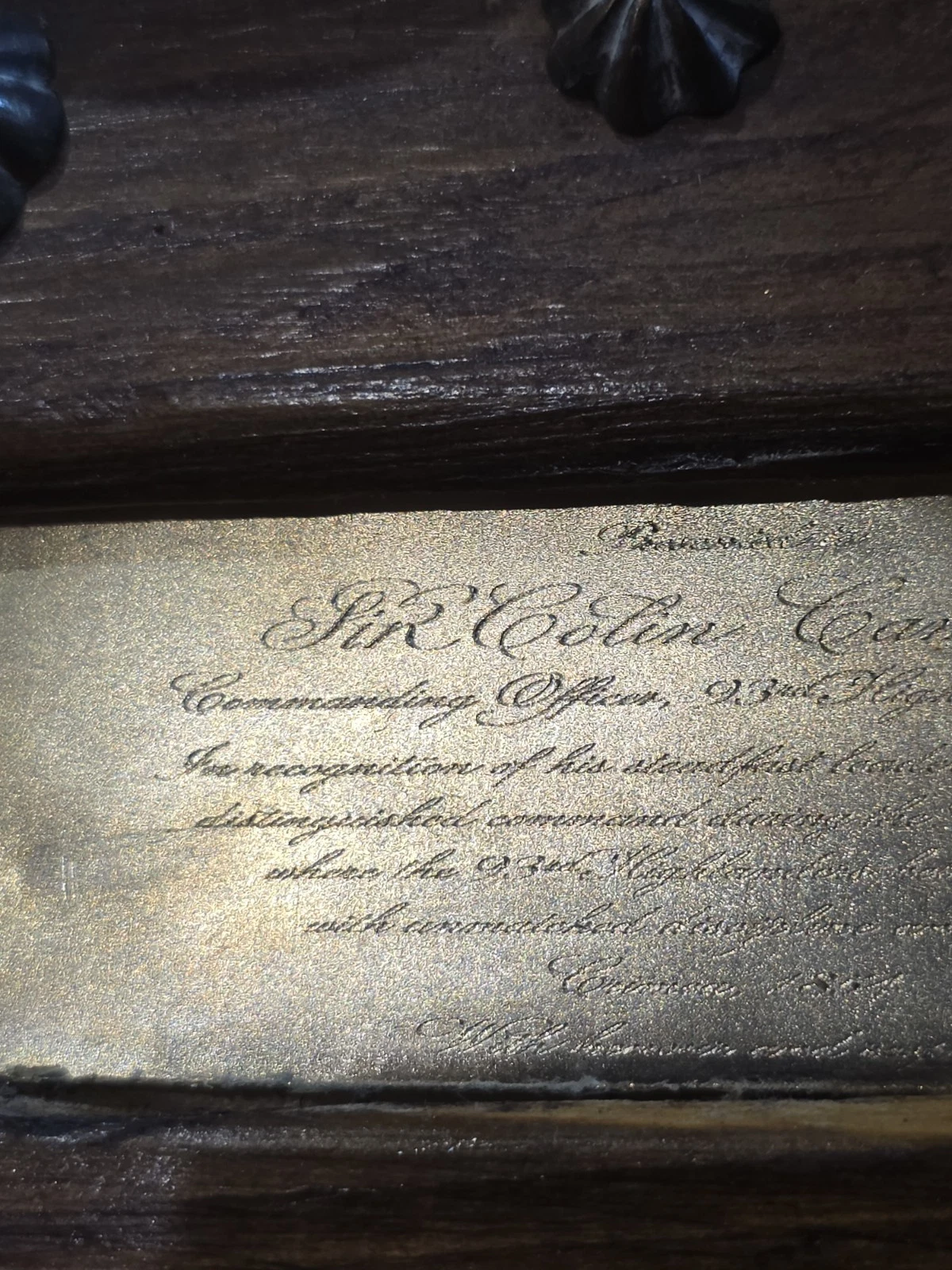
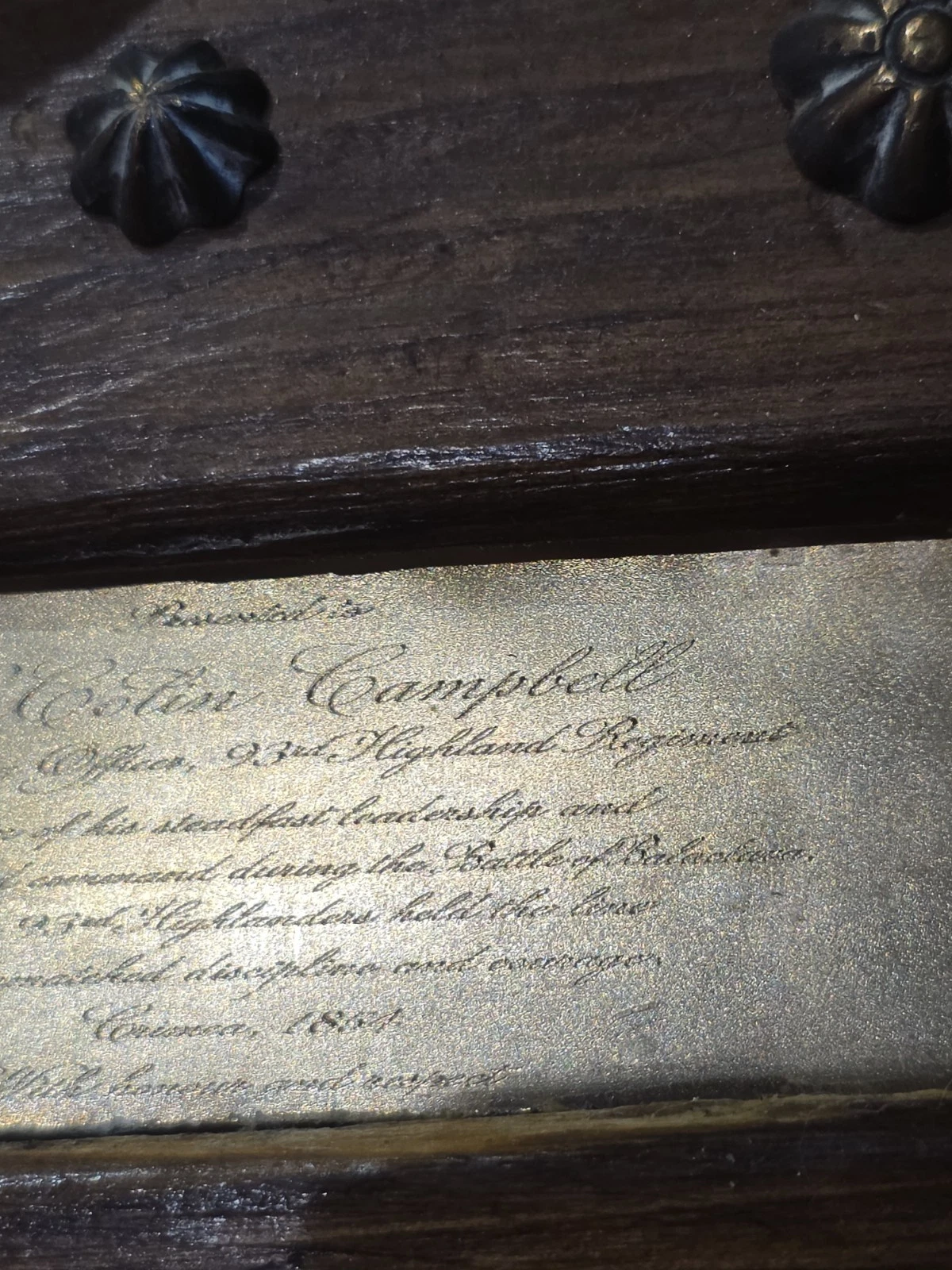
Presentation Plaque Transcription
The plaque is engraved in an elegant cursive script and reads as follows:
Presented to Sir Colin Campbell Commanding Officer, 93rd Highland Regiment In recognition of his steadfast leadership and distinguished command during the Battle of Balaclava, where the 93rd Highlanders held the line with unmatched discipline and courage. Crimea, 1854 With honour and respect.
Artifact Description
This commemorative desk set is rich in historical detail, combining military presentation elements with period-accurate features:
- The Inkwells: It features two ornate brass inkwells with hinged, domed lids. They rest on a decorative, scrolling brass gallery base plate.
- The Wooden Base: The base is carved from a heavy, rustic block of wood, accented with decorative brass florets and studs.
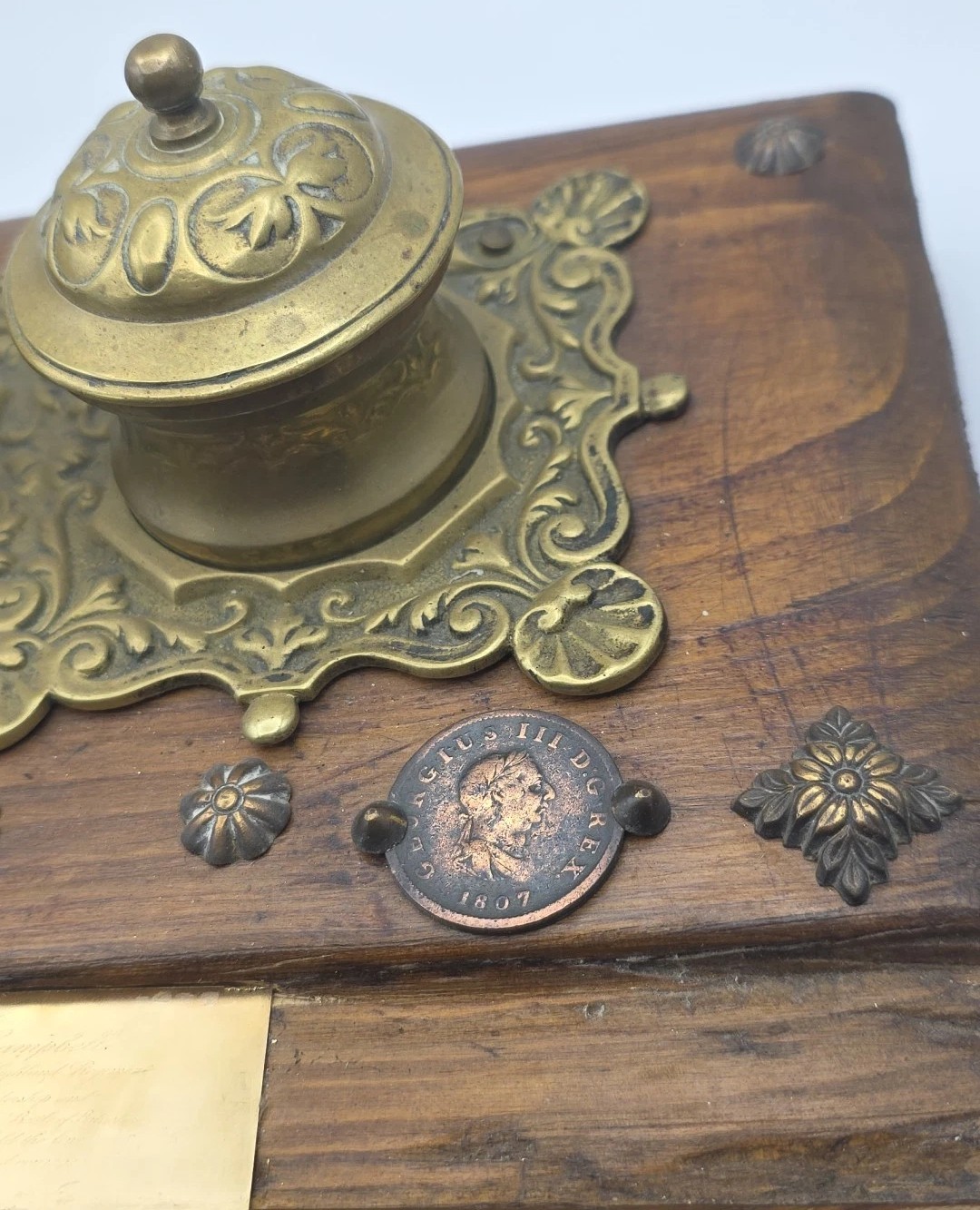
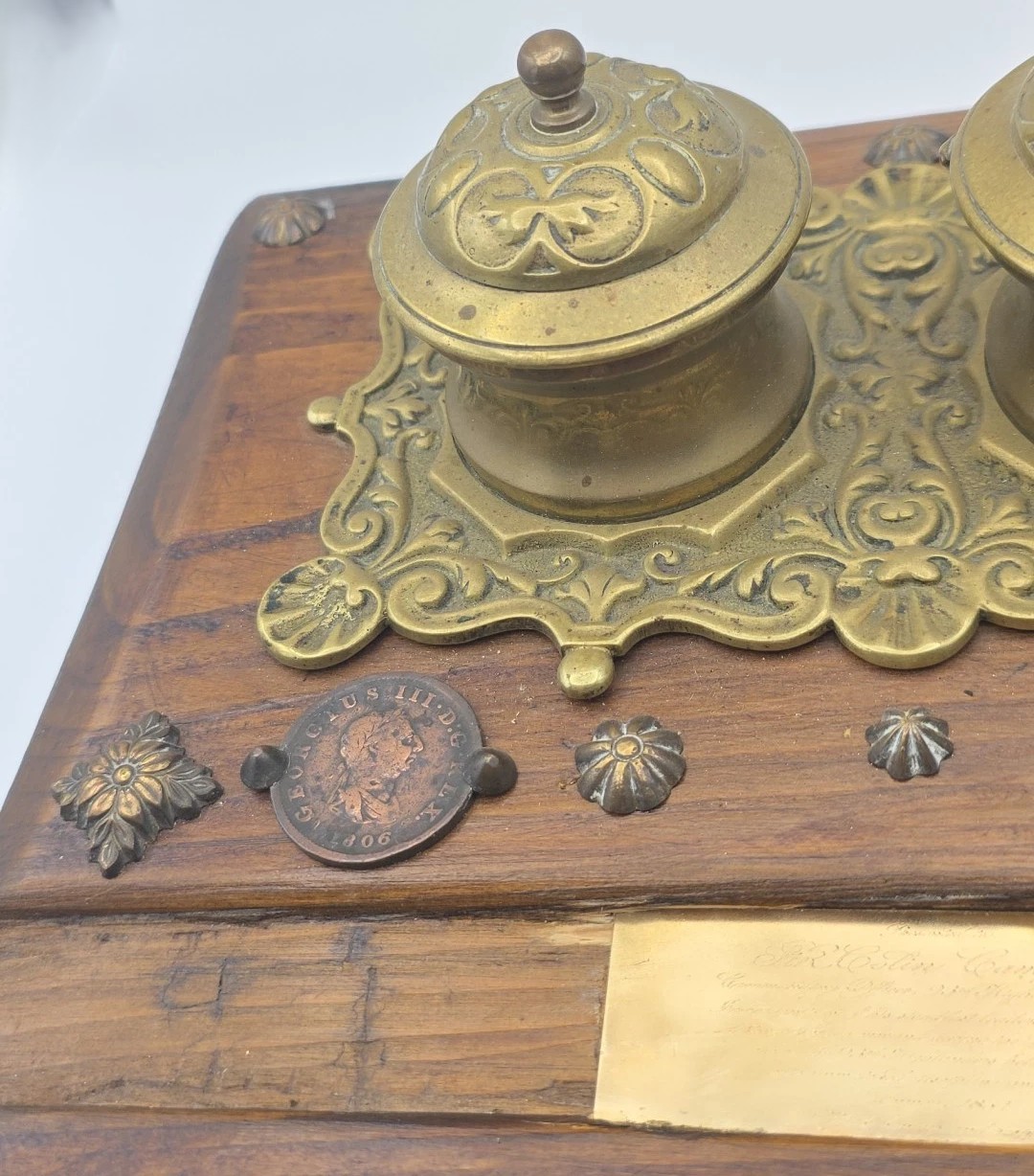
- Historical Coins: Inset into the front of the wooden base, flanking the presentation plaque, are two authentic British copper coins featuring King George III.
- The coin on the left is a George III token/halfpenny dated 1806.
- The coin on the right is a George III token/halfpenny dated 1807.
- Both are inscribed with GEORGIUS III • D:G • REX.
The presentation plaque on this inkstand encapsulates a watershed moment in British military history. To fully appreciate the piece, it helps to understand the massive conflict it represents, the specific tactical gamble of that battle, and the unique commander who led it.
- The Crimean War (1854–1856)
The Crimean War was a brutal, multi-national conflict fought primarily on the Crimean Peninsula (modern-day Ukraine). It pitted the Russian Empire against an alliance of Britain, France, the Ottoman Empire (Turkey), and the Kingdom of Sardinia.
- The Cause: Nominally sparked by religious disputes over the protection of Christian shrines in the Holy Land, the war’s deeper geopolitical driver was the “Eastern Question”—the European powers’ determination to halt Russian expansion into the decaying Ottoman Empire, which threatened vital global trade routes.
- Historical Significance: It is often considered the first “modern” war. It featured the earliest military use of the telegraph, naval torpedoes, explosive artillery shells, and tactical railways. It was also the first war extensively covered by battlefield photographers and newspaper war correspondents. The horrifying conditions and administrative blunders exposed by journalists led to sweeping military reforms and pioneered modern nursing via Florence Nightingale.
- The Battle of Balaclava & “The Thin Red Line”
On October 25, 1854, the Russian Army launched a massive assault to seize Balaclava, a vital fishing port that served as the primary supply base for the British army besieging nearby Sevastopol.
Early in the morning, Russian forces overran the outer Turkish-manned artillery redoubts, sending the surviving defenders fleeing. This left only a small, solitary force standing between a massive wave of Russian cavalry and the defenseless British base: the 93rd Sutherland Highlanders, supported by a small contingent of Royal Marines and walking wounded.
The Tactical Gamble
Standard 19th-century military doctrine dictated that infantry facing a cavalry charge must form a dense, hollow “square” four ranks deep. This presented a wall of bayonets that horses instinctively refused to charge.
However, Major-General Sir Colin Campbell looked at his 500 kilted Highlanders and realized that forming a square would leave his flank dangerously narrow and exposed. Trusting the steady discipline of his men and the devastating stopping power of their newly issued, rifled Minié muskets, Campbell made a highly unorthodox decision: he deployed them in a straight line just two ranks deep to stretch across the valley.
As 2,500 Russian cavalrymen thundered toward them, Campbell famously rode down the line and delivered a grim ultimatum:
“There is no retreat from here, men. You must die where you stand.”
To which a right-hand man, Private John Scott, cheerily replied:
“Aye, Sir Colin. An needs be, we’ll do that.”
The Birth of a Legend
The Highlanders stood perfectly motionless until the charging cavalry entered range. Rather than panicking, they delivered two incredibly disciplined, shattering volleys of rifle fire. The sheer wall of lead mowed down the front ranks, throwing the entire Russian cavalry charge into total chaos and forcing them to retreat in disarray. The port was saved in a matter of minutes.
William Howard Russell, the famous war correspondent for The Times, watched the dramatic standoff from the heights above. He beautifully described the 93rd as looking like a “thin red streak tipped with a line of steel.” Public imagination quickly condensed this into “The Thin Red Line,” which remains an enduring idiom for a minimal, unwavering defense standing against overwhelming odds.
- General Sir Colin Campbell (1792–1863)
Sir Colin Campbell was one of the most respected British military figures of the Victorian era, famously loved by his troops for his deep concern for their welfare.
- Humble Beginnings: Unlike most British officers of his time, who purchased their commissions through aristocratic wealth, Campbell was the son of a working-class Glasgow carpenter. He earned every promotion through raw merit, bravery, and hard fighting across a 50-year career.
- A Decorated Career: Long before the Crimea, he fought in the Peninsular War against Napoleon’s armies, the War of 1812 in America, the First China War, and the Second Sikh War in India.
- Leadership Style: His peers occasionally nicknamed him “Sir Crawling Camel” because he favored deliberate, meticulous planning over reckless, dashing charges—a safety-first approach designed to keep his soldiers alive. When later asked why he risked facing cavalry in a line rather than a traditional square, he simply replied:
“I knew the 93rd, and I did not think it worth the trouble of forming a square.”
- Later Life: Following his triumph in the Crimea, Campbell was sent to India to act as Commander-in-Chief during the 1857 Indian Mutiny (Sepoy Rebellion), where he successfully directed the Relief of Lucknow. For his monumental lifetime achievements, he was raised to the peerage as Baron Clyde in 1858 and eventually promoted to Field Marshall. He is buried in Westminster Abbey.
While the plaque does not state a specific day or month, we can narrow down the timeframe when this piece was created and presented based on the text and historical details:
1. The Earliest Possible Date (The Terminus Post Quem)
The piece could not have been made before late October 1854.
-
The text explicitly commemorates the Battle of Balaclava, which took place on October 25, 1854.
-
The final line of the primary text reads
"Crimea, 1854". This indicates the presentation was conceived to mark the events of that specific year.
2. The Practical Window of Presentation
Historically, detailed commemorative presentations like this were typically awarded in one of two windows:
-
The Immediate Aftermath (Late 1854–1855): It may have been commissioned and presented in the field or shortly after the battle by officers, a grateful municipality, or associates while the war was still actively being fought.
-
The Return to Britain (1856): When the Crimean War officially ended in 1856, Colin Campbell and the 93rd Highlanders returned to the UK. This homecoming sparked a massive wave of public celebrations, banquets, and the gifting of elaborate presentation silver, swords, and desk sets by Scottish cities (like Glasgow) and military committees to honor their war heroes.
3. A Note on the Materials
The choice of materials also heavily points to a mid-19th-century presentation date. The inclusion of the 1806 and 1807 King George III copper coins flanking the plaque is a classic Victorian design choice. Because Colin Campbell was born in 1792 and began his highly decorated military career during the Napoleonic Wars (under the reign of George III), incorporating 50-year-old coins from that era was a deliberate nod to the general’s long, legendary lifetime of service to the British Crown.
Sold for $1,085 in May 2026
Content disclaimer. The information posted is the owner’s best knowledge and may not have been vetted by the SOIC. We welcome comments, corrections, and additions, working to make our website information comprehensive and accurate.
Join the Society of Inkwell Collectors (SOIC) – it’s free!
Founded in 1981 as a non-profit organization,
we are documenting inkwells (and accessories).
We’re here to help and inform!