


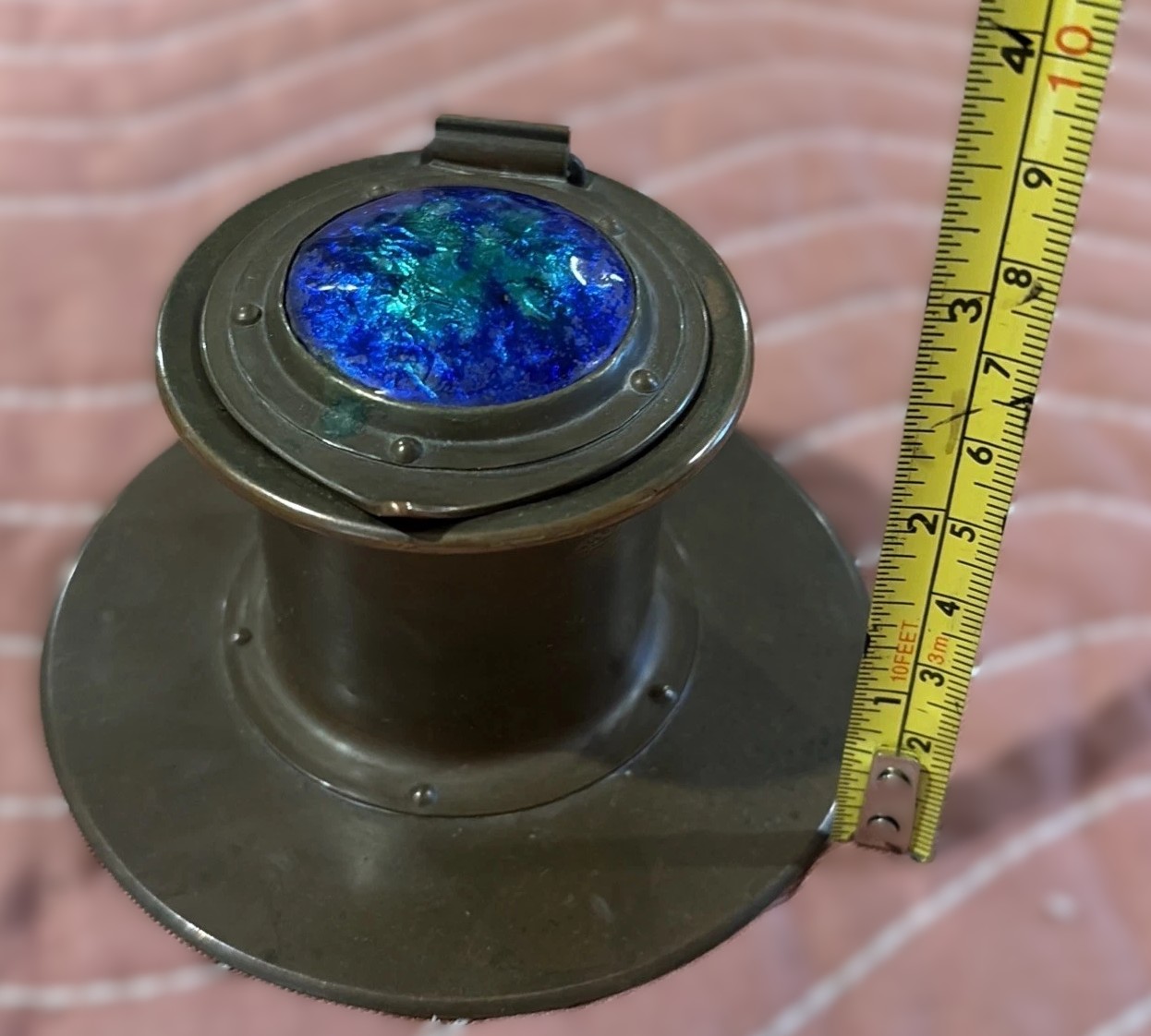
Copper Capstan Inkwell with Translucent Enamel Roundel
| Categories | Arts & Crafts |
| Material | Coppered metal |
| Markings | 682A |
| Manufacturer | Jesson and Birkett |
| Origin | England |
| Date or Era | circa 1905 |
| Measuring | 4 ½” diameter; 3 ¼” high |
Description
- Form and Design: The inkwell features a classic “capstan” or flared cylindrical silhouette rising cleanly from a broad, flat, circular base. This restrained geometric structure is characteristic of early 20th-century British Arts and Crafts metalwork.
- Lid and Enamel Roundel: The domed hinged lid is the centerpiece of the design, featuring a vibrant mottled blue-and-green translucent enamel roundel reminiscent of Ruskin Pottery or independent Birmingham guild work. The enamel insert is secured within a riveted circular copper frame featuring evenly spaced decorative rivets or studs.
- Interior: Opening the lid via its simple loop hinge reveals the internal well recess which would hold a glass or ceramic insert.
- Markings: The underside of the copper base is stamped with the manufacturing/model pattern series 682A (often referenced as the 682 series).
Production Context: Voysey vs. Liberty & Co.
While Jesson, Birkett & Co. famously inherited and manufactured specific designs by the celebrated architect-designer Charles Francis Annesley (C.F.A.) Voysey—most notably his model number 672 rectangular double inkwell—this specific circular capstan inkwell (Pattern 682) was not designed for Voysey or Liberty & Co.
Instead, it was a proprietary commercial design created and marketed directly by Jesson, Birkett & Co. as part of their independent catalog of fine art metalwork. Pieces like this were sold under their own name and monogram brand, capturing the disciplined, practical aesthetic championed by the Birmingham Arts and Crafts movement.
Date of Manufacture
This piece was manufactured between 1904 and 1910. Because the firm only existed under the name “Jesson, Birkett & Co.” for this brief six-year window before liquidation and restructuring, items bearing their distinct design numbers can be dated with accuracy.
History of the Maker: Jesson, Birkett & Co.
- Origins (1901–1904): The firm originally began in September 1901 as the Faulkner Bronze Company, founded in Birmingham by directors Fred G. Faulkner, Thomas Birkett, and Arthur G. Jesson. Birkett was a former member of the prestigious Birmingham Guild of Handicraft. The firm quickly developed a reputation for exceptional repoussé work, light fittings, and specialized copper wares.
- Expansion and Reconstitution (1904): In 1902, the firm bought out the designs, drawings, and templates of Richard Llewellyn Rathbone (a prominent Arts and Crafts metalworker who trained under W.A.S. Benson and made pieces for C.F.A. Voysey). When Fred Faulkner retired in 1904, the firm was reconstituted as Jesson, Birkett & Co. Ltd., operating out of the Highgate area of Birmingham.
- Style and Legacy: Jesson, Birkett & Co. combined high-quality hand-hammered craft with commercial viability. They frequently incorporated Ruskin Pottery cabochons, colorful enamel roundels, and whiplash details into their brass and copper work.
- Dissolution (1910): The company was liquidated in 1910. Its workshops, staff, and design assets were subsequently absorbed by master metalworker A.E. Jones, cementing their place as a foundational influence on Edwardian decorative art.
Sold for $213 in May 2026
Content disclaimer. The information posted is the owner’s best knowledge and may not have been vetted by the SOIC. We welcome comments, corrections, and additions, working to make our website information comprehensive and accurate.
Join the Society of Inkwell Collectors (SOIC) – it’s free!
Founded in 1981 as a non-profit organization,
we are documenting inkwells (and accessories).
We’re here to help and inform!