





Commemorative Inkstand – Allied Monarchs
| Categories | Souvenir |
| Type | Historical |
| Material | Porcelain |
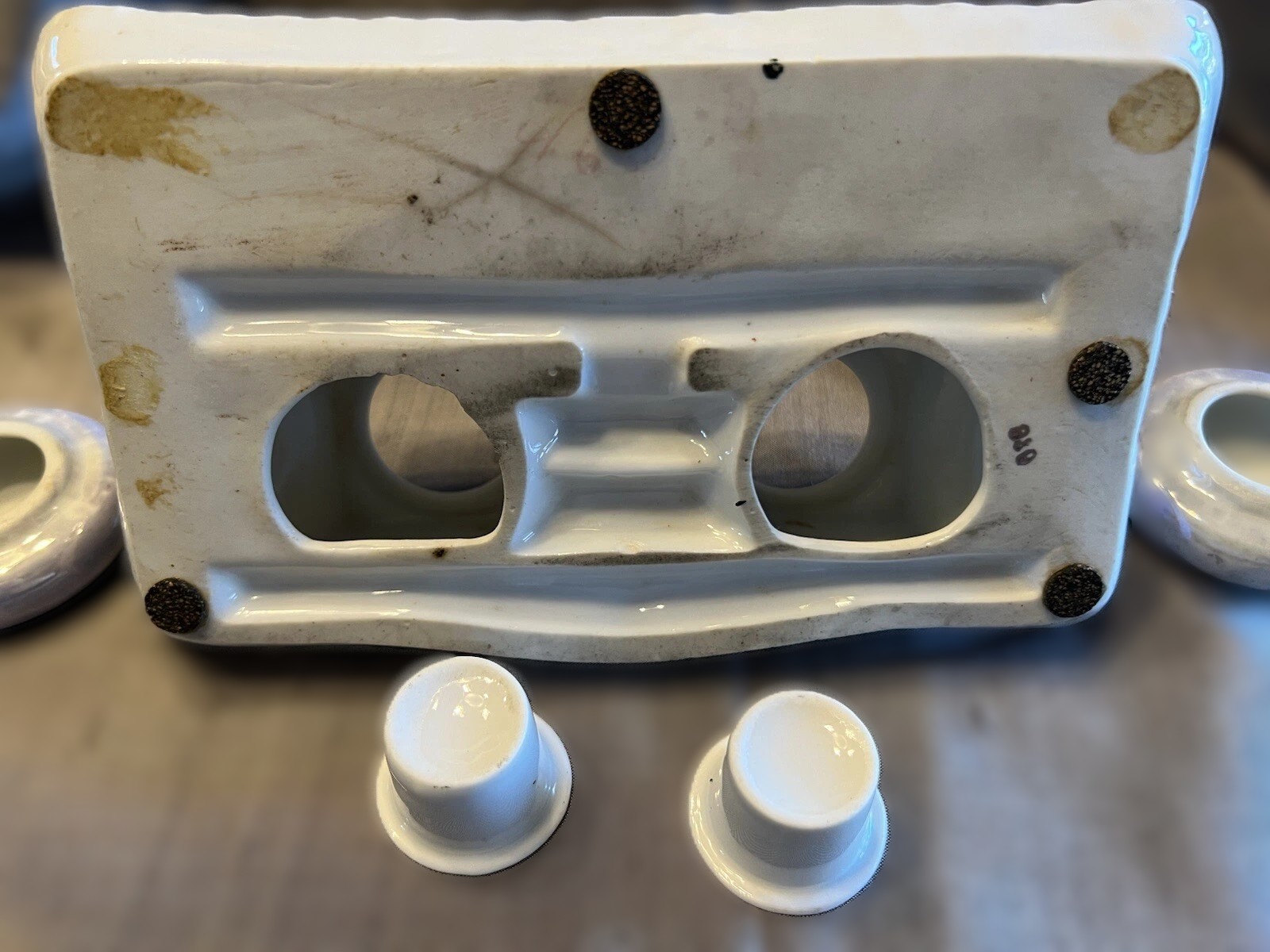
| Markings | Unmarked |
| Manufacturer | Undetermined |
| Origin | Germany |
| Date or Era | circa 1914 |
| Measuring | 7” x 4” |
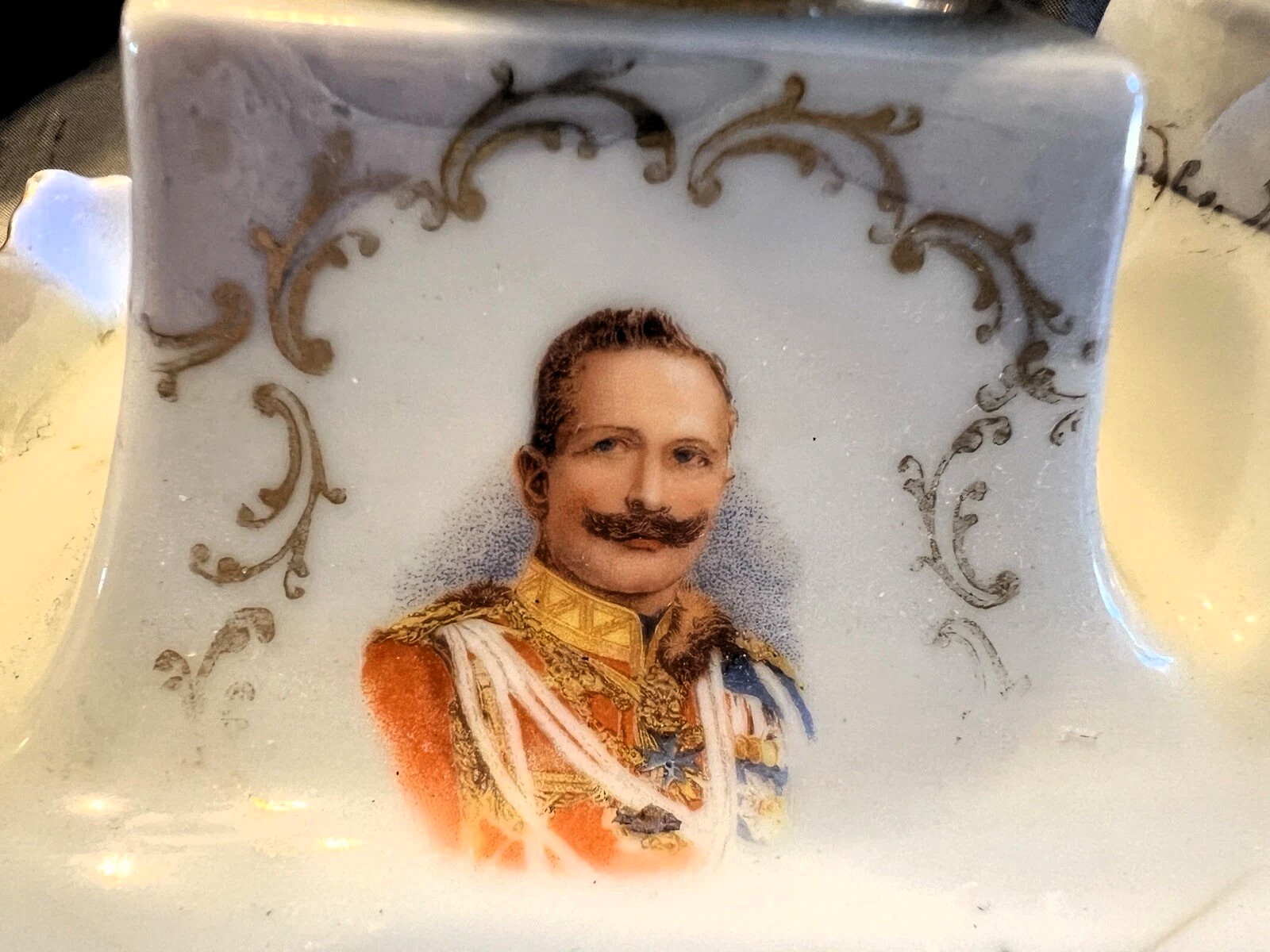
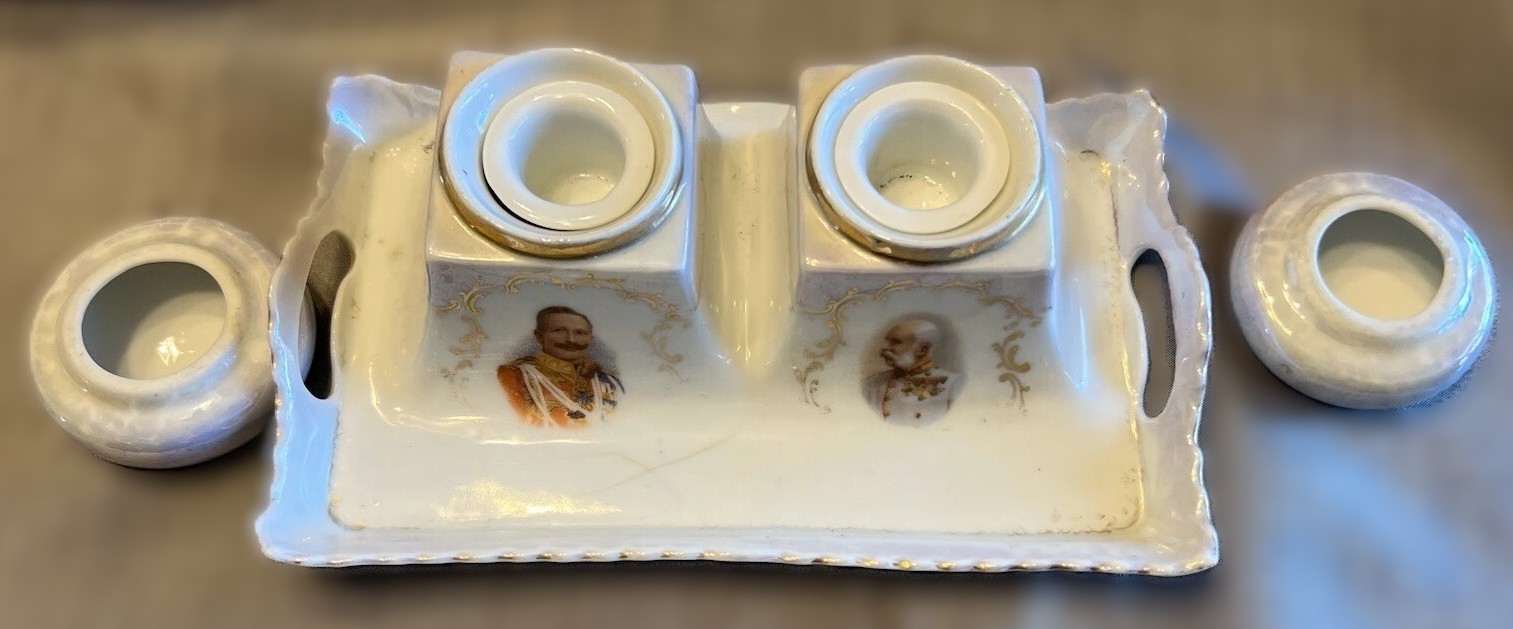
This porcelain double inkstand depicts the World War I allied monarchs, Kaiser Wilhelm II of Germany and Kaiser Franz Joseph I of Austria-Hungary.
Identification of the Men
The figures are almost certainly the monarchs of the Central Powers at the start of World War I, a common pairing on propaganda and commemorative items from the time (c. 1914–1918).
| Figure | Features (Based on Images) | Identity | Rationale |
| Older Man | Prominent sideburns, long life lines/wrinkles on the face, a distinctive formal beard/mustache combo. He has a slightly gaunt, aged look. | Kaiser Franz Joseph I (1830–1916) Emperor of Austria and King of Hungary. | The long sideburns connecting to a full mustache/beard are his unmistakable, iconic appearance in later life, which would be instantly recognizable on a commemorative item. |
| Younger Man | Swept-back hair, pronounced upturned (or “handlebar”) mustache. He looks younger than the other figure and wears a uniform with a high collar and epaulets. | Kaiser Wilhelm II (1859–1941) German Emperor and King of Prussia. | The aggressive, pointed, upswept mustache is the most famous trademark of Kaiser Wilhelm II. |
Relationship Between the Monarchs
Kaiser Franz Joseph I and Kaiser Wilhelm II were allies and were related by distant royal bloodlines, as was common among European royalty.
- Relationship: They were both members of the vast, intermarried European royalty. Wilhelm II was the grandson of Queen Victoria of the United Kingdom, and Franz Joseph I was a member of the House of Habsburg-Lorraine. More importantly, they were the leaders of the two primary Central Powers—Germany and Austria-Hungary—during World War I (1914–1918).
- Historical Significance: This pairing on an inkstand commemorates the Triple Alliance (later the Central Powers) and the deep political and military bond between the German and Austro-Hungarian Empires that defined the start of the war.
Description of the Inkstand
Based on the images, this is a commemorative inkstand designed to celebrate the alliance of the two monarchs.
- Material: It is made of porcelain.
- Composition: The inkstand features two central bust portraits, one on either side. These busts rise above the inkwell base, framed by gilt foliage.
- Date: Given the subject matter of the ruling monarchs as allies, the piece was most likely created during the period of World War I (1914–1918) as a patriotic souvenir.
Sold for $29 in September 2025
Content disclaimer. The information posted is the owner’s best knowledge and may not have been vetted by the SOIC. We welcome comments, corrections, and additions, working to make our website information comprehensive and accurate.
Join the Society of Inkwell Collectors (SOIC) – it’s free!
Founded in 1981 as a non-profit organization,
we are documenting inkwells (and accessories).
We’re here to help and inform!